Table of Contents
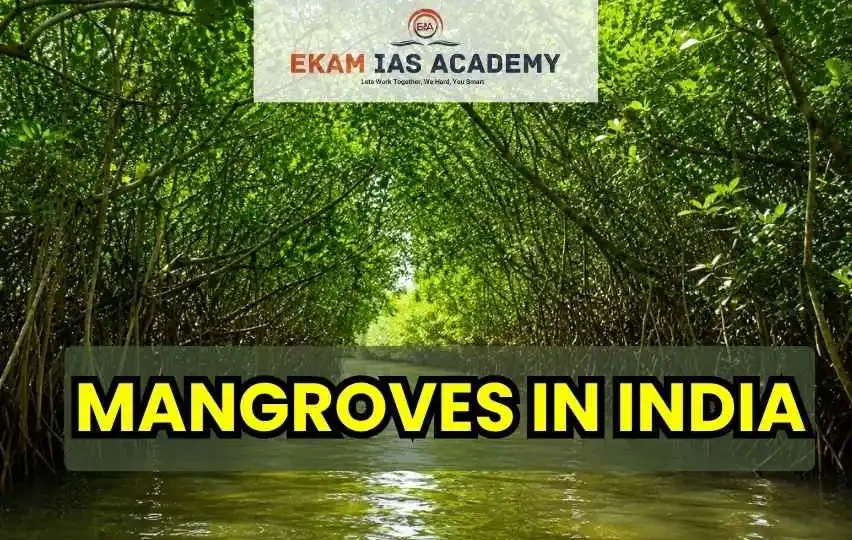
ToggleMangroves are specialized forest ecosystems found in the intertidal zones of tropical and subtropical sheltered coasts. They are often called the “roots of the sea” because of their unique ability to thrive in conditions that would kill most other plants—high salinity, extreme tides, and oxygen-poor soil. In India, they serve as a critical natural bioshield against coastal disasters.
Definition of Mangroves
Mangroves are a diverse group of halophytic (salt-tolerant) shrubs and trees that grow in the transition zone between land and ocean. They are biologically defined by their physiological adaptations to survive in saline water and anaerobic (oxygen-deficient) mud.
Characteristics of Indian Mangroves
- Salt Regulation: They possess specialized mechanisms to either exclude salt at the roots or excrete it through glands on their leaves.
- Respiration (Pneumatophores): Since the soil is waterlogged and lacks oxygen, mangroves develop specialized “breathing roots” called pneumatophores that grow upward into the air.
- Reproduction (Viviparity): To survive in the shifting tidal mud, mangrove seeds germinate while still attached to the parent tree (viviparity), dropping as developed “propagules” that can immediately take root.
- Stability (Prop/Stilt Roots): Many species develop arched prop roots or stilt roots to provide mechanical support in the unstable, soft substrate.
Distribution of Mangroves in India
According to the India State of Forest Report (ISFR) 2021/2023, India hosts approximately 4,992 sq. km of mangrove cover (about 0.15% of the country’s total area).
| Region | Major Sites | Key Features |
| East Coast | Sundarbans (WB), Bhitarkanika (Odisha), Coringa (AP) | Largest contiguous mangrove forest in the world; high biodiversity due to large deltas. |
| West Coast | Gulf of Kachchh (Gujarat), Thane Creek (Maharashtra) | Mostly found in creeks and estuaries; Gujarat has the 2nd largest cover in India. |
| Island Territories | Andaman & Nicobar Islands | Highest density and most pristine mangrove species in India. |
Types of Mangrove Vegetation
Mangroves in India exhibit distinct zonation based on their proximity to the sea:
Red Mangroves (Rhizophora): Found closest to the water’s edge with prominent prop roots.
Black Mangroves (Avicennia): Characterized by finger-like pneumatophores; found slightly further inland.
White Mangroves (Laguncularia): Found in the furthest inland zones where salinity is slightly lower.
Flora and Fauna
The indian mangroves ecosystem is a biodiversity hotspot:
- Flora: Dominant species include Rhizophora mucronata, Avicennia marina, and the Sundari tree (Heritiera fomes) from which the Sundarbans gets its name.
- Fauna: Home to the Royal Bengal Tiger, Saltwater Crocodile, Olive Ridley Turtles, Mudskippers, and the elusive Fishing Cat.
Importance of Mangroves in India
- Disaster Mitigation: They act as a natural bioshield, absorbing the energy of cyclones, storm surges, and tsunamis.
- Carbon Sequestration: Mangroves are elite “Blue Carbon” sinks, storing significantly more carbon than terrestrial forests.
- Livelihood: Support millions through fisheries (nursery for prawns and crabs) and honey collection.
- Pollution Filter: Their root systems trap sediments and heavy metals, maintaining water quality.
Threats to Mangroves in India
- Aquaculture Expansion: Conversion of mangrove land into commercial shrimp farms.
- Coastal Development: Infrastructure projects like ports, roads, and urban expansion (e.g., Mumbai’s coast).
- Climate Change: Rising sea levels threaten to submerge reefs and drown mangroves.
- Pollution: Oil spills and plastic waste block the lenticels of breathing roots.
Government Initiatives & MISHTI Scheme
The Government of India has significantly increased its focus on mangrove restoration:
- MISHTI Scheme UPSC: Launched in the Union Budget 2023-24, MISHTI (Mangrove Initiative for Shoreline Habitats & Tangible Incomes) aims for intensive mangrove plantation along the coastline and on saltpan lands using the CAMPA fund and MGNREGS.
- Magrove Alliance for Climate (MAC): India joined this global alliance at COP27 to promote mangroves as a nature-based solution to climate change.
- Legal Status: Mangroves are protected under the Coastal Regulation Zone (CRZ) notifications (CRZ-I category).
Conservation Measures
- Bio-Restoration: Implementing techniques like Biorock and nursery-based plantation.
- Community Participation: Engaging local communities (Mangrove Mitras) for surveillance and plantation.
- Legislative Action: Strengthening the Wildlife Protection Act and CRZ enforcement.
Conclusion
For mangroves in india UPSC preparation, it is crucial to recognize these forests not just as “swamps,” but as the first line of defense for a climate-vulnerable nation. Through initiatives like the MISHTI scheme, India is leading the way in coastal resilience, ensuring that the “Guardians of the Coast” continue to protect our ecological and economic future.
UPSC Prelims: PYQs & Practice Questions
Previous Year Questions (Prelims)
UPSC CSE Prelims 2011
Q: Which one of the following regions of India has a combination of mangrove forest, evergreen forest, and deciduous forest?
(a) North Coastal Andhra Pradesh
(b) South West Bengal
(c) Southern Saurashtra
(d) Andaman and Nicobar Islands
Answer: (d) Andaman and Nicobar Islands
Explanation:
The Andaman and Nicobar Islands possess a unique combination of ecosystems because of their equatorial climate and island geography. The islands contain extensive mangrove forests along coastal creeks, dense tropical evergreen forests, and patches of moist deciduous forests. In comparison, West Bengal mainly contains mangroves and deciduous vegetation but lacks significant tropical evergreen forests.
UPSC CSE Prelims 2019
Q: Consider the following States:
1. Chhattisgarh
2. Madhya Pradesh
3. Maharashtra
4. Odisha
With reference to the States mentioned above, in terms of percentage of forest cover to the total area of the State, which one of the following is the correct ascending order?
(a) 2-3-1-4
(b) 2-3-4-1
(c) 3-2-4-1
(d) 3-2-1-4
Answer: (c) 3-2-4-1
Explanation:
Although this is a broader forest cover question, it is highly relevant for understanding the ecological distribution of mangrove ecosystems in India. States like Odisha and Maharashtra contain important mangrove regions along their coasts. Forest cover statistics help in analyzing ecological diversity, conservation priorities, and coastal ecosystem management.
Practice Questions
Q: With reference to the MISHTI Scheme, consider the following statements:
1. It aims at mangrove plantation along the coastline and on salt pan lands.
2. The programme is implemented through the convergence of MGNREGS and the CAMPA Fund.
3. It was launched as part of India’s commitment to the Mangrove Alliance for Climate (MAC).
Select the correct answer:
(a) 1 and 2 only
(b) 2 and 3 only
(c) 1 and 3 only
(d) 1, 2 and 3
Answer: (d) 1, 2 and 3
Explanation:
All the statements are correct. The MISHTI Initiative (Mangrove Initiative for Shoreline Habitats & Tangible Incomes) was announced in the Union Budget 2023–24. It focuses on expanding mangrove plantations along India’s coastline and salt pan regions through convergence with schemes such as MGNREGS and the CAMPA Fund. The initiative also aligns with India’s international commitments under the Mangrove Alliance for Climate (MAC) announced during COP27.
Level: Moderate
Q: Which of the following adaptations is NOT typically found in Indian mangroves?
(a) Pneumatophores
(b) Viviparity
(c) Needle-like leaves to prevent frost damage
(d) Salt-excreting glands
Answer: (c) Needle-like leaves to prevent frost damage
Explanation:
Needle-like leaves are characteristic adaptations of coniferous vegetation in cold mountain biomes and are not associated with mangroves. Indian mangroves commonly exhibit specialized features such as pneumatophores (breathing roots), viviparity (seed germination while attached to the parent tree), and salt-excreting glands to survive in saline, oxygen-deficient coastal mudflats.
UPSC Mains – Previous Year & Practice Questions
Mains Previous Year Questions
Question: Coastal regions of India are prone to cyclones. Discuss the role of mangroves in reducing the impact of such disasters. (Mains 2019)
Question: Explain the causes and effects of coastal erosion in India. What are the available shore protection measures? (Mains 2021)
(Mangroves are a major biological solution for shoreline stabilization)
Question: Discuss the causes of the depletion of mangroves and explain their importance in maintaining coastal ecology. (Mains 2018)
Question: Write a critical note on the Sundarbans as a unique ecosystem. (Mains 2011)
Question: What is the economic importance of the marine ecosystem in India? Discuss the potential of the Blue Economy. (Mains 2015)
(Mangroves function as nurseries for nearly 80% of commercial fish species)
Mains Practice Questions
[10 Marks | 150 Words]
Question: Critically evaluate the MISHTI Scheme as a nature-based solution to achieve India’s Net Zero targets and improve coastal resilience.
[15 Marks | 250 Words]
Question: The Sundarbans is facing a “triple threat” of sea-level rise, salinity intrusion, and human encroachment. Suggest a multi-pronged strategy for its conservation.
[15 Marks | 250 Words]
Question: Compare the mangrove ecosystems of the East Coast and West Coast of India in terms of biodiversity and geographical extent.



Mangroves in India-FAQs
Why are the Sundarbans unique compared to other mangroves?
They are the only mangrove forest in the world inhabited by tigers (Royal Bengal Tiger). They also form the largest contiguous mangrove patch globally, shared between India and Bangladesh.
What is the 'Blue Carbon' value of mangroves?
Mangroves can sequester up to 4-10 times more carbon than terrestrial forests per unit area, storing it in the soil and biomass for millennia.
Which state has the 2nd largest mangrove cover in India?
While the Sundarbans (West Bengal) is first, Gujarat’s extensive coastline and creeks (Gulf of Kachchh) place it second.
How does the Coastal Regulation Zone (CRZ) protect mangroves?
Mangroves are classified under CRZ-IA (Ecologically Sensitive Areas). In this zone, no new construction or industrial activity is permitted, except for essential services like bridges or those specifically allowed by the Ministry.
What is the 'Mangrove Alliance for Climate' (MAC)?
It is an intergovernmental alliance (including India, UAE, Indonesia, etc.) launched at COP27 to scale up the conservation and restoration of mangrove forests globally to fight climate change.