Table of Contents
ToggleFreshwater covers less than 3% of the Earth’s water, yet it supports over 10% of all known animals and about 40% of all fish species. In India, freshwater bodies are not just ecological entities but are the lifelines of the civilization, supporting agriculture, industry, and spiritual traditions.
Definition of Freshwater Ecosystem
A freshwater ecosystem is a subset of Earth’s aquatic ecosystems characterized by water with a low salt concentration (usually less than 1% or 0.5 parts per thousand). These systems are distinct from marine ecosystems and are classified based on water movement and depth.
Characteristics of Freshwater Ecosystems
- Low Salinity: Minimal dissolved salt content compared to the ocean.
- Dynamic Oxygen Levels: Dissolved Oxygen (DO) varies significantly with temperature, flow rate, and biological activity.
- High Nutrients: Often rich in nitrates and phosphates, which can lead to high productivity.
- Thermal Stratification: In deep lakes, water forms layers of different temperatures (epilimnion, metalimnion, and hypolimnion).
Types of Freshwater Ecosystems in India
The wetlands and rivers UPSC syllabus divides these into two primary categories:
Lotic (Flowing Water)
- Rivers and Streams: India is home to 12 major river systems. The Himalayan rivers (Ganges, Brahmaputra) are perennial, while the Peninsular rivers (Godavari, Krishna) are largely rain-fed.
- Characteristics: High dissolved oxygen and constant nutrient transport.
Lentic (Standing Water)
- Lakes: High-altitude glacial lakes (Tso Moriri), freshwater lakes (Wular, Loktak), and man-made reservoirs.
- Ponds: Small, shallow bodies where light often reaches the bottom, allowing for rooted plant growth.
Wetlands
- Areas where the soil is saturated or inundated with water. India has over 80 Ramsar Sites, including the famous Chilika Lake (brackish/freshwater mix) and Keoladeo Ghana National Park.
Components of Freshwater Ecosystem
- Abiotic: Light, temperature, pH, and Dissolved Oxygen (DO).
- Biotic:
- Producers: Phytoplankton, algae, and floating/submerged macrophytes.
- Consumers: Zooplankton, insects, mollusks, and fish.
- Decomposers: Bacteria and fungi that recycle organic matter at the benthic zone.
Indian Freshwater Biodiversity
India’s freshwater bodies are hotspots for unique and endangered species:
- Mammals: The Gangetic River Dolphin (India’s National Aquatic Animal) and the Smooth-coated Otter.
- Reptiles: The Gharial (critically endangered) and Mugger crocodile.
- Fish: Mahseer (the “tiger of the water”), Hilsa, and various species of catfish.
- Avifauna: Migratory birds like the Siberian Crane and Bar-headed Goose.
Importance of Freshwater Ecosystems
- Drinking Water: The primary source of potable water for over 1.4 billion people.
- Food Security: Supports inland fisheries, which are a major source of protein and livelihood.
- Agriculture: Crucial for irrigation in a monsoon-dependent country.
- Climate Regulation: Wetlands act as carbon sinks and natural flood regulators (“Earth’s kidneys”).
Threats to Freshwater Ecosystem in India
- Pollution: Untreated industrial effluents and domestic sewage discharge (e.g., the crisis in the Yamuna).
- Eutrophication: Excessive agricultural runoff (fertilizers) leading to algal blooms and oxygen depletion.
- Dams and Diversions: Fragmentation of river connectivity, affecting migratory species like the Hilsa.
- Invasive Species: The spread of Water Hyacinth (Terror of Bengal) and African Catfish.
Conservation Measures
- National River Conservation Plan (NRCP): Focusing on the abatement of pollution in major rivers.
- Namami Gange Programme: An Integrated Conservation Mission for the Ganga.
- National Plan for Conservation of Aquatic Eco-systems (NPCA): A holistic program for both wetlands and lakes.
- Jal Shakti Abhiyan: Promoting water conservation and rainwater harvesting.
- Ramsar Convention: International treaty for the “wise use” of wetlands.
Conclusion
The health of the freshwater ecosystem in india UPSC is the ultimate metric of the nation’s environmental sustainability. For an environment ecology notes UPSC student, it is clear that restoring our rivers and protecting our wetlands is not just an ecological task but a survival necessity. Integrated water resource management and community participation are the keys to preserving India’s liquid gold for future generations.
UPSC Prelims: PYQs & Practice Questions
Previous Year Questions (Prelims)
UPSC CSE Prelims 2020
Q: With reference to the "Gangetic River Dolphin", consider the following statements:
1. It can only survive in freshwater.
2. It is listed as 'Endangered' under the IUCN Red List.
3. It uses echolocation for navigation and hunting.
Select the correct answer using the code given below:
(a) 1 and 2 only
(b) 2 and 3 only
(c) 1 and 3 only
(d) 1, 2 and 3
Answer: (d) 1, 2 and 3
Explanation:
The Gangetic River Dolphin (Susu) is India’s National Aquatic Animal. It survives only in deep freshwater river systems and is highly sensitive to pollution and habitat fragmentation caused by dams and barrages. Since it has very poor eyesight, it relies on echolocation for navigation and hunting. It is listed as Endangered under the IUCN Red List.
UPSC CSE Prelims 2013
Q: Which of the following are the "lentic" ecosystems?
1. Lake
2. River
3. Pond
4. Swamp
Select the correct answer:
(a) 1 and 2 only
(b) 1, 3 and 4 only
(c) 2 and 3 only
(d) 1, 2, 3 and 4
Answer: (b) 1, 3 and 4 only
Explanation:
Lentic ecosystems are standing or still water bodies such as lakes, ponds, and swamps/wetlands. In contrast, rivers are classified as lotic ecosystems because the water flows continuously in a definite direction.
Practice Questions
Q: In a freshwater lake, the "Benthic Zone" is characterized by:
(a) High levels of light penetration and photosynthetic activity.
(b) High temperature and low nutrient concentration.
(c) Decomposers and detritus-feeding organisms living at the bottom.
(d) The surface layer where most of the dissolved oxygen is generated.
Answer: (c) Decomposers and detritus-feeding organisms living at the bottom
Explanation:
The Benthic Zone forms the bottom layer of a water body and receives very little sunlight in deep lakes. It is dominated by decomposers such as bacteria and fungi, along with detritus-feeding organisms, which break down organic matter settling from upper layers.
Level: Moderate
Q: "Eutrophication" in Indian freshwater bodies is primarily caused by:
(a) Discharge of cold water from dams.
(b) Runoff of nitrates and phosphates from agricultural fields.
(c) Excessive fishing and removal of top predators.
(d) High concentrations of salt from industrial brine.
Answer: (b) Runoff of nitrates and phosphates from agricultural fields
Explanation:
Eutrophication refers to the excessive enrichment of water bodies with nutrients such as nitrates and phosphates. Fertilizer runoff promotes massive algal blooms, whose decomposition depletes dissolved oxygen, leading to fish mortality and ecological imbalance.
UPSC Mains – Previous Year & Practice Questions
Mains Previous Year Questions
Question: What is a wetland? Explain the Ramsar concept of “wise use” in the context of wetland conservation in India. (Mains 2018)
Question: Explain the causes and effects of water stress in India. How does it vary across different regions? (Mains 2021)
(Focus on depletion of freshwater aquifers and regional disparities)
Question: The Himalayas are highly prone to landslides. Discuss the impact on the freshwater river systems of North India. (Mains 2017)
Question: Enumerate the indirect services provided by an ecosystem. How do wetlands act as “Earth’s Kidneys”? (Mains 2014)
Question: Identify the main causes of the loss of biodiversity in India. (Mains 2023)
(Pollution and damming of freshwater river ecosystems are major causes)
Mains Practice Questions
[10 Marks | 150 Words]
Question: Discuss the impact of Thermal Stratification on the biological productivity of deep-water lakes in the Himalayan region.
[15 Marks | 250 Words]
Question: Analyze the role of the National River Conservation Plan (NRCP) in restoring the ecological health of the Yamuna River. What are the persistent challenges?
[15 Marks | 250 Words]
Question: Critically evaluate the significance of the Amrit Sarovar Mission in rejuvenating local freshwater bodies and ensuring village-level water security.



Freshwater Ecosystems in India-FAQs
What is 'Biochemical Oxygen Demand' (BOD)?
BOD is the amount of dissolved oxygen needed by organisms to break down organic matter in water. High BOD indicates that the water is heavily polluted with organic waste (like sewage).
Why is 'Loktak Lake' significant in Indian freshwater studies?
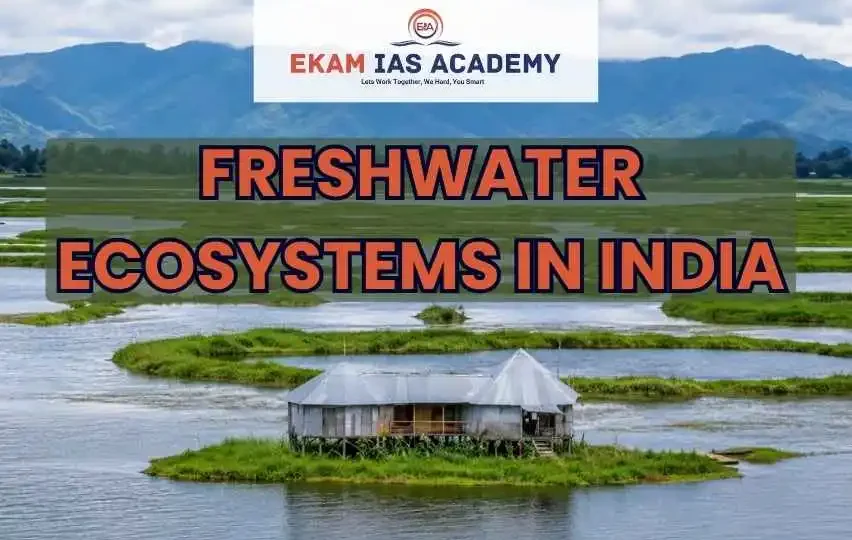
It is the largest freshwater lake in Northeast India, famous for its Phumdis (floating mats of organic matter) and the Keibul Lamjao National Park, the world’s only floating national park.
How do dams affect freshwater biodiversity?
Dams fragment rivers, blocking the migration of fish (like the Hilsa). They also alter the temperature and sediment flow, destroying downstream habitats.
What is the difference between 'Oligotrophic' and 'Eutrophic' lakes?
Oligotrophic lakes are deep, clear, and nutrient-poor (high DO). Eutrophic lakes are shallow, murky, and nutrient-rich (low DO), often leading to fish kills.
What is the 'Gangetic River Dolphin's' ecological role?
It is an indicator species. Its presence or absence tells us about the health of the entire river ecosystem. If the dolphin thrives, it means the water is clean and fish populations are stable.