Table of Contents
ToggleLinkage of Terrorism and Organized Crime in India
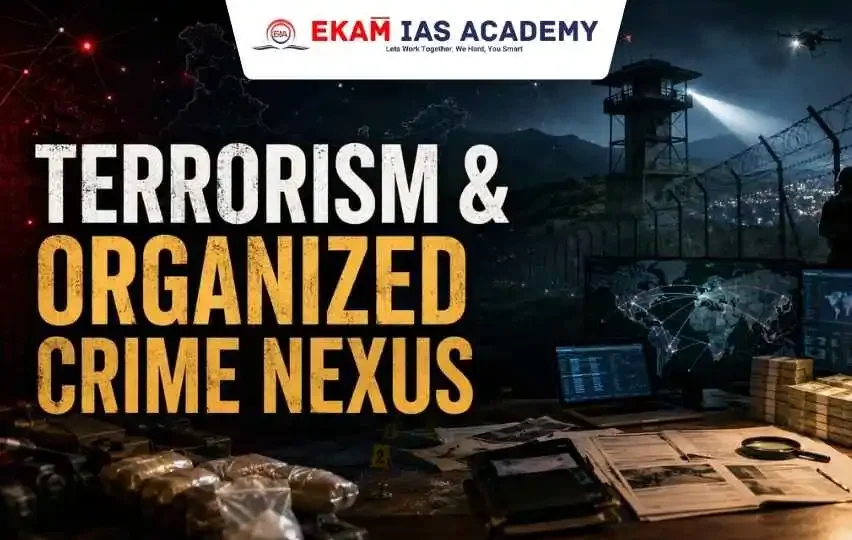
The contemporary security paradigm has shifted from isolated domestic disruptions to complex, hybrid security threats. The Linkage of Terrorism and Organized Crime in India has emerged as one of the most significant challenges to the nation’s sovereignty. Historically treated as distinct legal and operational challenges, Terrorism and Organized Crime have merged into a cooperative network. For aspirants preparing for the Terrorism and Organized Crime UPSC syllabus, understanding this relationship is vital to evaluating how criminal networks and insurgent forces work together to challenge the state’s authority.
Nature of the Linkage Between Terrorism and Organized Crime
The Terrorism Organized Crime Nexus in India operates across a spectrum of strategic and tactical cooperation. Security analysts classify the Terrorism and Organized Crime Nexus into three main phases:
Coexistence: Operating in the same geographic areas and utilizing identical underground networks without direct coordination.
Cooperation: Forming alliances where criminal syndicates handle logistics, cross-border smuggling, and asset layering, while terrorist networks provide protection and heavy weaponry.
Convergence: The complete merging of operations, where a single group carries out both political terror strikes and commercial criminal activities to sustain itself.
Factors Strengthening the Nexus
Several structural factors reinforce the Nexus Between Terrorism and Organized Crime:
- Financial Pressures: As global tracking chokes state-sponsored funds, militant outfits rely heavily on Terror Financing and Organized Crime to maintain their networks.
- Shared Logistics Pipelines: Both networks utilize the same porous border entry points, illegal weapons suppliers, and human smuggling channels.
- The Digital Domain: The anonymity of encrypted applications, dark-web communication systems, and virtual crypto-wallets allows both entities to coordinate seamlessly without physical contact.
Impact on India
The growth of Organized Crime and Terrorism in India weakens the country’s multi-layered defense architecture. Economically, it funds a sprawling parallel economy driven by counterfeit currency and money laundering. Socially, it fuels addiction crises in border regions through illicit drug pipelines. From a security standpoint, it creates a hybrid threat where criminal syndicates act as force multipliers for terrorist groups, making the management of Organized Crime and Internal Security in India increasingly complex.
Major Examples from India
The Terror-Crime Nexus in India is visible across several key theaters:
- The 1993 Mumbai Serials Blasts: A definitive example where an established domestic criminal syndicate (the D-Company) provided the logistical support, local intelligence, and transport lines for a major state-sponsored terror attack.
- The Punjab Drone Vector: A network where cross-border drug smugglers collaborate with active militant handlers to drop both high-grade narcotics and military weapons into Indian territory.
- The Northeast Insurgency Grid: Local insurgent groups running systemic extortion rackets, illegal mining operations, and weapons smuggling across the porous Indo-Myanmar border to fund ongoing operations.
India's Institutional and Legal Framework
To disrupt the Link Between Terrorism and Organized Crime, India has developed a comprehensive security architecture:
- The Unlawful Activities (Prevention) Act (UAPA): The primary legislative tool targeting terror operations, enhanced to allow the designation of individual operators to disrupt leadership structures.
- The Prevention of Money Laundering Act (PMLA): Used to trace, freeze, and seize assets generated through illegal criminal enterprises before they can be diverted into funding terror operations.
- Specialized Enforcement Agencies: The National Investigation Agency (NIA) serves as the central node for tracking complex terror networks, supported by the Narcotics Control Bureau (NCB) and the Enforcement Directorate (ED).
- Intelligence Sharing Platforms: The Multi-Agency Centre (MAC) facilitates daily real-time data integration between central intelligence bodies and state law enforcement units.
International Cooperation & Challenges
Because these syndicates operate globally, India collaborates with international bodies like Interpol and the Financial Action Task Force (FATF) to isolate state sponsors of terror and check illicit financial channels.
However, Terrorism and Organized Crime in India remains difficult to eradicate due to persistent operational challenges. Systemic differences in state police capabilities can create weak points in domestic defense, while tracking decentralized darknet financial transactions across tax havens presents a continuous technological challenge for investigators.
Way Forward
To break this symbiotic relationship, India must adopt a proactive, technology-driven strategy:
- AI-Enabled Financial Tracking: Utilizing advanced machine learning algorithms to identify irregular transaction patterns and map darknet crypto-wallets.
- Smart Border Management: Upgrading border infrastructure with anti-drone laser defenses, underground sensor grids, and real-time satellite surveillance.
- Strengthening Local Grids: Improving the technical capabilities of state intelligence wings to ensure rapid information sharing with central databases.
Conclusion
Neutralizing the Linkage of Terrorism and Organized Crime in India requires an adaptive strategy that goes beyond conventional policing. By combining modern digital forensics, international legal cooperation, and strict financial tracking, India can systematically dismantle the economic and logistical pillars supporting these hybrid threat networks. Ensure your preparation remains up to date by reviewing our regularly updated repository of internal security micro-analyses.
UPSC Prelims: PYQs & Practice Questions
Previous Year Questions (Prelims)
Q: With reference to the Prevention of Money Laundering Act (PMLA), 2002, which is heavily used to dismantle Terror Financing and Organized Crime loops, consider the following statements: (UPSC CSE 2021)
1. Under the Act, an officer implementing the law can carry out the provisional attachment of property derived from criminal activities for a period not exceeding 180 days.
2. The specialized special courts designated to try offences under PMLA are constituted by the Central Government in consultation with the Chief Justice of the respective High Court.
Which of the statements given above is/are correct?
(a) 1 only
(b) 2 only
(c) Both 1 and 2
(d) Neither 1 nor 2
Answer: (c) Both 1 and 2
Explanation:
Both statements are correct under the PMLA framework. Section 5 of the Act permits authorized officers of the Enforcement Directorate to provisionally attach properties believed to be proceeds of crime for up to 180 days. Section 43 provides that the Central Government, in consultation with the Chief Justice of the High Court, designates Sessions Courts as Special Courts for speedy trial of money laundering offences.
Q: Consider the following statements regarding the global framework against transnational crimes and terror links: (UPSC CSE 2023)
1. The United Nations Office on Drugs and Crime (UNODC) tracks the illicit flow of drug proceeds that feed global terror networks.
2. The United Nations Convention against Transnational Organized Crime (UNTOC) is the first legally binding global instrument explicitly dedicated to criminalizing the financing of standalone, ideological terror acts.
Which of the statements given above is/are correct?
(a) 1 only
(b) 2 only
(c) Both 1 and 2
(d) Neither 1 nor 2
Answer: (a) 1 only
Explanation:
Statement 1 is correct. The UNODC is the primary UN entity dealing with drugs, crime, corruption, and transnational criminal networks. Statement 2 is incorrect because the UNTOC focuses on structured criminal syndicates involved in activities such as human smuggling, firearms trafficking, and money laundering. The treaty specifically linked to terror financing is the International Convention for the Suppression of the Financing of Terrorism, 1999.
Practice Questions
Q: The Terrorism Organized Crime Nexus in India relies on various transactional methodologies. Consider the following statements regarding Fake Indian Currency Notes (FICN) and its role in internal subversion:
1. FICN functions as an economic tool where organized crime networks print and smuggle currency to earn profit, while terror outfits use its circulation to destabilize the national economy.
2. In India, offences involving high-volume smuggling of fake currency are included within the scheduled offence framework under the National Investigation Agency (NIA) Act, 2008.
Which of the statements given above is/are correct?
(a) 1 only
(b) 2 only
(c) Both 1 and 2
(d) Neither 1 nor 2
Answer: (c) Both 1 and 2
Explanation:
Both statements are correct. FICN represents a classic convergence point in the nexus between Terrorism and Organized Crime. For criminal cartels, it acts as a black-market profit tool; for terrorist networks, it works as an asymmetric weapon to weaken public confidence in currency and generate untraceable liquidity for field operations. Recognizing this threat, offences relating to counterfeiting of national currency have been brought within the investigative mandate of the NIA.
Q: Under the current operational architecture of Organized Crime and Internal Security in India, which central platform serves as the principal nodal authority for checking and blocking the illegal diversion of dual-use chemical precursors that can be modified into explosive compounds by terror networks?
(a) Financial Intelligence Unit (FIU-IND)
(b) Narcotics Control Bureau (NCB)
(c) National Security Council Secretariat (NSCS)
(d) Central Bureau of Investigation (CBI)
Answer: (b) Narcotics Control Bureau (NCB)
Explanation:
The Narcotics Control Bureau (NCB) is mandated under the NDPS Act to monitor and regulate the manufacture, transport, and cross-border movement of chemical precursors such as ephedrine, acetic anhydride, and pseudoephedrine. These substances may be diverted for processing narcotics or misused by insurgent groups, making NCB a key enforcement body in preventing such illegal diversion.
UPSC Mains – Previous Year & Practice Questions
Mains Previous Year Questions
UPSC CSE 2022
Question: Discuss the types of organized crimes. Describe the linkages between terrorists and organized crime that exist at the national and transnational levels.
GS-3 | 10 Marks | 150 Words
UPSC CSE 2021
Question: Analyse the complexity and intensity of terrorism, its causes, linkages and obnoxious nexus. Also suggest measures required to be taken to eradicate the menace of terrorism.
GS-3 | 15 Marks | 250 Words
UPSC CSE 2019
Question: The dynamic linkage between poverty, underdevelopment, and organized crime networks creates a fertile breeding ground for low-intensity proxy warfare. Critically evaluate this statement with reference to the internal security challenges observed in India's border states.
GS-3 | 15 Marks | 250 Words
UPSC CSE 2014
Question: India’s proximity to two of the world's biggest illicit opium-growing regions has enhanced its internal security concerns. Explain the linkages between drug trafficking and other illicit activities such as gunrunning, money laundering, and human trafficking. What countermeasures should be taken to prevent the same?
GS-3 | 15 Marks | 250 Words
UPSC CSE 2014
Question: International organized crime networks exploit the legal gaps between different national jurisdictions to protect their illicit assets. Discuss the role of global frameworks like the UNTOC and FATF in addressing these vulnerabilities.
GS-3 | 15 Marks | 250 Words
Mains Practice Questions
[15 Marks | 250 Words]
Question: The interaction within the Terror-Crime Nexus in India has shifted from simple, transaction-based relationships to a deeper operational convergence. Analyze this shift and explain how it complicates traditional counter-terrorism efforts.
[15 Marks | 250 Words]
Question: The digital landscape, including encrypted applications, darknet marketplaces, and virtual crypto-wallets, has accelerated the growth of the Terrorism and Organized Crime Nexus. Examine the gaps in India's technical intelligence systems and suggest defensive countermeasures.
[10 Marks | 150 Words]
Question: Breaking the financial link between terrorist networks and organized crime syndicates requires close cooperation between state enforcement units and central investigative bodies under the PMLA framework. Discuss the federal challenges that can affect this coordination.



Linkage of Terrorism and Organized Crime in India-FAQs
What is the linkage between terrorism and organized crime?
The linkage refers to cooperation between terrorist groups and criminal syndicates for funding, logistics, weapons supply, smuggling, fake currency, money laundering and safe movement.
How does organized crime support terrorism in India?
Organized crime supports terrorism by providing funds, forged documents, smuggling routes, local intelligence, arms supply and drug-trafficking networks.
What are examples of the terror-crime nexus in India?
Major examples include the 1993 Mumbai serial blasts, narco-terrorism in Punjab, cross-border drone smuggling and insurgent extortion networks in the Northeast.
Which laws help India fight the terrorism-organized crime nexus?
Important laws include the UAPA, PMLA, NDPS Act, and state laws like MCOCA, supported by agencies such as NIA, ED, NCB and state police.
Why is this topic important for UPSC?
It is important for UPSC GS Paper 3 because it connects with internal security, terrorism, organized crime, money laundering, border management, narco-terrorism and cyber threats.