Table of Contents
ToggleNational Security Guard (NSG): India’s Premier Counter-Terrorism Force
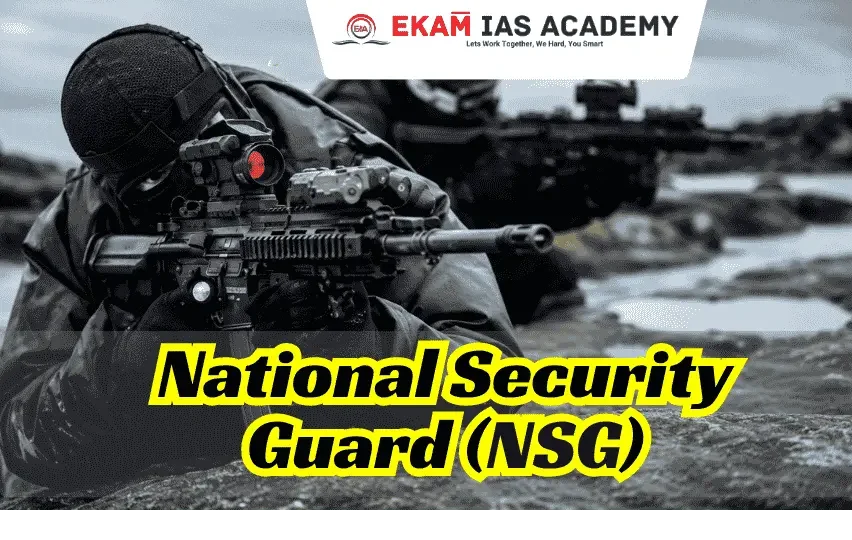
In the complex matrix of India’s Internal Security architecture, the National Security Guard (NSG) serves as the ultimate federal contingency unit. Known popularly as the Black Cats due to their distinctive dark uniforms and tactical gear, the NSG is India’s premier Counter Terrorism Force and Hostage Rescue Force.
Historical Background
The genesis of the NSG lies in the security vulnerabilities exposed during the early 1980s. Following the cabinet’s decision in 1984 to raise a world-class federal contingency force, the Union Parliament enacted the National Security Guard Act, 1986, giving the force a formal statutory identity.
The primary objective was to create a highly motivated, elite, and “zero-error” force modeled on global special forces like Germany’s GSG-9 and the British SAS. The NSG was designed to intervene exclusively in exceptional circumstances when state police or standard paramilitary forces are overwhelmed by highly organized terror elements.
Organizational Structure and Major Components
The NSG functions directly under the administrative control of the Ministry of Home Affairs (MHA). It is headed by a Director-General (DG), who is traditionally selected from the Indian Police Service (IPS)
| Component | Role | Key Features |
|---|---|---|
| Ministry of Home Affairs (MHA) | Administrative Ministry | Overall administrative control of NSG |
| Director General (DG), NSG | Head of NSG | Overall command and leadership |
| Special Action Group (SAG) | Combat / Strike Arm | • 100% Indian Army Deputation• Offense & Tactical Ops |
| Special Ranger Group (SRG) | Support / Security Arm | • Drawn from CAPFs & Police• Logistics & Core Support |
The operational manpower of the NSG is unique because it is a 100% deputation-based force—it has no direct recruitment cadre of its own. It draws its personnel from two primary streams:
A. The Special Action Group (SAG)
This is the primary strike and offensive wing of the NSG.
- 51 SAG: Tasked strictly with counter-terrorism, hostage rescue, and counter-insurgency operations.
- 52 SAG: Specializes in counter-hijack operations (commonly known as the “Hijack Busters”).
- Recruitment: Personnel in the SAG are drawn entirely on deputation from the Indian Army.
B. The Special Ranger Group (SRG)
The SRG serves as the support and security element of the force.
- Recruitment: Personnel are drawn from the CAPFs (Central Armed Police Forces like CRPF, BSF, ITBP) and state police forces.
- Function: While the SRG historically handled VVIP protection duties, a critical policy decision in late 2024 redirected the SRG away from personal VVIP security to focus purely on tactical support and counter-terrorism reinforcement
C. Supporting Components
- Special Composite Group (SCG): Stationed across five critical regional hubs (Mumbai, Chennai, Hyderabad, Kolkata, and Gandhinagar) to ensure swift local response times.
- National Bomb Data Centre (NBDC): Acts as India’s nodal agency for recording, post-blast investigation, and analyzing bombing incidents nationwide.
Operational Importance & Major Operations
The NSG is deployed only as a last resort in extreme internal crises. Unlike border guarding forces, National Security Guard Functions are highly tactical, focused on precision, and aimed at reducing collateral damage in high-pressure urban scenarios.
Over the decades, the NSG has proven its mettle in some of the most challenging operations in India’s history:
| Operation Name | Year | Location / Objective | Tactical Outcome |
| Operation Black Thunder I & II | 1986 / 1988 | Golden Temple, Amritsar | Successfully cleared militants from the temple complex with minimal damage to the holy site. |
| Operation Ashwamedh | 1993 | Raja Sansi Airport, Amritsar | Rescued 141 hostages from a hijacked Indian Airlines Boeing 737 with zero hostage casualties. |
| Operation Vajra Shakti | 2002 | Akshardham Temple, Gujarat | Neutralized heavily armed terrorists holding hostages within the temple complex. |
| Operation Black Tornado | 2008 | Taj, Oberoi, & Nariman House (Mumbai) | Eliminated multiple Lashkar-e-Taiba terrorists during the coordinated 26/11 attacks, rescuing hundreds. |
Coordination with Other Agencies
To ensure flawless operational execution during a crisis, the NSG maintains close inter-agency channels:
- State Police Forces: The local police establish the outer cordon during a crisis, allowing NSG teams to execute the inner-tactical breach.
- Intelligence Bureau (IB) & RAW: Real-time actionable threat feeds from central intelligence bureaus are vital for planning precision strikes.
- Military Liaison: Regular joint exercises with the Indian Army’s special forces ensure that the SAG stays aligned with state-of-the-art combat tactics.
Challenges Faced by the NSG
- The Golden Hour Delay: Despite regional hubs, the time lost in mobilizing and airlifting heavy equipment to remote crisis areas can hinder the critical initial phase of an attack.
- Rapidly Evolving Urban Asymmetric Warfare: Modern terrorists use highly encrypted satellite networks, drone-carried payloads, and dirty bombs, requiring the force to continuously adapt.
- Deputation Cycles: As a 100% secondment force, the constant rotation of highly trained personnel back to their parent organizations (usually after 3-5 years) creates a continuous training cycle.
Modernization and Recent Developments
To maintain its edge as a elite force, the NSG has implemented key technical and structural upgrades:
- Anti-Drone Systems: The force has upgraded its capability to detect, track, and jam hostile micro-UAVs.
- Niche K9 Squad Integration: Deployment of the specialized triple-purpose K9 squad, capable of tracking, detecting IEDs, and assisting in assault missions.
- Strategic Hub Expansion: Recognizing the shifting threat landscape, the central government announced the establishment of a new regional NSG hub in Ayodhya, Uttar Pradesh.
- Advanced Equipment Induction: Integrating state-of-the-art night vision equipment, handheld ballistic shields with exoskeletons, and laser illuminators for low-light urban environments.
NSG vs. Other Security Forces
| Metric | National Security Guard (NSG) | Central Reserve Police Force (CRPF) | Special Protection Group (SPG) |
| Core Mandate | Specialized counter-terrorism, hijack busters, and hostage rescue. | Internal security, riot control, and counter-insurgency. | Dedicated protection of the Prime Minister of India. |
| Recruitment | 100% Deputation (Army & CAPFs). | Direct recruitment alongside some deputations. | Deputation primarily from CAPFs, IPS, and state police. |
| Operation Area | Exceptional, pinpoint urban/rural terror targets. | Widespread field deployment across active conflict zones. | Static and mobile protection zones centered around the PM. |
Way Forward
To keep the NSG a highly prepared and agile force, future policies should focus on:
Dedicating the Force to its Core Mandate: The complete removal of VIP security duties from the SRG is a positive step toward keeping the force focused strictly on counter-terrorism.
Upgrading Airborne Mobility: Arranging dedicated, round-the-clock air transport assets in coordination with the Indian Air Force can reduce critical mobilization delays.
Enhancing Tech-Driven Combat Capability: Investing in artificial intelligence, autonomous robotic entry units, and advanced electronic surveillance tools will help minimize personnel risk during high-risk interventions.
Conclusion
The National Security Guard (NSG) remains India’s premier federal contingency force, executing a highly specialized, “zero-error” mandate in counter-terrorism and hostage rescue operations. Recent structural reforms, such as the complete removal of personal VIP security duties from its Special Ranger Group (SRG), successfully redirect the force back to its core tactical purpose. As asymmetric, tech-driven, and hybrid threats continue to evolve, the NSG’s continued integration of modern technology and rapid-response capabilities will be essential to safeguarding India’s sovereign interests and internal security.
UPSC Prelims: PYQs & Practice Questions
Previous Year Questions (Prelims)
Q: Consider the following statements regarding the Central Armed Police Forces (CAPFs) in India:
1. The National Security Guard (NSG) is one of the designated CAPFs functioning under the Ministry of Home Affairs.
2. Unlike other CAPFs, the NSG has a mix of personnel from both the Indian Army and various police forces on a deputation basis.
3. The NSG is primarily tasked with peacetime border management duties in addition to counter-terror operations.
Which of the statements given above is/are correct?
(a) 1 and 2 only
(b) 2 and 3 only
(c) 1 and 3 only
(d) 1, 2, and 3
Answer: (a) 1 and 2 only
UPSC Equivalent Base Year: 2023 | Theme: Security Forces & CAPFs under MHA
Explanation:
Statement 1 is correct. The NSG is classified under the Central Armed Police Forces under the administrative control of the Ministry of Home Affairs (MHA).
Statement 2 is correct. The NSG has no direct recruitment and is a completely deputation-based force. Its core operational wing, the Special Action Group (SAG), is drawn entirely from the Indian Army, while the Special Ranger Groups (SRG) consist of personnel drawn from CAPFs and State Police forces.
Statement 3 is incorrect. The NSG is a federal contingency force meant for specialized counter-terror, counter-hijacking, and hostage rescue operations. It does not manage or guard borders; that responsibility lies with dedicated border guarding forces like BSF, ITBP, and SSB.
Q: Consider the following pairs of internal security units and their parent organizations:
1. CoBRA (Commando Battalion for Resolute Action): Central Reserve Police Force (CRPF)
2. Special Action Group (SAG): National Security Guard (NSG)
3. Special Protection Group (SPG): Central Industrial Security Force (CISF)
Which of the pairs given above is/are correctly matched?
(a) 1 only
(b) 1 and 2 only
(c) 2 and 3 only
(d) 1, 2, and 3
Answer: (b) 1 and 2 only
UPSC Equivalent Base Year: 2021 | Theme: Specialized Wings of Security Forces
Explanation:
Pair 1 is correctly matched. CoBRA is a specialized jungle-warfare-trained unit of the CRPF created to counter Left-Wing Extremism (LWE).
Pair 2 is correctly matched. The Special Action Group (SAG) is the elite offensive wing of the NSG, consisting entirely of personnel deputed from the Indian Army.
Pair 3 is incorrectly matched. The Special Protection Group (SPG) is an independent specialized security agency governed by the SPG Act, 1988. It is not a wing of the CISF.
Practice Questions
Q: With reference to the National Security Guard (NSG), consider the following statements:
1. It was raised in the wake of Operation Blue Star in 1984 to deal with complex internal security challenges and terrorism.
2. The Director-General of the NSG is traditionally an officer appointed from the Indian Army's Lieutenant General rank.
3. The motto of the NSG is "Sarvatra Sarvottam Suraksha".
Which of the statements given above are correct?
(a) 1 and 2 only
(b) 2 and 3 only
(c) 1 and 3 only
(d) 1, 2, and 3
Answer: (c) 1 and 3 only
Explanation:
Statement 1 is correct. The post-Operation Blue Star security assessment in 1984 highlighted the need for a highly trained federal strike force, leading to the creation of the NSG in 1986.
Statement 2 is incorrect. Although the operational fighting arm is drawn from the Indian Army, the administrative and operational head, the Director-General (DG) of the NSG, is traditionally a senior officer from the Indian Police Service (IPS), not the Army.
Statement 3 is correct. The motto of the force is "Sarvatra Sarvottam Suraksha", meaning omnipresent, omnipotent security.
Q: Which of the following operations was/were conducted by the National Security Guard (NSG)?
1. Operation Vijay (1999)
2. Operation Vajra Shakti (2002)
3. Operation Black Tornado (2008)
Select the correct answer using the code given below:
(a) 3 only
(b) 2 and 3 only
(c) 1 and 2 only
(d) 1, 2, and 3
Answer: (b) 2 and 3 only
Explanation:
Operation Vijay is incorrect. It was the joint military action by the Indian Armed Forces to evict infiltrators from the Kargil sector in 1999. The NSG was not the primary force.
Operation Vajra Shakti is correct. It was conducted by the NSG in 2002 to neutralize terrorists who had attacked the Akshardham Temple in Gandhinagar, Gujarat.
Operation Black Tornado is correct. It was the NSG operation during the 26/11 Mumbai terror attacks in 2008, where commandos secured the Taj Mahal Palace Hotel, Oberoi Trident, and Nariman House.
UPSC Mains – Previous Year & Practice Questions
Mains Previous Year Questions
UPSC CSE 2023 | GS-3
Question: What are the internal security challenges being faced by India? Give out the role of Central Intelligence and Investigative Agencies tasked to counter such threats.
Marks: 15 Marks | Word Limit: 250 Words
UPSC CSE 2022 | GS-3
Question: Discuss the types of organized crime. Describe the linkages between terrorists and organized crime that present a major challenge to India's internal security.
Marks: 15 Marks | Word Limit: 250 Words
UPSC CSE 2018 | GS-3
Question: The banned security organizations often present a challenge to state police forces. In this light, discuss the role of federal contingency forces like the NSG during zero-error counter-terrorist interventions.
Marks: 10 Marks | Word Limit: 150 Words
UPSC CSE 2017 | GS-3
Question: The Indian government has recently focused on regional hubs for the National Security Guard (NSG). Analyze how this decentralization strengthens India's immediate response mechanism to asymmetric terror strikes.
Marks: 15 Marks | Word Limit: 250 Words
UPSC CSE 2016 | GS-3
Question: Analyze the vulnerabilities of India's critical infrastructure. How does the mandate of specialized forces like the NSG play a pivotal role in neutralizing threats to these installations?
Marks: 10 Marks | Word Limit: 150 Words
Mains Practice Questions
Question: “While specialized forces like the National Security Guard (NSG) possess elite tactical capabilities, internal security operations in India cannot succeed without seamless integration with local police and intelligence agencies. Elaborate.”
Question: “The 2008 Mumbai terror attacks exposed critical delays in the deployment of the National Security Guard (NSG). Discuss the subsequent reforms introduced to improve the NSG's operational readiness and the challenges that persist today.”
Question: “The National Security Guard (NSG) was raised as a specialized federal contingency force to handle exceptional situations. Evaluate its structural composition and its core mandate in India's internal security architecture.”



National Security Guard (NSG)-FAQs
What is the National Security Guard?
The National Security Guard is India’s elite federal contingency force for counter-terrorism, hostage rescue, counter-hijack and high-risk tactical operations.
Why is NSG called Black Cats?
NSG personnel are popularly called Black Cats because of their distinctive black uniforms and specialized tactical combat gear.
When was the NSG established?
The NSG was created after the security challenges of the early 1980s and received statutory backing through the National Security Guard Act, 1986.
What are SAG and SRG in NSG?
The Special Action Group is the main strike arm drawn from the Indian Army, while the Special Ranger Group is the support and reinforcement wing drawn from CAPFs and police forces.
Why is NSG important for UPSC GS 3?
NSG is important for GS 3 Internal Security because it covers counter-terrorism, hostage rescue, federal contingency response, urban security threats and inter-agency coordination.