Table of Contents
ToggleCentral Reserve Police Force (CRPF): Pillar of India’s Internal Security
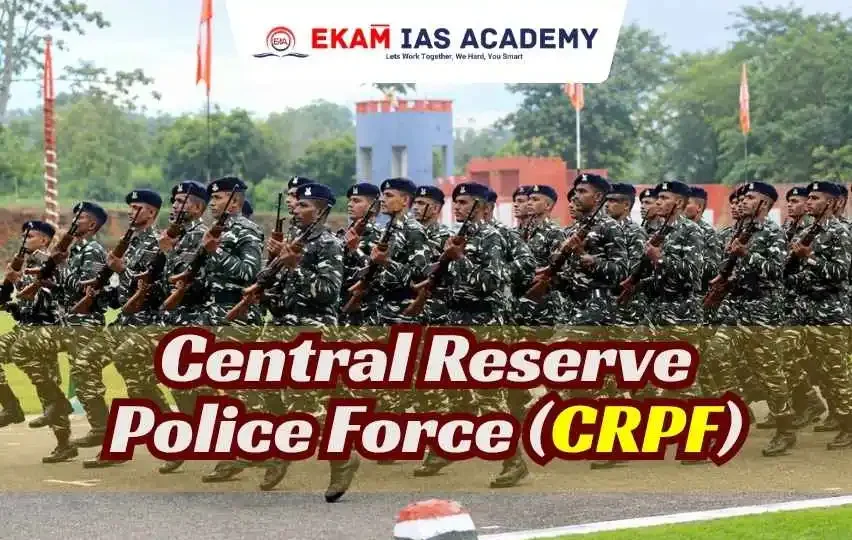
Maintaining the integrity of a nation’s domestic frontiers is a dynamic challenge that lies at the intersection of state authority, tactical governance, and citizen trust. In India’s national security architecture, the Central Reserve Police Force (CRPF) stands as the primary bulwark of Internal Security.
Historical Background & Organizational Structure
The CRPF was originally raised on July 27, 1939, as the Crown Representative’s Police to safeguard British imperial interests in sensitive areas. Following India’s independence, the force was renamed and reorganized under the CRPF Act on December 28, 1949, under the guidance of Sardar Vallabhbhai Patel. This transition transformed it into an armed force of the Union.
| Wing | Responsibilities |
|---|---|
| Operations Wing | State Deployments, Law & Order, Elections |
| Specialized Wings | CoBRA, RAF, Parliament Security |
| Administrative Wing | Personnel, Logistics, Training Academies |
Administratively, the Central Reserve Police Force (CRPF) functions under the Ministry of Home Affairs (MHA). It is headed by a Director General (DG), traditionally a senior officer of the Indian Police Service (IPS). To oversee its vast personnel, the force is structured into several administrative and operational sectors across the country.
Specialized Units & CRPF Functions
The strength of the CRPF lies in its specialized units, each designed to address specific internal threats:
- Commando Battalion for Resolute Action (CoBRA): Formed in 2008, CoBRA is a specialized guerrilla warfare unit. It is highly trained in jungle warfare and serves as India’s premier Anti-Naxal Force to dismantle insurgent networks in remote forest terrains.
- Rapid Action Force (RAF): Established in 1992, the Rapid Action Force is a specialized, zero-lethal unit designed for rapid deployment during communal riots, public strikes, and major law-and-order crises.
- Special Duty Group (SDG) & Parliament Duty Group (PDG): These units provide secure access control and protective layers for key government installations and VIPs.
Operational Importance & Coordination with Other Agencies
The operational importance of the CRPF centers on its role as the ultimate stabilizer during domestic crises. Unlike border-guarding forces, CRPF Functions are highly diverse. Personnel manage public order during elections, respond to civil unrest, and handle counter-insurgency operations in Jammu & Kashmir and the Northeast.
To achieve its goals, the force coordinates closely with other agencies. During anti-terrorist or anti-Maoist operations, the CRPF works with state police forces, local intelligence bureaus, and specialized state units like the Greyhounds of Andhra Pradesh or the District Reserve Guard (DRG) of Chhattisgarh. This inter-agency teamwork ensures that local intelligence is matched with the CRPF’s tactical strength.
Government Initiatives, Modernization & Recent Developments
The Government of India has introduced several key initiatives to support Police Modernization and enhance the combat capabilities of the CRPF:
- Technology-Driven Operations: The CRPF has integrated micro-UAVs (Unmanned Aerial Vehicles), thermal imaging cameras, and mine-protected vehicles (MPVs) into its operations. These tools help detect improvised explosive devices (IEDs) and conduct reconnaissance in thick jungle terrain.
- Decisive Wins Against Left Wing Extremism: A sustained, twelve-year strategy combining security operations with local development culminated on March 31, 2026, when the government declared the country effectively free from Left Wing Extremism. This milestone was achieved through intelligence-driven efforts like Operation Black Forest in Chhattisgarh.
- Forward Operating Bases (FOBs): The strategic deployment of FOBs deep within former insurgent strongholds has allowed the CRPF to maintain a continuous presence, securing development projects like road construction and mobile tower installations.
Challenges Faced by the CRPF
- Asymmetric Warfare and IEDs: Frontline personnel face constant threats from hidden IEDs, landmines, and ambush tactics used by insurgent groups in dense forests.
- Prolonged Deployment Stress: Due to a high demand from state governments for law-and-order assistance, CRPF battalions often experience continuous deployments. This limits their rest and training cycles.
- Collateral Friction: Operating in densely populated civilian areas requires personnel to balance strict security enforcement with respect for human rights, all while under intense public and media scrutiny.
CRPF vs. Other Central Armed Police Forces
The table below outlines how the CRPF differs from other CAPFs:
| Force Name | Primary Focus | Operational Environment | Primary Inter-Agency Partners |
| CRPF | Internal Security, Counter Insurgency, & Riot Control | Forest terrains, urban centers, and conflict zones | State Police, Intelligence Bureau, and local administration |
| BSF | Border Security (Pakistan & Bangladesh borders) | Sandy deserts, riverine plains, and open borders | Customs, Narcotics Control Bureau, and State Police |
| CISF | Critical Infrastructure Protection & Aviation Security | Airports, space centers, and industrial facilities | Bureau of Civil Aviation Security (BCAS) & Ministry of Civil Aviation |
Way Forward
To strengthen India’s internal security framework, future efforts must focus on reducing the operational strain on the CRPF. State governments should be encouraged to build up their own state police capacities for routine law-and-order duties, allowing the CRPF to focus on specialized counter-insurgency tasks. Continued investment in modern technology, such as anti-drone defense systems, lightweight body armor, and real-time satellite data sharing, will further protect frontline personnel.
Conclusion
In conclusion, the Central Reserve Police Force (CRPF) remains central to India’s Internal Security architecture. Through its adaptable specialized units like CoBRA and the Rapid Action Force, the CRPF successfully addresses complex domestic security challenges, ensuring a safe environment for the nation’s continued growth.
UPSC Prelims: PYQs & Practice Questions
Previous Year Questions (Prelims)
Q: With reference to the security challenges in India, the term "Red Corridor" is associated with which of the following?
(a) Areas affected by cross-border insurgencies in the Northeast
(b) Regions experiencing Left-Wing Extremism
(c) International drug trafficking routes along the western border
(d) Coastal zones vulnerable to maritime infiltration
Answer: (b) Regions experiencing Left-Wing Extremism
Explanation:
The "Red Corridor" refers to the region in the eastern, central, and southern parts of India that experienced significant Naxalite-Maoist insurgency. The CRPF and its specialized CoBRA unit serve as the primary federal forces deployed to secure these areas.
Q: Consider the following statements regarding the command structure of the Central Armed Police Forces (CAPFs) during internal security deployments:
1. When deployed in aid of civil power in a state, CAPF units operate under the administrative control of the respective State Police.
2. The operational guidelines for deploying CAPF units to assist state administrations are issued by the Ministry of Home Affairs.
Which of the statements given above is/are correct?
(a) 1 only
(b) 2 only
(c) Both 1 and 2
(d) Neither 1 nor 2
Answer: (b) 2 only
Explanation:
Statement 1 is incorrect. Even when deployed to assist state administrations, CAPF units like the CRPF remain under the administrative control of the Union Ministry of Home Affairs. They coordinate closely with local state authorities but maintain their own independent chain of command.
Statement 2 is correct. The Ministry of Home Affairs (MHA) is the nodal authority that manages, allocates, and issues operational guidelines for deploying these central forces.
Practice Questions
Q: The specialized wings of the Central Reserve Police Force (CRPF) are designed to handle distinct internal security threats. In this context, consider the following statements:
1. The Commando Battalion for Resolute Action (CoBRA) was raised specifically to counter urban terrorism and hostage situations.
2. The Rapid Action Force (RAF) is trained to use non-lethal weapons to control public riots and sectarian violence.
3. The CRPF is the designated nodal agency for coordinating the security of all phases of the General Elections in India.
Which of the statements given above are correct?
(a) 1 and 2 only
(b) 2 and 3 only
(c) 1 and 3 only
(d) 1, 2 and 3
Answer: (b) 2 and 3 only
Explanation:
Statement 1 is incorrect. CoBRA was raised specifically for jungle warfare and counter-insurgency operations against Left-Wing Extremism (LWE) cadres in deep forest areas, not for urban anti-terror or hostage situations, which are generally handled by the National Security Guard (NSG).
Statement 2 is correct. The Rapid Action Force (RAF) is trained to manage public rioting, civil unrest, and sectarian violence using minimal force and non-lethal crowd-control techniques.
Statement 3 is correct. The CRPF acts as the primary coordinator for mobilizing and deploying CAPFs across the country during state and national elections.
Q: The Indian government's approach to resolving Left-Wing Extremism (LWE) involves a combination of security and developmental strategies. Consider the following statements:
1. The SAMADHAN doctrine, introduced by the Ministry of Home Affairs, serves as a comprehensive framework for countering LWE.
2. The Security Related Expenditure (SRE) scheme provides financial support directly to state police forces to build up local security infrastructure.
3. Under the National Policy and Action Plan, the CRPF acts as the lead force for executing the “Security” pillar of the anti-LWE strategy.
Which of the statements given above are correct?
(a) 1 and 2 only
(b) 2 and 3 only
(c) 1 and 3 only
(d) 1, 2 and 3
Answer: (d) 1, 2 and 3
Explanation:
Statement 1 is correct. The SAMADHAN doctrine — Smart leadership, Aggressive strategy, Motivation and training, Actionable intelligence, Dashboard-based KPIs, Harnessing technology, Action plan for each theatre, and No access to financing — is a key strategic framework used to address LWE.
Statement 2 is correct. The SRE scheme supports state police forces by funding capacity building, local training, security-related expenditure, and infrastructure upgrades.
Statement 3 is correct. The CRPF serves as the lead central force for implementing the security measures under the National Policy and Action Plan against Left-Wing Extremism.
UPSC Mains – Previous Year & Practice Questions
Mains Previous Year Questions
UPSC CSE 2015 | GS-3
Question: The concept of hot pursuit and surgical strikes has entered into the lexicon of managing frontiers. Discuss the civilian and military coordination challenges during such operations.
Marks: 12.5 Marks | Word Limit: 200 Words
UPSC CSE 2018 | GS-3
Question: The North-Eastern region of India has been infested with insurgencies for a long time. Analyze the major reasons for the survival of these armed groups and the role of CAPFs in establishing peace.
Marks: 15 Marks | Word Limit: 250 Words
UPSC CSE 2020 | GS-3
Question: Left-Wing Extremism (LWE) is showing a downward trend, but still affects several parts of the country. Briefly explain the Government of India's approach to counter this challenge.
Marks: 10 Marks | Word Limit: 150 Words
UPSC CSE 2022 | GS-3
Question: Analyze the multi-dimensional challenges posed by external state and non-state actors to the internal security of India. Discuss the defensive measures required to secure vulnerable regions.
Marks: 15 Marks | Word Limit: 250 Words
UPSC CSE 2024 | GS-3
Question: The deployment of Central Armed Police Forces (CAPFs) to manage local law and order situations has increased significantly. Discuss the impact of this trend on their core training and operational capabilities.
Marks: 15 Marks | Word Limit: 250 Words
Mains Practice Questions
[15 Marks | 250 Words]
Question: “The official eradication of Left-Wing Extremism in early 2026 marks a major milestone in India's internal security history.” Evaluate the role of the CRPF and its specialized CoBRA unit in achieving this outcome, and discuss the measures needed to prevent a resurgence of these movements.
[15 Marks | 250 Words]
Question: “Continuous deployment of the CRPF for routine law-and-order duties in states can lead to operational fatigue and reduce their effectiveness in high-stakes counter-insurgency roles.” Suggest policy reforms to balance state police duties with central security deployments.
[10 Marks | 150 Words]
Question: “With internal security threats increasingly adopting hybrid tactics, police modernization must expand beyond physical equipment to include advanced cyber-intelligence systems.” Analyze how the CRPF can integrate digital surveillance tools to improve its tactical operations.



Central Reserve Police Force (CRPF)-FAQs
What is the Central Reserve Police Force?
The Central Reserve Police Force is India’s major Central Armed Police Force responsible for internal security, counter-insurgency, riot control, election security and law-and-order support.
When was CRPF established?
The CRPF was originally raised on July 27, 1939, as the Crown Representative’s Police and was reorganized under the CRPF Act on December 28, 1949. The official CRPF site also mentions this historical evolution.
What is CoBRA in CRPF?
CoBRA stands for Commando Battalion for Resolute Action. It is a specialized CRPF unit trained for jungle warfare and anti-Naxal operations.
What is the role of Rapid Action Force?
The Rapid Action Force is a specialized CRPF unit used for riot control, communal violence management and rapid law-and-order deployment.
Why is CRPF important for UPSC GS 3?
CRPF is important for GS 3 Internal Security because it covers counter-insurgency, Left Wing Extremism, riot control, CAPFs, police modernization and centre-state security coordination.