Table of Contents
ToggleHolding the Court Accountable Amid Democratic Strain
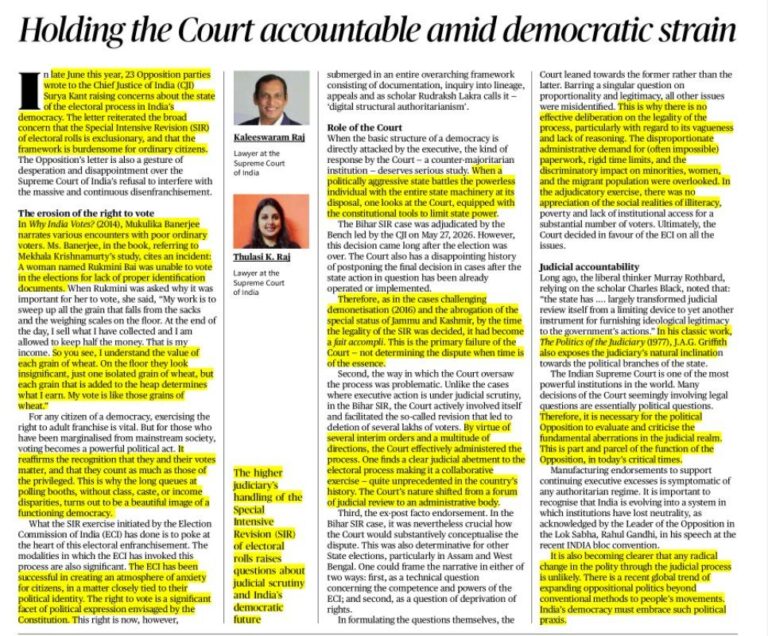
The debate over judicial accountability in India has gained importance after Opposition parties raised concerns about the handling of the Special Intensive Revision (SIR) of electoral rolls. The issue goes beyond electoral procedure. It touches the core of Indian democracy: the right to vote, institutional fairness, judicial review and the role of courts in protecting constitutional rights.
Why the SIR Issue Matters
Right to Vote and Democratic Participation
The right to vote is central to democracy. Any process that affects electoral rolls must be transparent, fair and inclusive. If genuine voters are removed due to documentation problems, migration, poverty, illiteracy or administrative errors, democratic participation is weakened.
The article highlights that the SIR process has created anxiety among citizens, especially marginalised groups who may struggle to prove identity or residence through formal documents.
Role of the Judiciary
Counter-Majoritarian Responsibility
In a constitutional democracy, courts are expected to protect individuals and minorities from arbitrary state action. When executive decisions affect basic democratic rights, the judiciary must act as a constitutional safeguard.
The Supreme Court’s role is especially important when electoral processes are questioned. Courts must ensure that the Election Commission and state institutions function within constitutional limits.
Need for Effective Judicial Review
Judicial review should not be reduced to technical questions alone. Courts must examine whether the process is fair, whether vulnerable citizens are protected, and whether the exercise strengthens or weakens democracy.
Concerns Over Judicial Accountability
Institutional Trust
The article argues that courts must remain accountable because judicial decisions can shape the future of democracy. If courts appear reluctant to intervene in issues affecting voting rights, public confidence may weaken.
Judicial accountability does not mean attacking judicial independence. It means ensuring that courts remain transparent, reasoned, rights-oriented and sensitive to democratic consequences.
Democracy Beyond Courts
Role of Political Opposition
The article also suggests that courts alone cannot protect democracy. Political opposition, civil society, media and citizens must remain active. Democratic resistance must happen through constitutional politics, public debate and institutional pressure.
Conclusion
Holding the court accountable amid democratic strain is essential for protecting constitutional democracy. The SIR debate raises deeper questions about voting rights, judicial review and institutional responsibility. For UPSC aspirants, this topic is important under polity, judiciary, electoral reforms, constitutional morality, governance and democratic accountability.
Vocabulary Boost
• Judicial Review → Court’s power to examine constitutional validity.
• Disenfranchisement → Denial or loss of voting rights.
• Electoral Integrity → Fairness and credibility of elections.
• Constitutional Morality → Governance guided by constitutional values.
• Rule of Law → Equal application of law to all.
Frequently Asked Questions (FAQs)
What is the main issue discussed in the article?
The article discusses judicial accountability, the SIR electoral roll revision process, and the Supreme Court’s role in protecting democratic rights.
Why is the SIR process controversial?
SIR is controversial because it may exclude genuine voters due to documentation gaps, migration, poverty, illiteracy or administrative errors.
Why is the right to vote important in democracy?
The right to vote allows citizens to participate in governance and ensures political equality in a democratic system.
What is the judiciary’s role in electoral matters?
The judiciary must ensure that electoral processes remain fair, transparent, constitutional and protective of citizens’ rights.
Why is this topic important for UPSC?
It is important for UPSC under polity, judiciary, electoral reforms, governance, constitutional morality and democratic accountability.
Source From : The Hindu
Why Policy Needs to Focus on Gender Wealth Inequality
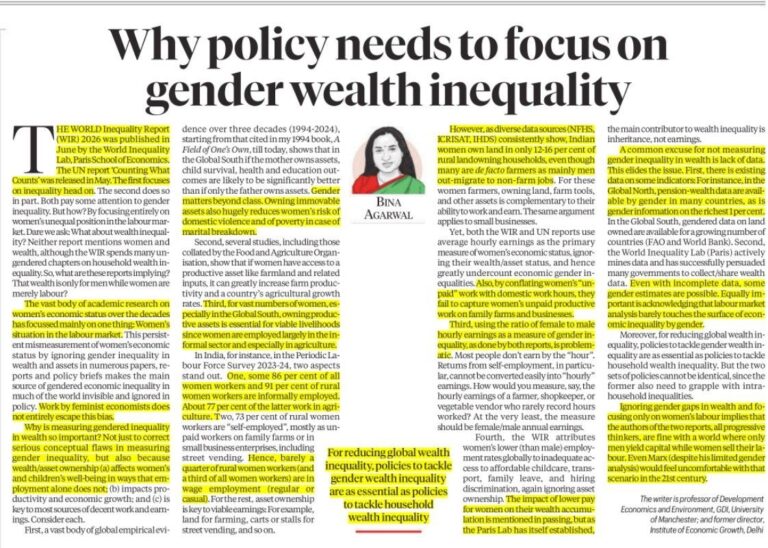
Gender wealth inequality is an important but often ignored dimension of economic inequality. While most discussions on gender focus on women’s labour force participation, wages and education, the article argues that women’s ownership of wealth and productive assets is equally crucial. Without addressing women’s access to land, housing, inheritance, savings and productive resources, economic empowerment remains incomplete.
Why Gender Wealth Inequality Matters
Beyond Labour Market Inequality
Women’s economic position is commonly measured through employment and income. However, wealth ownership gives long-term security, bargaining power and protection during crises. Assets such as land, house property, livestock, business capital and savings help women withstand poverty, domestic violence, widowhood and economic shocks.
If women earn income but do not control assets, their economic independence remains limited.
Women and Asset Ownership
Importance of Land and Property
In many parts of India, especially rural areas, women work in agriculture but do not own land. This limits their access to credit, government schemes, farm inputs and decision-making power. Land ownership also improves women’s social status and bargaining power within households.
The article highlights that women’s asset ownership is not only a gender justice issue but also an economic growth issue. When women control productive assets, household welfare, children’s education and agricultural productivity improve.
Data Gaps in Measuring Inequality
Lack of Gender-Disaggregated Wealth Data
A major problem is the lack of reliable data on women’s wealth ownership. Many inequality reports focus on income or household wealth but do not measure who within the household owns or controls assets. This hides gender inequality inside families.
Better surveys and gender-disaggregated data are needed to design effective policies.
Policy Priorities
Strengthening Women’s Economic Rights
Policies must focus on women’s land rights, inheritance rights, joint property ownership, access to credit, skill development and support for women-led enterprises. Legal rights alone are not enough; implementation and social awareness are equally important.
Conclusion
Reducing gender wealth inequality is essential for inclusive development. India must move beyond counting women’s labour participation and focus on their ownership of assets, property and productive resources. For UPSC aspirants, this topic is important under gender justice, inclusive growth, poverty, social empowerment, land reforms and economic inequality.
Vocabulary Boost
• Wealth Inequality → Unequal ownership of assets and wealth.
• Productive Assets → Assets used to generate income (land, tools, livestock).
• Financial Inclusion → Access to banking and financial services.
• Inheritance Rights → Legal rights to inherit family property.
• Economic Empowerment → Greater control over economic resources and decisions.
Frequently Asked Questions (FAQs)
What is gender wealth inequality?
Gender wealth inequality refers to unequal ownership and control of assets such as land, housing, savings, inheritance and business capital between men and women.
Why is wealth ownership important for women?
Wealth ownership gives women financial security, bargaining power, access to credit and protection during crises such as poverty, widowhood or domestic violence.
Why is land ownership important for rural women?
Land ownership helps rural women access credit, farm inputs, government schemes and decision-making power in agriculture.
What is the major data gap in gender wealth inequality?
Most surveys measure household wealth but do not clearly show who within the household owns or controls the assets.
Why is this topic important for UPSC?
It is important for UPSC under gender justice, inclusive growth, poverty, social empowerment, land reforms and economic inequality.