Table of Contents
ToggleMMDR Amendment Bill 2026
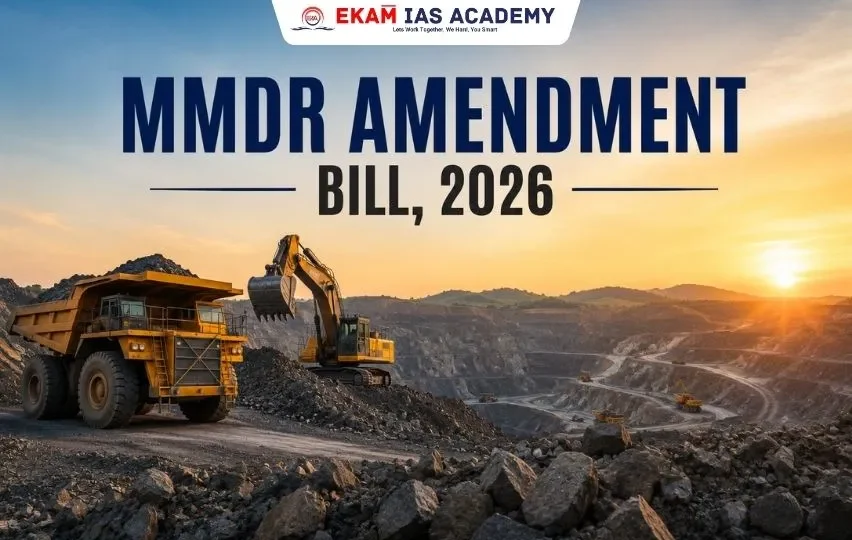
The Parliament has passed the Mines and Minerals (Development and Regulation) Amendment Bill, 2026 with the objective of creating a uniform and predictable taxation framework for the mining sector.
The amendment seeks to regulate State-level taxes and levies on mineral rights and mineral-bearing lands to reduce uncertainty for investors and promote domestic mineral production. However, the move has raised concerns regarding State fiscal autonomy, constitutional federalism and the balance between Centre-State powers following the Supreme Court’s 2024 judgment on mineral taxation.
Key Features of the MMDR Amendment Bill, 2026
Greater Union Control over Mineral-Bearing Lands
The Bill modifies the existing framework of the MMDR Act, 1957 by bringing mineral-bearing lands under greater regulatory supervision of the Union Government.
This aims to establish consistency in mineral governance and prevent multiple taxation structures across different States.
Restrictions on State Levies
A new provision, Section 9D, prevents States from imposing additional taxes, cesses or charges on mineral rights and mineral-bearing lands, except under conditions prescribed by the Central Government.
The move is intended to reduce the burden of multiple levies on mining companies and create a stable investment environment.
Retrospective Relief on Past Dues
The amendment provides that certain unpaid or unrecovered State levies imposed before the amendment will become invalid.
However, amounts already paid by mining companies will not be refunded.
Rule-Making Powers of the Centre
The Bill empowers the Central Government to frame rules specifying the conditions under which States may impose future levies related to minerals.
Significance of the Amendment
Tax Certainty for Mining Sector
Multiple and unpredictable State-level charges have increased operational costs for mining companies. A uniform framework can provide greater clarity and encourage investment.
Boost to Mineral Production
Reducing regulatory uncertainty can help increase domestic mineral extraction, strengthen supply chains and support India’s demand for critical minerals.
Promoting Investment
A predictable taxation regime can attract both domestic and foreign investment into mining, exploration and mineral processing sectors.
Existing Constitutional Framework Governing Minerals in India
The regulation of minerals in India is governed mainly by the Mines and Minerals (Development and Regulation) Act, 1957.
- Entry 54, Union List: Allows Parliament to regulate mines and mineral development when considered necessary in public interest.
- Entry 23, State List: Gives States power over mines and mineral development subject to Union laws.
- Entry 50, State List: Provides States the power to tax mineral rights, subject to limitations imposed by Parliament.
- Entry 49, State List: Deals with taxation of land, including mineral-bearing lands.
Under the existing system:
- The Centre regulates major minerals and determines royalty rates.
- States grant mining leases and collect royalty payments.
- Minor minerals are largely regulated by State Governments.
The Supreme Court in 2024 clarified that royalty is not a tax, but a contractual payment made for obtaining mineral rights.
Concerns Regarding the MMDR Amendment Bill, 2026
Impact on Fiscal Federalism
The Bill restricts States from imposing certain taxes on mineral rights and mineral-bearing lands, raising concerns regarding the financial autonomy of mineral-producing States.
Questions have been raised about whether Parliament can limit State powers under Entry 49 of the State List, which relates to land taxation.
Conflict with Supreme Court Judgment
In Mineral Area Development Authority v. Steel Authority of India (2024), a nine-judge Constitution Bench of the Supreme Court held that States have legislative competence to tax mineral rights and mineral-bearing lands.
The judgment also allowed States to recover past tax dues from 1 April 2005.
By altering the effect of unpaid past levies, the amendment has raised concerns regarding legislative powers and separation of powers.
Article 14 Concerns
The Bill invalidates unpaid past dues but does not provide refunds for amounts already paid.
This difference in treatment may raise questions regarding equality before law under Article 14 of the Constitution.
Excessive Delegation
The Bill allows the Central Government to prescribe conditions for State taxation through rules.
Critics argue that important issues related to State taxation powers should have clearer legislative guidelines.
Evolution of the MMDR Act, 1957
The MMDR Act, 1957 provides the legal framework for regulating mines and mineral development in India.
Major reforms include:
- 2015 Amendment: Introduced auction-based allocation of mineral concessions, created District Mineral Foundations (DMFs) and National Mineral Exploration Trust (NMET).
- 2020 Amendment: Allowed wider participation in coal auctions, including companies without prior mining experience.
- 2021 Amendment: Allowed captive mines to sell a portion of mineral production in the open market.
- 2023 Amendment: Opened critical minerals such as lithium, titanium, niobium and tantalum to private participation and introduced exploration licences.
- 2025 Amendment: Proposed mineral exchanges for transparent trading and removed restrictions on captive mine sales.
Measures Needed for Sustainable Mineral Governance
Strengthening Centre-State Coordination
A permanent mechanism involving the Centre and States can improve cooperation in mineral taxation, auctions, exploration and revenue sharing.
Improving District Mineral Foundation Outcomes
DMF funds should be utilised effectively for healthcare, education, livelihood generation and infrastructure development in mining-affected areas.
Promoting Critical Mineral Security
India should strengthen the National Critical Mineral Mission by expanding exploration, recycling, overseas mineral acquisition and domestic processing capabilities.
Sustainable Mining Practices
Mine closure plans, ecological restoration and land reclamation should become integral parts of the mining lifecycle.
Use of Technology
Satellite monitoring, drones, GPS-based mineral tracking and digital permits can help control illegal mining activities.
Conclusion
The MMDR Amendment Bill, 2026 attempts to create a stable and investment-friendly mineral taxation system while strengthening India’s mineral security.
However, its success depends on maintaining a balance between economic efficiency and constitutional federalism. A sustainable mining framework must ensure predictable taxation, protect State revenues, promote responsible extraction and support India’s long-term goals of Atmanirbhar Bharat and critical mineral independence.


Frequently Asked Questions on MMDR Amendment Bill, 2026
What is the MMDR Amendment Bill 2026?
The MMDR Amendment Bill 2026 seeks to create a uniform and predictable taxation framework for mineral rights and mineral-bearing lands.
What is the main objective of the MMDR Amendment Bill 2026?
Its main objective is to reduce taxation uncertainty, encourage investment and promote domestic mineral production.
How does the Bill affect State taxation powers?
The Bill restricts States from imposing certain additional taxes, cesses or charges on mineral rights and mineral-bearing lands, subject to conditions prescribed by the Centre.
Why has the Bill raised concerns about federalism?
The Bill has raised concerns because it may affect the fiscal powers of States over mineral rights and land taxation under the Constitution.
Which Supreme Court judgment is relevant to the Bill?
The Bill is linked to the 2024 Supreme Court judgment in Mineral Area Development Authority v. Steel Authority of India, which held that States have the power to tax mineral rights and mineral-bearing lands.