Table of Contents
ToggleIndividual Satyagraha
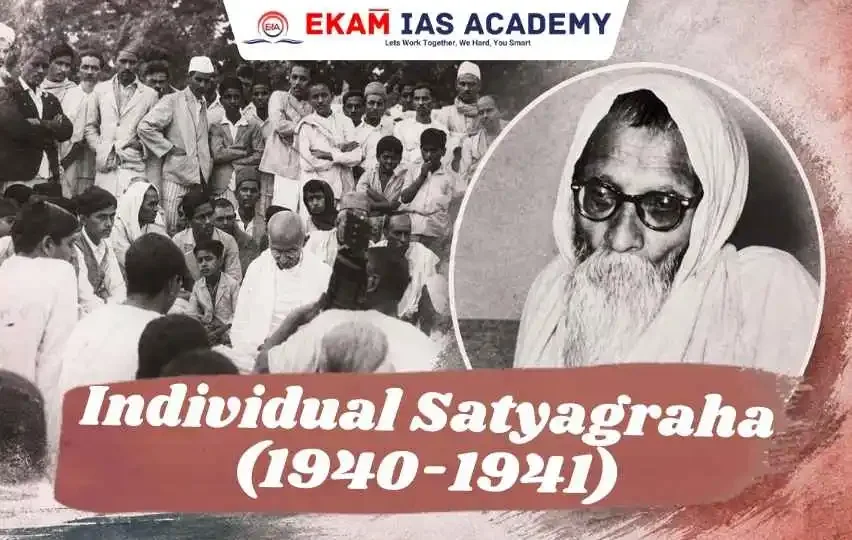
The Individual Satyagraha 1940-1941 was a targeted, moral protest movement launched by Mahatma Gandhi during the Indian Freedom Struggle. A cornerstone topic in Modern Indian History UPSC preparation, this Individual Satyagraha movement affirmed the Indian right to free speech while registering non-violent opposition to Britain pulling India into World War II without public consent.
Historical Background
Following the outbreak of World War II and Indian National Movement developments, Britain unilaterally declared India a belligerent party. The Congress Ministries resigned in protest in late 1939, leading to a constitutional stalemate.
Why Did Gandhi Launch Individual Satyagraha
Evaluating the Individual Satyagraha causes, Gandhi sought to express national discontent without initiating a full-blown civil disobedience movement that might destabilize Britain’s anti-fascist war effort.
Launch of Individual Satyagraha
The movement began in October 1940. The primary Individual Satyagraha objectives were to uphold freedom of speech to preach against the war and to prove that Indian non-embarrassment was not a sign of weakness.
Programme of Individual Satyagraha
Chosen satyagrahis would make a public speech against the war, inform local authorities in advance, and court arrest. If not arrested, they would march toward Delhi, sparking the famous “Delhi Chalo Movement.”
Major Leaders and Satyagrahis
Acharya Vinoba Bhave first Satyagrahi initiated the movement on October 17, 1940, at Paunar, followed by Jawaharlal Nehru second Satyagrahi, and Brahma Datt as the third.
Government Response
The colonial authorities responded with firm repression, arresting over 25,000 satyagrahis by mid-1941 under wartime emergency regulations.
Significance of Individual Satyagraha
The Individual Satyagraha significance lies in providing a moral safety valve, unifying political workers, and keeping the spirit of resistance alive across urban and rural India.
Limitations of Individual Satyagraha
- Restricted scope and limited mass participation by design.
- Could not alter Britain’s immediate imperial policy during wartime.
Individual Satyagraha and August Offer
Gandhi Individual Satyagraha was launched directly as a rejection of the unsatisfactory Individual Satyagraha and August Offer framework of 1940.
Individual Satyagraha and Cripps Mission
The movement paved the way for the Individual Satyagraha and Cripps Mission negotiations in 1942 as Britain sought to resolve growing Indian dissatisfaction.
Individual Satyagraha vs Non-Cooperation Movement
- Non-Cooperation Movement: Mass-based, disruptive, involving boycott of institutions.
- Individual Satyagraha: Selective, limited, moral protest centered on freedom of expression.
Timeline of Important Events
- August 1940: Rejection of August Offer.
- October 1940: Launch of Individual Satyagraha 1940.
- December 1941: Suspended as world war threats reached Indian borders.
Conclusion
Mastering Individual Satyagraha UPSC concepts is essential for organizing your UPSC History Notes. It served as a critical moral prelude that set the stage for the Individual Satyagraha and Quit India Movement transition in 1942.
UPSC Prelims: PYQs & Practice Questions
Previous Year Questions
Q: With reference to the Rowlatt Satyagraha, which of the following statements is/are correct?
1. The Rowlatt Act was based on the recommendations of the Sedition Committee.
2. During the Rowlatt Satyagraha, Gandhiji tried to utilise the organisational network of the Home Rule Leagues.
3. Demonstrations against the Simon Commission coincided with the Rowlatt Satyagraha.
Select the correct answer using the code given below:
(a) 1 and 2 only
(b) 2 only
(c) 1 and 3 only
(d) 1, 2 and 3
Answer: (a) 1 and 2 only
Explanation:
Statement 1 is correct. The
Rowlatt Act was based on the recommendations of the
Sedition Committee headed by
Sir Sidney Rowlatt.
Statement 2 is correct. Mahatma Gandhi organised the
Satyagraha Sabha and drew upon the organisational networks created by the
Home Rule Leagues during the anti-Rowlatt agitation.
Statement 3 is incorrect. The
Rowlatt Satyagraha took place in 1919, whereas the
Simon Commission arrived in India in 1928.
Q: Who among the following was chosen by Mahatma Gandhi as the
first Satyagrahi for the
Individual Satyagraha launched in 1940?
(a) Jawaharlal Nehru
(b) Sardar Vallabhbhai Patel
(c) Acharya Vinoba Bhave
(d) Dr. Rajendra Prasad
Answer: (c) Acharya Vinoba Bhave
Explanation:
Mahatma Gandhi selected
Acharya Vinoba Bhave as the
first Individual Satyagrahi.
He began the protest on
17 October 1940 at
Paunar in Maharashtra.
Jawaharlal Nehru was selected as the
second Satyagrahi, while
Brahma Datt was the third.
Practice Questions
Q: With reference to the Individual Satyagraha (1940–1941), consider the following statements:
1. It was launched as a direct response to the rejection of the August Offer of 1940.
2. The primary demand of the Satyagrahis was the immediate declaration of full independence for India.
3. If a Satyagrahi was not arrested after making an anti-war speech, he was directed to march towards Delhi under the slogan “Delhi Chalo”.
Which of the statements given above are correct?
(a) 1 and 2 only
(b) 1 and 3 only
(c) 2 and 3 only
(d) 1, 2 and 3
Answer: (b) 1 and 3 only
Explanation:
Statement 1 is correct. The
Individual Satyagraha was launched in
October 1940 after the Congress rejected the
August Offer and opposed India's participation in the Second World War without the consent of its people.
Statement 2 is incorrect. The immediate objective was not to launch a mass struggle for complete independence. The Satyagrahis asserted the
right to freedom of speech and publicly opposed India's forced participation in the British war effort.
Statement 3 is correct. If a Satyagrahi was not arrested after delivering the prescribed anti-war speech, he was expected to
march towards Delhi. This gave rise to the popular expression
“Delhi Chalo”.
Q: Consider the following leaders of the Indian Freedom Movement:
1. Acharya Vinoba Bhave
2. Jawaharlal Nehru
3. Brahma Datt
In which order were they selected by Mahatma Gandhi to offer Individual Satyagraha in 1940?
(a) 1 - 2 - 3
(b) 2 - 1 - 3
(c) 1 - 3 - 2
(d) 3 - 1 - 2
Answer: (a) 1 - 2 - 3
Explanation:
Mahatma Gandhi personally selected the first Individual Satyagrahis.
1. Acharya Vinoba Bhave – First Satyagrahi, who began the movement on
17 October 1940.
2. Jawaharlal Nehru – Selected as the
second Satyagrahi.
3. Brahma Datt – Selected as the
third Satyagrahi.
Therefore, the correct sequence is
1 - 2 - 3.
UPSC Mains – Previous Year & Practice Questions
Mains Previous Year Questions
[10 Marks | 150 Words]
Question: Assess the nature and objectives of the Individual Satyagraha launched by Mahatma Gandhi in 1940. How did it differ from his earlier mass movements? (UPSC CSE Mains 2021, GS Paper I)
[15 Marks | 250 Words]
Question: Discuss how the Indian National Congress navigated its strategy during the Second World War between non-embarrassment of Britain and asserting national dignity. (UPSC CSE Mains 2014, GS Paper I)
[10 Marks | 150 Words]
Question: Write a short note on the significance of the Individual Satyagraha of 1940 in the Indian freedom struggle. (UPSC CSE Mains 2007, Modern History)
[10 Marks | 150 Words]
Question: Examine the political background that led to the launch of the Individual Satyagraha and its eventual impact on nationalist politics. (UPSC CSE Mains 2002, Modern History)
[15 Marks | 250 Words]
Question: Trace the trajectory of Mahatma Gandhi's Satyagraha strategies from the Non-Cooperation Movement to the Quit India Movement. (UPSC CSE Mains 1997, Modern History)
Mains Practice Questions
[15 Marks | 250 Words]
Question: “The Individual Satyagraha was not designed to seek immediate political power, but to establish a moral platform and assert the right to free expression.” Critically evaluate.
[15 Marks | 250 Words]
Question: How did the failure of the August Offer (1940) pave the way for the Individual Satyagraha? Explain how this movement acted as a strategic bridging phase before the launch of the Quit India Movement in 1942.
[10 Marks | 150 Words]
Question: Compare and contrast the organizational methods, scope and objectives of the Individual Satyagraha (1940) with the Civil Disobedience Movement (1930).
Individual Satyagraha-FAQs
What was Individual Satyagraha 1940-1941?
Individual Satyagraha was a limited moral protest launched by Mahatma Gandhi against Britain’s decision to involve India in World War II without Indian consent.
Why did Gandhi launch Individual Satyagraha?
Gandhi launched it to assert the right to free speech and oppose India’s forced participation in the war without starting a full mass movement.
Who was the first Individual Satyagrahi?
Acharya Vinoba Bhave was selected by Gandhi as the first Individual Satyagrahi in October 1940.
Who was the second Individual Satyagrahi?
Jawaharlal Nehru was chosen as the second Individual Satyagrahi.
Why is Individual Satyagraha important for UPSC?
It is important because it connects World War II, August Offer, Gandhi’s strategy, freedom of speech, Cripps Mission and the transition toward Quit India Movement.