

Table of Contents
ToggleTHE COST OF INDIA’S PRIVATE HEALTH-CARE BOOM
TOPIC: (GS2) POLITY: THE HINDU
Recently, the Parliamentary Standing Committee on Health and Family Welfare, in its 176th Report, highlighted the sharp disparity in treatment costs between private and public hospitals.
Policy Contradictions
- Standardised package rates and mandatory pre-treatment cost estimates for transparency.
- Linking room tariffs in private hospitals to nearby three-star hotel rates.
- Cross-subsidisation by corporate hospitals to reserve regulated beds for Ayushman Bharat (AB-PMJAY) beneficiaries.
- India seeks greater private and foreign capital in Tier2/3 cities, yet is reviewing FDI rules for hospital acquisitions, creating uncertainty for investors.
- Currently, India allows 100% FDI under the automatic route in hospitals, which has helped India emerge as a global medical destination, but the Committee warns of rising costs due to aggressive corporatisation.
Role of Private Investment
- Hospitals demand high capital investment for land, ICUs, advanced equipment, laboratories, and skilled personnel.
- Public hospitals alone cannot meet the demand for secondary and tertiary care.
- Private and foreign investors bring capital, technology, and managerial expertise, bridging gaps in infrastructure.
- India’s healthcare sector recorded ₹10,000 crore worth of deals in Q2 FY26, including hospital acquisitions, diagnostics, and specialty care.
- Leading hospital chains plan to add 18,000+ beds over the next 3–5 years, through greenfield projects and acquisitions.
FDI Trends in Healthcare
- India received USD 58.8 billion FDI equity inflows in FY 2025–26, a growth of 18% over the previous year.
- Top contributors: Singapore (25%), Mauritius (24%), and the USA (10%).
- Healthcare remains a preferred sector for private equity and foreign investors due to high demand for specialty care and diagnostics.
Concerns of Incentive Structures
- In health care, providers possess far more knowledge than patients, creating a situation where patients depend heavily on doctors’ judgments.
- Strong revenue pressures can influence the volume and type of care delivered, sometimes beyond medical necessity.
- Corporate hospitals, backed by private equity, face pressure to recover costs through high salaries, advanced equipment, and strict revenue targets.
- This environment can lead to overmedicalisation unnecessary tests, prolonged admissions, or procedures such as caesarean deliveries and angioplasties, driven more by institutional incentives than patient need.
FDI and Regulation
- Review of FDI in hospital acquisitions is justified.
- Key questions: Does investment create new capacity or merely acquire existing assets?
- Greenfield investments should be encouraged; acquisitions must avoid market concentration and excessive pricing.
- Public concessions (land, tax benefits) must link to affordable beds and insurance participation.
Strengthening Public Health
- Beyond Regulation: India cannot rely solely on price caps or FDI reviews; public hospitals must be strengthened to provide a credible alternative to private care.
- Primary Health Care Focus: Greater emphasis is needed on prevention, early detection, and timely treatment, reducing the burden on tertiary facilities.
- Insurance Reform: Schemes like Ayushman Bharat–PMJAY should incentivise appropriate and necessary care, rather than rewarding higher volumes of procedures.
- Clinical Safeguards: Evidencebased protocols, clinical audits, and transparent billing systems can protect both patients and doctors from commercial pressures and unnecessary interventions.
Conclusion
India’s private health-care boom bridges gaps but raises affordability and ethical concerns. Regulation, FDI scrutiny, and pricing reforms matter, yet strengthening public systems ensures medical priorities over profit motives.
MAKING INDIA’S FOOD SYSTEM CLIMATEPROOF
TOPIC: (GS3) ENVIRONMENT: THE HINDU
India’s food security faces growing climate risks, prompting a shift toward climate-resilient and sustainable food systems.
India’s Achievements
- India’s foodgrain production crossed 350 million tonnes in 202425, including record harvests of rice (135+ million tonnes) and wheat (110+ million tonnes), making India the world’s secondlargest producer of cereals.
- Digitisation and the One Nation One Ration Card (ONORC) have expanded coverage to 800 million beneficiaries under the National Food Security Act (NFSA), 2013.
- The Food Corporation of India (FCI) maintains 60–70 million tonnes of buffer stocks, providing resilience against market volatility.
- The Pradhan Mantri Poshan Shakti Nirman (PMPOSHAN) scheme covers 11.8 crore schoolchildren, linking food security with nutrition.
- Over 90% of ration cards are digitised, and biometric authentication via Aadhaar has reduced leakages, strengthening transparency in food distribution.
Climate Risks to Food Systems
- Rising Temperatures : A 0.5°C rise in winter temperatures per decade in Punjab and Haryana has sharply reduced wheat productivity.
- Erratic Monsoons : The 2026 monsoon forecast was revised down to 90% of the longperiod average, placing kharif crops in the belownormal category.
- Groundwater Depletion: Over 60% of India’s crop area is rainfed, making it highly vulnerable to rainfall shocks.
- Groundwater reserves in northwestern states are declining at alarming rates, weakening irrigation buffers for rice and wheat belts.
- ICAR has identified 310 districts as climatevulnerable, with 109 in the “very high risk” category.
- Extreme Weather: Floods and heatwaves damaged 3.2 million hectares of crops in 2024 alone, affecting storage and transport infrastructure.
Need for Crop Diversification
- Current procurement remains concentrated in rice and wheat, largely sourced from Punjab, Haryana, Uttar Pradesh, regions facing severe groundwater stress.
- Diversification towards millets, pulses, oilseeds, and nutricereals strengthens resilience, and supports India’s International Year of Millets momentum.
- A broader procurement base enhances dietary diversity, promotes water conservation, and ensures climate adaptation, reducing ecological stress from ricewheat dominance.
- The Public Distribution System (PDS), covering 800 million beneficiaries, can integrate locally appropriate millets and pulses, linking food security with nutrition and sustainability.
Financing ClimateResilient Systems
- Green Finance Tools: Climateresilient agriculture requires green bonds, adaptation finance, insurance mechanisms, and resilient valuechain investments to mobilise sustainable capital.
- NetZero Integration: Embedding food systems into India’s netzero pathway enables measurable emission reductions, carbon sequestration, and resilience targets across agriculture, water, energy, and transport.
- Building a Climate Buffer: India can create a broader “climate buffer” diversified crops, resilient infrastructure, climate information systems, insurance, and water management similar to traditional grain reserves.
INDIAN INITIATIVES FOR CLIMATERESILIENT INFRASTRUCTURE
- Coalition for Disaster Resilient Infrastructure (CDRI): India leads a global platform promoting resilient infrastructure design and riskmanagement standards.
- Union Budget 202627: Allocated major capital expenditure towards green growth, ESG integration, and climateresilient infrastructure development.
- Urban Climate Resilience: Focus on heatresilient cooling, floodproof drainage, and watersecure planning for rapidly growing Indian cities.
- Policy Reforms: Resilience clauses embedded in contracts, force majeure linked to hazard thresholds, and mandatory risk assessments.
- Financing Mechanisms: Use of green bonds, adaptation finance, insurance instruments, and PPPs for sustainable infrastructure expansion.
Conclusion
Climateresilient food and nutrition security is the logical next phase of India’s food policy. By embedding climate risk management into NFSA planning and procurement, India can ensure that its food systems remain nutritious, sustainable, and resilient for future generations.
RESTORING URBAN LAKES
TOPIC: (GS3) ENVIRONMENT: THE HINDU
India’s urban lakes and wetlands, vital for biodiversity, carbon storage, and climate resilience, are disappearing rapidly due to encroachment, pollution, and weak governance.
What are wetlands?
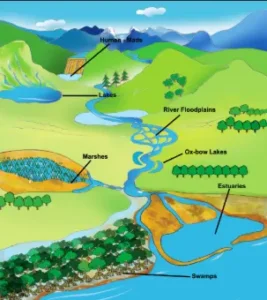
- Wetlands are ecosystems where land is saturated or flooded with water, permanently or seasonally, supporting unique biodiversity and vital ecological functions.
- As per the Ramsar Convention (1971), wetlands include marshes, fens, peatlands, lakes, rivers, mangroves, coral reefs, estuaries, lagoons, reservoirs, rice paddies, and aquaculture ponds.
- They are areas with static or flowing, fresh, brackish, or salt water, not deeper than 6 meters at low tide.
Ecological Importance
- Wetlands cover 6% of Earth’s surface, storing more carbon per unit area than terrestrial forests.
- They act as urban climate buffers, mitigating floods, heat islands, and water scarcity.
- Lakes support biodiversity, regulate microclimates, and sustain urban liveability.
Current Crisis
- Encroachment: Rapid urbanisation treats lakes as vacant land, converting catchments into real estate.
- Pollution: Untreated sewage, industrial effluents, and solid waste choke water bodies, making many biologically dead.
- Data Evidence:
- J&K lost 500+ lakes since 1967 (CAG report).
- Hyderabad lost 61% of lake area since 1979, with 268 lakes disappearing between 2002–2012.
- Governance Gaps: Fragmented accountability, weak coordination, and prioritisation of beautification (promenades, lighting) over ecological repair.
Way Forward
- Integrate Lakes into Urban Planning: Treat them as ecological infrastructure, not vacant land.
- Legal Protection: Strict enforcement of lake boundaries and catchments with penalties for encroachment.
- Unified Governance: Streamline fragmented authorities under accountable institutions.
- Community Ownership: Institutionalise citizen participation for sustained local stewardship.
- Ecological Restoration: Focus on feeder channels, catchments, and water quality rather than cosmetic beautification.
Government Initiatives
- Ramsar Sites Expansion: India has increased designated wetlands, signalling highlevel recognition of conservation.
- National Missions: Atal Mission for Rejuvenation and Urban Transformation, Jal Shakti Abhiyan, and Mission Amrit Sarovar provide frameworks but face diluted ground impact.
- State Action: Telangana’s HYDRAA agency reclaimed encroached lakebeds, cleared illegal structures, and restored hydrological flows doubling Nalla Cheruvu’s spread from 16 to 30 acres.
- Citizen Movements: Local “lake champions” in Bengaluru and Hyderabad revived Puttenahalli, Jakkur, and Kudikunta lakes through community engagement.
Conclusion
India’s urban lakes face climate stress, biodiversity loss, and public health risks; only legal protection, accountability, and citizen engagement can ensure resilient ecosystems in warming cities.
USING DISASTER FUNDS FOR HEATWAVES
TOPIC: (GS3) DISASTER MANAGEMENT: THE HINDU
Recently the Ministry of Home Affairs notified heatwaves and lightning as natural calamities, making them eligible for disaster funds.
Disaster Finance Framework
- Under Article 280, the Finance Commission recommends disaster fund allocations.
- The 16th Finance Commission (FCXVI) allocated ₹2.04 lakh crore for State disaster funds (202631), a 28% increase from the previous Commission.
- Distribution: ₹1.6 lakh crore to the State Disaster Response Fund (SDRF) and the rest to the State Disaster Mitigation Fund (SDMF).
- SDRF: Immediate relief, response, and reconstruction.
- SDMF: Longterm risk reduction and resilience building.
Heatwave Risks
- Over 57% of districts, home to threefourths of India’s population, face high to veryhigh heat risk.
- Rising hot days, warm nights, and humidity reduce human recovery capacity.
- Health surveillance (2026 data): 4,853 heatstroke cases and 20 confirmed deaths between March–July.
Funding Options for States
- SDRF: Relief and compensation for heatrelated losses (lives, crops, livelihoods).
- SDMF: Longterm mitigation — cooling shelters, earlywarning systems, resilient infrastructure.
- Nodal agencies: State Disaster Management Authorities (SDMA) and State Emergency Operations Centres.
Challenges in Implementation
- Only 300 cities/districts across 23 States have Heat Action Plans (HAPs), leaving 4,800 ULBs and 800 districts uncovered.
- 79% of HAPs rely on selfallocation of funds, limiting execution.
- Weak technical capacity and fragmented planning hinder fund utilisation.
Way Forward
- Expand Heat Planning: All districts and ULBs must prepare HAPs with vulnerability mapping.
- Convert Plans into Projects: States need model proposals; research institutions and NGOs can provide technical support.
- Strengthen Health Surveillance: Capture broader heatrelated illnesses beyond heatstroke.
- Integrate Schemes: Link heat solutions with existing development programmes.
- Innovative Finance: Use parametric insurance — payouts triggered automatically when temperature thresholds are crossed.
Conclusion
With heatwaves now recognised as disasters, States can fully access disaster funds; effective use requires planning, surveillance, capacity building, and innovative financing for resilience.
ACTING CJ OF RAJASTHAN HIGH COURT
TOPIC: (GS2) POLITY: THE HINDU
Recently, a series of letters addressed to the Chief Justice of India raised concerns about the functioning of the Rajasthan High Court under its Acting Chief Justice.
Key Issues Flagged
- Irregular Case Transfers: Allegations of sudden withdrawal and reassignment of cases without justification.
- Administrative Concerns: Reports of maladministration and questionable practices in judicial and administrative functioning.
- Nepotism & Favouritism: Concerns over the designation of advocates as seniors and alleged preferential treatment.
- Intimidation of Officers: Claims that judicial officers were threatened with punitive transfers.
- Resource Misuse: Proposals for extravagant infrastructure projects, criticised as wasteful expenditure.
Key Allegations
- Sudden withdrawal and reassignment of cases to the ACJ’s Bench.
- Humiliation of judicial officers and threats of retributive transfers.
- Nepotism in designating favoured advocates as seniors.
- Proposal for a costly multistoried guest house, termed wasteful expenditure.
Institutional Concerns
- Justice Mehta repeatedly requested appointment of a regular Chief Justice from outside Rajasthan, citing erosion of credibility.
- The ACJ is due to retire in September 2026, intensifying calls for urgent reform.
Ad Hoc Judges
- Definition: Judges appointed temporarily to deal with shortage of judges, arrears of work, or special situations.
- Constitutional Basis:
- Article 127: Allows the Chief Justice of India, with Presidential consent, to appoint a High Court judge as an ad hoc judge of the Supreme Court when quorum is lacking.
- Article 224A: Enables Chief Justice of a High Court, with Presidential consent, to request retired judges to sit as ad hoc judges in High Courts.
- Purpose: Reduce pendency, especially in High Courts where 60+ lakh cases are pending.
- Examples: Allahabad High Court (2026) appointed five retired judges under Article 224A to clear longpending cases.
Acting Judges
- Definition: Judges appointed temporarily to perform the duties of a High Court judge or Chief Justice when the office is vacant or the incumbent is unable to perform duties.
- Constitutional Basis:
- Article 224: Provides for appointment of Additional and Acting Judges in High Courts.
- Purpose: Ensure continuity of judicial functioning during vacancies, illness, or administrative delays in appointing permanent judges.
- Nature: Unlike ad hoc judges (often retired), acting judges are usually serving judges appointed to temporarily fill gaps.
Conclusion
The episode underscores the fragility of judicial administration when leadership is contested. It highlights the need for transparent appointments, strict accountability, and institutional safeguards to preserve public trust in the judiciary.
INDIA’S R&D FUNDING SYSTEM AND WHY IT NEEDS MAPPING
TOPIC: (GS3) SCIENCE AND TECHNOLOGY: THE HINDU
The NITI Aayog’s report on Ease of Doing R&D revealed that nearly 80% of Anusandhan National Research Foundation (ANRF) funds are concentrated in IITs, despite its mandate to support diverse institutions.
R&D Funding in India
- GERD Growth: Increased from 0.64% of GDP (202021) to 0.84% (202324), tripling in absolute terms from ₹79,355 crore (201314) to ₹2,44,768 crore (202324).
- Funding Concentration: Nearly 80% of ANRF funds concentrated in IITs, limiting support to wider universities and research bodies.
- Overlap Issues: Multiple agencies fund similar research areas, leading to duplication and inefficient use of public money.
- Private Sector Role: Still limited, with government contributing ~55% of GERD, industry ~40%, far below advanced economies where corporate share is 70–80%.
Current Challenges
- Scattered Databases: Funding records lie across dozens of agencies in inconsistent formats.
- Duplication Risk: Multiple agencies may fund similar projects, leading to inefficient use of public money.
- Lack of Transparency: No unified system to track who is funded, by whom, for what purpose, and whether duplication exists.
- Metadata Issues: Researcher names and institutions appear differently across datasets, preventing automated tracking.
Proposed Solutions
- Unified Project Management System (UPMS): A national portal to streamline planning, funding, monitoring, and evaluation of R&D projects.
- Persistent Digital Identifiers (PIDs): Unique machinereadable IDs for grants, researchers (ORCID), institutions (ROR), and funders.
- Metadata Infrastructure: Standardised details on funding agency, institution, researcher, amount, duration, and field.
- Global Models: Systems like Crossref Grant DOI, UK Gateway to Research, and EU CORDIS/OpenAIRE show how identifiers can prevent duplication and track outcomes.
Way Forward
- Hybrid Approach: India can build a sovereign national portal (UPMS) while ensuring compatibility with global PID systems.
- Transparency: Linking grants to publications, patents, and data ensures accountability.
- Efficiency: Helps identify overlapping proposals, fund concentration, and alignment with national priorities.
- Global Visibility: Makes Indian research comparable within international datasets, boosting credibility and collaboration.
Major Schemes & Missions
- RDI Fund: ₹1 lakh crore corpus for deeptech (AI, robotics, space, semiconductors, clean energy).
- India Semiconductor Mission: ₹76,000 crore for fabrication, packaging, and design ecosystem.
- India AI Mission: ₹10,372 crore for AI research and applications.
- National Quantum Mission (NQM): ₹6,004 crore for quantum computing, communication, sensing, and materials.
- NMICPS: ₹3,660 crore for AI, robotics, cybersecurity, and cyberphysical systems.
Conclusion
India’s R&D ecosystem urgently needs a map of where funds go. By adopting PIDs, metadata, and a unified portal, India can reduce duplication, improve efficiency, and align research investments with national priorities. This reform is essential to transform India into a global innovation hub.
PRAGATI PLATFORM
TOPIC: (GS2) POLITY: THE HINDU
PRAGATI (ProActive Governance and Timely Implementation) is the Government of India’s flagship digital platform launched in 2015. It enables the Prime Minister to directly monitor projects, schemes, and grievances in real time, ensuring accountability and faster execution.
Design & Technology
- Developed inhouse by the PMO with support from the National Informatics Centre (NIC).
- Integrates digital data management, video conferencing, and geospatial technology for realtime monitoring.
- Ensures that when the PM reviews an issue, he has access to the latest updates, visuals, and project status on screen.
Structure
- Threetier system: PMO, Union Government Secretaries, and State Chief Secretaries.
- The Prime Minister chairs review meetings with State and Central officials to resolve bottlenecks.
- A multitier followup mechanism ensures timely implementation of decisions.
Functions
- Fasttracks pending projects and schemes by removing interdepartmental hurdles.
- Monitors grievances flagged from public databases and ongoing programmes.
- Cabinet Secretariat oversees projects, while Ministries handle schemes and grievances under PMO supervision.
Conclusion
PRAGATI exemplifies India’s push for digital governance and accountability, ensuring that projects and grievances are addressed swiftly through direct PMlevel intervention. It strengthens cooperative federalism by bringing States and the Union Government together on a single platform.
NATIONAL SHIPPING BOARD
TOPIC: (GS3) ECONOMY: THE HINDU
The National Shipping Board (NSB) is a permanent statutory body established in 1959 under Section 4 of the Merchant Shipping Act, 1958. It plays a crucial role in advising the Government of India on shipping and maritime development.
Functions
- Advises the government on shipping policy, development, and regulation.
- Provides recommendations that shape India’s National Maritime Policy.
- Reviews issues related to merchant fleet expansion, seafarer welfare, and port development.
Composition
- Chairman and Members form the Board.
- Six Members elected by Parliament (four from Lok Sabha, two from Rajya Sabha).
- Additional members (not exceeding sixteen) appointed by the Central Government to represent government, shipowners, and seamen.
- Tenure: Two years for Chairman and members.
- Nodal Ministry: Ministry of Ports, Shipping and Waterways.
Recent Development
- NSB recently held its first ‘Sagar Samvad’, proposing a fivepoint roadmap to add 100 vessels to India’s merchant fleet in five years.
- This initiative aims to strengthen India’s blue economy, maritime trade capacity, and global shipping competitiveness.
Conclusion
The National Shipping Board remains a key advisory body in India’s maritime governance. By guiding fleet expansion, policy reforms, and seafarer welfare, it ensures India’s shipping sector aligns with national growth and global trade ambitions.