Table of Contents
ToggleThe Indo-Pacific Region has emerged as the global center of gravity in the 21st century. Shifting from a purely “Asia-Pacific” focus, the Indo-Pacific construct recognizes the seamless connectivity between the Indian and Pacific Oceans. For New Delhi, India-pacific relations UPSC represent a move toward a multi-polar world where India acts as a “bridge” and a net security provider.
Historical Background
India’s connection to the Pacific is not new. Historically, the “Chola Navy” and ancient maritime trade routes linked India to Southeast Asian kingdoms. In the modern era, the shift began with the “Look East Policy” (1991), which evolved into the more proactive “Act East Policy” (2014). Prime Minister Modi’s 2018 speech at the Shangri-La Dialogue formally articulated India’s vision of an “Open, Free, and Inclusive” Indo-Pacific.
Definition and Scope
The definition and scope of the Indo-Pacific vary among nations. For India, it extends from the shores of Africa to the Americas, encompassing the entire Indian Ocean and the Western and Central Pacific. This inclusive definition contrasts with narrower interpretations that exclude the Western Indian Ocean.
Strategic Significance
- Global Trade: Over 60% of global GDP and 50% of global maritime trade pass through this region.
- Energy Security: Vital sea lines of communication (SLOCs) and choke points like the Strait of Malacca are located here.
- Geopolitics: The region is the primary theater for the US-China power rivalry, making Indo-Pacific strategy India critical for maintaining strategic autonomy.
India's Initiatives
India has launched several institutional frameworks to secure its interests:
- SAGAR Policy: “Security and Growth for All in the Region,” emphasizing cooperative maritime security.
- IPOI: The Indo-Pacific Oceans Initiative, focusing on maritime ecology, disaster risk reduction, and trade connectivity.
- IFC-IOR: The Information Fusion Centre for real-time maritime domain awareness.
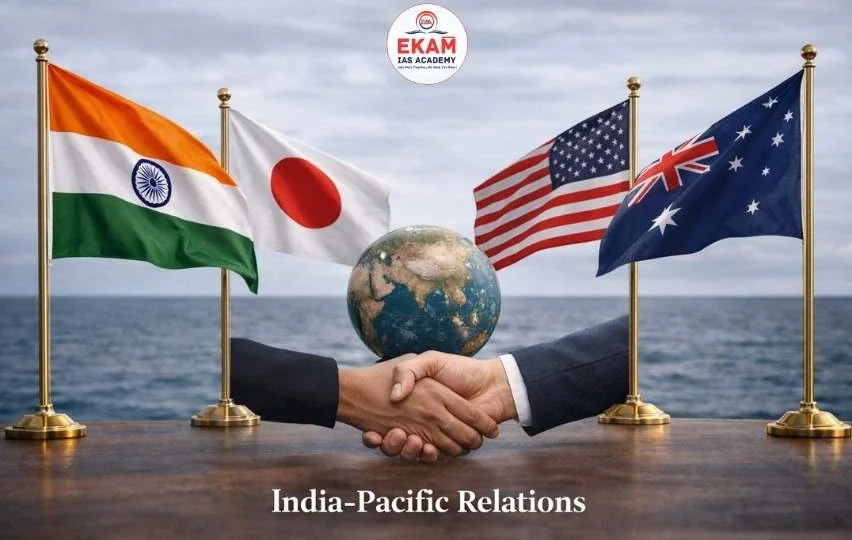
- Quad Engagement: Active participation in the Quadrilateral Security Dialogue (India, USA, Japan, Australia).
Key Areas of Cooperation
- Maritime Security: Joint naval exercises like Malabar and Milan.
- Blue Economy: Sustainable use of ocean resources for economic growth.
- Connectivity: Developing infrastructure projects like the Trilateral Highway and the Kaladan Multi-modal Project.
- Disaster Relief: India’s role as a first responder in HADR (Humanitarian Assistance and Disaster Relief) operations.
Recent Developments
- IPEF Participation: India’s active role in the Indo-Pacific Economic Framework for Prosperity, specifically in supply chain resilience and clean energy.
- Island Diplomacy: Increased engagement with Pacific Island Countries (PICs) through the FIPIC (Forum for India-Pacific Islands Cooperation) summit.
- Maritime Partnerships: Deployment of Indian naval assets to the South China Sea for “presence and surveillance” missions.
Importance for India’s Foreign Policy
The Indo-Pacific is the linchpin of India’s “Act East” and “Link West” policies.
- Countering Hegemony: Preventing any single power from dominating the maritime commons.
- Economic Integration: Aligning India’s economy with the fast-growing markets of East and Southeast Asia.
- IR UPSC notes pacific region: Essential for understanding India’s transition from a “balancing” power to a “leading” power.
Challenges and Risks
- Militarization: Increased naval presence and base-building (e.g., China’s “String of Pearls”).
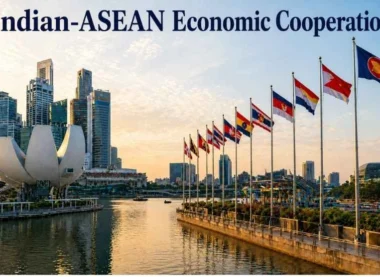
- ASEAN Centrality: Balancing the interests of the Quad with the concerns of ASEAN nations regarding “bloc politics.”
- Logistical Barriers: Limited naval budget and infrastructure gaps in the Andaman and Nicobar Islands.
Way Forward
- Strengthening Mini-laterals: Deepening ties via groups like India-France-Australia or India-Japan-Australia.
- Undersea Domain Awareness: Investing in submarine tech and deep-sea sensors.
- Rules-Based Order: Advocating for the strict adherence to UNCLOS (United Nations Convention on the Law of the Sea).
Conclusion
The India-Pacific strategic partnership is the defining relationship of the modern era. As the global order shifts eastward, India’s ability to maintain an “inclusive” and “rules-based” Indo-Pacific will determine its status as a global superpower. For UPSC aspirants, mastering this topic is non-negotiable for a high score in International Relations.
UPSC Prelims: PYQs & Practice Questions
Previous Year Questions (Prelims)
Q: With reference to the ‘Indo-Pacific Oceans Initiative’ (IPOI), consider the following statements:
1. It was launched by the Prime Minister of India at the East Asia Summit in 2019.
2. It is a treaty-based organization focused primarily on military alliances to counter regional hegemony.
3. One of its key pillars is 'Maritime Ecology' and 'Disaster Risk Reduction'.
Which of the statements given above are correct?
(a) 1 and 2 only
(b) 2 and 3 only
(c) 1 and 3 only
(d) 1, 2, and 3
Answer: (c) 1 and 3 only
Explanation:
Statement 1 is correct because the Indo-Pacific Oceans Initiative was launched by the Prime Minister of India at the East Asia Summit in 2019. Statement 2 is incorrect because IPOI is not a treaty-based organization and not a military alliance. It is an open and non-treaty-based initiative for cooperative solutions in the Indo-Pacific. Statement 3 is correct because Maritime Ecology and Disaster Risk Reduction are among its important pillars.
Q: Which of the following best describes the term 'Merchant Shipping Information Fusion Centre - Indian Ocean Region' (IFC-IOR)?
(a) A joint venture between India and Japan to build ports in Southeast Asia.
(b) A tracking system for illegal migration in the Pacific islands.
(c) A facility to enhance maritime domain awareness and share information on white shipping.
(d) A naval base in the Andaman and Nicobar Islands.
Answer: (c) A facility to enhance maritime domain awareness and share information on white shipping
Explanation:
IFC-IOR, located in Gurugram, was established by the Indian Navy to improve maritime domain awareness in the Indian Ocean Region. It tracks merchant vessels and shares white shipping information with partner countries to strengthen maritime security against threats such as piracy, terrorism, and illegal activities at sea.
Practice Questions
1. India
2. USA
3. Japan
4. Australia
5. France
Select the correct answer:
(a) 1, 2, and 3 only
(b) 1, 2, 3, and 4 only
(c) 1, 3, 4, and 5 only
(d) All of the above
Answer: (b) 1, 2, 3, and 4 only
Explanation:
The Quad is a strategic dialogue comprising India, the United States, Japan, and Australia. France, although an important Indo-Pacific stakeholder, is not a member of the Quad. Therefore, the correct answer is 1, 2, 3, and 4 only.
UPSC Mains – Previous Year & Practice Questions
Mains Previous Year Questions
Q1. [UPSC CSE Mains 2023]
Question: Discuss the strategic importance of the Indo-Pacific region for India, particularly in the context of maritime security and the 'Act East' Policy.
Q2. [UPSC CSE Mains 2021]
Question: The newly tri-nation partnership AUKUS is aimed at countering China’s ambitions in the Indo-Pacific region. Is it going to supersede the existing partnerships in the region? Discuss.
Q3. [UPSC CSE Mains 2014]
Question: With respect to the South China Sea, maritime territorial disputes and rising tension affirm the need for safeguarding maritime security to ensure freedom of navigation and overflight throughout the region. In this context, discuss the bilateral issues between India and China.
Q4. [UPSC CSE Mains 2021]
Question: Critically examine the aims and objectives of SCO. What importance does it hold for India?
Q5. [UPSC CSE Mains 2016]
Question: Evaluate the economic and strategic dimensions of India’s Look East Policy in the context of the post-Cold War international scenario.
Mains Practice Questions
Q1. [15 Marks | 250 Words]
Question: "ASEAN Centrality is the heartbeat of India's vision for the Indo-Pacific." Analyze this statement in the light of the 'Indo-Pacific Oceans Initiative' (IPOI).
Q2. [10 Marks | 150 Words]
Question: "The Indo-Pacific is no longer just a maritime space but a theater for 'Mini-lateralism'." Discuss the significance of groupings like the Quad and AUKUS for India's strategic autonomy.
Q3. [15 Marks | 250 Words]
Question: Examine the challenges India faces in securing the 'Choke Points' of the Indo-Pacific while balancing its 'Link West' and 'Act East' policies.



The Indo-Pacific Region-fAQs
What is the "Indo-Pacific" and how is it different from "Asia-Pacific"?
The “Asia-Pacific” usually refers to East Asia, Southeast Asia, and Oceania. The Indo-Pacific is a broader construct that links the Indian Ocean and the Pacific Ocean as a single strategic space. For India, it extends from the shores of Africa to the Americas.
What is the 'SAGAR' Vision?
SAGAR stands for “Security and Growth for All in the Region.” It is India’s policy for the Indian Ocean and the broader Indo-Pacific, focusing on maritime cooperation, disaster relief, and sustainable development.
Why is the 'Strait of Malacca' significant in this region?
It is a primary “choke point” connecting the Indian and Pacific Oceans. Nearly 25% of global trade and most of the energy supplies for East Asia pass through this narrow waterway.
What is India’s stand on 'Freedom of Navigation' (FON)?
India advocates for a rules-based international order and strict adherence to UNCLOS (United Nations Convention on the Law of the Sea). India supports the right of all nations to navigate and fly over international waters without intimidation.
How does the Quad benefit India?
The Quad provides India with a platform to collaborate with like-minded democracies on maritime security, supply chain resilience, vaccine diplomacy, and critical technologies (like 5G and Space), while maintaining a balance of power in the region.