Table of Contents
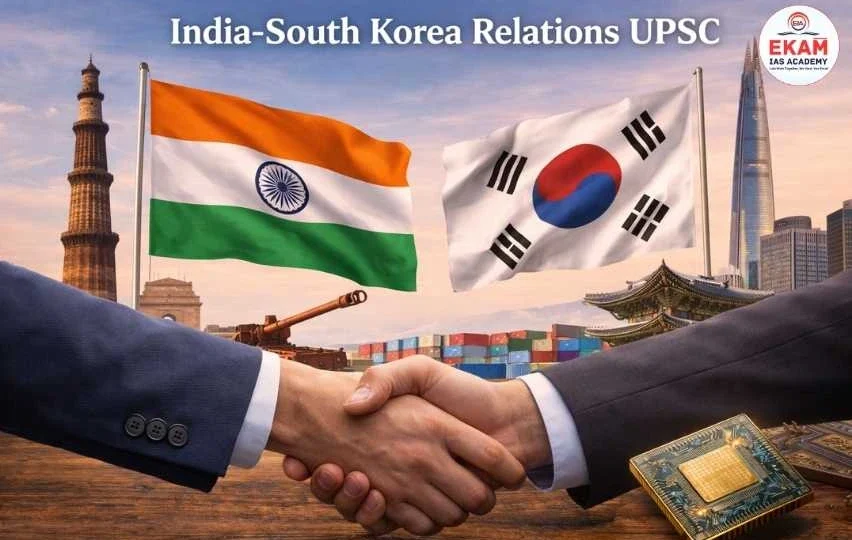
ToggleIndia-South Korea relations UPSC focus on a partnership that has evolved from a limited economic engagement to a robust Special Strategic Partnership. As two major democracies in the Indo-Pacific, India and the Republic of Korea (RoK) share a common interest in maintaining a rules-based regional order. The relationship is underpinned by the convergence of India’s “Act East Policy” and South Korea’s “Indo-Pacific Strategy.”
Historical and Cultural Linkage
The ties between the two nations are centuries old, rooted in a shared Buddhist heritage.
- The Legend of Princess Suriratna: According to the Samguk Yusa, Princess Suriratna from Ayodhya traveled to Korea in 48 AD to marry King Suro, becoming Queen Heo Hwang-ok.
- Modern History: India played a pivotal role during the Korean War (1950-53). The 60th Parachute Field Ambulance of the Indian Army provided medical cover, and India chaired the Neutral Nations Repatriation Commission (NNRC) to handle prisoners of war.
Political and Strategic Relations
In 2015, the relationship was upgraded to a “Special Strategic Partnership” during PM Modi’s visit to Seoul.
- Indo-Pacific Convergence: Both nations are increasingly collaborating on the Indo-Pacific strategy india korea, focusing on maritime security and freedom of navigation.
- Strategic Autonomy: Both countries seek to navigate the US-China rivalry by strengthening “Middle Power” cooperation.
Economic and Trade Relations
The economic pillar is the strongest driver of this relationship.
- India Korea CEPA: The Comprehensive Economic Partnership Agreement (CEPA), which came into effect in 2010, was a landmark in bilateral trade. However, both nations are currently negotiating an upgrade to the CEPA to address the growing trade deficit on India’s side.
- Investment Hub: South Korea is a major investor in India, with giants like Samsung, Hyundai, and LG becoming household names. Samsung’s mobile factory in Noida is one of the world’s largest.
Defence, Security, and Cooperation
- K-9 Vajra: A prime example of “Make in India” in defense is the K-9 Vajra-T self-propelled howitzer, developed through a partnership between Hanwha Aerospace and L&T.
- Maritime Cooperation: Regular joint naval exercises and coast guard cooperation to secure Sea Lines of Communication (SLOCs).
- Cyber Security: Both nations are deepening cooperation in emerging technologies, including 5G, Artificial Intelligence, and Space.
Recent Developments
- Semiconductor Partnership: Discussions regarding Korean investment in India’s nascent semiconductor ecosystem.
- Critical Minerals: Collaboration in securing supply chains for lithium and rare earth elements essential for the EV revolution.
- Supply Chain Resilience: Participation in the Indo-Pacific Economic Framework (IPEF) alongside other democratic partners.
Challenges in the Relationship
- Trade Deficit: India faces a persistent trade gap, primarily due to the nature of CEPA and non-tariff barriers in the Korean market.
- Geopolitical Constraints: South Korea’s preoccupation with the North Korean nuclear threat and India’s focus on its border issues with China can sometimes limit the scope of broader regional cooperation.
- Infrastructure Delays: Past hurdles faced by Korean companies (e.g., the POSCO project in Odisha) have created a sense of caution among investors.
Key Areas of Cooperation & Way Forward
- Energy Transition: Joint R&D in Green Hydrogen and battery storage technology.
- Digital Infrastructure: Leveraging South Korea’s hardware prowess with India’s software and SaaS capabilities.
- Upgrading CEPA: Concluding the review of the trade agreement to make it more balanced and contemporary.
Conclusion
For IR UPSC notes South Korea, it is evident that the partnership is vital for India’s technological and industrial growth. As the Indo-Pacific becomes the center of global geopolitics, the synergy between India’s market size and Korea’s high-tech manufacturing will be the defining feature of this Special Strategic Partnership.
UPSC Prelims: PYQs & Practice Questions
Previous Year Questions (Prelims)
Q: Consider the following pairs:
Exercise/Project — Partner Country
1. K9-Vajra-T — South Korea
2. Sahyog-Hyeoblyeog — South Korea
3. SIMBEX — South Korea
Which of the pairs given above is/are correctly matched?
(a) 1 and 2 only
(b) 2 and 3 only
(c) 1 and 3 only
(d) 1, 2, and 3
Answer: (a) 1 and 2 only
Explanation:
K9-Vajra-T is a self-propelled howitzer built in India with technology support from South Korea. Sahyog-Hyeoblyeog is a joint Coast Guard exercise between India and South Korea. However, SIMBEX is a naval exercise between India and Singapore, not South Korea. Hence, only pairs 1 and 2 are correctly matched.
Q: With reference to the 'Comprehensive Economic Partnership Agreement' (CEPA) between India and South Korea, consider the following statements:
1. It covers trade in goods, services, and investments.
2. It excludes tariff reductions on sensitive sectors like agriculture and fisheries.
Which of the statements given above is/are correct?
(a) 1 only
(b) 2 only
(c) Both 1 and 2
(d) Neither 1 nor 2
Answer: (c) Both 1 and 2
Explanation:
The India-South Korea CEPA is a broad-based agreement covering trade in goods, services, and investments. At the same time, certain sensitive sectors such as agriculture and fisheries were largely kept out of major tariff liberalization in order to protect domestic interests. Therefore, both statements are correct.
Previous Year Questions (Prelims)
Q3. [UPSC Trend-based]
Q: In which year was the bilateral tie between India and South Korea elevated to a 'Special Strategic Partnership'?
(a) 2010
(b) 2014
(c) 2015
(d) 2018
Answer: (c) 2015
Explanation:
During Prime Minister Narendra Modi's visit to Seoul in May 2015, India and South Korea upgraded their relationship from a "Strategic Partnership" to a "Special Strategic Partnership." This reflected the growing depth of bilateral cooperation in trade, defence, technology, and regional strategic affairs.
UPSC Mains – Previous Year & Practice Questions
Mains Previous Year Questions
Question: Evaluate the economic and strategic dimensions of India’s 'Look East' Policy (now Act East) in the context of its relations with South Korea.
Question: Discuss the convergence between India’s 'Act East Policy' and South Korea’s 'New Southern Policy' (now transitioned to Indo-Pacific Strategy).
Question: How can South Korea assist India in its quest for indigenous defense manufacturing under the 'Make in India' initiative? Discuss with examples.
Question: "The Indo-Pacific is becoming a theater of competition. In this light, analyze the importance of middle-power coalitions like India-South Korea."
Question: Critically examine the reasons for the stagnant bilateral trade between India and South Korea despite the CEPA being in place for over a decade.
Mains Practice Questions
Q1. [15 Marks | 250 Words]
Question: "The historical and cultural links between India and South Korea, ranging from Princess Suriratna to the Korean War, provide a unique 'Soft Power' foundation for modern ties." Elaborate.
Q2. [10 Marks | 150 Words]
Question: Examine the significance of the India-South Korea partnership in the global semiconductor and critical mineral supply chains.
Q3. [15 Marks | 250 Words]
Question: "While defense and technology remain the engines of the India-South Korea partnership, the trade deficit remains a friction point." Suggest measures to make the economic partnership more balanced.



India-South Korea Relations-fAQs
What is the legend of Princess Suriratna?
It is a 2,000-year-old legend stating that a princess from Ayodhya (Suriratna) traveled to Korea and married King Kim Suro, becoming Queen Heo Hwang-ok. This forms the bedrock of the deep cultural and emotional connection between the two nations.
What is the 'K9 Vajra' and why is it important for IR?
The K9 Vajra-T is a 155mm/52-caliber self-propelled howitzer. It is significant in International Relations as it represents a successful transition from a “buyer-seller” relationship to a “co-production” model under the Make in India program.
Why is India seeking a review of the CEPA?
India has a significant and widening trade deficit with South Korea. The review aims to address non-tariff barriers faced by Indian exporters (especially in pharmaceuticals and steel) and to modernize the agreement to include new sectors like digital trade.
How did India contribute to the Korean War?
India remained neutral but provided a medical unit (60th Parachute Field Ambulance) that treated over 200,000 wounded. India also chaired the Neutral Nations Repatriation Commission (NNRC) to oversee the exchange of prisoners of war after the armistice.
What is the 'India-Korea Friendship Park'?
Opened in 2021 in New Delhi, it commemorates the contribution of Indian peacekeepers during the Korean War and serves as a symbol of the strong military and diplomatic bonds between the two countries.