Table of Contents
ToggleThe grassland ecosystem UPSC preparation requires a deep dive into how climate, fire, and grazing maintain these vast open spaces. Grasslands are found on every continent except Antarctica and serve as the natural habitat for some of the world’s largest herbivore populations.
Definition of Grassland Ecosystem
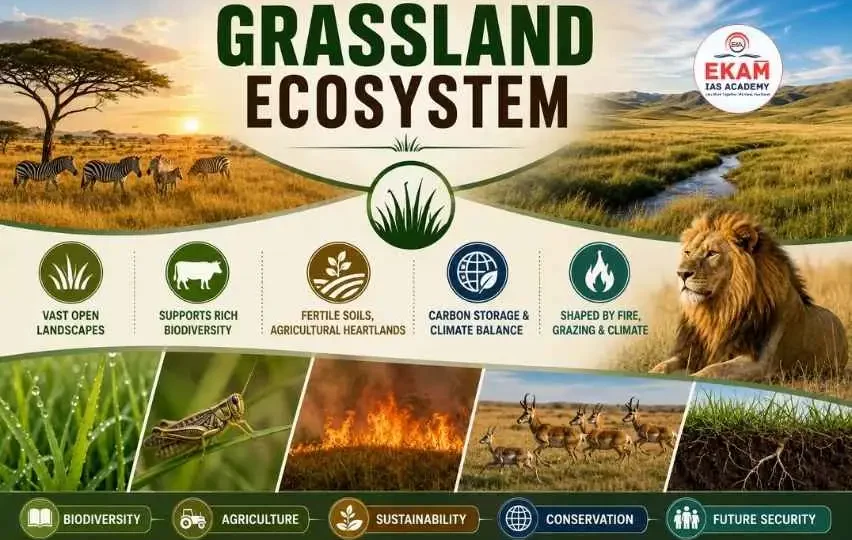
A grassland ecosystem is an area dominated by grasses rather than large shrubs or trees. It is characterized by low and irregular rainfall, which prevents the growth of dense forests but provides enough moisture to sustain various species of perennial grasses.
Types of Grasslands
Grasslands are broadly classified into two main categories based on their latitude and climate:
Savanna (Tropical Grasslands)
- Location: Found near the equator, between tropical rainforests and deserts.
- Climate: High temperatures year-round with a distinct wet and dry season.
- Vegetation: Dominant grasses with scattered, drought-resistant trees like the Baobab or Acacia.
- Example: The African Savanna and the Llanos of South America.
Temperate Grasslands
- Location: Found in the mid-latitudes, in the interior of continents.
- Climate: Characterized by cold winters and hot summers with moderate rainfall.
- Vegetation: Almost entirely devoid of trees and shrubs; the soil is exceptionally fertile (often called Chernozems).
- Example: The Prairies (North America), Steppes (Eurasia), Pampas (South America), and the Veldts (South Africa).
Characteristics of Grasslands
- Intermediate Rainfall: Usually receiving between 25 cm and 75 cm of rain annually.
- Frequent Fires: Periodic fires are essential to prevent forest encroachment and to trigger seed germination.
- High Grazing Pressure: Support large populations of herbivores which recycle nutrients back into the soil.
- Fertile Soil: Particularly in temperate regions, the accumulation of organic matter makes the soil highly productive for agriculture.
Components of Grassland Ecosystem
- Abiotic Components: Include soil nutrients, temperature, and seasonal rainfall.
- Biotic Components:
- Producers: Various species of grasses (Cynodon, Dichanthium) and few shrubs.
- Consumers: Primary consumers like bison, zebras, and grasshoppers; secondary consumers like snakes and lizards; and tertiary consumers like lions and hawks.
- Decomposers: Bacteria and fungi that break down organic litter into humus.
Adaptations in Grassland Ecosystem
- Plants: Grasses have basal meristems (growth points at the base), allowing them to regrow quickly after grazing or fire. Many have deep, fibrous root systems to reach underground water.
- Animals: Many animals are cursorial (built for running) to escape predators in open terrain. Smaller animals often adopt a fossorial (burrowing) lifestyle to escape heat and fire.
Importance of Grasslands
- Agriculture: They are the “breadbaskets” of the world, providing the bulk of the world’s wheat, corn, and livestock.
- Carbon Sequestration: Grasslands store massive amounts of carbon underground in their extensive root systems.
- Biodiversity: Habitats for iconic and endangered species like the Great Indian Bustard and the One-horned Rhino.
Threats to Grasslands
- Conversion to Cropland: Over-exploitation for agriculture leads to desertification.
- Overgrazing: Excessive livestock density destroys the grass cover, leading to soil erosion.
- Climate Change: Altered rainfall patterns can shift grasslands into deserts or shrublands.
Conservation Measures
- Sustainable Grazing: Implementing rotational grazing to allow grass recovery.
- Protected Areas: Strengthening National Parks and Wildlife Sanctuaries (e.g., Velavadar Blackbuck National Park in India).
- Restoration Ecology: Reintroducing native grass species and controlled burning to maintain the ecosystem balance.
Conclusion
For sustainable agriculture India UPSC goals, protecting grasslands is paramount. They are not “wastelands” but dynamic ecosystems that support life, regulate climate, and provide essential services. Understanding the nuances between savanna and temperate grasslands is key for any aspirant looking to master environmental geography.
UPSC Prelims: PYQs & Practice Questions
Previous Year Questions (Prelims)
Q: Which one of the following is the characteristic climate of the Tropical Savannah Region? (UPSC CSE Prelims 2013)
(a) Rainfall throughout the year
(b) Rainfall in winter only
(c) An extremely short dry season
(d) A definite dry and wet season
Answer: (d) A definite dry and wet season
Explanation:
The Savanna ecosystem is defined by clear seasonality—a hot, wet season followed by a dry season. Fire and grazing, along with this climate, prevent dense forest growth and allow grasses to dominate.
Q: Which of the following is/are the unique characteristic/characteristics of equatorial forests? (UPSC CSE Prelims 2014)
1. Presence of tall, closely set trees with crowns forming a continuous canopy.
2. Co-existence of a large number of species.
3. Presence of numerous varieties of epiphytes.
Select the correct answer:
(a) 1 only
(b) 2 and 3 only
(c) 1, 2 and 3
(d) None
Answer: (c) 1, 2 and 3
Explanation:
Equatorial forests are characterized by dense canopy cover, high biodiversity, and abundant epiphytes. These features distinguish them from grasslands, which lack continuous canopy due to limited rainfall.
Practice Questions
Q: Consider the following statements regarding temperate grasslands:
1. They are characterized by highly fertile soils known as 'Chernozems'.
2. Trees are abundant due to the high moisture content in mid-latitude regions.
Which of the statements given above is/are correct?
(a) 1 only
(b) 2 only
(c) Both 1 and 2
(d) Neither 1 nor 2
Answer: (a) 1 only
Explanation:
Statement 1 is correct: temperate grasslands (e.g., Steppes, Prairies) have highly fertile Chernozem soils.
Statement 2 is incorrect: Trees are scarce due to limited rainfall and frequent fires that prevent woody vegetation from establishing.
Q: The "Shola" grasslands, a mix of stunted montane forests and rolling grasslands, are found in which part of India?
(a) The Himalayas
(b) The Western Ghats
(c) The North-East Hills
(d) The Aravalis
Answer: (b) The Western Ghats
Explanation:
Shola ecosystems are unique high-altitude grassland-forest mosaics found in the Southern Western Ghats (Nilgiris, Anaimalai, and Palani hills). They are biodiversity-rich and ecologically fragile.
UPSC Mains – Previous Year & Practice Questions
Mains Previous Year Questions
Question: Discuss the role of grasslands in the conservation of the Great Indian Bustard. (Mains 2023)
(Focuses on habitat specificity and conservation of grassland ecosystems)
Question: Explain the causes and effects of desertification. How is the degradation of grasslands contributing to this phenomenon? (Mains 2021)
Question: What is an ecosystem? Describe the various services provided by an ecosystem. (Mains 2017)
(Grasslands provide fodder, carbon sequestration, and water regulation)
Question: Coastal regions of India are vulnerable to various climate change impacts. Discuss. (Mains 2019)
(Affects coastal grassland–mangrove ecotones and biodiversity)
Question: How does biodiversity vary in India? How is the Biological Diversity Act, 2002 helpful in conservation? (Mains 2020)
(Includes diverse grasslands like Banni grasslands of Kutch)
Mains Practice Questions
[10 Marks | 150 Words]
Question: Grasslands are often described as 'transitional ecosystems'. Explain the environmental factors that prevent a grassland from becoming either a desert or a forest.
[15 Marks | 250 Words]
Question: Analyze the ecological and economic significance of savanna and temperate grasslands. Why are temperate grasslands referred to as the 'granaries of the world'?
[15 Marks | 250 Words]
Question: Despite their ecological importance, grasslands in India are often classified as 'wastelands'. Discuss the implications of this classification on biodiversity conservation.



Grasslands ecosystem-FAQs
What is the primary difference between Savanna and Temperate Grasslands?
Savannas are tropical, have higher temperatures year-round, and feature scattered trees (e.g., Acacia). Temperate grasslands (like Prairies) have extreme seasonal temperature variations (cold winters, hot summers) and are almost entirely devoid of trees.
Why are fires important for a grassland ecosystem?
Fires clear out invasive woody shrubs and old, dead grass, returning nutrients to the soil and allowing new, nutrient-rich grass to sprout. Many grass species have seeds that only germinate after being exposed to fire.
What is 'Banni' in the context of Indian grasslands?
Banni is one of Asia’s largest and finest grassland ecosystems, located in the Kutch district of Gujarat. it is known for its high biodiversity and the unique “maldhari” pastoralist community.
How do animals adapt to the open landscape of grasslands?
Animals usually adapt through speed (to outrun predators in open space) or burrowing (to hide from predators and escape the heat/fire).
What is 'Desertification' of grasslands?
It is a type of land degradation in which a relatively dry land region becomes increasingly arid, typically losing its bodies of water as well as vegetation and wildlife. In grasslands, this is often caused by overgrazing and climate change.