
Table of Contents
ToggleA desert is a landscape or region that receives very little precipitation. The desert ecosystem UPSC syllabus emphasizes the unique biological adaptations required to survive in moisture-deficient environments. These ecosystems are found across the globe, from the tropical belts to the high-altitude plateaus of the Himalayas.
Definition of Desert Ecosystem
A desert ecosystem is a biological community where the interactions between biotic and abiotic factors are governed by extreme water scarcity. Geographically, a desert is defined as any region that receives less than 25 cm (10 inches) of annual rainfall and experiences a higher rate of evapotranspiration than precipitation.
Characteristics of Desert Ecosystem
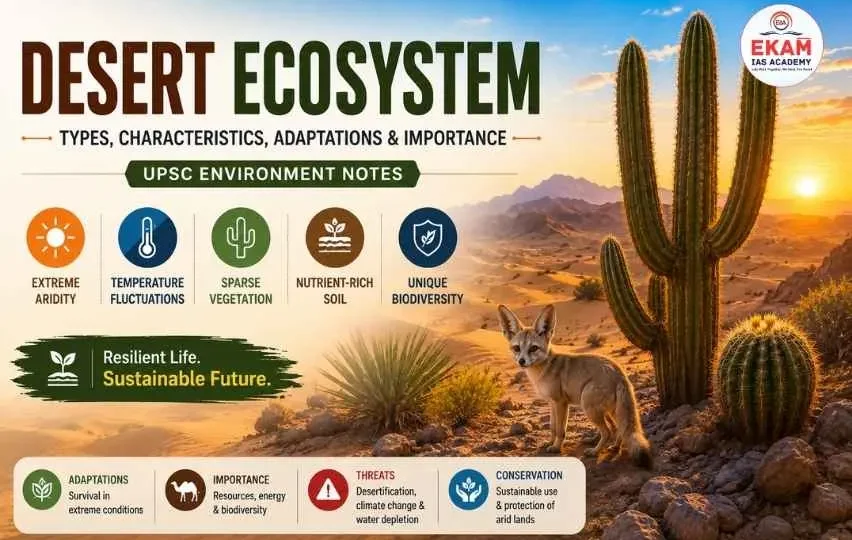
- Extreme Aridity: The most defining trait; water is the primary limiting factor for life.
- Temperature Fluctuations: Deserts often have high diurnal temperature ranges (scorching days and freezing nights) due to the lack of humidity to trap heat.
- Sparse Vegetation: Low biomass density with specialized flora.
- Nutrient-Rich Soil: While dry, desert soils often contain high concentrations of minerals because they are not leached away by rain, though they lack organic matter (humus).
Types of Deserts
- The types of deserts UPSC candidates must distinguish between are primarily based on temperature and location:
Hot and Cold Desert Ecosystem
- Hot Deserts: Found in tropical and subtropical regions. They have high temperatures year-round. Examples include the Sahara (Africa) and the Thar Desert (India/Pakistan).
- Cold Deserts: Found in high-altitude or high-latitude regions. They experience heavy snowfall in winter rather than rain. Examples include the Gobi Desert (Mongolia) and Ladakh (India).
Coastal and Rain-Shadow Deserts
- Coastal Deserts: Formed near cold ocean currents (e.g., Atacama).
- Rain-Shadow Deserts: Formed on the leeward side of mountain ranges (e.g., Death Valley).
Components of Desert Ecosystem
- Abiotic Components: Intense solar radiation, sandy or rocky soil, high wind speeds, and minimal moisture.
- Biotic Components:
- Producers: Includes xerophytes (cacti), ephemeral herbs, and deep-rooted shrubs.
- Consumers: Herbivores like camels and gazelles; carnivores like snakes, scorpions, and fennec foxes.
- Decomposers: Thermophilic bacteria and fungi that break down organic matter at high temperatures.
Adaptations in Desert Ecosystem
Evolutionary strategies in the hot and cold desert ecosystem are focused on water conservation:
- Xerophytic Plants: Many possess succulent stems to store water, waxy cuticles to prevent transpiration, and spines instead of leaves. Some have phreatophytic roots that reach deep groundwater.
- Animal Adaptations: Most animals are nocturnal (active at night). Many are uricotelic (excreting solid uric acid to save water) and possess thick skins or scales to prevent moisture loss.
Importance of Desert Ecosystem
- Mineral Resources: Deserts are major sources of gypsum, borates, nitrates, and hydrocarbons.
- Solar Energy Potential: High solar insolation makes them ideal for large-scale renewable energy projects.
- Unique Biodiversity: They host specialized species that provide genetic material for drought-resistant crop development.
Threats to Desert Ecosystem
- Desertification: The expansion of desert-like conditions into productive lands due to overgrazing and deforestation.
- Climate Change: Increasing temperatures are pushing even hardy species past their physiological limits.
- Groundwater Depletion: Over-extraction for irrigation in desert fringes leads to soil salinization.
Conservation Measures
- Shelterbelts: Planting rows of trees to act as windbreaks and prevent sand dune movement.
- Integrated Watershed Management: Conserving every drop of seasonal rainfall.
- Protection of Scrubber Forests: Limiting grazing in fragile arid lands to allow natural regeneration.
Conclusion
The desert ecosystem is a testament to the resilience of life. For environment ecology notes UPSC, deserts are not “barren wastelands” but complex systems that regulate global climate and house incredible biodiversity. Protecting these regions from human-induced desertification is essential for maintaining global ecological stability.
UPSC Prelims: PYQs & Practice Questions
Previous Year Questions (Prelims)
Q: Which of the following leaf modifications occur(s) in the desert ecosystem to inhibit water loss?
1. Hard and waxy leaves
2. Tiny leaves or no leaves
3. Thorns instead of leaves
Select the correct answer using the code given below:
(a) 2 and 3 only
(b) 2 only
(c) 3 only
(d) 1, 2 and 3
Answer: (d) 1, 2 and 3
Explanation:
Desert plants, known as xerophytes, utilize all three mechanisms to conserve water. Waxy cuticles reduce transpiration, while tiny leaves and thorns minimize surface area exposed to sunlight and dry winds.
UPSC CSE Prelims 2013
Q: Which of the following is/are the characteristic/characteristics of a hot desert?
1. High diurnal range of temperature
2. High annual range of temperature
3. Absence of clouds
Select the correct answer:
(a) 1 only
(b) 1 and 3 only
(c) 2 and 3 only
(d) 1, 2 and 3
Answer: (b) 1 and 3 only
Explanation:
Hot deserts experience a high diurnal temperature range because the absence of clouds allows rapid heating during the day and quick loss of heat at night. However, the annual temperature range is generally lower than in temperate continental regions.
Practice Questions
Q: With reference to the rain-shadow effect, consider the following statements:
1. It results in the formation of an arid region on the windward side of a mountain range.
2. The Patagonia Desert and the Great Basin Desert are examples of this phenomenon.
Which of the statements given above is/are correct?
(a) 1 only
(b) 2 only
(c) Both 1 and 2
(d) Neither 1 nor 2
Answer: (b) 2 only
Explanation:
Statement 1 is incorrect because the rain-shadow region forms on the leeward side of mountains, where descending dry air reduces rainfall. Statement 2 is correct since the Patagonia Desert and the Great Basin Desert are classic examples formed due to mountain barriers blocking moisture-bearing winds.
Level: Moderate
Q: Animals in cold desert ecosystems like Ladakh often possess which of the following adaptations?
(a) Large ears to dissipate excess body heat.
(b) High concentration of salt in their blood.
(c) Thick fur and a layer of subcutaneous fat.
(d) Migration to the plains during the summer months.
Answer: (c) Thick fur and a layer of subcutaneous fat
Explanation:
Animals living in cold deserts face extremely low temperatures and strong winds. Thick fur and subcutaneous fat layers provide insulation, helping them conserve body heat and survive in sub-zero climatic conditions.
UPSC Mains – Previous Year & Practice Questions
Mains Previous Year Questions
Question: Explain the causes and effects of desertification. How is it related to the loss of biodiversity? (Mains 2021)
(Focuses on the expansion of arid lands and ecosystem degradation)
Question: What do you understand by ‘Environmental Ethics’? (Mains 2013)
(Often discussed in the context of mining and resource extraction in fragile desert biomes)
Question: Identify the main causes of the loss of biodiversity in the Indian context. (Mains 2023)
(Overgrazing and water diversion in the Thar Desert are major contributing factors)
Question: What is the importance of ‘Ladakh’ from the perspective of strategic and environmental security? (Mains 2018)
(Focuses on the fragile cold desert ecosystem and border significance)
Question: Describe the various services provided by an ecosystem. (Mains 2017)
(Deserts provide mineral resources, solar energy potential, and unique ecological services)
Mains Practice Questions
[10 Marks | 150 Words]
Question: Discuss the physiological and behavioral adaptations of fauna in the desert ecosystem. How do these adaptations help in water conservation?
[15 Marks | 250 Words]
Question: Analyze the role of ‘Shelterbelt’ and ‘Sand-dune Stabilization’ techniques in combating desertification in Western India.
[15 Marks | 250 Words]
Question: Deserts are no longer considered “wastelands” but are emerging as centers for renewable energy. Evaluate the potential of solar and wind energy in the Thar Desert ecosystem.



Desert Ecosystem-FAQs
What is the primary limiting factor in a desert?
Water. Aridity is the defining characteristic of all types of deserts UPSC covers, affecting everything from soil chemistry to animal behavior.
What are 'Ephemerals' in the desert?
These are drought-evading plants that complete their entire life cycle (germination to seed production) in a very short period following a rare rain event.
How does 'Salinization' occur in desert soils?
When deserts are heavily irrigated, the high evaporation rate causes water to rise to the surface via capillary action, leaving behind salts that eventually make the soil toxic for plants.
Is the Gobi Desert hot or cold?
It is a cold desert. While it can be warm in the summer, it experiences extremely cold winters with temperatures often dropping below -30°C.
What is 'Allen’s Rule' in the context of desert animals?
It suggests that animals in warmer climates tend to have longer limbs, ears, and tails (like the fennec fox) to increase surface area for heat dissipation. This is the opposite of animals in the tundra.