

...

Daily Current Affairs 21-May-2026

Share this Post

MARITIME CHOKEPOINTS IN THE INDIAN OCEAN

TOPIC: (GS1) GEOGRAPHY: THE HINDU

Rising geopolitical tensions in West Asia have once again drawn global focus to critical maritime chokepoints

What are Maritime Chokepoints?

  • Definition: Narrow waterways such as straits or canals where a large share of global shipping must pass.
  • Examples: Strait of Hormuz, BabelMandeb, Malacca Strait, Suez Canal, Panama Canal.
  • Function: Act as “pressure points” in global trade, concentrating cargo flows of oil, LNG, minerals, and container goods.

Why They Are Important

  • Global Trade Dependence: Over 80% of global trade by volume and 70% by value relies on maritime routes.
  • Energy Security: Around 20–25% of global oil trade passes through the Strait of Hormuz, while 10% of seaborne oil moves via BabelMandeb, and 80% of China’s oil imports transit the Malacca Strait.
  • Economic Impact: Even temporary blockades or attacks can raise freight costs, insurance premiums, and fuel prices, disrupting manufacturing and logistics worldwide.
  • Geopolitical Sensitivity: States controlling or patrolling chokepoints gain strategic leverage, often leading to military buildups and freedomofnavigation operations.

Key Strategic Chokepoints

Strait of Hormuz

  • Location: Between Iran and Oman, linking Persian Gulf → Arabian Sea.
  • Importance:
    • Handles 20–25% of global oil trade.
    • Critical for India, China, Japan, EU energy imports.
    • Military tensions here directly affect global crude prices.
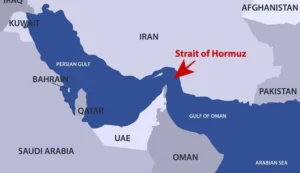
Strait of Hormuz

BabelMandeb Strait

  • Location: Between Yemen (Arabia) and Djibouti/Eritrea (Africa).
  • Connects Red Sea → Gulf of Aden → Suez Canal.
  • Importance:
    • Nearly 10% of global seaborne oil trade.
    • Key for Asia–Europe container shipping.
    • Recent Houthi rebel attacks disrupted traffic, forcing ships around Cape of Good Hope, raising costs.
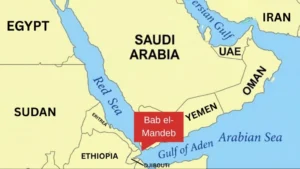
BabelMandeb Strait

Malacca Strait

  • Location: Between Malaysia, Singapore, Indonesia.
  • Connects Indian Ocean → Pacific Ocean.
  • Importance:
    • Carries ~25% of global trade.
    • 80% of China’s oil imports pass through.
    • Strategic vulnerability in IndoPacific geopolitics.

Challenges & Alternatives

  • Few practical alternatives:
    • Pipelines bypassing Hormuz have limited capacity.
    • Cape of Good Hope route adds time & cost.
  • Hence, uninterrupted functioning of chokepoints is essential for global economic stability.
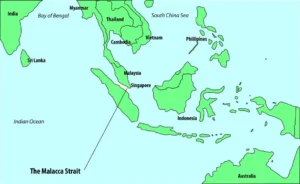
Malacca Strait

Conclusion

Maritime chokepoints in the Indian Ocean—Hormuz, BabelMandeb, and Malacca—are the lifelines of global trade and energy security. In short: Their stability ensures economic resilience and strategic balance worldwide.

EMPOWERING LOCAL GOVERNMENTS FOR GROWTH AND INNOVATION IN INDIA

TOPIC: (GS2) POLITY: THE HINDU

local governments in India remain financially and administratively weak, despite constitutional recognition under the 73rd and 74th Amendments (1993). They continue to be dependent on state governments

Local Governments in India

  • Third Tier of Governance: Local governments represent the grassroots level of administration, comprising Urban Local Bodies (ULBs) and Panchayati Raj Institutions (PRIs).
  • Democratic Significance: They embody participatory democracy, enabling citizens to directly engage in decisionmaking and local development.
  • Functional Role: Responsible for service delivery, urban planning, sanitation, water supply, and rural development, making them vital for everyday governance.

Challenges Faced by Local Governments

  • Weak Administrative Capacity: Only ~10% of government employees work under local bodies (vs ~65% in US/China). Lack of trained manpower reduces efficiency in service delivery.
  • Poor Financial Autonomy: Local tax revenue stagnant at 0.3% of GDP. ULB expenditure < 1% of GDP, compared to states (15x higher) and Centre (20x higher).
  • Dependence on States: Reliance on state transfers undermines autonomy. Key appointments (municipal commissioners, staff) controlled by states.
  • Failure to Monetise Land: India’s land revenue stuck at ~1% of GDP, while China raised it to 10% at peak. Public land under PSUs, defence, ports, temples remains underutilised.

Way Forward

  • Competitive SubFederalism: Encourage competition among cities for efficiency and innovation.
  • Fiscal Empowerment: Expand property tax base, land monetisation, user charges.
  • Administrative Autonomy: Local bodies should control appointments, transfers, and staff accountability.
  • Urban Political Weight: Rising urban population and upcoming Census/delimitation may strengthen local governance.
  • Smart Governance: Use digital platforms, participatory budgeting, and citizen engagement for transparency.

LOCAL GOVERNMENT ARCHITECTURE IN INDIA

  • Threetier system: Union → State → Local Governments.
  • Urban Local Bodies (ULBs): Municipal Corporations, Municipal Councils, Nagar Panchayats.
  • Rural Local Bodies: Panchayati Raj Institutions (PRIs) — Gram Panchayat, Panchayat Samiti, Zila Parishad.
  • Role: Deliver services like sanitation, water supply, housing, rural development, and local infrastructure.
  • Challenge: Financial dependence on states, limited autonomy, and capacity constraints.

73rd Constitutional Amendment Act (1992)

  • Added Part IX to the Constitution.
  • Established Panchayati Raj Institutions (PRIs) as constitutional bodies.
  • Key Provisions:
    • Threetier structure: Gram Panchayat, Panchayat Samiti, Zila Parishad.
    • Reservation for SCs, STs, and women (1/3rd seats).
    • State Finance Commission every 5 years to recommend fund distribution.
    • State Election Commission to conduct local polls.
    • Eleventh Schedule: 29 subjects transferred to PRIs (e.g., agriculture, health, education, rural housing).

74th Constitutional Amendment Act (1992)

  • Added Part IXA to the Constitution.
  • Established Urban Local Bodies (ULBs) as constitutional entities.
  • Key Provisions:
    • Types of ULBs: Municipal Corporations (large cities), Municipal Councils (medium towns), Nagar Panchayats (transitional areas).
    • Reservation for SCs, STs, and women.
    • Twelfth Schedule: 18 subjects transferred (urban planning, roads, water supply, public health, slum improvement).
    • State Finance Commission and State Election Commission mandated for urban governance.

Conclusion

Local governments are the foundation of grassroots democracy. In short: Empowering them with resources, autonomy, and accountability is essential for India’s growth, innovation, and livability in the face of rapid urbanisation.

INTERNATIONAL LAW AND MULTILATERALISM

TOPIC: (GS2) INTERNATIONA RELATIONS: THE HINDU

Norway’s Foreign Minister recently reiterated that violations of international law must be condemned universally, highlighting debates on double standards in global governance.

International Model & Principles

  • UN Charter: Establishes the foundation of modern international relations by upholding sovereign equality of states, prohibiting intervention in domestic affairs, and mandating the peaceful settlement of disputes to maintain global security.
  • Geneva Conventions: Form the core of international humanitarian law, setting rules to protect civilians, prisoners of war, and combatants during armed conflicts, thereby ensuring minimum standards of humanity even in wartime.
  • Paris Agreement: A landmark global climate accord emphasizing collective responsibility for reducing greenhouse gas emissions, promoting sustainable development, and supporting climate finance and technology transfer to vulnerable nations.
  • UNCLOS 1982: Known as the “constitution of the oceans,” it defines maritime boundaries, navigational rights, and resource management, ensuring freedom of navigation while balancing sovereign rights over Exclusive Economic Zones (EEZs).

Challenges in International Law

  • Selective Enforcement: Powerful states often bypass rules (e.g., unilateral interventions in Iraq, Ukraine conflict).
  • Geopolitical Rivalries: USChina tensions weaken WTO and UN consensus.
  • Energy & Trade Security: Blockades in Strait of Hormuz or Red Sea disrupt global supply chains.
  • Climate & Environment: Weak enforcement of emission targets despite rising global temperatures.
  • Technology & Cybersecurity: Lack of binding global norms on AI, data privacy, cyber warfare.

Way Forward

  • Strengthen Institutions: Reform the UN Security Council to ensure fair representation of developing nations, making global decisionmaking more democratic and credible.
  • Universal Accountability: Establish mechanisms where all violators of international law are treated equally, avoiding selective condemnation by powerful states.
  • Inclusive Multilateralism: Empower the Global South with greater voice in institutions like the UN, WTO, and IMF, ensuring balanced participation in shaping global rules.
  • Climate & Technology Governance: Develop binding international frameworks for carbon credits, AI ethics, and cyber security norms, addressing emerging global challenges.
  • India’s Role: Promote a rulesbased order, leverage outcomes from the G20 presidency, and expand SouthSouth cooperation to position India as a bridge between developed and developing worlds.

Conclusion

International law and multilateralism remain the pillars of global peace and cooperation. In short: A fair, inclusive, and accountable system is essential to tackle conflict, climate change, and technological disruptions in the 21st century.

ZWANWOLF EFFECT

TOPIC: (GS3) SCIENCE AND TECHNOLOGY: THE HINDU

NASA’s MAVEN spacecraft recently detected the ZwanWolf Effect in the Martian ionosphere, marking the first time this phenomenon has been observed in a planetary atmosphere.

ZwanWolf Effect

  • The ZwanWolf Effect, discovered in 1976, explains how charged particles are compressed and guided along magnetic flux tubes due to pressure gradients created by solar wind.
  • On Earth, this phenomenon plays a crucial role in deflecting solar wind, thereby shielding the planet’s atmosphere from continuous solar radiation.
  • The recent detection of this effect on Mars is remarkable because, despite lacking a global magnetic field, the planet exhibits similar plasma interactions, offering new insights into space weather and atmospheric evolution.
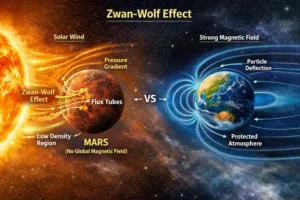
ZwanWolf Effect

How the Effect Works

  • Solar Wind: Stream of charged particles emitted by the Sun.
  • As solar wind approaches a planet’s magnetic boundary, it compresses plasma.
  • This creates a pressure gradient, forcing particles along magnetic structures.
  • The result: regions of low particle density adjacent to flux tubes — the hallmark of the ZwanWolf effect.

Significance of the New Findings

  • Mars’ Atmosphere: Observed below 200 km altitude in the ionosphere, showing charged particles being redistributed.
  • Atmospheric Loss: Supports MAVEN’s earlier finding that Mars lost ~2/3 of its early atmosphere to space.
  • Comparative Planetology: Demonstrates that even without a global magnetic field, Mars experiences solar wind interactions similar to Earth.
  • Space Weather Impact: Helps predict how solar storms affect planetary atmospheres — crucial for future human missions to Mars.

MAVEN Mission Highlights

  • Launched: 2013, arrived at Mars in 2014.
  • First mission dedicated to studying upper atmosphere and ionosphere.
  • Instruments:
    • Solar wind analyzer.
    • Ultraviolet spectrometer.
    • Mass spectrometer.
  • Key finding: Mars’ atmosphere thinned drastically due to solar wind stripping.

Way Forward

  • Deeper Research: Study how localized magnetic anomalies on Mars interact with solar wind.
  • Comparative Models: Apply findings to exoplanets lacking magnetic fields.
  • Human Exploration: Understanding plasma dynamics is vital for shielding astronauts and equipment.
  • Global Collaboration: Encourage joint missions (NASAESAISRO) to expand knowledge of planetary atmospheres.

Conclusion

The ZwanWolf Effect on Mars reveals how solar wind shapes planetary atmospheres. In short: It strengthens our understanding of space weather, atmospheric loss, and planetary habitability.

INTERNATIONAL BOOKER PRIZE

TOPIC: (GS2) SOCIETY: THE HINDU

The 2026 International Booker Prize was awarded to Taiwan Travelogue by Yáng Shuāngzǐ, translated by Lin King.

Key Features

  • Awarded annually to both author and translator.
  • Prize money: £50,000, shared equally between author and translator.
  • Shortlisted authors and translators receive £2,500 each.
  • Encourages global readership of quality fiction beyond Englishlanguage originals.

Indian Winners

  • Geetanjali ShreeTomb of Sand (2022), translated by Daisy Rockwell. First Hindi work to win.
  • Banu MushtaqHeart Lamp (2025), translated by Deepa Bhasthi. First Kannada work to win.

Significance

  • Recognises the art of translation as equal to original writing.
  • Expands global literary diversity, bringing voices from Asia, Africa, and Latin America to international readers.
  • Strengthens India’s literary presence, showcasing regional languages on the global stage.

Conclusion

The International Booker Prize is a symbol of cultural exchange and literary inclusivity. In short: It empowers authors and translators to bring regional stories to global audiences, enriching world literature.

UNMANNED AERIAL VEHICLE LAUNCHED PRECISION GUIDED MISSILE (ULPGMV3)

TOPIC: (GS2) SCIENCE AND TECHNOLOGY: THE HINDU

The DRDO has successfully completed final development trials of the ULPGMV3 in both airtoground and airtoair modes.

ULPGMV3

  • The ULPGMV3 is a precisionguided missile designed to be launched from unmanned aerial vehicles (UAVs).
  • Developed by Research Centre Imarat (RCI), Hyderabad with support from other DRDO labs, it enhances India’s indigenous defence technology and modern warfare readiness.

ULPGMV3

Key Features

  • Dualchannel seeker: Highdefinition optics for diverse target engagement.
  • Operational flexibility: Works in plains and highaltitude regions.
  • DayNight Capability: Equipped with twoway data link for postlaunch target updates.
  • Modular warheads:
    • Antiarmour (RHA + ERA tanks).
    • Penetrationcumblast (antibunker).
    • Prefragmentation (high lethality zone).
  • Range: Up to 4 km (day) and 2.5 km (night).
  • Weight: ~12.5 kg, enabling integration with lightweight drones and portability for soldiers.

Strategic Significance

  • Enhances UAV strike capability, reducing risk to pilots.
  • Supports mountain warfare and remote operations.
  • Strengthens India’s counterarmour and bunkerbusting capacity.
  • Boosts Make in India defence ecosystem, reducing reliance on imports.

Way Forward

  • Integration with armed UAV platforms like RustomII and future swarm drones.
  • Export potential to friendly nations under Defence Diplomacy.
  • Continuous upgrades with AIenabled targeting and extended range seekers.

Conclusion

The ULPGMV3 represents a leap in India’s indigenous precision strike capability. In short: It strengthens drone warfare, battlefield flexibility, and selfreliance in defence technology.

LOKTAK LAKE

TOPIC: (GS3) ENVIRONMENT: THE HINDU

Loktak Lake in Manipur, famous for its floating islands (phumdis), has been in focus due to ecological concerns and tourism development projects.

Loktak Lake

  • Loktak Lake is the largest freshwater lake in Northeast India, covering ~287 sq. km.
  • Known for its circular floating islands (phumdis), it is a unique ecological and cultural heritage site.
  • Declared a Ramsar wetland (1990) and listed in the Montreux Record (1993) due to ecological threats.
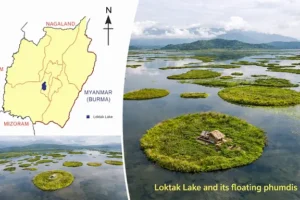
Loktak Lake

Key Features

  • Phumdis: Floating masses of vegetation, soil, and organic matter; 20% above water, 80% submerged.
  • Habitats: Support fishing huts, settlements, and wildlife.
  • Keibul Lamjao National Park: World’s only floating national park, home to the endangered Sangai deer (browantlered deer).
  • Rivers feeding the lake: Khuga, Nambul, Imphal, Kongba, Iril, Thoubal, Heirok, Sekmai.
  • Uses: Hydropower (Loktak Hydroelectric Project), fisheries, transport, irrigation, and tourism.

Ecological Concerns

  • Hydropower impact: Ithai Barrage altered water levels, affecting phumdis and fish diversity.
  • Pollution: Urban waste and agricultural runoff degrading water quality.
  • Encroachment: Human settlements on phumdis increasing ecological stress.
  • Climate change: Rising temperatures and erratic rainfall affecting lake ecology.

Way Forward

  • Promote ecotourism with strict regulation.
  • Strengthen communitybased conservation involving local fishers and farmers.
  • Restore phumdis through scientific management and biodiversity monitoring.
  • Integrate Loktak into India’s climate adaptation and wetland conservation policies.

Conclusion

Loktak Lake is a lifeline of Manipur’s ecology and culture. In short: Protecting its fragile ecosystem is essential for biodiversity, livelihoods, and sustainable development in Northeast India.


Write a Review

Your email address will not be published. Required fields are marked *

Seraphinite AcceleratorOptimized by Seraphinite Accelerator
Turns on site high speed to be attractive for people and search engines.