Table of Contents
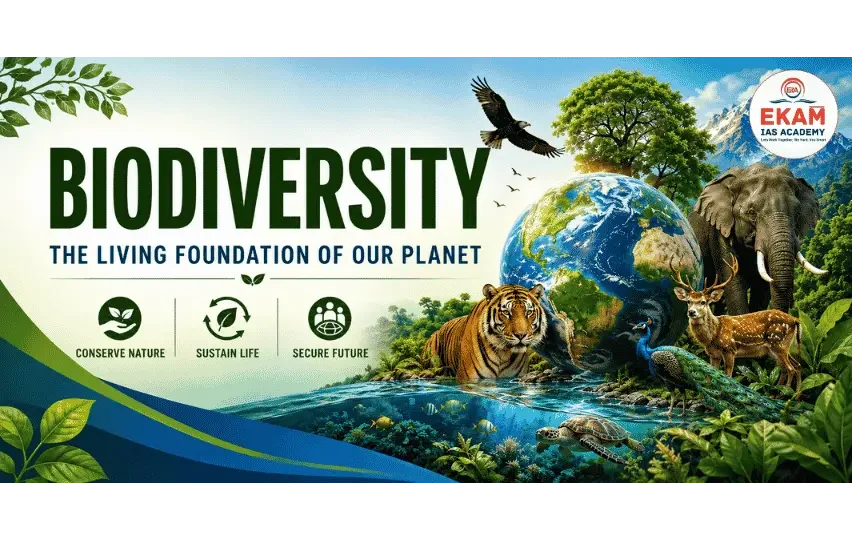
ToggleBiodiversity is the living foundation of our planet, underpinning essential ecosystem services from carbon sequestration to food security. However, anthropogenic pressures have pushed Earth into a new geological epoch—the Anthropocene—marked by a severe global biodiversity crisis.
What is Biodiversity and its Components?
Biodiversity refers to the variety and variability of all living organisms on Earth. It is systematically evaluated across three interconnected tiers:
- Genetic Diversity: The variation of genes within a single species (e.g., thousands of distinct rice varieties in India).
- Species Diversity: The variety of different species within a specific region or habitat.
- Ecosystem Diversity: The variety of habitats, biological communities, and ecological processes across biomes (e.g., deserts, rainforests, mangroves).
The Current State of Global Biodiversity
Global monitoring reports present a alarming diagnosis of the biosphere:
- The Living Planet Report: Published by the World Wildlife Fund (WWF), recent editions show an average decline of nearly 70% in monitored wildlife populations (mammals, birds, amphibians, reptiles, and fish) globally since 1970.
- IPBES Assessment: The Intergovernmental Science-Policy Platform on Biodiversity and Ecosystem Services warns that nearly 1 million species currently face extinction, many within decades—a rate unprecedented in human history.
- The Sixth Mass Extinction: Unlike the previous five prehistoric mass extinctions caused by catastrophic planetary events (e.g., asteroid impacts), the current wave of extinctions is driven entirely by human activity.
Major Threats to Global Biodiversity
The primary drivers of this degradation are summarized by the acronym HIPPO:
- H – Habitat Destruction: Deforestation for commercial agriculture, linear infrastructure projects, and urban sprawl breaking down pristine habitats.
- I – Invasive Species: Non-native species aggressively outcompeting indigenous flora and fauna.
- P – Pollution: Plastic accumulation in marine trenches, chemical runoff causing aquatic eutrophication, and heavy metal toxicity in soils.
- P – Population Growth: Exponential human population growth driving unsustainable consumption patterns.
- O – Overexploitation: Destructive overfishing, illegal wildlife poaching, and uncontrolled logging.
Biodiversity Hotspots of the World
First conceptualized by Norman Myers in 1988, a Biodiversity Hotspot is an area of exceptional ecological wealth facing severe destruction. To qualify, a region must meet two strict criteria:
- It must contain at least 1,500 species of endemic vascular plants.
- It must have lost at least 70% of its original primary vegetation. Globally, there are 36 recognized biodiversity hotspots, which cover just 2.4% of Earth’s land surface but support more than half of the world’s endemic plant and bird species.
State of Biodiversity in India
India is recognized globally as an ecological heavyweight:
- Megadiverse Stature: India holds just 2.4% of the world’s land area but supports nearly 7% to 8% of all recorded global species.
- Hotspot Presence: Four of the world’s 36 biodiversity hotspots extend into India: The Himalayas, The Western Ghats, The Indo-Burma region, and Sundaland (including the Nicobar Islands).
- Rich Endemism: India’s unique geographic convergence zones support thousands of endemic species, such as the Malabar Civet and the Sangai Deer.
Important Reports and Indices
- Red List of Threatened Species: Compiled by the International Union for Conservation of Nature (IUCN), it assesses the precise extinction risk of thousands of species worldwide.
- Global Biodiversity Outlook (GBO): Published periodically by the Convention on Biological Diversity (CBD) to track progress toward global conservation targets.
- Species Protection Index (SPI): Measures how effectively a nation’s protected area network safeguards its unique species footprints.
International and Indian Conservation Initiatives
Global challenges demand structured multilateral and domestic responses for effective biodiversity conservation UPSC modules outline:
Global Frameworks
- Convention on Biological Diversity (CBD): The landmark international treaty signed at the 1992 Earth Summit.
- Kunming-Montreal Global Biodiversity Framework (GBF): Adopted to replace the Aichi Targets, it sets out four overarching goals for 2050 and 23 targets for 2030, headlined by the “30 by 30” target—a commitment to effectively conserve 30% of the world’s lands and oceans by 2030.
India’s Initiatives
- Biological Diversity Act, 2002: Enacted to fulfill CBD obligations, decentralizing protection through a three-tier system: the National Biodiversity Authority (NBA), State Biodiversity Boards (SBBs), and local Biodiversity Management Committees (BMCs).
- People’s Biodiversity Registers (PBRs): Formally documents local traditional knowledge and biological resources to prevent biopiracy.
- Protected Area Expansion: Consists of over 1,000 declared National Parks, Wildlife Sanctuaries, Conservation Reserves, and Biosphere Reserves.
Challenges and Conservation Measures
- The Finance Gap: Mobilizing the hundreds of billions of dollars needed annually to fund international ecosystem restoration projects.
- Policy Silos: Balancing immediate economic growth metrics with long-term ecological sustainability.
- Community-Led Conservation: Shifting toward a rights-based approach that includes indigenous communities as the primary stewards of wild spaces.
- Restoration Ecology: Implementing nature-based solutions, such as reconstructing damaged wetlands and re-establishing safe wildlife migration corridors.
Conclusion
Reversing the current crisis requires looking beyond isolated patches of protected land. Biodiversity must be integrated into core financial systems, infrastructure development, and agricultural planning. Securing a sustainable future requires swift execution of international commitments like the Kunming-Montreal framework, ensuring that nature is valued not as a collection of free resources, but as the essential capital that sustains all life.
UPSC Prelims: PYQs & Practice Questions
Previous Year Questions (Prelims)
UPSC CSE Prelims 2023
Q: Consider the following statements:
1. Invasive Species Specialist Group, which develops the
Global Invasive Species Database, belongs to the
International Union for Conservation of Nature (IUCN).
2. The Convention on Biological Diversity (CBD) mandates countries to prevent the introduction of, control or eradicate those alien species which threaten ecosystems, habitats or species.
Which of the statements given above is/are correct?
(a) 1 only
(b) 2 only
(c) Both 1 and 2
(d) Neither 1 nor 2
Answer: (c) Both 1 and 2
Explanation:
Both statements are correct. The Invasive Species Specialist Group (ISSG) is a global network of scientific experts operating under the
Species Survival Commission (SSC) of the IUCN. It contributes to the study of invasive alien species and their role in global biodiversity loss.
Under Article 8(h) of the Convention on Biological Diversity (CBD), member countries are required to prevent the introduction of, control or eradicate alien species that threaten ecosystems, habitats or species.
UPSC CSE Prelims 2011
Q: The "Global Biodiversity Outlook" report, which assesses the status of global biodiversity and tracks international performance toward conservation targets, is periodically published by which of the following?
(a) United Nations Environment Programme (UNEP)
(b) Secretariat of the Convention on Biological Diversity (CBD)
(c) World Wide Fund for Nature (WWF)
(d) International Union for Conservation of Nature (IUCN)
Answer: (b) Secretariat of the Convention on Biological Diversity (CBD)
Explanation:
The Global Biodiversity Outlook (GBO) is the flagship publication of the
Secretariat of the Convention on Biological Diversity (CBD). It summarizes the global status of biological diversity and evaluates collective progress made by nations toward global biodiversity targets.
Note: The World Wide Fund for Nature (WWF) publishes the Living Planet Report, which tracks trends in vertebrate wildlife populations.
Practice Questions
Q: With reference to the Kunming-Montreal Global Biodiversity Framework (GBF), consider the following statements:
1. It mandates member nations to reduce the global footprint of consumption by 2030, specifically by halving global food waste.
2. The headline "30 by 30" target demands that only developed countries commit to effectively conserving 30% of global land and marine areas.
Which of the statements given above is/are correct?
(a) 1 only
(b) 2 only
(c) Both 1 and 2
(d) Neither 1 nor 2
Answer: (a) 1 only
Explanation:
Statement 1 is correct. Target 16 of the
Kunming-Montreal GBF focuses on reducing the global footprint of consumption, including the goal of
halving global food waste by 2030.
Statement 2 is incorrect. The "30 by 30" target, under Target 3, applies globally and collectively to all participating contracting parties, both developed and developing. It aims to conserve 30% of terrestrial, inland water, coastal and marine ecosystems by 2030.
Q: According to the Living Planet Report 2024 published by the World Wildlife Fund (WWF), which ecosystem type has experienced the sharpest average percentage decline in monitored wildlife populations globally since 1970?
(a) Terrestrial Ecosystems
(b) Marine Ecosystems
(c) Freshwater Ecosystems
(d) Montane Ecosystems
Answer: (c) Freshwater Ecosystems
Explanation:
The Living Planet Report 2024 highlights that
Freshwater Ecosystems are under the most intense anthropogenic pressure. They recorded a severe
85% average decline in monitored vertebrate populations between 1970 and 2024.
This decline is sharper than that seen in terrestrial ecosystems and marine ecosystems, making freshwater biodiversity one of the most threatened components of global biodiversity.
UPSC Mains – Previous Year & Practice Questions
Mains Previous Year Questions
Mains 2018
Question: How does biodiversity vary in India?
How is the Biological Diversity Act, 2002 helpful in the conservation of flora and fauna?
(Core question evaluating national-level distribution and legislative protection metrics.)
Mains 2023
Question: Identify the main causes of the loss of
biodiversity in India.
(Requires applying macro threats like habitat fragmentation, pollution, and climate change locally.)
Mains 2020
Question: How does the draft
Environment Impact Assessment (EIA) Notification, 2020 differ from the existing
EIA Notification, 2006?
(Directly ties into how fast-tracking industrial clearances threatens baseline biodiversity areas.)
Mains 2021
Question: Explain the purpose of the
Green Grid Initiative launched at World Leaders Summit of the
COP26 UN Climate Change Conference in Glasgow.
(Links global energy frameworks with land management and ecosystem preservation.)
Mains 2014
Question: Enumerate the indirect services provided by an ecosystem. How do wetlands act as “Earth’s Kidneys”?
Mains Practice Questions
[15 Marks | 250 Words]
Question: The Kunming-Montreal Global Biodiversity Framework is hailed as the “Paris Agreement for Nature”. Analyze its structural targets and the financial challenges developing nations face in meeting its mandates.
[15 Marks | 250 Words]
Question: The world is undergoing the “Sixth Mass Extinction”, uniquely driven by anthropogenic activities. Detail how this ecological crisis threatens global food security and public health via zoonotic spillovers.
[10 Marks | 150 Words]
Question: Evaluate how the activation of local Biodiversity Management Committees (BMCs) and People's Biodiversity Registers (PBRs) under the Biological Diversity Act, 2002 can transform biodiversity conservation UPSC paradigms into citizen-led climate initiatives.



Global Biodiversity-FAQs
What is the ‘30 by 30’ global target?
The ‘30 by 30’ target, under the Kunming-Montreal Global Biodiversity Framework, aims to protect and restore at least 30% of land, inland water, coastal and marine areas by 2030. It focuses on effective and equitable conservation.
What is IPBES?
IPBES is an intergovernmental body established in 2012, often called the IPCC for biodiversity. It provides scientific assessments to guide policies on biodiversity, ecosystem services, and sustainable development.
How does the Living Planet Index measure biodiversity?
The Living Planet Index, by WWF and ZSL, tracks changes in populations of vertebrate species like mammals, birds, reptiles, amphibians, and fish. It shows population decline or recovery trends, not just extinctions.
What is Access and Benefit Sharing under India’s Biological Diversity Act?
ABS ensures that companies using local biological resources or traditional knowledge share benefits with local communities. It is regulated by the National Biodiversity Authority.
Why is the current biodiversity crisis called the Sixth Mass Extinction?
It is called the Sixth Mass Extinction because species are disappearing far faster than natural rates. Unlike earlier extinctions, this crisis is mainly driven by human activities like habitat loss, pollution, and climate change.