Table of Contents
ToggleIndia's "Israel Habit" Meets West Asian Realities
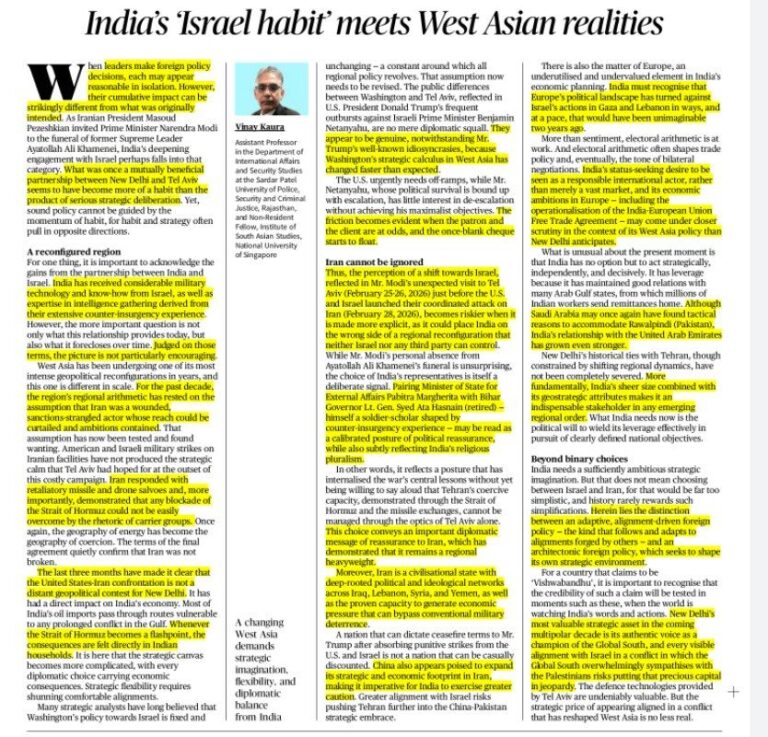
India’s engagement with West Asia has evolved significantly over the past decade, particularly through its expanding strategic partnership with Israel. Cooperation in defence, technology, cybersecurity, agriculture, and intelligence has strengthened bilateral ties. However, the changing geopolitical landscape in West Asia—including the Gaza conflict, rising Israel-Iran tensions, and shifting regional alliances—requires India to pursue a more balanced and pragmatic foreign policy that safeguards its long-term strategic interests.
Why in News?
The editorial highlights that the ongoing Gaza crisis and increasing regional instability have exposed the limitations of an Israel-centric approach. It argues that India must recalibrate its West Asia policy by balancing strategic partnerships with humanitarian concerns and regional realities.
Background
India has traditionally supported the Palestinian cause while maintaining friendly relations with Arab countries. Since establishing full diplomatic ties with Israel in 1992, bilateral cooperation has expanded rapidly. At the same time, the Gulf region remains crucial for India’s energy security, trade, investments, and the welfare of over nine million Indian expatriates, making balanced diplomacy essential.
Key Highlights of the Editorial
The editorial argues that India’s strong partnership with Israel should not overshadow its broader interests in West Asia. As regional equations evolve, India must engage constructively with Israel, Palestine, Iran, and Gulf nations. It also highlights the growing importance of economic diplomacy, regional connectivity initiatives, and strategic autonomy in navigating the region’s complex geopolitical environment.
Major Challenges
India faces the challenge of balancing its defence partnership with Israel while preserving strong ties with Arab nations and Iran. Rising regional conflicts threaten energy supplies, maritime trade routes, and the safety of the Indian diaspora. Additionally, increasing geopolitical competition among major powers has made diplomatic decision-making more complex.
Government Initiatives
India’s regional engagement is supported by initiatives such as the Think West Policy, the India-Middle East-Europe Economic Corridor (IMEC), the India-UAE Comprehensive Economic Partnership Agreement (CEPA), and the I2U2 Grouping, all aimed at strengthening economic and strategic cooperation.
Conclusion
India’s future in West Asia depends on maintaining a balanced, multi-aligned foreign policy that combines strategic partnerships with diplomatic flexibility. By strengthening engagement with all regional stakeholders while protecting its energy, economic, and security interests, India can reinforce its role as a responsible and influential power in West Asia.
Vocabulary Boost
•Strategic Autonomy → Independent foreign policy decision-making.
• Geopolitical Reconfiguration → Shift in regional power dynamics.
• Strategic Alignment → Cooperation based on shared interests.
• Diplomatic Signalling → Actions conveying foreign policy intent.
• Regional Balance → Maintaining relations with competing powers.
Frequently Asked Questions (FAQs)
What does India’s “Israel habit” mean?
It refers to India’s growing strategic comfort with Israel in areas like defence, technology, agriculture and intelligence, sometimes making West Asia policy appear too Israel-centric.
Why is West Asia important for India?
West Asia is crucial for India’s energy security, trade, investments, maritime routes and the safety of over nine million Indian expatriates.
What challenges does India face in West Asia?
India must balance ties with Israel, Palestine, Iran and Gulf countries while managing risks from the Gaza conflict, Israel-Iran tensions and regional instability.
What are India’s major initiatives in West Asia?
Important initiatives include the Think West Policy, IMEC, India-UAE CEPA and I2U2 Grouping, which support economic and strategic engagement.
Why is this topic important for UPSC?
It is important for UPSC because it connects with GS Paper II international relations, India-Israel relations, West Asia policy, strategic autonomy, energy security and diaspora diplomacy.
Source From : The Hindu
The Indo-Pacific Is Here to Stay: India’s Strategic Role in Asian Geopolitics
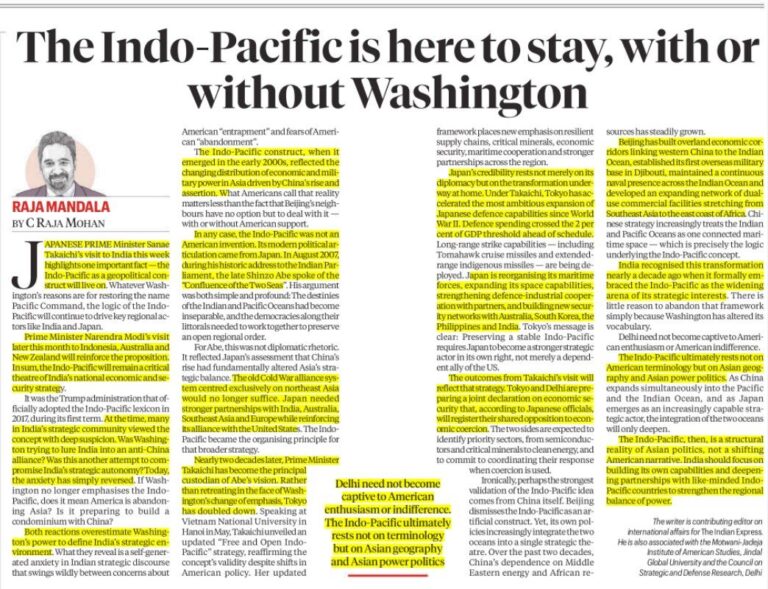
The Indo-Pacific has become one of the most important geopolitical regions in the world. Japanese Prime Minister Sanae Takaichi’s India visit in July 2026 highlights the growing strategic importance of India in Japan’s foreign policy and the wider Asian security framework. Her visit shows that the Indo-Pacific is no longer only an American idea; it has become a structural reality shaped by Asian geography, trade, maritime security, and power politics.
Why the Indo-Pacific Matters
The Indo-Pacific connects the Indian Ocean and the Pacific Ocean, making it vital for global trade, energy flows, and maritime connectivity. Countries such as India, Japan, Australia, South Korea, and the Philippines are strengthening cooperation to maintain a free, open, and stable region.
For India, the Indo-Pacific is directly linked to its economic growth, maritime security, and strategic autonomy. As China’s influence grows across the South China Sea, Indian Ocean, and East Africa, India’s role in maintaining the regional balance of power becomes more significant.
Japan’s Renewed Indo-Pacific Strategy
Stronger India-Japan Partnership
Japan sees India as a key partner in building resilient supply chains, defence cooperation, critical minerals partnerships, and maritime security networks. The India-Japan relationship is no longer limited to diplomacy; it now includes technology, infrastructure, defence, and economic security.
Reducing Dependence on the United States
The article argues that the Indo-Pacific will continue with or without Washington’s active leadership. While the United States remains important, Asian countries are increasingly building their own regional frameworks. This shows the maturity of the Indo-Pacific concept.
India’s Strategic Opportunity
Maritime Security and Regional Balance
India’s location in the Indian Ocean gives it a natural advantage. By working with Japan and other partners, India can protect sea lanes, counter coercion, and strengthen regional stability.
Conclusion
The Indo-Pacific is not a temporary diplomatic slogan. It is a long-term strategic reality. India must use this opportunity to deepen partnerships, protect its maritime interests, and shape the future balance of power in Asia.
Vocabulary Boost
• Indo-Pacific → Strategic region linking the Indian and Pacific Oceans.
• Strategic Autonomy → Independent foreign policy decisions.
• Maritime Security → Protection of sea routes and interests.
• Balance of Power → Preventing dominance by one state.
• Supply Chain Resilience → Reliable and secure trade networks.
Frequently Asked Questions (FAQs)
What is the Indo-Pacific?
The Indo-Pacific is a strategic region connecting the Indian Ocean and Pacific Ocean, important for trade, security, and global power politics.
Why is the Indo-Pacific important for India?
It helps India protect maritime security, trade routes, energy supplies, and balance China’s growing influence in the region.
Why is Japan focusing on India in the Indo-Pacific?
Japan sees India as a key partner for defence cooperation, supply chains, economic security, and regional stability.
Is the Indo-Pacific dependent only on the United States?
No. The Indo-Pacific is now a structural reality of Asian geopolitics and will continue with or without Washington’s active role.
Why is this topic important for UPSC?
It is important for UPSC International Relations because it covers India-Japan relations, QUAD, maritime security, China’s rise, and foreign policy.