
Table of Contents
Toggle3rd India–Australia Annual Summit 2026 Explained
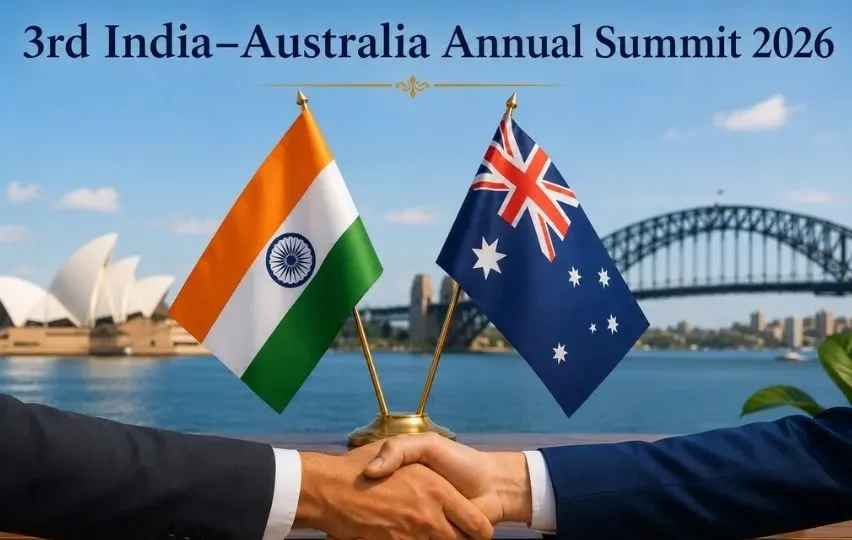
The 3rd India–Australia Annual Summit, held on 9 July 2026 in Melbourne, marked another milestone in the growing strategic partnership between India and Australia. Prime Minister Narendra Modi participated in the summit at the invitation of Australian Prime Minister Anthony Albanese. The meeting commemorated six years of the India–Australia Comprehensive Strategic Partnership (CSP) and reaffirmed both nations’ commitment to strengthening cooperation across trade, defence, critical minerals, clean energy, education, emerging technologies, and Indo-Pacific security.
The summit reflects the shared vision of India and Australia for a free, open, inclusive, and rules-based Indo-Pacific while expanding economic ties and people-to-people connections. For UPSC aspirants, the summit is highly relevant under International Relations, Bilateral Relations, Economy, Defence, and Current Global Affairs.
Why is the 3rd India–Australia Annual Summit in the News?
The 3rd India–Australia Annual Summit gained prominence after Prime Minister Narendra Modi and Australian Prime Minister Anthony Albanese met in Melbourne on 9 July 2026.
The summit reviewed the progress made under the Comprehensive Strategic Partnership (CSP) and announced new initiatives to deepen cooperation in trade, defence, clean energy, critical minerals, education, and maritime security.
About the India–Australia Comprehensive Strategic Partnership (CSP)
India and Australia elevated their bilateral relationship to a Comprehensive Strategic Partnership (CSP) in 2020.
The partnership provides a broad framework for cooperation in:
- Trade and investment
- Defence and security
- Maritime cooperation
- Clean energy
- Critical minerals
- Science and technology
- Education and skill development
- Cybersecurity
- Regional and global issues
The 2026 summit marked six years of this strategic partnership.
Key Highlights of the 3rd India–Australia Annual Summit
Push for the Comprehensive Economic Cooperation Agreement (CECA)
One of the major outcomes of the summit was the renewed commitment to conclude the Comprehensive Economic Cooperation Agreement (CECA) at the earliest.
Both countries agreed to negotiate an ambitious, balanced, and mutually beneficial agreement that would strengthen bilateral economic ties.
Expected Benefits of CECA
- Expansion of trade in goods and services.
- Increased bilateral investment.
- Promotion of digital trade.
- Greater mobility for professionals.
- Enhanced market access for businesses.
- Stronger economic integration between India and Australia.
The agreement is expected to build upon the existing India–Australia Economic Cooperation and Trade Agreement (ECTA) and further expand bilateral trade.
Strengthening Strategic and Defence Cooperation
The summit reaffirmed the growing strategic partnership between the two countries.
Both sides agreed to enhance cooperation in:
- Maritime security
- Defence collaboration
- Joint military exercises
- Information sharing
- Defence technology
- Regional security
New arrangements relating to maritime security and defence cooperation were also finalized.
India and Australia continue to work together to ensure a free, open, inclusive, and rules-based Indo-Pacific region based on international law and freedom of navigation.
Energy Transition Partnership
Energy cooperation emerged as another important pillar of the summit.
Both countries agreed to deepen collaboration in:
Civil Nuclear Energy
Exploring peaceful uses of nuclear technology for clean energy generation.
Solar Energy
Promoting renewable energy projects and solar cooperation.
Clean Energy Technologies
Supporting innovation in green hydrogen, battery technologies, and low-carbon solutions.
Energy Security
Strengthening resilient energy supply chains and diversifying energy sources.
Australia’s rich reserves of critical minerals complement India’s rapidly growing energy requirements, making the partnership strategically significant.
Cooperation in Critical Minerals
Australia is among the world’s leading producers of critical minerals such as:
- Lithium
- Cobalt
- Rare Earth Elements
- Nickel
These minerals are essential for:
- Electric vehicles
- Battery manufacturing
- Renewable energy technologies
- Electronics
- Defence manufacturing
The summit emphasized securing resilient supply chains for these strategic resources.
Return of Indian Cultural Heritage
A significant cultural achievement of the summit was Australia’s decision to voluntarily return several cultural artefacts of Tamil Nadu origin.
The artefacts include:
- A stone sculpture of Nandi
- A metal Trident (Trishul) bearing the image of Bhadrakali
- A six-headed stone statue of Lord Karthikeya
The return of these artefacts reflects growing cooperation in cultural diplomacy and the protection of shared heritage.
It also strengthens India’s global efforts to recover stolen cultural property.
Education and Emerging Technologies
Both countries agreed to expand cooperation in:
- Higher education
- Research collaboration
- Student mobility
- Artificial Intelligence
- Quantum technologies
- Cybersecurity
- Digital innovation
- Skill development
Education continues to be one of the strongest pillars of India–Australia relations, with thousands of Indian students pursuing higher education in Australia.
Challenges in India–Australia Relations
Despite significant progress, certain challenges remain.
Trade Challenges
- Untapped trade potential.
- Pending CECA negotiations.
- Market access concerns.
Supply Chain Dependence
Both countries continue to face challenges arising from dependence on regional supply chains, particularly involving China.
Agricultural Market Access
Negotiations must balance sensitive agricultural interests while expanding bilateral trade.
Mobility Issues
Differences remain regarding:
- Professional mobility
- Student visas
- Skilled migration
- Recognition of qualifications
Regulatory Differences
Variations in standards and regulations continue to require harmonization.
The success of the partnership will depend on effective implementation of agreements and sustained economic engagement.
Significance of the Summit
The summit demonstrates the growing convergence between India and Australia in strategic, economic, and regional affairs.
It strengthens cooperation in:
- Indo-Pacific security
- Trade and investment
- Clean energy
- Critical minerals
- Defence
- Maritime security
- Technology
- Education
- Cultural diplomacy
The partnership also contributes to regional stability and supports a rules-based international order.
UPSC Prelims Quick Facts
| Topic | Fact |
|---|---|
| Event | 3rd India–Australia Annual Summit |
| Date | 9 July 2026 |
| Venue | Melbourne, Australia |
| Indian PM | Narendra Modi |
| Australian PM | Anthony Albanese |
| Partnership | Comprehensive Strategic Partnership (CSP) |
| Key Agreement | Comprehensive Economic Cooperation Agreement (CECA) |
| Major Focus | Trade, Defence, Energy, Indo-Pacific, Critical Minerals |
| Cultural Highlight | Return of Tamil Nadu artefacts |
| UPSC Relevance | International Relations, Economy, Defence |
UPSC Mains Perspective
GS Paper II
- India–Australia Bilateral Relations
- Indo-Pacific Strategy
- Maritime Security
- International Agreements
- Cultural Diplomacy
GS Paper III
- Energy Security
- Critical Minerals
- Trade and Investment
- Emerging Technologies
- Defence Cooperation
Conclusion
The 3rd India–Australia Annual Summit 2026 reflects the deepening strategic partnership between two major Indo-Pacific democracies. From advancing the Comprehensive Economic Cooperation Agreement (CECA) to strengthening defence cooperation, clean energy partnerships, critical mineral supply chains, and cultural diplomacy, the summit has laid the foundation for a stronger and more comprehensive bilateral relationship. As both countries work towards implementing these commitments, the partnership is expected to contribute significantly to regional stability, sustainable economic growth, and a resilient Indo-Pacific. For UPSC aspirants, this summit is an important topic under International Relations, Trade, Defence, Energy Security, and India’s Foreign Policy.



Frequently Asked Questions (FAQs) About the 3rd India–Australia Annual Summit 2026
What was the main objective of the 3rd India–Australia Annual Summit 2026?
The primary objective of the 3rd India–Australia Annual Summit 2026 was to strengthen bilateral cooperation in trade, defence, critical minerals, clean energy, education, emerging technologies, and Indo-Pacific security under the India–Australia Comprehensive Strategic Partnership (CSP).
What is the Comprehensive Economic Cooperation Agreement (CECA)?
The Comprehensive Economic Cooperation Agreement (CECA) is a proposed trade agreement between India and Australia aimed at expanding cooperation in trade in goods and services, investment, digital trade, and the mobility of professionals, while promoting balanced and mutually beneficial economic growth.
Why is the India–Australia partnership strategically important?
India and Australia share a common vision of maintaining a free, open, inclusive, and rules-based Indo-Pacific region. Their partnership strengthens cooperation in maritime security, defence, regional stability, supply chain resilience, and economic development.
What were the major outcomes of the 3rd India–Australia Annual Summit?
Key outcomes of the summit included renewed commitment to conclude the CECA, enhanced defence and maritime cooperation, expanded collaboration in clean energy and critical minerals, and Australia’s agreement to return several Tamil Nadu-origin cultural artefacts to India.
Why is the 3rd India–Australia Annual Summit important for UPSC preparation?
The summit is significant for UPSC as it covers topics related to India–Australia bilateral relations, CECA, Indo-Pacific strategy, defence cooperation, energy security, critical minerals, cultural diplomacy, and international trade, making it relevant for both Prelims and GS Paper II & III.