Table of Contents
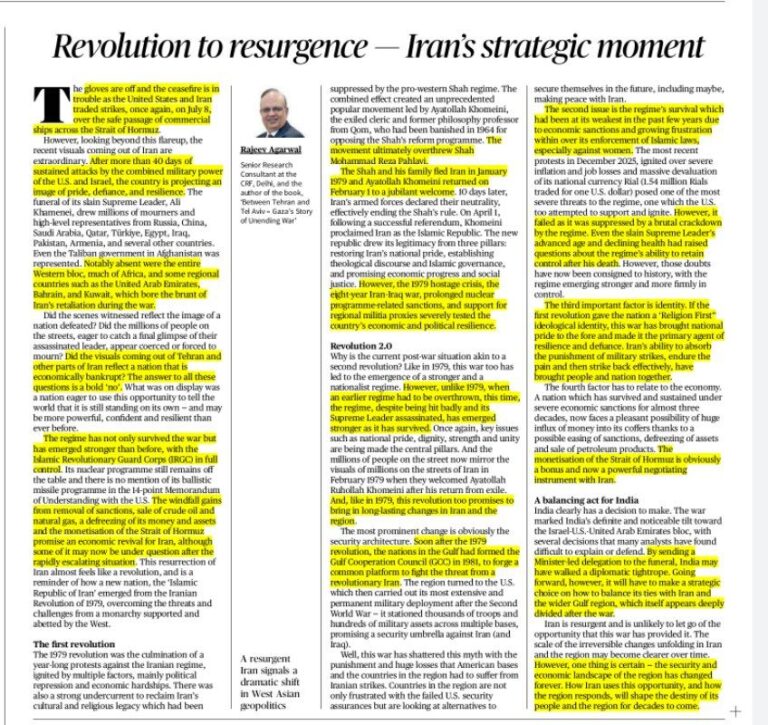
ToggleRevolution to Resurgence: Iran’s Strategic Moment in West Asia
The recent confrontation involving Iran, Israel and the United States has reshaped the geopolitical conversation in West Asia. Despite military pressure, sanctions and diplomatic isolation, Iran has projected an image of resilience and strategic confidence. The article highlights that Iran’s survival during the crisis has strengthened its regional position and created a new moment of geopolitical significance.
Iran’s Strategic Resilience
From Pressure to Projection
Iran has faced decades of economic sanctions, political isolation and military threats. Yet, during the recent crisis, it managed to keep the Strait of Hormuz open, avoided total escalation and demonstrated that it remains a major power in the region.
This matters because the Strait of Hormuz is one of the world’s most important energy routes. Any disruption there can affect global oil prices, energy security and trade flows.
Historical Context: The 1979 Revolution
Revolution 1.0
The article connects Iran’s present moment with the 1979 Iranian Revolution, which overthrew the Shah and established the Islamic Republic. That revolution was built on anti-Western sentiment, nationalism, religious legitimacy and resistance against external interference.
Iran’s political system has survived war, sanctions and internal unrest. This long survival has shaped its current strategic identity.
Revolution 2.0: A New Phase
National Unity and Regional Assertion
The current crisis may mark a new phase for Iran. The confrontation has strengthened national pride and reinforced the idea that Iran can withstand pressure from powerful adversaries.
Iran has also used regional alliances and strategic partnerships to maintain influence. Its relations with countries such as Russia, China and regional actors help it resist Western isolation.
Challenges Before Iran
Economy and Succession
Despite its resilience, Iran faces major internal challenges. Economic hardship, inflation, sanctions, unemployment and public protests remain serious concerns. Another major issue is leadership succession, especially due to the advanced age of Iran’s Supreme Leader.
India’s Balancing Act
Strategic Caution
For India, Iran remains important for energy security, connectivity and regional diplomacy. At the same time, India also has close ties with Israel, the United States and Gulf countries. Therefore, India must follow a careful and balanced foreign policy.
Conclusion
Iran’s strategic moment shows that West Asian geopolitics is entering a new phase. The country’s ability to survive pressure has strengthened its bargaining position. For UPSC aspirants, this topic is important under India-Iran relations, West Asia, energy security, geopolitics, strategic autonomy and international relations.
Vocabulary Boost
• Resurgence → Revival of power or influence.
• Strategic Leverage → Advantage used to influence outcomes.
• Regime Resilience → Ability of a government to survive crises.
• Strategic Autonomy → Independent foreign policy decision-making.
• Regional Security Architecture → Framework for regional security cooperation.
Frequently Asked Questions (FAQs)
Why is Iran’s recent strategic moment important?
Iran’s recent strategic moment is important because it shows the country’s resilience despite sanctions, military pressure and regional isolation.
Why is the Strait of Hormuz important in this crisis?
The Strait of Hormuz is a key global oil route, and any disruption there can affect energy security, crude oil prices and global trade.
What was the 1979 Iranian Revolution?
The 1979 Iranian Revolution overthrew the Shah and established the Islamic Republic, shaping Iran’s anti-Western and nationalist political identity.
What challenges does Iran face internally?
Iran faces economic sanctions, inflation, unemployment, public protests and uncertainty over future leadership succession.
Why is this topic important for UPSC?
It is important for UPSC International Relations because it covers West Asia geopolitics, India-Iran relations, energy security, strategic autonomy and regional power balance.
Source From : The Hindu
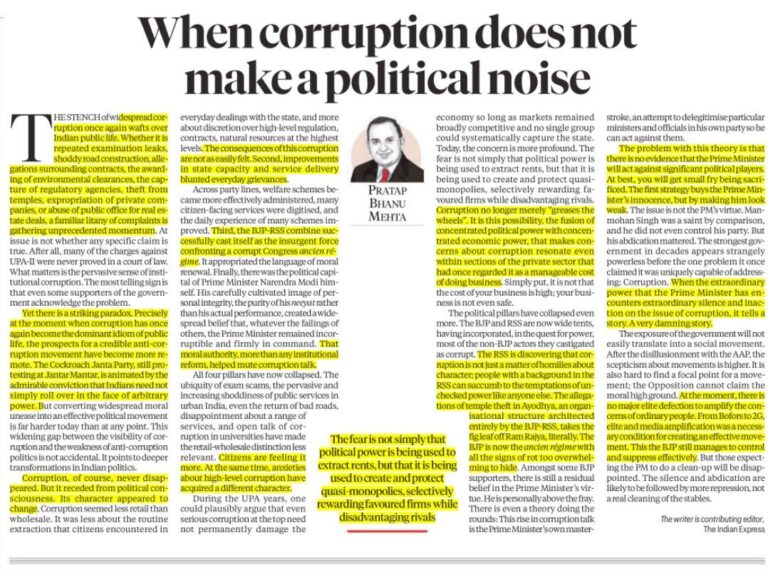
When Corruption Does Not Make a Political Noise
Corruption in India has long been a major issue in public life, electoral politics and governance. From public contracts and regulatory decisions to land deals, political funding and welfare delivery, corruption affects both state capacity and public trust. However, the article highlights an important paradox: even when corruption allegations are visible, they do not always become a powerful political movement.
Why Corruption No Longer Creates Mass Outrage
Changing Nature of Corruption
Earlier, corruption was often seen in everyday interactions between citizens and the state, such as delays in services, bribes and discretionary approvals. Over time, digitisation, direct benefit transfers and improved service delivery have reduced some forms of petty corruption.
However, this does not mean corruption has disappeared. The concern is that corruption may have shifted from retail-level bribery to large-scale political economy issues involving contracts, monopolies, public resources and regulatory capture.
Political Corruption and Public Perception
Weakening of Anti-Corruption Mobilisation
The article argues that corruption once had the power to unite citizens across political lines. Movements against corruption gained strength because people directly felt its impact in daily life. Today, even serious allegations often fail to create sustained public anger.
One reason is political polarisation. Supporters may dismiss allegations against their preferred leaders, while opposition claims may be seen as politically motivated. This reduces the ability of corruption issues to become a common democratic concern.
Institutional Challenges
Accountability and Transparency
A healthy democracy needs strong institutions that can investigate corruption independently. When enforcement agencies, regulators and oversight bodies are perceived as politically influenced, public trust weakens.
Corruption is not only about illegal money. It also affects economic competition, public procurement, governance quality and citizen confidence. If state power is used to favour selected firms or weaken rivals, it can damage both democracy and the market economy.
Why This Matters for India
Governance and Democracy
For India, the key challenge is to ensure that corruption does not become normalised. Public debate must move beyond political blame and focus on institutional reform, transparency in political funding, stronger audits, independent investigation and citizen accountability.
Conclusion
The absence of political noise around corruption does not mean the problem has disappeared. It may indicate deeper political fatigue, polarisation and institutional weakness. For UPSC aspirants, this topic is important under governance, transparency, accountability, ethics, electoral reforms and anti-corruption mechanisms.
Vocabulary Boost
• State Capture → Private influence over public decisions.
• Cronyism → Favouring connected individuals or firms.
• Quasi-monopoly → Market dominated by very few players.
• Institutional Accountability → Mechanisms holding power answerable.
• Political Mobilisation → Organising public action around an issue.
Frequently Asked Questions (FAQs)
Why does corruption fail to create political outrage sometimes?
Corruption may fail to create outrage due to political polarisation, weak public trust, and the perception that allegations are politically motivated.
Has corruption disappeared from public life in India?
No. Petty corruption may have reduced in some areas, but large-scale corruption through contracts, regulation and political funding remains a concern.
How has digitisation affected corruption?
Digitisation, direct benefit transfers and online services have reduced some forms of everyday bribery and improved service delivery.
Why is institutional accountability important?
Strong institutions are needed to investigate corruption independently, ensure transparency and protect public trust in governance.
Why is this topic important for UPSC?
It is important for UPSC under governance, ethics, transparency, accountability, electoral reforms and anti-corruption mechanisms.