

Table of Contents
ToggleBuilding an Atmanirbhar Philanthropy Ecosystem
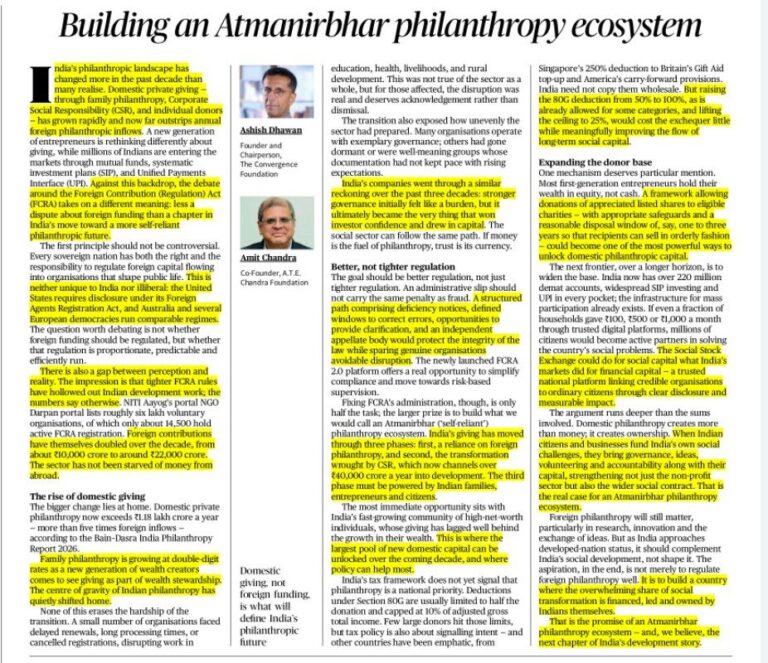
India’s philanthropic landscape is rapidly evolving. Domestic private giving, Corporate Social Responsibility (CSR) initiatives, and individual donations have grown significantly, while foreign philanthropy is declining. A new generation of entrepreneurs is thinking differently about giving, emphasizing systematic investment plans, mutual funds, digital payments, and measurable social impact. The debate over foreign funding and the FCRA has further highlighted the need for self-reliant and accountable philanthropy in India.
Key Principles of Atmanirbhar Philanthropy
Catalytic Philanthropy
The Anusandhan National Research Foundation (ANRF), notified in 2024, exemplifies catalytic philanthropy. For every rupee invested in pre-commercial research, companies can expect to convert a fraction into commercially viable outputs. Strategic investment ensures high productivity and impact while mitigating risk.
Structured, Institutional Support
India’s giving ecosystem is evolving in three phases: reliance on foreign philanthropy, the transformation through CSR, and now mobilization by Indian entrepreneurs and citizens. Institutional mechanisms, including structured funds and frameworks, ensure sustained support for long-term social projects.
Expanding the Donor Base
India has seen growth in first-generation entrepreneurs holding wealth in equity and cash. A framework allowing donations of appreciated listed shares, with proper safeguards, enables orderly deployment of philanthropic capital. Small contributions from households, even ₹100–₹1,000 per month, can now aggregate into significant social impact.
Role of the Social Stock Exchange
The Social Stock Exchange allows ordinary citizens to invest transparently in social projects, improving governance and accountability. These mechanisms provide a platform for measurable, impactful philanthropy, encouraging broader participation across society.
Strategic Opportunities
Domestic Capacity Building
India now has the funds, talent, and infrastructure to build a self-reliant philanthropic ecosystem. Leveraging digital payments, mutual funds, and structured giving frameworks, India can reduce reliance on foreign funding and amplify social impact domestically.
Integration with Research and Innovation
Philanthropy can be integrated with R&D and innovation. Public-private partnerships and corporate venture arms can fund socially impactful projects, ensuring sustainable development across health, education, and rural livelihoods.
Conclusion
India’s philanthropic ecosystem is transitioning toward Atmanirbhar, structured, and accountable giving. With institutional mechanisms, expanded participation, and catalytic investment, India has the opportunity to mobilize domestic capital for lasting social change. For UPSC aspirants, this topic is relevant under governance, civil society, CSR, economic development, and social entrepreneurship.
Vocabulary Boost
Philanthropy → Voluntary giving for public welfare.
Social Capital → Networks and trust enabling collective action.
FCRA → Law regulating foreign contributions in India.
Wealth Stewardship → Responsible use of wealth for wider benefit.
Self-reliance → Building domestic capacity with reduced external dependence.
Frequently Asked Questions (FAQs)
What is Atmanirbhar philanthropy?
Atmanirbhar philanthropy refers to a self-reliant, structured, and accountable ecosystem for domestic giving in India, reducing dependence on foreign funds.
How is India’s philanthropic landscape changing?
India’s domestic giving, CSR initiatives, and individual donations have grown significantly, while foreign philanthropic inflows have declined.
What role does the Social Stock Exchange play?
The Social Stock Exchange allows ordinary citizens and investors to contribute to social projects with transparency, measurable impact, and governance accountability.
How can Indian entrepreneurs contribute to philanthropy?
Entrepreneurs can donate equity, listed shares, or corporate venture funds, invest in pre-commercial research, and participate in structured giving initiatives.
Why is this topic important for UPSC?
It is relevant under governance, civil society, CSR, social entrepreneurship, economic development, and policy frameworks for social impact.
Source From : The Hindu
I Was Part of the Protest March in Delhi, Saw Democratic Politics Take a New Turn
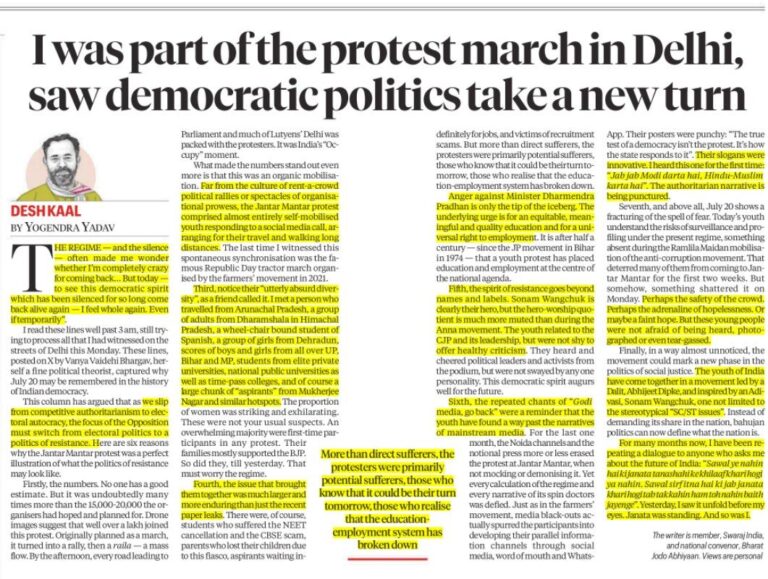
The article highlights the Jantar Mantar protest in Delhi where youth and citizens mobilised to demand reforms in education and employment systems. Organized primarily through social media and self-mobilisation, this movement demonstrates the changing face of democratic activism in India, moving beyond traditional political party structures.
Key Features of the Protest
Organic Youth Mobilisation
Unlike conventional movements, the Jantar Mantar protest was self-organised. Participants travelled from across India, including students from elite universities and rural areas, demonstrating the nationwide engagement of youth in policy-related issues.
Focus on Education and Employment
The protest targeted systemic failures in India’s education and employment infrastructure, highlighting the challenges faced by students, aspirants, and young professionals. Key issues included exam cancellations, recruitment inefficiencies, and quality education concerns.
Role of Political and Media Engagement
Media Amplification
Coverage by social media, digital platforms, and mainstream media gave the movement national visibility. Young protesters were photographed, streamed live, and widely discussed, amplifying the impact without a central leadership.
Political Response
The protest showcased how youth activism can exert pressure on political leadership. While some established parties remained cautious, the movement influenced public debate, illustrating the power of decentralized civic action.
Lessons from the Movement
- Youth engagement can highlight systemic issues ignored by formal politics.
- Social media and digital networks enable rapid mobilisation without centralized authority.
- Effective civic action requires visibility, persistence, and moral clarity.
- Movements like these can influence policy indirectly by shaping public discourse and creating accountability pressure.
Conclusion
The Jantar Mantar protest exemplifies the evolution of democratic participation in India, where self-mobilised youth can challenge systemic shortcomings and amplify public concerns. For UPSC aspirants, this topic is relevant under governance, civil society, youth participation, democratic accountability, and policy reforms.
Vocabulary Boost
Mobilisation → Organising people for collective action.
Political Participation → Citizen involvement in democratic processes.
Dissent → Public expression of disagreement.
Accountability → Responsibility for decisions and outcomes.
Grassroots Movement → Collective action originating among ordinary citizens.
Frequently Asked Questions (FAQs)
What was the main focus of the Delhi protest?
The protest focused on reforms in India’s education and employment systems, including exam cancellations and recruitment inefficiencies.
How was the protest organised?
It was largely self-mobilised, coordinated via social media and digital platforms, without centralized political leadership.
Who participated in the protest?
Participants included students from elite universities, rural areas, and citizens from across India, reflecting nationwide engagement.
How did media amplify the movement?
Social media, live streams, and mainstream coverage increased visibility and public awareness, giving the protest national attention.
Why is this topic important for UPSC?
It is relevant under governance, civil society, youth participation, democratic accountability, and policy reforms.