

Table of Contents
ToggleA Growth Story That Needs Women at Work: India’s Female Workforce Challenge
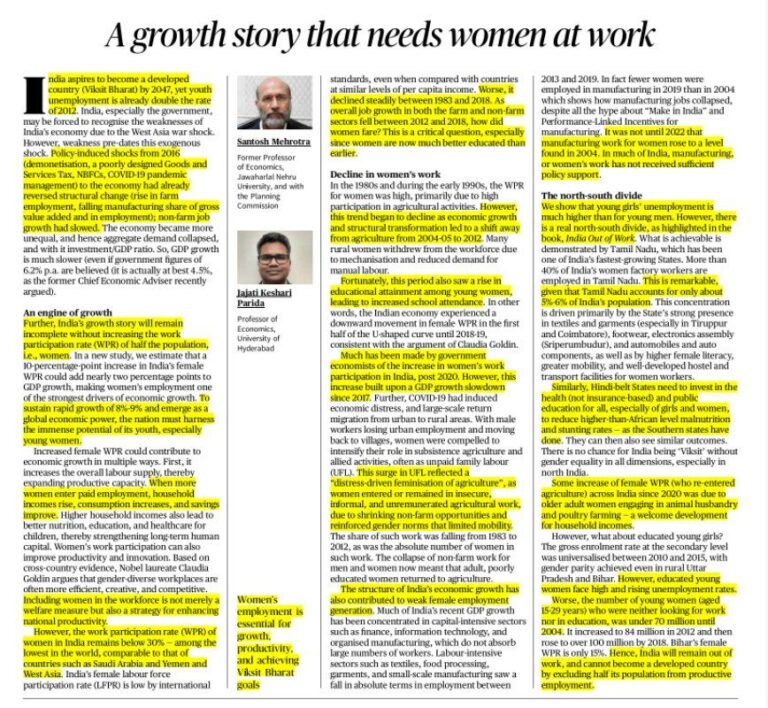
India aims to become a developed economy by 2047, but achieving this vision requires greater participation of women in the workforce. Despite improvements in education and economic opportunities, India’s Female Labour Force Participation Rate (FLFPR) remains significantly lower compared to many developed and emerging economies. Increasing women’s employment is essential for inclusive growth, productivity, and social empowerment.
Women’s Workforce Participation and Economic Growth
Low Female Labour Force Participation
India’s female workforce participation has remained below global standards due to multiple factors:
- Social and cultural barriers
- Lack of suitable employment opportunities
- Safety concerns
- Unequal household responsibilities
- Limited access to childcare facilities
A larger female workforce can increase household incomes, improve savings, and strengthen overall economic growth.
Reasons Behind Declining Women’s Employment
Shift from Agriculture to Non-Farm Sectors
Economic transformation has reduced dependence on agriculture, but the expansion of formal non-farm jobs has not been sufficient to absorb women workers.
Women face challenges in accessing:
- Manufacturing jobs
- Industrial employment
- Service sector opportunities
Education–Employment Gap
Although women’s educational attainment has improved, employment opportunities have not grown proportionately. Many educated women remain outside the workforce due to social expectations, mobility restrictions, and lack of flexible work options.
Regional Variations
Southern States Performing Better
States like Tamil Nadu and Kerala show relatively higher female workforce participation due to:
- Better education levels
- Higher female literacy
- Improved transport facilities
- Greater economic opportunities
North-South Divide
Several northern states continue to experience lower female participation due to restrictive social norms, lower mobility, and limited employment opportunities.
Measures to Increase Women’s Employment
Policy and Institutional Reforms
India needs to focus on:
- Expanding childcare and maternity support
- Improving workplace safety
- Promoting women entrepreneurship
- Increasing skill development opportunities
- Creating flexible work arrangements
- Encouraging women in STEM and emerging sectors
Conclusion
Women’s participation in the workforce is not only a gender equality issue but also an economic necessity. A higher female workforce participation rate can accelerate India’s growth journey and help achieve the goal of a developed India by 2047.
Vocabulary Boost
1. FLFP – Female Labour Force Participation
2. Human Capital – Skills and capabilities of people
3. Structural Transformation – Shift towards industry and services
4. Gender Dividend – Growth benefits from women’s participation
5. Care Economy – Paid and unpaid caregiving work
Frequently Asked Questions (FAQs)
What is Female Labour Force Participation Rate (FLFPR)?
Female Labour Force Participation Rate (FLFPR) refers to the percentage of working-age women who are either employed or actively seeking employment.
Why is women’s workforce participation important for India’s growth?
Greater women’s participation increases productivity, household income, savings, human capital development, and contributes significantly to India’s economic growth.
Why is female workforce participation low in India?
Major reasons include social norms, unpaid care responsibilities, lack of safe workplaces, limited job opportunities, skill gaps, and mobility constraints.
Which states show better female workforce participation in India?
States such as Tamil Nadu and Kerala perform relatively better due to higher female literacy, education levels, better infrastructure, and more employment opportunities.
What measures can improve women’s employment in India?
Key measures include improving childcare facilities, ensuring workplace safety, promoting women entrepreneurship, expanding skill development, and creating flexible employment opportunities.
Source From : The Hindu
India Has Ridden Out the Crisis of Iran War, But a Bigger Challenge Lies Ahead
The Iran war and its geopolitical consequences have created a complex situation for India, affecting energy security, trade routes, and diplomatic choices. While India has successfully managed immediate economic disruptions, the larger challenge lies in navigating a changing global order, balancing relations with major powers, and strengthening domestic capabilities.
Lessons from Past Crises
Comparison with the 1991 Economic Crisis
In 1991, India faced a severe balance of payments crisis triggered by the Gulf War, high oil prices, and declining foreign exchange reserves. The crisis forced India to undertake major economic reforms.
In contrast, India in 2026 has:
- Larger foreign exchange reserves
- A stronger financial system
- A more diversified economy
- Greater global economic integration
However, new challenges have emerged beyond traditional macroeconomic instability.
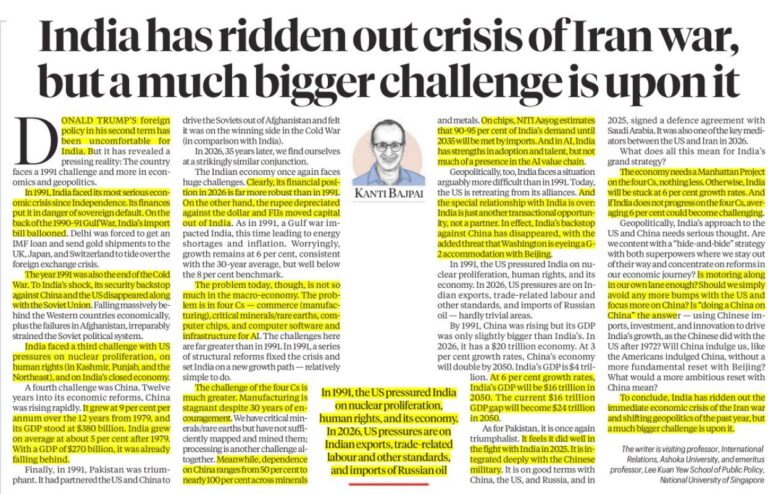
The Four Cs Challenge
1. Commerce
India must strengthen its manufacturing sector and improve export competitiveness. Global supply chain disruptions and geopolitical tensions highlight the need for resilient domestic industries.
2. Critical Minerals
India remains dependent on imports for several critical minerals required for:
- Renewable energy
- Electronics
- Defence technology
- Semiconductor manufacturing
Diversifying mineral supply chains is essential for strategic autonomy.
3. Chips and Semiconductor Ecosystem
The semiconductor industry has become a key area of geopolitical competition. India needs stronger capabilities in chip manufacturing, research, and supply chain development.
4. Artificial Intelligence
AI will shape future economic and security competition. India must move beyond being a consumer of technology and develop indigenous AI capabilities.
Geopolitical Challenges
Balancing Relations with Major Powers
India faces a difficult diplomatic environment involving:
- United States
- China
- Russia
- West Asian countries
While strategic autonomy remains India’s guiding principle, changing global alliances require careful diplomacy.
China Challenge
China’s economic and technological rise presents a long-term challenge. India must balance competition with economic engagement while strengthening domestic capabilities.
Way Forward
India needs a long-term strategy focused on:
- Increasing manufacturing capacity
- Developing semiconductor capabilities
- Securing critical mineral supplies
- Promoting innovation and research
- Building resilient supply chains
- Strengthening defence and technological autonomy
Conclusion
India has successfully managed the immediate impact of the Iran war crisis, but the future challenge lies in building economic and technological resilience. The next phase of growth will depend on how effectively India addresses the four Cs — commerce, critical minerals, chips, and artificial intelligence.
Vocabulary
1. Strategic Autonomy – Independent policy choices
2. Critical Minerals – Resources vital for technology
3. Supply Chain Resilience – Ability to handle disruptions
4. Tech Sovereignty – Control over key technologies
5. Geopolitical Shift – Change in global power equations
Frequently Asked Questions (FAQs)
How has India managed the economic impact of the Iran war crisis?
India has managed the crisis through stronger foreign exchange reserves, a diversified economy, improved financial stability, and better economic resilience compared to the 1991 Gulf War period.
What are the major challenges highlighted for India’s future growth?
The major challenges are the Four Cs — Commerce, Critical Minerals, Chips, and Artificial Intelligence (AI), which are essential for economic competitiveness and strategic autonomy.
Why are critical minerals important for India?
Critical minerals are essential for sectors like renewable energy, electric vehicles, semiconductors, defence technology, and advanced manufacturing. Reducing import dependence is crucial for national security.
How does China’s rise affect India’s strategic choices?
China’s economic and technological growth creates challenges for India in trade, technology, and security. India needs to balance competition with cooperation while strengthening domestic capabilities.
Why is this topic important for UPSC preparation?
This topic is relevant under International Relations, Energy Security, Economic Development, Strategic Autonomy, Semiconductor Policy, and Emerging Technologies (GS Paper 2 & GS Paper 3).