

Table of Contents
ToggleNepal Earthquake and Himalayan Disasters
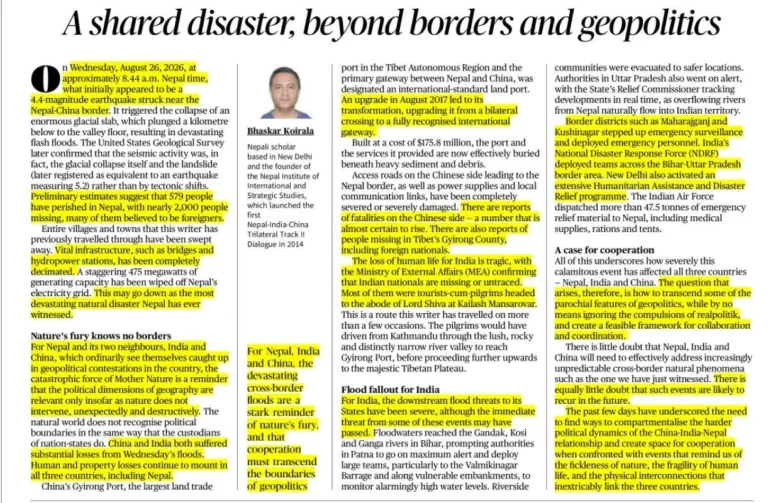
A powerful earthquake near the Nepal-China border has once again highlighted the vulnerability of the Himalayan region to natural disasters. The event triggered a massive glacial collapse, leading to devastating flash floods that affected Nepal, India and China. The disaster demonstrates that natural hazards in the Himalayas do not respect political boundaries and require coordinated regional responses.
Himalayan Disasters: A Shared Regional Challenge
The earthquake and subsequent glacial collapse caused widespread destruction in Nepal, damaging villages, infrastructure and power systems. The disaster resulted in significant loss of life, with many people reported missing.
The Himalayan region is highly vulnerable because of:
- Fragile mountain geology
- Rapid glacier changes
- Steep slopes and unstable terrain
- Increasing extreme weather events
- Human pressure on fragile ecosystems
Such disasters highlight that the security of Himalayan communities is closely connected across borders.
Impact on Nepal, India and China
The disaster affected all three Himalayan neighbours.
In Nepal, settlements, roads and hydropower infrastructure suffered severe damage. The Gyirong Port, an important connectivity point between Nepal and China, was also affected, disrupting transport links.
In India, downstream flood risks increased, particularly in border regions of Bihar and Uttar Pradesh. Authorities monitored rivers such as the Gandak, Kosi and Ganga and activated disaster response mechanisms.
The National Disaster Response Force (NDRF) deployed teams and provided humanitarian assistance, while India supplied emergency relief materials, including medical supplies, food and tents.
Nature Beyond Geopolitical Boundaries
The article emphasises that natural forces operate independently of political borders. Although India, Nepal and China have complex geopolitical relationships, Himalayan disasters create shared challenges that require cooperation.
Climate change, glacier instability and unpredictable weather events are likely to increase future risks. Therefore, disaster management cannot remain limited within national boundaries.
Need for Regional Disaster Cooperation
The Himalayan countries need stronger cooperation in:
- Early warning systems
- Glacier and river monitoring
- Disaster response coordination
- Data sharing
- Climate adaptation strategies
Such cooperation does not require ignoring geopolitical differences but creating practical mechanisms to address common threats.
Conclusion
The Nepal earthquake and glacial flood disaster serve as a reminder that the Himalayas connect communities, ecosystems and economies across borders.
India, Nepal and China must move beyond short-term geopolitical differences and develop stronger regional disaster management frameworks. Protecting Himalayan lives requires recognising that nature is interconnected, and cooperation is the only sustainable response to shared environmental risks.
Frequently Asked Questions (FAQs)
Why are Himalayan regions vulnerable to disasters?
The Himalayas have young and unstable geology, steep slopes and changing climatic conditions. These factors increase the risk of earthquakes, landslides, flash floods and glacier-related disasters.
How did the Nepal earthquake affect neighbouring countries?
The disaster affected Nepal, India and China through infrastructure damage, flood risks and disruption of cross-border connectivity. It highlighted the interconnected nature of Himalayan hazards.
Why are glacial collapses dangerous?
Glacial collapses can suddenly release large amounts of water and debris, triggering destructive flash floods that can damage settlements and infrastructure downstream.
What role did India play after the disaster?
India activated disaster response mechanisms, deployed NDRF teams and provided humanitarian assistance, including emergency supplies and medical support.
Why is regional cooperation important for Himalayan disaster management?
Since Himalayan rivers, glaciers and ecosystems cross national boundaries, countries need cooperation in monitoring, early warnings, data sharing and disaster response.
Source From : The hindu
Ethanol Blending in India
India’s Ethanol Blended Petrol (EBP) Programme was introduced to reduce crude oil imports, support farmers and promote cleaner fuel alternatives. However, the growing dependence on food grains for ethanol production has created concerns regarding food security, crop diversification and long-term sustainability.
Evolution of Ethanol Blending Programme in India
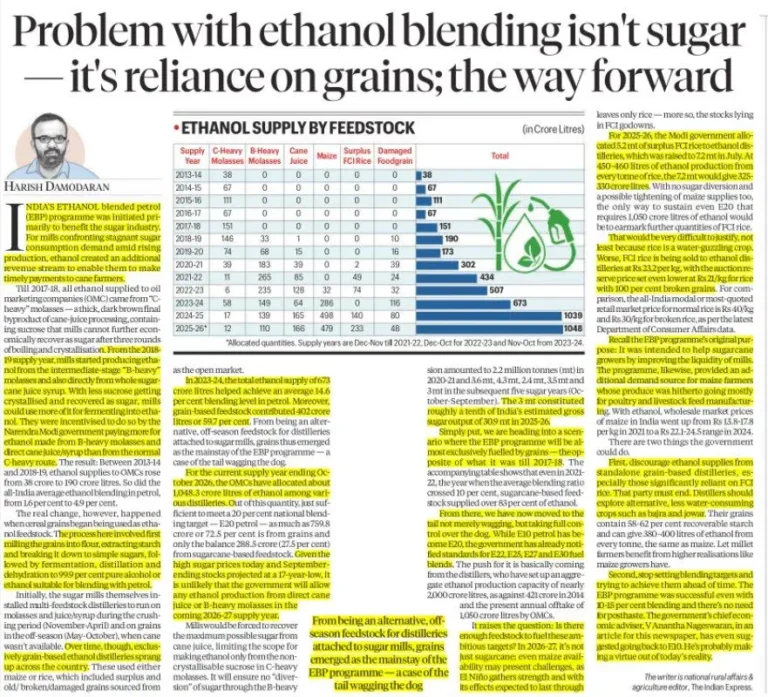
Initially, India’s ethanol programme was largely based on sugarcane by-products, especially molasses generated by sugar mills. This helped the sugar industry manage surplus production while providing an additional source of income for farmers.
However, since 2018, the government expanded ethanol feedstock sources by allowing grains such as maize, broken rice and other cereals for ethanol production.
This diversification helped increase ethanol availability and supported the target of achieving 20% ethanol blending in petrol (E20).
Rising Dependence on Grains for Ethanol
According to the article, ethanol production has increasingly shifted from being sugar-based to grain-based.
The share of grain-based ethanol has grown significantly, with maize and other grains becoming important sources of ethanol supply. This shift has helped meet blending targets but has also raised concerns about competition between fuel production and food consumption.
The article argues that the issue with ethanol blending is not sugarcane alone but the increasing reliance on food grains.
Food Security Concerns
Using maize, rice and other grains for ethanol can influence agricultural choices and market prices.
Higher demand for ethanol feedstock may encourage farmers to shift towards fuel crops rather than food crops. This could affect food availability, especially when India already faces challenges related to nutrition security and rising food demand.
The article highlights that policies promoting ethanol should carefully consider their impact on grain markets and consumer prices.
Challenges of Grain-Based Ethanol
Grain-based ethanol also raises concerns related to:
- Competition between food and fuel
- Water consumption for crop production
- Crop diversification
- Impact on livestock feed availability
- Market distortions due to procurement incentives
While ethanol provides benefits in terms of energy security and reduced fossil fuel dependence, these benefits must be balanced with agricultural sustainability.
Way Forward: A Balanced Ethanol Policy
ndia needs a balanced approach that promotes biofuel growth without compromising food security.
The way forward includes:
- Greater focus on non-food feedstocks
- Promotion of second-generation ethanol from agricultural waste
- Scientific assessment of water and land requirements
- Avoiding excessive dependence on food grains
- Ensuring that ethanol targets do not distort agricultural priorities
Conclusion
India’s ethanol blending programme has contributed to reducing oil import dependence and supporting farmers. However, the future challenge lies in managing the food versus fuel trade-off.
A sustainable ethanol policy should move beyond simply increasing blending percentages and focus on environmentally responsible and food-secure pathways. The goal should be achieving energy security without compromising India’s agricultural stability and nutritional needs.
Frequently Asked Questions (FAQs)
What is the Ethanol Blended Petrol (EBP) Programme?
The EBP Programme aims to blend ethanol with petrol to reduce crude oil imports, promote renewable energy and support farmers through alternative markets for agricultural products.
What is the Ethanol Blended Petrol (EBP) Programme?
The EBP Programme aims to blend ethanol with petrol to reduce crude oil imports, promote renewable energy and support farmers through alternative markets for agricultural products.
Why is grain-based ethanol becoming a concern?
Increasing use of maize, rice and other grains for ethanol may create competition between fuel production and food consumption, affecting crop patterns and food security.
What are the main feedstocks used for ethanol production in India?
India uses sugarcane-based products such as molasses and grain-based feedstocks including maize, broken rice and other cereals for ethanol production.
Does ethanol blending help India’s energy security?
Yes, ethanol blending reduces dependence on imported crude oil and supports domestic fuel production. However, sustainability concerns need to be addressed.
What is the sustainable way forward for ethanol production?
India should promote waste-based ethanol, second-generation biofuels and balanced feedstock policies to achieve energy security without harming food availability.