Table of Contents
ToggleWavell Plan 1945
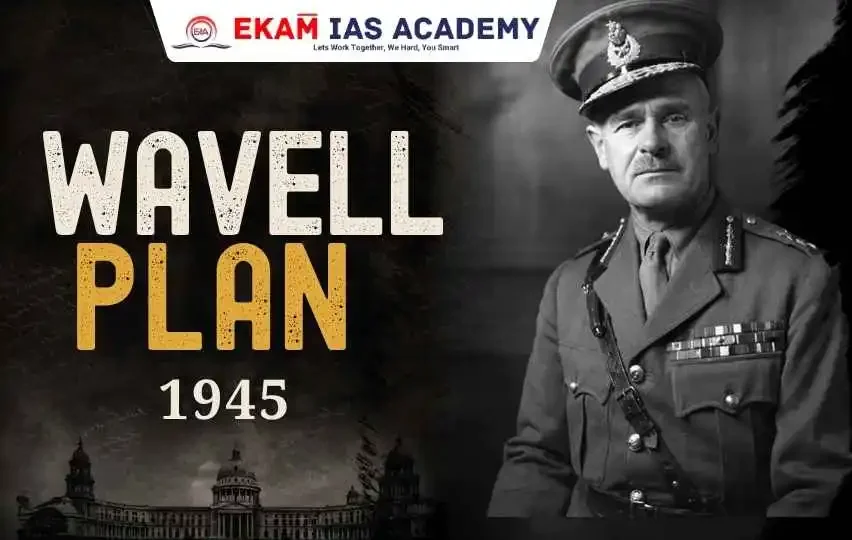
The Wavell Plan 1945 was a critical constitutional proposal presented by the Viceroy of India, Lord Wavell, to resolve the ongoing political deadlock between the British Crown, the Congress, and the Muslim League. A foundational topic in Modern Indian History UPSC preparation, this initiative was designed to rebuild the Executive Council and move India toward self-governance during the final phase of the Indian National Movement.
Historical Background
By mid-1945, World War II in Europe had ended, and the British government faced international pressure to resolve the Indian political crisis. Lord Wavell visited London to hold consultations, resulting in official Wavell Plan proposals aimed at securing Indian cooperation for the ongoing war against Japan and formulating a interim governance structure.
Main Proposals of the Wavell Plan
The primary Wavell Plan features included:
- Reconstructing the Viceroy’s Executive Council, with all members being Indians except the Viceroy and the Commander-in-Chief.
- Equal representation for caste Hindus and Muslims in the council.
- Transfer of the portfolio of Foreign Affairs to an Indian member.
- Veto power of the Viceroy to remain intact, though not to be exercised unconstitutionally.
Shimla Conference, 1945
To discuss these proposals, Lord Wavell convened the historic Wavell Plan and Shimla Conference in June 1945 at Shimla. Leaders from across the political spectrum gathered to negotiate the formation of the new Executive Council.
Why Did the Shimla Conference Fail
The primary cause of the Shimla Conference failure was the irreconcilable standoff over nominee selection for the Executive Council, leading to the ultimate Wavell Plan failure.
Role of the Muslim League
Regarding the Wavell Plan and Muslim League dynamics, Wavell Plan and Jinnah demanded that the Muslim League hold the exclusive right to nominate all Muslim members to the Executive Council, insisting on a communal veto over constitutional decisions.
Role of the Indian National Congress
In the context of the Wavell Plan and Congress, the Indian National Congress rejected the League’s claim, refusing to be categorized purely as a “caste Hindu” party and asserting its right to nominate members from all religious communities, including Muslims.
Significance of the Wavell Plan
Evaluating the Wavell Plan significance, the proposal officially acknowledged the necessity of an all-Indian Executive Council and underscored that British policy could no longer bypass organized Indian political consensus.
Limitations of the Wavell Plan
- Retained ultimate executive authority and veto power with the Viceroy.
- Deepened political friction by accepting communal parity in the council composition.
Wavell Plan and the Road to Independence
The deadlock exposed the escalating Congress Muslim League dispute, showing that future constitutional progress required a complete transfer of power rather than temporary administrative adjustments during the Freedom Struggle UPSC timeline.
Wavell Plan vs Cripps Mission
- Cripps Mission (1942): Focused on post-war Dominion Status and framing a constitution.
- Wavell Plan (1945): Focused on immediate interim administrative restructuring of the Viceroy’s Executive Council.
Wavell Plan vs Cabinet Mission Plan
- Wavell Plan (1945): Proposed interim executive council representation without addressing sovereign partition.
- Cabinet Mission (1946): Envisaged a three-tiered federal structure and a Constituent Assembly to draft a constitution for a united India.
Timeline of Important Events
- May 1945: World War II ends in Europe.
- June 14, 1945: Broadcast of the Wavell Plan 1945.
- June 25 – July 14, 1945: Shimla Conference 1945 convened and failed.
Conclusion
Understanding these Wavell Plan UPSC Notes is vital for organizing comprehensive revision material. The plan served as the final major attempt at interim administrative reform before the arrival of the Cabinet Mission, making it an essential milestone in Wavell Plan UPSC preparation.
UPSC Prelims: PYQs & Practice Questions
Previous Year Questions
Q: With reference to 8th August 1942 in Indian history, which one of the following statements is correct?
(a) Quit India Resolution was adopted by the AICC.
(b) Viceroy’s Executive Council was expanded to include more Indians.
(c) Congress ministries resigned in seven provinces.
(d) Cripps proposed Dominion Status with a condition that it would be accepted only if the Indian National Congress agreed to it.
Answer: (a) Quit India Resolution was adopted by the AICC
Explanation:
On 8 August 1942, the
All India Congress Committee (AICC) adopted the
Quit India Resolution at
Gowalia Tank Maidan in Bombay.
Option (b) is incorrect. The restructuring and expansion of the
Viceroy’s Executive Council became a major feature of the
Wavell Plan of 1945.
Option (c) is incorrect. The
Congress ministries resigned in October–November 1939 following India's involvement in the Second World War without consultation with Indian leaders.
Option (d) is incorrect. The
Cripps Proposals of 1942 offered Dominion Status after the war and provided for constitution-making, but the statement given does not correctly describe the proposal.
Q: Which one of the following submitted in
1945 the proposal for the formation of an
Interim Government at the Centre comprising equal representation for Hindus and Muslims?
(a) Sapru Committee
(b) Wavell Plan
(c) Cabinet Mission
(d) Mountbatten Plan
Answer: (b) Wavell Plan
Explanation:
The Wavell Plan of 1945 proposed the reconstruction of the
Viceroy’s Executive Council.
Under the proposal, all members of the Executive Council, except the
Viceroy and the Commander-in-Chief, were to be Indians.
It also proposed
equal representation for caste Hindus and Muslims, commonly referred to as the
parity principle.
The proposals were discussed at the
Shimla Conference of 1945, but the negotiations ultimately failed.
Practice Questions
Q: With reference to the Wavell Plan of 1945, consider the following statements:
1. It proposed that all members of the Viceroy's Executive Council, including the Commander-in-Chief, should be Indians.
2. It provided for equal representation between caste Hindus and Muslims in the reconstituted Executive Council.
3. The portfolio of Foreign Affairs was proposed to be transferred from the Governor-General to an Indian member.
Which of the statements given above are correct?
(a) 1 and 2 only
(b) 2 and 3 only
(c) 1 and 3 only
(d) 1, 2 and 3
Answer: (b) 2 and 3 only
Explanation:
Statement 1 is incorrect. The
Wavell Plan proposed that all members of the
Viceroy's Executive Council would be Indians
except the Viceroy and the Commander-in-Chief.
Statement 2 is correct. The Plan introduced the principle of
equal representation between caste Hindus and Muslims
in the reconstituted Executive Council.
Statement 3 is correct. The
Foreign Affairs portfolio was proposed to be transferred to an
Indian member of the Executive Council.
Q: Why did the Shimla Conference of 1945, convened by Lord Wavell, ultimately collapse?
(a) The Indian National Congress refused to accept Dominion Status as an interim measure.
(b) Muhammad Ali Jinnah insisted that the Muslim League must have the exclusive right to nominate all Muslim members to the Executive Council.
(c) Mahatma Gandhi and the Congress boycotted the conference entirely.
(d) The British Government withdrew the offer due to the outbreak of the Royal Indian Navy Mutiny.
Answer: (b) Muhammad Ali Jinnah insisted that the Muslim League must have the exclusive right to nominate all Muslim members to the Executive Council
Explanation:
The major reason for the failure of the
Shimla Conference was the disagreement over the
nomination of Muslim members to the Viceroy's Executive Council.
Muhammad Ali Jinnah and the Muslim League demanded the
exclusive right to nominate all Muslim representatives.
The Indian National Congress rejected this claim because accepting it would effectively portray the Congress as only a
“caste Hindu” organisation and undermine its claim to represent Indians across religious communities, including
nationalist Muslims.
This disagreement created a political deadlock and led to the
collapse of the Shimla Conference in 1945.
UPSC Mains – Previous Year & Practice Questions
Mains Previous Year Questions
[10 Marks | 150 Words]
Question: Examine how the failure of the Wavell Plan and the Shimla Conference reflected the growing political and communal divide in colonial India. (UPSC CSE Mains 2022, GS Paper I)
[15 Marks | 250 Words]
Question: Analyse the shift in British policy towards Indian political parties from the outbreak of the Second World War to the convening of the Shimla Conference in 1945. (UPSC CSE Mains 2015, GS Paper I)
[10 Marks | 150 Words]
Question: Discuss the main proposals of the Wavell Plan and explain why it failed to reconcile the differences between the Indian National Congress and the Muslim League. (UPSC CSE Mains 2007, Modern History)
[10 Marks | 150 Words]
Question: Critically evaluate the role of Lord Wavell in handling the constitutional crisis in India during 1945–1947. (UPSC CSE Mains 2001, Modern History)
[15 Marks | 250 Words]
Question: Trace the evolution of constitutional proposals for an Interim Government from the Cripps Mission (1942) to the Wavell Plan (1945). (UPSC CSE Mains 1998, Modern History)
Mains Practice Questions
[15 Marks | 250 Words]
Question: “By granting the Muslim League a virtual veto at the Shimla Conference of 1945, Lord Wavell inadvertently strengthened communal separatism and made the partition of India almost inevitable.” Critically analyse.
[15 Marks | 250 Words]
Question: Compare and contrast the Wavell Plan (1945) with the Cabinet Mission Plan (1946) in terms of their objectives, proposed executive structures and impact on Indian unity.
[10 Marks | 150 Words]
Question: How did the disagreement over the nomination of Muslim representatives highlight the fundamental conflict between the secular nationalism of the Congress and the communal politics of the Muslim League during the Shimla Conference of 1945?
Wavell Plan 1945-FAQs
What was the Wavell Plan 1945?
The Wavell Plan was a constitutional proposal announced by Viceroy Lord Wavell in 1945 to reconstruct the Viceroy’s Executive Council with more Indian representation.
Why was the Wavell Plan introduced?
It was introduced to resolve the political deadlock between the British, Congress and Muslim League and to secure Indian cooperation during the final phase of World War II.
What were the main proposals of the Wavell Plan?
It proposed an all-Indian Executive Council except the Viceroy and Commander-in-Chief, parity between caste Hindus and Muslims, and transfer of Foreign Affairs to an Indian member.
Why did the Shimla Conference fail?
It failed mainly because Jinnah insisted that only the Muslim League should nominate Muslim members, while Congress rejected being treated as only a caste-Hindu party.
Why is the Wavell Plan important for UPSC?
It is important because it connects World War II, Congress-Muslim League tensions, interim government proposals, Shimla Conference and the road to the Cabinet Mission.