

Table of Contents
ToggleAI Model Selection: Why Workloads Matter More Than Leaderboards
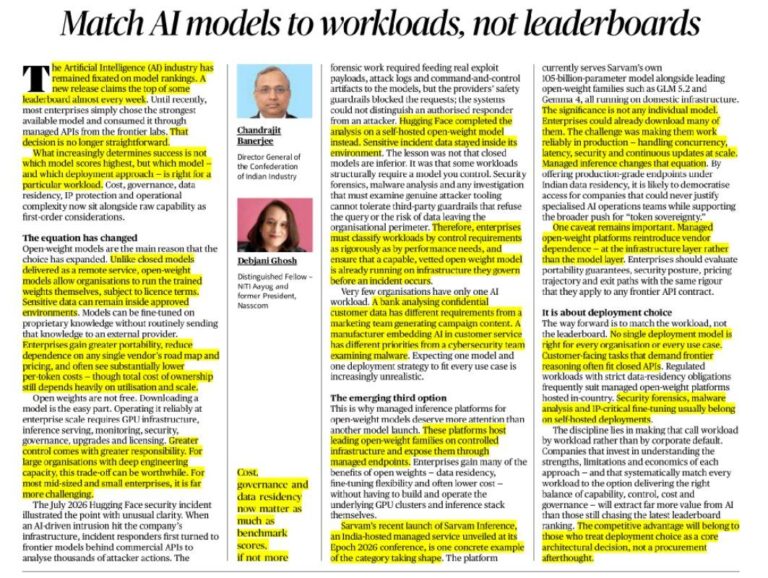
The Artificial Intelligence industry is increasingly focused on model rankings and benchmark scores. However, enterprises choosing an AI model need to look beyond leaderboards. According to the article, factors such as cost, governance, data residency, security and operational complexity can be as important as model performance when deploying AI at scale.
Why AI Leaderboards Are Not Enough
Earlier, organisations often selected the strongest available AI model through managed APIs. The rise of open-weight AI models has changed this approach by allowing organisations to download, customise and run models within their own infrastructure.
This provides greater control over sensitive data and reduces dependence on a single vendor. However, self-hosting also requires substantial infrastructure, GPU capacity, monitoring, security and technical expertise.
Therefore, the most powerful model may not always be the most suitable model for every enterprise workload.
Open-Weight vs Closed AI Models
Different workloads demand different deployment strategies.
Customer-facing applications requiring advanced reasoning may benefit from leading closed API models. In contrast, regulated workloads involving strict data residency requirements, security analysis, malware investigation and IP-sensitive fine-tuning may be better suited to self-hosted open-weight models.
The article argues that enterprises should classify workloads according to control requirements and performance needs before selecting an AI model.
Why Data Residency and Security Matter
Sensitive organisational information cannot always be sent to external AI providers. The article highlights a security incident involving Hugging Face, where restrictions prevented sensitive forensic data from leaving the organisation’s environment.
Such situations demonstrate why enterprises may need AI models operating completely within controlled infrastructure.
Managed AI Inference: An Emerging Option
A third option is managed inference, which combines some advantages of open-weight models with managed infrastructure.
The article cites Sarvam Inference, an India-hosted managed service, as an example. Such platforms may help enterprises meet data-residency requirements without having to build and maintain complete GPU infrastructure themselves.
Conclusion
Enterprise AI adoption should focus on matching the right AI model to the right workload, rather than simply choosing the highest-ranked model.
The future of enterprise AI will likely involve a combination of closed APIs, self-hosted open models and managed inference platforms. Organisations that balance performance, cost, security, governance and data sovereignty will gain greater long-term value from artificial intelligence.
Vocabulary
1. Open-weight Model – AI model whose trained weights are accessible
2. Data Residency – Keeping data within a specified jurisdiction
3. Self-hosting – Running AI on an organisation’s own infrastructure
4. Managed Inference – Third-party infrastructure for running AI models
5. Vendor Lock-in – Dependence on a single technology provider
Frequently Asked Questions (FAQs)
Why should companies not rely only on AI leaderboards?
AI leaderboards mainly measure model performance on benchmarks. Enterprise deployment must also consider security, cost, governance, data residency and infrastructure requirements.
What are open-weight AI models?
Open-weight models allow organisations to access and run trained model weights within their own infrastructure. They can offer greater control, customisation and protection of sensitive organisational data.
When are closed AI models more suitable?
Closed AI APIs may be useful for applications requiring advanced reasoning capabilities and rapid deployment. They can reduce the infrastructure burden of running large models internally.
Why is data residency important in enterprise AI?
Data residency ensures that sensitive information remains within approved geographic or organisational boundaries. This is especially important for regulated industries, cybersecurity and confidential business operations.
What is managed AI inference?
Managed inference provides access to AI models through managed infrastructure while offering greater deployment control than conventional external APIs. It can reduce the burden of maintaining expensive GPU infrastructure.
Source From : The Hindu
Freedom of Expression in India: Democracy, Dissent and Youth Politics
India’s Independence Day is not only a celebration of freedom but also an occasion to examine how democracy, dissent and freedom of expression in India function in everyday public life. The article uses the student mobilisation at Jantar Mantar to explore the changing relationship between political power, youth activism and democratic spaces.
Jantar Mantar and the Politics of Protest
The Jantar Mantar protests demonstrated how organised public action can challenge even a politically powerful government. According to the article, student mobilisation exposed the importance of public spaces where citizens can question authority and express disagreement.
However, the larger concern is whether such democratic spaces remain open once protests disappear from public attention. Political freedom, the article argues, must extend beyond elections to include the ability to organise, debate and dissent.
Youth Activism and Freedom of Expression
The article highlights several instances involving university students, activists and academic discussions to raise questions about the limits of free speech and dissent in India.
It refers to controversies surrounding student slogans, proposed university discussions, institutional restrictions and criticism of political leaders. These examples illustrate the tension between maintaining public order and protecting legitimate democratic expression.

Universities as Spaces for Democratic Debate
Universities play an important role in encouraging debate, disagreement and critical thinking. The article argues that educational institutions should remain spaces where difficult political, legal and social questions can be discussed rather than avoided.
Restrictions imposed through administrative pressure or fear of controversy may weaken the intellectual freedom essential to democratic societies.
Elections and the Limits of Political Choice
The article also questions whether electoral victories alone represent the full meaning of democracy. While elections provide political legitimacy, democracy additionally requires institutional accountability, civil liberties and space for opposition.
The experience of recent youth movements, according to the article, shows that democratic participation continues between elections through protests, public debate and civic engagement.
Conclusion
India’s democratic strength depends not only on the right to vote but also on the freedom to question, organise, protest and participate in public debate. Independence must therefore be understood as an ongoing democratic responsibility.
Protecting universities, public spaces and peaceful dissent can ensure that freedom remains a living constitutional principle rather than merely an annual celebration.
Vocabulary
1. Pluralism – Coexistence of diverse views
2. Dissent – Expression of disagreement
3. Civil Liberties – Fundamental freedoms of citizens
4. Political Mobilisation – Organising people for collective political action
5. Catalyst – Force that accelerates change
Frequently Asked Questions (FAQs)
Why is freedom of expression important in a democracy?
Freedom of expression allows citizens to question governments, debate public policies and communicate different viewpoints. It strengthens accountability and meaningful democratic participation.
What role do student movements play in democracy?
Student movements can raise social and political concerns that may otherwise receive limited attention. They also encourage youth participation in public affairs and democratic debate.
Why are universities important for freedom of expression?
Universities provide spaces for research, discussion and critical thinking. Academic freedom allows students and scholars to debate controversial issues without unnecessary restrictions.
Are elections alone enough to ensure democracy?
Elections are essential, but democracy also depends on civil liberties, accountable institutions, political opposition and freedom of expression. Citizen participation must continue between elections.
How can India strengthen democratic freedoms?
India can strengthen democracy by protecting peaceful protest, academic freedom, open debate and institutional accountability. Citizens must have meaningful opportunities to participate beyond the electoral process.