

Table of Contents
ToggleEMPLOYMENT GUARANTEE IN LIMBO
TOPIC: (GS3) ECONOMY: THE HINDU
Employment generation under the VB-G RAM G Act, which replaced MGNREGA in July 2026, has witnessed a sharp decline of over 40%, raising concerns about rural livelihoods and fiscal management.
Background of Transition
- MGNREGA Legacy: Provided 100 days of guaranteed rural employment since 2005.
- VB-G RAM G Launch: Announced in Dec 2025, formally implemented on July 1, 2026.
- Rules & Wage Rates: Draft rules released May 2026; final rules notified end of June. Wage rate fixed at ₹300/day.
- Budget Allocation: Union allocation ₹95,692 crore; combined Centre–State budget projected at ₹1.5 lakh crore.
Employment Trends
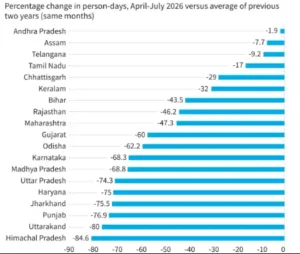
- Sharp Decline: July 2026 generated ~9 crore person-days vs 15 crore in July 2025 — decline of 40%.
- Seasonal Impact: April–July usually accounts for ~50% of annual employment; in 2026 only 70 crore person-days vs 128 crore (2024–25).
- State Variations:
- Smaller decline in Andhra Pradesh, Assam, Telangana.
- Severe crash (60–85%) in Madhya Pradesh, Uttar Pradesh, Jharkhand.
- Fiscal Paradox: Despite higher budget, employment generation fell drastically.
Challenges
- Administrative Confusion: Delay in framing rules led to suspension of works in many districts.
- Centre–State Cost Sharing: 60:40 ratio burdens poorer States disproportionately.
- Technology Barriers: Mandatory facial recognition at worksites risks exclusion of workers.
- Fiscal Stress: Pending dues of ₹20,422 crore (2025–26) add to States’ liabilities.
- Equity Concerns: Poorer States with higher demand face deeper employment gaps.
Way Forward
- Transparent Allocation: Clear formula for Centre–State burden sharing to avoid arbitrary stress.
- Strengthen Federal Coordination: Cooperative fiscal planning to ensure equitable distribution.
- Technology Inclusion: Alternatives to facial recognition to prevent exclusion.
- Timely Fund Release: Settlement of pending dues and faster disbursement to States.
- Demand-Driven Flexibility: Retain MGNREGA’s demand-based nature to safeguard rural livelihoods during shocks.
Conclusion
Without urgent reforms, VB-G RAM G risks undermining India’s rural safety net; cooperative federalism and demand-driven flexibility are essential to restore trust and livelihoods.
PM CARES FUND AND UTILISATION
TOPIC: (GS2) POLITY: THE HINDU
The audited financial statements of PM CARES Fund (2023–24 & 2024–25) reveal a sharp fall in donations and minimal utilisation of funds, raising concerns about transparency and accountability.
PM CARES Fund
- Creation: Established in March 2020 as a public charitable trust. Intended to provide emergency relief during crises such as pandemics and disasters.
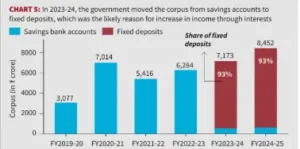
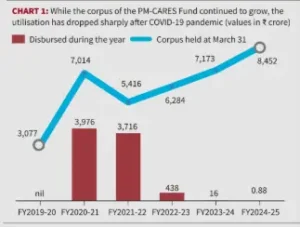
- Corpus Growth: Corpus increased by 25.8% between 2022–23 and 2024–25. Grew from ₹6,722 crore → ₹8,453 crore.
- Interest Income: In 2023–24, corpus shifted from savings accounts to fixed deposits. By 2024–25, interest income was ₹475 crore, nearly equal to donations.
- Donation Trends: Donations have declined sharply in recent years. Corpus growth sustained largely through financial returns rather than public contributions.
Key Findings
- Utilisation Collapse: Spending dropped from ₹437.9 crore (2022–23) to just ₹87.5 lakh (2024–25).
- Refunds Issue: Refunds from implementing agencies exceeded actual utilisation; details remain undisclosed.
- Transparency Concerns: Delay of two years in releasing audited statements; change of auditors during this period.
- Fund Flow: Donations + interest income far outpaced disbursements, leaving large idle balances.
Challenges
- Accountability Gap: Lack of disclosure on beneficiaries and implementing agencies.
- Underutilisation: Only 0.01% of corpus spent in 2024–25, undermining emergency relief purpose.
- Public Trust: Criticism from civil society and opposition over opacity.
- Comparative Benchmark: CAG reports show higher utilisation in other disaster relief funds like SDRF/NDRF.
Way Forward
- Enhanced Transparency: Regular disclosure of beneficiaries, implementing agencies, and fund utilisation.
- Independent Oversight: CAG audit or parliamentary scrutiny to ensure accountability.
- Efficient Utilisation: Align spending with urgent needs — health, disaster relief, climate resilience.
- Public Engagement: Encourage citizen participation and feedback mechanisms.
Conclusion
Without transparency and timely utilisation, PM CARES risks becoming a static corpus rather than a dynamic relief instrument.
CORPORATE INVESTMENT IN INDIA
TOPIC: (GS3) ECONOMY: THE HINDU
Corporate investment as a share of GDP has fallen sharply since demonetisation (2016), continuing despite tax cuts and low interest rates, raising concerns about demand and profitability.
Historical Trends
- Rise in 2004: Corporate investment surged from 6.5% to 10.3% of GDP. Marked the beginning of India’s highgrowth phase.
- Global Financial Crisis 2008: Investment levels fell due to external shock. Gradual recovery followed as global demand improved.
- Demonetisation Shock 2016: Triggered a sustained decline in investment share. Considered a selfinflicted disruption compared to external crises.
- Covid Impact 2020–21: Added another external shock. However, the downward trend had already started earlier, post2016.
Determinants of Investment
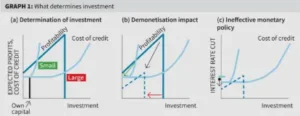
- Profitability: Firms invest when expected profits exceed costs; larger firms benefit from economies of scale.
- Confidence & Animal Spirits: Optimism pushes profitability curve outward; shocks like demonetisation reduce confidence.
- Cost of Credit: Small firms face higher borrowing costs due to Kalecki’s “principle of increasing risk.”
Manufacturing Sector
- Small Firms: Limited own capital → higher interest costs. Credit constraints often cut profitability curve early. MSMEs hit hardest post2016.
- Large Firms: Own capital cushions credit costs. Constrained by market demand, not finance.
- Panel Data 2000–2024:
- Small firms → low profitability, high interest costs.
- Large firms → high profitability, low interest costs.
- Confirms asymmetry in investment drivers across firm sizes.
Challenges
- Demand Weakness: RBI reports (2025) show capacity utilisation below 75%.
- MSME Stress: SIDBI data (2025) highlights rising NPAs in small firms.
- Policy Ineffectiveness: Corporate tax cut (2018) failed to boost investment; investment/GDP ratio remains below 10%.
Way Forward
- Boost Demand: Government spending on infrastructure, rural employment, and welfare to push profitability curve outward.
- Credit Access: Expand credit guarantee schemes and reduce cost of borrowing for MSMEs.
- Confidence Building: Stable policy environment to restore investor trust.
- Inclusive Growth: Ensure small firms benefit from reforms, not just large corporates.
Conclusion
Reviving corporate investment requires demandside stimulus through government expenditure, not just tax cuts or low interest rates.

BIHAR’S ALCOHOL BAN AND ECONOMIC DIMENSIONS
TOPIC: (GS2) POLITY: THE HINDU
A recent report at the India Policy Forum 2026 recommended lifting Bihar’s alcohol ban, but new evidence shows the ban has improved social wellness and reduced violence against women.
Background of the Ban
- Implementation in 2016: Introduced by the Bihar government to reduce alcoholrelated health and social problems.
- Revenue Impact: Estimated to have reduced State revenue by about 14%, though longterm gains in public health and safety are expected to outweigh this loss.
- Policy Criticism: Recent reports have questioned its effectiveness, citing crime data and fiscal concerns, but these assessments are considered incomplete.
Impact on Violence and Health
- Crime Data Limitations: NCRB records only severe cases; many domestic violence incidents remain unreported.
- Improved Reporting: Rise in reported crimes linked to better awareness, legal aid, and de-stigmatisation, not necessarily more violence.
- Violence Reduction:
- Lancet Regional Health (2024): Ban prevented 21 lakh cases of intimate partner violence.
- Peer-reviewed study (2024): Significant drop in assaults on women.
- Health Gains:
- Reduced hypertension, diabetes, and obesity among men.
- Ban prevented 18 lakh cases of overweight/obesity.
Economic and Social Considerations
- Excise Revenue Loss: The ban reduced State excise collections by about 14% of total revenue.
- National Economic Cost: Alcohol consumption is estimated to cost India 1.45% of GDP annually (~₹98 lakh crore), as per the International Journal of Drug Policy (2019).
- Social Losses vs Gains: The social costs of alcohol are assessed to be three times higher than the fiscal gains from excise taxes.
- Public Welfare Benefits: Improvements in safety, productivity, and family wellbeing outweigh the shortterm fiscal losses.
Challenges
- Health Infrastructure: Limited addiction and mental health services.
- Employment & Awareness: Need for expanded education, jobs, and awareness campaigns.
- Policy Alternatives: Global evidence (WHO) suggests rationing, restricted availability, and pricing policies as softer options.
Way Forward
- Strengthen Services: Scale up mental health and de-addiction centres.
- Balanced Policy: Explore intermediate measures like rationing and controlled access.
- Public Education: Intensify campaigns on health risks and social costs.
- Evidence-Based Governance: Use quasi-experimental studies for policy evaluation.
Conclusion
Bihar’s alcohol ban has delivered clear social and health benefits, and future policy must build on these gains rather than undo them.
ROTATING DETONATION ENGINE
TOPIC: (GS3) SCIENCE AND TECHNOLOGY: THE HINDU
India’s defence startup DPropulse has successfully tested a Rotating Detonation Engine (RDE) at a DRDO facility in Hyderabad, marking a breakthrough in indigenous propulsion technology.
Rotating Detonation Engine
- Concept: Unlike conventional engines that use deflagration (subsonic burning), RDEs rely on supersonic detonation waves rotating inside the chamber.
- Efficiency: Produces higher thrust with the same fuel, improving range and payload capacity.
- Design: Mechanically simple, with no moving parts, making them easier and cheaper to manufacture compared to gas turbines.
- Applications: Potential use in missiles, aircraft, and space propulsion systems.
Advantages
- Fuel Savings: Better combustion efficiency reduces fuel consumption.
- Compact Design: Space saved in engine volume can be used for extra fuel or payload.
- Cost Efficiency: Simplified design lowers manufacturing and maintenance costs.
- Strategic Edge: Enhances India’s selfreliance in advanced defence propulsion.
Challenges
- Stability Issues: Maintaining continuous detonation waves is technically complex.
- Material Stress: Hightemperature shock waves demand advanced heatresistant alloys.
- Scaling Up: Transitioning from lab prototypes to operational deployment requires extensive testing.
Way Forward
- Research Collaboration: Strengthen partnerships between DRDO, IITs, and private startups.
- Material Innovation: Invest in indigenous development of hightemperature composites.
- Global Benchmarking: Learn from U.S. and Russian RDE programmes to accelerate deployment.
- Strategic Deployment: Integrate RDEs into missile and aerospace projects under Atmanirbhar Bharat.
Conclusion
The successful RDE test signals India’s entry into nextgeneration propulsion systems, vital for defence and space selfreliance.
NATIONAL ANUBHAV AWARDS
TOPIC: (GS2) POLITY: THE HINDU
The Minister of State for Personnel, Public Grievances and Pensions recently conferred the National Anubhav Awards 2026 to 15 awardees in New Delhi.
About the Awards
- Launch: Started in March 2015 by the Department of Pension & Pensioners’ Welfare (DoPPW), Ministry of Personnel.
- Purpose: Recognises outstanding contributions of retiring employees and encourages knowledge sharing.
- Eligibility:
- Central Government employees, CPSE staff, and Public Sector Bank employees.
- Those retiring within 8 months or retired within the last 3 years can submit “Anubhav writeups.”
Objectives
- Knowledge Repository: Build a database of valuable suggestions and experiences.
- Nation Building: Channel the expertise of retiring employees for policy improvement.
- Institutional Learning: Help Ministries/Departments adopt replicable best practices.
Recognition
- Awardees: Receive a medal, certificate, and ₹10,000 cash prize.
- Jury Certificate Winners: Honoured with a medal and certificate.
Conclusion
The National Anubhav Awards transform retiring employees’ experiences into a living knowledge bank, strengthening governance and nationbuilding.
ELECTRONICS COMPONENTS MANUFACTURING SCHEME
TOPIC: (GS3) ECONOMY: THE HINDU
The National Panchayat Awards (NPA) were recently announced, highlighting the role of Panchayati Raj Institutions (PRIs) in advancing local governance and Sustainable Development Goals (SDGs).
Background
- Instituted under the Incentivization of Panchayats (IoP) scheme, a key component of the Rashtriya Gram Swaraj Abhiyan (RGSA).
- Revamped in 2022 to align with 9 themes of Localization of SDGs (LSDGs), covering all 17 SDGs.
- Objective: To assess Panchayat performance, encourage competitive spirit, and catalyze the process of achieving LSDGs by 2030.
Themes for Evaluation
Panchayats are ranked based on performance under nine LSDG themes:
- Poverty-free Panchayat and enhanced livelihoods.
- Healthy Panchayat.
- Child-friendly Panchayat.
- Water-sufficient Panchayat.
- Clean and Green Panchayat.
- Self-sufficient infrastructure in Panchayat.
- Socially just and secured Panchayat.
- Good governance Panchayat.
- Women-friendly Panchayat.
Award Categories
- Deen Dayal Upadhyay Panchayat Satat Vikas Puraskar (DDUPSVP): Recognises outstanding Gram Panchayats across the nine LSDG themes.
- Nanaji Deshmukh Sarvottam Panchayat Satat Vikas Puraskar (NDSPSVP): Awarded to the best-performing Panchayats at District, Block, and Gram Panchayat levels on an overall basis.
Significance
- Promotes grassroots democracy and strengthens local governance.
- Encourages Panchayats to act as agents of SDG localization.
- Enhances accountability and transparency in developmental outcomes.
- Builds momentum for inclusive and sustainable rural development.
Conclusion
By rewarding innovation and efficiency, these awards reinforce the role of PRIs as the foundation of India’s democratic and developmental framework.
INDIA ROAD ACCIDENT FATALITIES
TOPIC: (GS2) GOVERNANCE: THE HINDU
Recently, India’s road accident fatalities came into news as official figures for 2024 showed discrepancies between reports released by the Ministry of Road Transport and Highways (MoRTH) and the National Crime Records Bureau (NCRB), raising concerns over data consistency and reliability for policy planning.
Sources of Road Accident Data
- Police records: Primary source, as police are first responders.
- MoRTH data collection: Through its Transport Research Wing (TRW), using formats under the UNESCAP Asia-Pacific project.
- Information gathered: Accident identification, road conditions, vehicles, driver details.
- Shift to eDAR/iRAD: Designed for real-time reporting, but state-level delays persist.
- NCRB data: Compiled via State Crime Record Bureaus (SCRBs), District Crime Record Bureaus (DCRBs), and local police stations.
Legal Basis of Road Accident Data Recording
- Section 106 of Bharatiya Nyaya Sanhita: Fatal road accidents caused by negligence are registered under this section (earlier covered under IPC Section 304-A).
- WHO Global Practice: Nearly half of the countries worldwide rely primarily on police data for accident reporting.
Reasons for Discrepancies
- Different reporting channels: NCRB (Home Ministry) vs MoRTH (coordination with States).
- Mandatory reporting bias: Police must report to NCRB, but MoRTH depends on state cooperation.
- Data limitations: TRW formats restrict details, leading to gaps.
- Under-reporting risks: Victims dying after 30 days often not updated.
- Subjective bias: Police judgments may affect accuracy.
- Persistent challenges: Despite eDAR/iRAD, states report inconsistently.
India’s Global Position
- India has the highest total fatalities worldwide, followed by China and the USA.
- Countries like Iran report higher per capita death rates.
- Several developing nations (Pakistan, Nigeria, Ethiopia, China) show lower per capita fatality rates compared to India.
Measures to Improve Data Accuracy
- Unified Reporting System: Establish a single national platform integrating police, transport, and health departments to ensure consistency.
- Real-time Digital Tools: Strengthen use of e-DAR/iRAD systems with mandatory updates from all states to reduce delays and mismatches.
- Standardized Formats: Adopt uniform templates across ministries and states for accident reporting to avoid variation in categories and definitions.
- Health Department Integration: Include hospital and emergency care data to capture fatalities occurring after the accident, reducing under-reporting.
Conclusion
Reliable statistics are essential for effective policy design, infrastructure planning, and enforcement strategies. Strengthening real-time reporting systems, harmonising data channels, and reducing under-reporting are critical to addressing India’s road safety crisis.