Table of Contents
ToggleCivil Rebellions
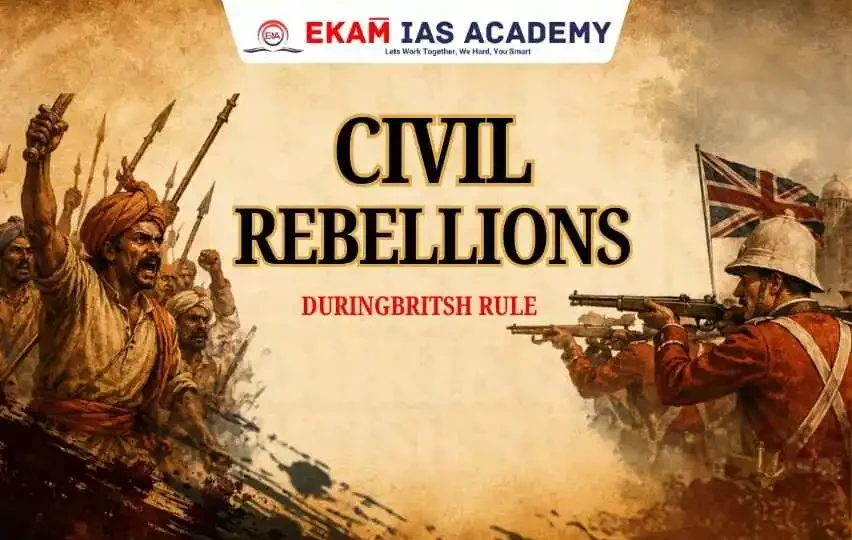
The history of colonial expansion in India is marked by continuous armed resistance and popular uprisings. Understanding Civil Rebellions During British Rule is vital for Civil Rebellions UPSC preparation, as these early anti-colonial resistance movements laid the structural foundation for the broader Indian Freedom Struggle UPSC and the eventual Revolt Against British Rule.
Causes of Civil Rebellions
The relentless political, economic, and administrative changes introduced by the East India Company sparked widespread disaffection among all strata of Indian society.
- Displacement of traditional rulers, zamindars, and chieftainships by colonial conquest.
- Exorbitant land revenue demands, strict enforcement of revenue laws, and widespread land alienation.
- Disruption of rural handicraft economies and impoverishment of artisans due to British free-trade policies.
- Destruction of traditional judicial systems and extortion by colonial police and revenue officials.
Major Civil Rebellions Before 1857
Prior to the Great Revolt of 1857, several Civil Uprisings in India broke out across various regions against British authorities and their local agents.
- Sannyasi Fakir Rebellion (1763–1800): Led by religious mendicants, peasants, and displaced zamindars in Bengal following the disastrous famine of 1770.
- Paika Rebellion 1817: Led by Bakshi Jagabandhu in Odisha against the British land revenue policies and displacement of traditional Paika militia.
- Kittur Rebellion (1824–1829): Led by Rani Chennamma and Rayanna in Karnataka against the British annexation policy under the doctrine of lapse principles.
- Ahom Revolt (1828): Led by Gomdhar Konwar in Assam following the East India Company’s failure to withdraw after the First Anglo-Burmese War.
Major Civil and Peasant Rebellions in the 19th Century
Following the mid-19th century, several prominent Peasant Rebellions in India directly challenged colonial landlords and oppressive moneylenders.
- Indigo Revolt 1859: Indigo growers in Bengal refused to sow indigo under forced, coercive contracts enforced by European planters.
- Pabna Agrarian Movement (1870s–1880s): Bengal peasants formed agrarian leagues to resist illegal cesses, exorbitant rent hikes, and eviction attempts by zamindars.
- Deccan Riots 1875: Peasants in Maharashtra targeted Marwari and Gujarati moneylenders, systematically destroying debt bonds and mortgage decrees.
Tribal Rebellions Against British Rule
A distinct category of resistance, Tribal Rebellions in India targeted the invasion of traditional tribal ecosystems by colonial administrators and outside moneylenders (dikus).
- Santhal Rebellion (1855–1856): Led by Sidhu and Kanhu in the Rajmahal hills against money-lenders and Company rule.
- Khasi Rebellion (1829–1833): Led by Tirot Sing against British road construction through the Khasi hills in Meghalaya.
- Munda Uprising (1899–1900): Led by Birsa Munda in the Chhota Nagpur region against the destruction of the Khuntkatti (joint tenure) system.
Civil Rebellions and the Revolt of 1857
The widespread local discontent generated by decades of civil and tribal uprisings created an explosive atmosphere. When the Sepoy Mutiny broke out in May 1857, displaced zamindars, peasants, and rural masses joined the sepoys, transforming a military mutiny into a popular anti-colonial uprising across Northern and Central India.
Common Features of Civil Rebellions
- Local Leadership: Led by deposed rajas, landlords, religious leaders, or traditional village chiefs.
- Localized Scope: Remained geographically isolated and centered on immediate local grievances.
- Traditional Weaponry: Reliance on traditional weapons like bows, arrows, swords, and spears against modern British artillery.
Why Did Civil Rebellions Fail
- Lack of centralized coordination, modern military strategy, and unified national leadership.
- Military and technological superiority of the East India Company’s forces.
- Absence of a comprehensive socio-political vision for a post-colonial Indian nation-state.
Significance of Civil Rebellions
Evaluating Civil Rebellions During British Rule UPSC highlights their strategic impact:
- Shattered the myth of peaceful British rule and Indian passive acceptance.
- Maintained a continuous tradition of armed resistance against foreign domination.
- Served as foundational inspiration for subsequent mass national movements in Modern Indian History .
Civil Rebellions vs Tribal Rebellions vs Peasant Movements
- Civil Rebellions: Led primarily by displaced traditional elites (rulers, zamindars) supported by rural populations to restore pre-colonial political order.
- Tribal Rebellions: Spontaneous, intense uprisings by indigenous tribes to protect ancestral land, forest autonomy, and culture from outside encroachers (dikus).
- Peasant Movements: Focused on specific economic demands such as high rents, illegal cesses, debt relief, and security of land tenure.
Important Civil Rebellions
| Rebellion / Movement | Year | Region | Key Leaders |
| Sannyasi Fakir Rebellion | 1763–1800 | Bengal | Manju Shah, Debi Chaudhurani |
| Paika Rebellion | 1817 | Odisha | Bakshi Jagabandhu |
| Kittur Rebellion | 1824–1829 | Karnataka | Rani Chennamma, Rayanna |
| Khasi Rebellion | 1829–1833 | Meghalaya | Tirot Sing |
| Ahom Revolt | 1828 | Assam | Gomdhar Konwar |
| Indigo Revolt | 1859 | Bengal | Digambar Biswas, Bishnu Biswas |
| Deccan Riots | 1875 | Maharashtra | Local Peasant Farmers |
Timeline of Civil Rebellions
- 1763: Outbreak of the Sannyasi Fakir Rebellion.
- 1817: Start of the Paika Rebellion 1817 in Odisha.
- 1824: Launch of the Kittur Rebellion under Rani Chennamma.
- 1829: Commencement of the Khasi Rebellion led by Tirot Sing.
- 1859: Outbreak of the Indigo Revolt 1859 in Bengal.
- 1875: Outbreak of the Deccan Riots 1875 in Maharashtra.
Conclusion
Developing comprehensive UPSC History Notes on early uprisings is essential for mastering the Anti Colonial Movements India syllabus. These continuous British Rule Rebellions in India were vital predecessors that laid the groundwork for modern political agitation during the Civil Rebellions in India era.
UPSC Prelims: PYQs & Practice Questions
Previous Year Questions
Q: With reference to the history of India, "Ulgulan" or the Great Tumult is the description of which of the following events?
(a) The Paika Rebellion of 1817
(b) The Munda Rebellion of 1899–1900
(c) The Santhal Rebellion of 1855–56
(d) The Kol Mutiny of 1831–32
Answer: (b) The Munda Rebellion of 1899–1900
Explanation:
The Munda Rebellion of 1899–1900, led by
Birsa Munda in the
Chhota Nagpur region, is historically known as the
"Ulgulan" or Great Tumult.
The movement opposed the disruption of the traditional
Khuntkatti land tenure system and the growing influence of
British administrators, landlords and other outsiders or dikus.
The movement combined demands for
agrarian rights, tribal autonomy and resistance to colonial rule.
Q: Which one of the following statements does
not apply to the system of Subsidiary Alliance established by Lord Wellesley?
(a) To maintain a large standing army at others' expense
(b) To keep India safe from the Napoleonic danger
(c) To secure a fixed income for the Company
(d) To establish British paramountcy over the Indian States
Answer: (c) To secure a fixed income for the Company
Explanation:
The Subsidiary Alliance, associated with
Lord Wellesley, aimed to strengthen British political and military control over Indian States.
It enabled the British to maintain
subsidiary troops at the expense of Indian rulers,
counter the
French and Napoleonic threat, and expand
British paramountcy.
Securing a
fixed income for the East India Company was not the principal objective of the Subsidiary Alliance.
Revenue arrangements such as the
Permanent Settlement were more directly related to securing regular land revenue.
Practice Questions
Q: With reference to the Paika Rebellion of 1817, consider the following statements:
1. The Paikas were the traditional landed militia of the Gajapati rulers of Odisha.
2. The rebellion was led by Bakshi Jagabandhu Bidyadhar against British land revenue policies and disruption of the traditional salt economy.
3. The uprising remained completely confined to Puri and failed to garner support from local peasantry and tribal groups.
Which of the statements given above are correct?
(a) 1 and 2 only
(b) 2 and 3 only
(c) 1 and 3 only
(d) 1, 2 and 3
Answer: (a) 1 and 2 only
Explanation:
Statements 1 and 2 are correct.
The Paikas were the traditional hereditary landed militia associated with the rulers of Odisha.
The rebellion of 1817 was led by
Bakshi Jagabandhu Bidyadhar, the military commander of the
King of Khurda.
Major causes included the loss of
rent-free Paikali lands, oppressive revenue policies, currency-related grievances and problems arising from British control over the
salt economy.
Statement 3 is incorrect.
The rebellion was not confined to Puri. It spread across areas including
Khurda, Banapur, Puri and Cuttack and received support from
peasants, local zamindars and Kondh tribal groups.
Q: Which of the following early civil/tribal uprisings are correctly matched with their respective leaders?
1. Kittur Rebellion — Rani Chennamma and Rayanna
2. Sannyasi-Fakir Rebellion — Manju Shah and Debi Chaudhurani
3. Ahom Revolt — Gomdhar Konwar
4. Ramosi Uprising — Chittur Singh and Vasudev Balwant Phadke
Select the correct answer using the code given below:
(a) 1 and 3 only
(b) 2 and 4 only
(c) 1, 2 and 3 only
(d) 1, 2, 3 and 4
Answer: (d) 1, 2, 3 and 4
Explanation:
Pair 1 is correctly matched.
The Kittur Rebellion was led by
Rani Chennamma and later continued by
Sangolli Rayanna against British intervention in Karnataka.
Pair 2 is correctly matched.
The Sannyasi-Fakir Rebellion in Bengal involved leaders such as
Majnu Shah and figures associated with the resistance tradition such as
Debi Chaudhurani.
Pair 3 is correctly matched.
The Ahom Revolt of 1828 was associated with
Gomdhar Konwar and resistance to continued British presence in Assam.
Pair 4 is correctly matched.
The Ramosi uprisings in Maharashtra were associated with
Chittur Singh, while later anti-British resistance in the region was led by
Vasudev Balwant Phadke.
Therefore, option (d) is correct.
UPSC Mains – Previous Year & Practice Questions
Mains Previous Year Questions
[15 Marks | 250 Words]
Question: Evaluate the nature and significance of the tribal and civil rebellions in India prior to the Revolt of 1857. (UPSC CSE Mains 2020, GS Paper I)
[15 Marks | 250 Words]
Question: “The civil and peasant uprisings of the first century of British rule were local, isolated and backward-looking, yet they provided the foundation for future national resistance.” Discuss. (UPSC CSE Mains 2018, GS Paper I)
[10 Marks | 150 Words]
Question: Examine the causes behind the Indigo Revolt of 1859–60. How did it differ from earlier traditional civil rebellions? (UPSC CSE Mains 2014, GS Paper I)
[15 Marks | 250 Words]
Question: Discuss the character and historical importance of the Paika Rebellion of 1817 in Odisha. Can it be termed as the First War of Indian Independence? (UPSC CSE Mains 2007, Modern History)
[10 Marks | 150 Words]
Question: “The early civil rebellions against the East India Company were led by traditional elites seeking to restore a bygone feudal order.” Critically analyse. (UPSC CSE Mains 1999, Modern History)
Mains Practice Questions
[15 Marks | 250 Words]
Question: “The rapid economic impoverishment of rural India under the East India Company's land revenue settlements was the single most pervasive cause behind civil uprisings before 1857.” Elucidate.
[15 Marks | 250 Words]
Question: Compare and contrast Civil Rebellions with Tribal Uprisings in 19th-century India in terms of their leadership structure, socio-economic grievances and methods of resistance.
[10 Marks | 150 Words]
Question: Why did early civil rebellions consistently fail to overthrow British rule despite widespread popular participation? Analyse the structural and strategic weaknesses of these uprisings.
Civil Rebellions-FAQs
What were Civil Rebellions During British Rule?
Civil Rebellions were early anti-colonial uprisings led by displaced rulers, zamindars, peasants, artisans and local communities against British rule.
What were the main causes of Civil Rebellions?
Major causes included colonial conquest, high land revenue, land alienation, decline of handicrafts, police oppression and disruption of traditional power structures.
Which were important Civil Rebellions before 1857?
Important examples include the Sannyasi-Fakir Rebellion, Paika Rebellion, Kittur Rebellion, Ahom Revolt and Khasi Rebellion.
How were Civil Rebellions different from Tribal Rebellions?
Civil Rebellions were often led by displaced elites or local leaders, while Tribal Rebellions were mainly aimed at protecting tribal land, forest rights and culture from outsiders.
Why are Civil Rebellions important for UPSC?
They are important because they show early resistance to colonial rule and provide background for the Revolt of 1857 and later Indian national movements.