Table of Contents
ToggleState Formation in India
The dynamic process of State Formation in India reflects the evolving socioeconomic, linguistic, and political aspirations of a diverse nation. Article 1 describes India as a “Union of States,” establishing an indestructible Union with destructible states. For civil services aspirants, understanding State Formation UPSC, constitutional frameworks under Article 3 UPSC, and the impact of State Reorganisation in India is crucial for mastering key concepts in Indian Polity UPSC.
Constitutional Provisions & Procedure for Formation of New States
Key Constitutional Articles
- Article 2 : Empowers Parliament to admit into the Union, or establish, new states on terms and conditions it thinks fit (applies to territories not previously part of India).
- Article 3 : Authorizes Parliament to form new states, alter boundaries, diminish or increase state areas, or change state names (applies to existing components of the Indian Union).
- Article 4: Clarifies that laws made under Articles 2 and 3 are not considered constitutional amendments under Article 368.
Important Constitutional Provisions
| Article | Provision |
|---|---|
| Article 1 | Name and territory of the Union |
| Article 2 | Admission or establishment of new States |
| Article 3 | Formation and alteration of States |
| Article 4 | Laws under Articles 2 and 3 |
| Seventh Schedule | Distribution of legislative powers |
Procedure Under Article 3
- Presidential Recommendation: A bill introducing state reorganization can only be introduced in either House of Parliament with the prior recommendation of the President.
- State Legislature Reference: The President must refer the bill to the concerned state legislature for expressing its views within a specified time limit.
- Non-Binding Views: Parliament is not bound by the views or recommendations of the state legislature and can proceed with simple majority approval.
Historical Evolution of State Reorganisation
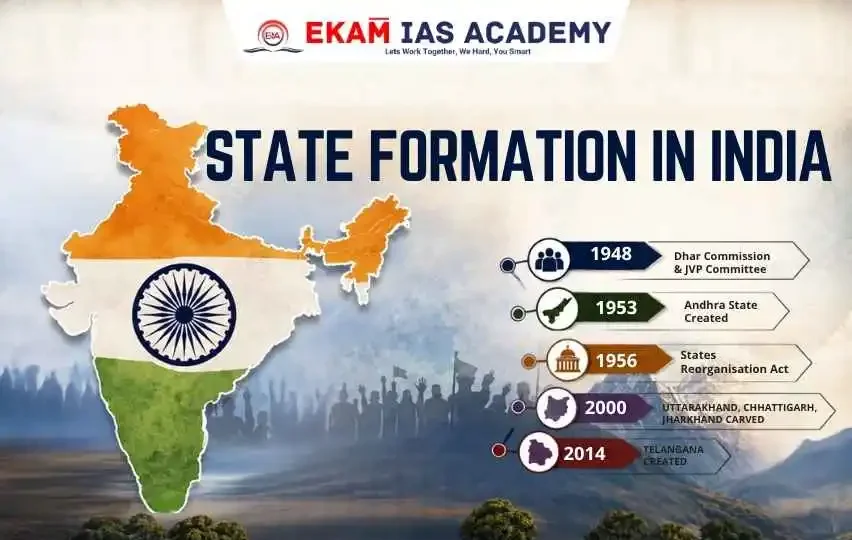
| Year | Development |
|---|---|
| 1948 | Dhar Commission & JVP Committee |
| 1953 | Andhra State Created on Linguistic Basis |
| 1956 | States Reorganisation Act |
| 2000 | UP, MP, Bihar Carved |
| 2014 | Telangana Created |
Important Commissions and Committees
- Dhar Commission (1948): Recommended reorganization based on administrative convenience rather than linguistic considerations.
- JVP Committee (1948): Comprising Jawaharlal Nehru, Vallabhbhai Patel, and Pattabhi Sitaramayya, it formally rejected language as the primary criterion for statehood.
- Andhra State Creation (1953): The death of Potti Sreeramulu following a 56-day hunger strike forced the government to create the first linguistic state.
- States Reorganisation Commission UPSC (1953–1955): Headed by Fazl Ali (along with H.N. Kunzru and K.M. Panikkar), it accepted linguistic homogeneity as a primary factor but rejected “one language, one state.” This led to the landmark States Reorganisation Act 1956.
Creation of New States in India & Recent Milestones
- Reorganisation Milestones: Creation of Gujarat & Maharashtra (1960), Nagaland (1963), Punjab & Haryana (1966), and Northeastern states under the North-Eastern Areas Reorganisation Act (1971).
- Creation of States in 2000: Chattisgarh (from MP), Uttarakhand (from UP), and Jharkhand (from Bihar) were carved out based on administrative challenges and regional backwardness.
- Formation of Telangana (2014): Bifurcated Andhra Pradesh following decades of public demand, highlighting identity and developmental asymmetry.
Major Issues, Challenges, and Arguments
Arguments in Favour of Smaller States
- Administrative Efficiency: Better governance reach and lower administrative overhead per capita.
- Targeted Development: Focus on local tribal, geographic, or economic backwardness.
- Balanced Regional Growth: Reduces regional disparities within large states.
Arguments Against Excessive State Fragmentation
- Fiscal Unviability: Increased administrative costs and dependency on Central grants.
- Inter-State Disputes: Escalation of water-sharing conflicts, border disputes, and capital asset distribution issues.
- State Formation and Regionalism: Risks fueling narrow parochialism over national integration.
Conclusion
Analyzing State Formation Issues reveals a continuous balancing act between administrative feasibility and sub-national identity. Strengthening State Formation and Federalism through cooperative institutional mechanisms ensures that the Linguistic Reorganisation of States and the creation of Smaller States in India enhance governance without compromising national unity.
UPSC Prelims: PYQs & Practice Questions
Previous Year Questions
Q: Consider the following statements regarding the creation of new States in India under Article 3 of the Constitution:
1. A Bill introducing the reorganisation of any State can be introduced in either House of Parliament only on the recommendation of the President.
2. The views expressed by the concerned State Legislature on the reorganisation Bill are binding on Parliament.
Which of the statements given above is/are correct?
(a) 1 only
(b) 2 only
(c) Both 1 and 2
(d) Neither 1 nor 2
Answer: (a) 1 only
Explanation:
Statement 1 is correct.
Under Article 3, a Bill relating to the
formation of a new State or alteration of the area, boundaries or name of an existing State
can be introduced in either House of Parliament only on the
recommendation of the President.
Statement 2 is incorrect.
Where the proposal affects the area, boundaries or name of a State, the President refers the Bill to the
concerned State Legislature for expressing its views within a specified period.
However, the views of the State Legislature are
advisory and not binding on Parliament.
Parliament may accept, modify or reject those views.
Q: Which of the following bodies/commissions recommended the
reorganisation of Indian States primarily on the basis of administrative convenience rather than language
in 1948?
(a) Fazl Ali Commission
(b) Dhar Commission
(c) States Reorganisation Commission
(d) Wanchoo Committee
Answer: (b) Dhar Commission
Explanation:
The S.K. Dhar Commission, also known as the
Linguistic Provinces Commission, was appointed in
1948 to examine the question of reorganising provinces on linguistic lines.
The Commission recommended that the reorganisation of States should be based primarily on
administrative convenience rather than language.
This approach was broadly supported subsequently by the
JVP Committee comprising
Jawaharlal Nehru, Vallabhbhai Patel and Pattabhi Sitaramayya.
Later, the Fazl Ali Commission of 1953 gave greater importance to
linguistic homogeneity along with administrative, economic and national considerations.
Practice Questions
Q: With reference to Article 2 and Article 3 of the Constitution of India, consider the following statements:
1. Article 2 relates to the admission or establishment of new States that were not previously part of the territory of India.
2. Article 3 relates to the internal reorganisation of existing States within the Indian Union.
3. Any law passed under Article 2 or Article 3 requires a constitutional amendment under Article 368 ratified by half of the State Legislatures.
How many of the statements given above are correct?
(a) Only one
(b) Only two
(c) All three
(d) None
Answer: (b) Only two
Explanation:
Statement 1 is correct.
Article 2 empowers Parliament to
admit into the Union or establish new States.
It primarily deals with territories that were not already part of the existing Indian Union.
Statement 2 is correct.
Article 3 deals with the
internal reorganisation of States, including the formation of new States and alteration of
areas, boundaries or names of existing States.
Statement 3 is incorrect.
Under Article 4, laws made under
Articles 2 and 3 are not treated as constitutional amendments for the purposes of
Article 368.
Such laws can therefore be passed through the
ordinary legislative process by a simple majority and do not require ratification by half of the State Legislatures.
Q: Consider the following events regarding State Reorganisation in post-independence India:
1. Creation of Andhra State
2. Enactment of the States Reorganisation Act
3. Bifurcation of Bombay State into Maharashtra and Gujarat
4. Creation of Nagaland as a full-fledged State
Which one of the following is the correct chronological sequence?
(a) 1 — 2 — 3 — 4
(b) 2 — 1 — 4 — 3
(c) 1 — 3 — 2 — 4
(d) 2 — 3 — 1 — 4
Answer: (a) 1 — 2 — 3 — 4
Explanation:
1. Andhra State was created in
October 1953 and became the first State created on a
linguistic basis after independence.
2. States Reorganisation Act, 1956 reorganised the political map of India and created
14 States and 6 Union Territories.
3. Bombay State was bifurcated in
1960 into
Maharashtra and Gujarat.
4. Nagaland became a full-fledged State in
1963.
Therefore, the correct sequence is
1 — 2 — 3 — 4.
UPSC Mains – Previous Year & Practice Questions
Mains Previous Year Questions
[15 Marks]
Question: “The constitutional mechanism under Article 3 demonstrates that India is an indestructible Union of destructible States.” Discuss in the context of federal balance and State autonomy. (UPSC GS Paper II – 2022)
[15 Marks]
Question: Has the creation of smaller States in India fulfilled the objectives of better governance and accelerated economic development? Analyse with examples of the States created in 2000. (UPSC GS Paper II – 2021)
[10 Marks]
Question: Examine the factors behind the demand for new States in contemporary India. Are these demands predominantly driven by regional identity or developmental imbalances? (UPSC GS Paper II – 2018)
[12.5 Marks]
Question: Discuss the impact of the States Reorganisation Act, 1956 on linguistic integration and the Centre-State administrative equilibrium in India. (UPSC GS Paper II – 2016)
[10 Marks]
Question: Critically evaluate the political and economic consequences of the bifurcation of Andhra Pradesh under the Andhra Pradesh Reorganisation Act, 2014. (UPSC GS Paper II – 2014)
Mains Practice Questions
[15 Marks | 250 Words]
Question: “While linguistic reorganisation in 1956 preserved national integration, modern demands for State creation are increasingly grounded in sub-regional governance concerns and economic neglect.” Critically examine.
[10 Marks | 150 Words]
Question: Analyse whether the non-binding nature of State Legislature opinions under Article 3 compromises the spirit of Cooperative Federalism.
[15 Marks | 250 Words]
Question: “Creating smaller States is not a panacea for governance deficits unless accompanied by effective fiscal decentralization and administrative capacity.” Discuss.
State Formation in India-FAQs
What is State Formation in India?
State Formation in India refers to the creation, alteration, merger, division, or renaming of states under constitutional provisions.
Which Article deals with formation of new states?
Article 3 empowers Parliament to form new states, alter state boundaries, change state names, or increase and diminish state areas.
Are state legislature views binding under Article 3?
No. The concerned state legislature is consulted, but its views are not binding on Parliament.
What was the importance of the States Reorganisation Act 1956?
The Act reorganised Indian states largely on linguistic lines and created a more rational federal map after independence.
Why is State Formation important for UPSC?
It is important because it connects Article 3, Indian federalism, linguistic reorganisation, smaller states, Telangana formation and Centre-State relations.