Table of Contents
ToggleState Reorganization Commission (SRC)
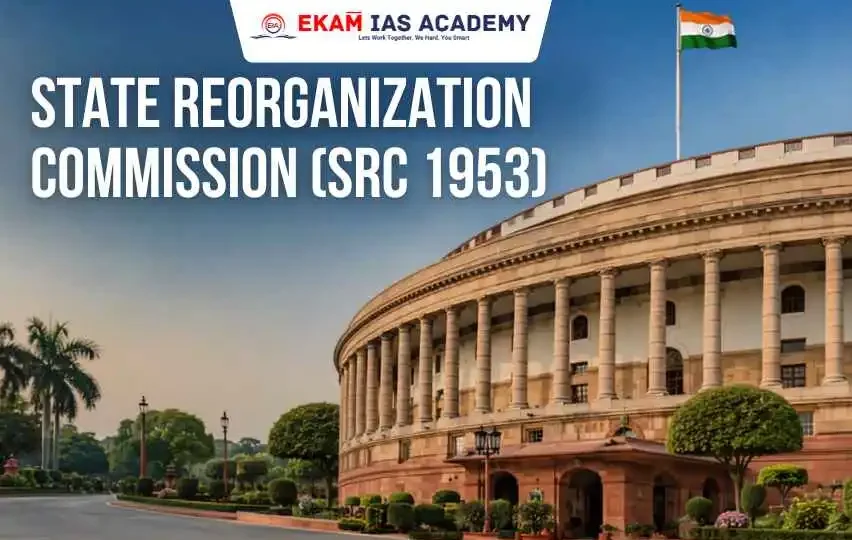
The State Reorganization Commission (SRC 1953) was a landmark statutory body established to redraw India’s internal administrative boundaries on a rational basis. Mastering State Reorganization Commission Notes is essential for State Reorganisation Commission UPSC preparation, as it connects key concepts in Indian Polity UPSC and Post Independence India.
Historical Background and Formation
Demands for the Linguistic Reorganisation of States intensified immediately post-independence. Earlier panels like the Dhar Commission (1948) and JVP Committee (1948) prioritized administrative convenience over linguistic identity. However, following the 56-day hunger strike and martyrdom of Potti Sriramulu, intense public pressure forced the Formation of Andhra State in October 1953 as India’s first linguistic state. To address similar nationwide demands, the Union Government appointed the Fazl Ali Commission in December 1953, comprising Justice Fazl Ali, H.N. Kunzru, and K.M. Panikkar.
Terms of Reference
The primary mandate of the commission was to examine the reorganization of state boundaries while preserving national unity, financial viability, and administrative efficiency. Submitted in 1955, its report rejected the “one language-one state” doctrine but broadly accepted language as a primary criterion.
Major Recommendations
Its major recommendations led directly to the enactment of the State Reorganisation Act 1956 and the Seventh Constitutional Amendment 1956. This reform abolished the colonial-era four-fold classification of states (Part A, B, C, and D) and restructured the nation into 14 states and 6 union territories on November 1, 1956.
Constitutional Provisions & Post-1956 Evolution
The Reorganization of States in India is governed by Part I of the Constitution:
- Article 2: Empowers Parliament to admit or establish new states into the Union.
- Article 3: Authorizes Parliament to form new states, alter areas, boundaries, or names of existing states by simple majority.
- Article 4: Clarifies that laws enacted under Articles 2 and 3 are not considered constitutional amendments under Article 368.
- This framework enabled the subsequent creation of states, including Maharashtra and Gujarat (1960), Nagaland (1963), Punjab and Haryana (1966), Chhattisgarh, Uttarakhand, and Jharkhand (2000), Telangana (2014), and the reorganization of Jammu & Kashmir (2019).
Impact, Criticism, & Significance for Indian Federalism
While critics argued that linguistic reorganization could foster sub-national chauvinism, the State Reorganization Commission – UPSC Perspective highlights how accommodating regional identity actually strengthened democratic participation and consolidated national integration. By fulfilling regional aspirations, the SRC fortified the foundations of Indian Federalism. These UPSC Polity Notes provide crucial insights into how India evolved as an “indestructible Union of destructible states.”
Conclusion
The State Reorganization Commission (SRC 1953) fundamentally reshaped India’s internal political map by aligning state boundaries with linguistic identities and administrative efficiency. Through the State Reorganisation Act 1956, it eliminated colonial-era administrative divisions, strengthening Indian Federalism by balancing regional aspirations with national integration. The constitutional provisions under Articles 2, 3, and 4 continue to ensure that India’s state boundaries remain dynamic, adaptable, and responsive to evolving socio-economic needs.
UPSC Prelims: PYQs & Practice Questions
Previous Year Questions (Prelims)
Q: Consider the following statements regarding the reorganisation of states in India:
1. The State Reorganisation Commission set up in 1953 rejected the theory of
“one language, one state.”
2. The Seventh Constitutional Amendment Act, 1956 abolished the distinction between Part A and Part B States and completely removed Part C and Part D States.
Which of the statements given above is/are correct?
(a) 1 only
(b) 2 only
(c) Both 1 and 2
(d) Neither 1 nor 2
Answer: (c) Both 1 and 2
Explanation:
Statement 1 is correct. The
Fazl Ali Commission, also known as the State Reorganisation Commission of 1953, accepted language as an important basis for reorganising states but rejected the rigid principle of
“one language, one state” in the interest of national unity and administrative viability.
Statement 2 is correct. The
Seventh Constitutional Amendment Act, 1956, together with the State Reorganisation Act, 1956, abolished the earlier classification of Part A, Part B, Part C and Part D units.
The country was subsequently reorganised into
14 States and 6 Union Territories.
Q: With reference to Parliament’s power to reorganise states under Article 3 of the Constitution of India, consider the following statements: (UPSC CSE Prelims 2018)
1. A Bill proposing changes in the name, area or boundary of a State can be introduced in either House of Parliament only on the recommendation of the President.
2. The President must refer the Bill to the concerned State Legislature for expressing its views within a specified period.
3. The advice or opinion offered by the State Legislature is legally binding on Parliament.
Which of the statements given above are correct?
(a) 1 and 2 only
(b) 2 and 3 only
(c) 1 and 3 only
(d) 1, 2 and 3
Answer: (a) 1 and 2 only
Explanation:
Statement 1 is correct. Under
Article 3, a Bill relating to the formation of a new State or alteration of the area, boundary or name of an existing State can be introduced in Parliament only with the
prior recommendation of the President.
Statement 2 is correct. Where the proposal affects the area, boundary or name of a State, the President must refer the Bill to the concerned
State Legislature for expressing its views within the prescribed period.
Statement 3 is incorrect. The opinion of the State Legislature is
not binding on Parliament. Parliament may accept, modify or reject the views expressed by the State.
Practice Questions
Q: Which of the following commissions or committees were appointed prior to the State Reorganisation Commission, 1953, to examine the demand for linguistic states?
1. S.K. Dhar Commission
2. JVP Committee comprising Jawaharlal Nehru, Vallabhbhai Patel and Pattabhi Sitaramayya
3. Sarkaria Commission
Select the correct answer using the code given below:
(a) 1 and 2 only
(b) 2 and 3 only
(c) 1 and 3 only
(d) 1, 2 and 3
Answer: (a) 1 and 2 only
Explanation:
Statements 1 and 2 are correct. The
S.K. Dhar Commission was appointed in June 1948, while the
JVP Committee was constituted in December 1948 to examine demands for the creation of linguistic states.
Both bodies opposed language as the sole basis for state reorganisation and gave greater importance to
administrative convenience, national unity and economic viability.
Statement 3 is incorrect. The
Sarkaria Commission was appointed in 1983 to examine
Centre-State relations, not the reorganisation of states on linguistic grounds.
Q: Consider the following statements regarding Article 4 of the Constitution of India:
1. A law made under Article 2 or Article 3 for creating new States or altering the areas, boundaries or names of existing States is not regarded as a constitutional amendment under Article 368.
2. Such a law can be passed by Parliament through a simple majority.
Which of the statements given above is/are correct?
(a) 1 only
(b) 2 only
(c) Both 1 and 2
(d) Neither 1 nor 2
Answer: (c) Both 1 and 2
Explanation:
Statement 1 is correct. Article 4 provides that laws enacted under
Article 2 or Article 3, including consequential amendments to the First and Fourth Schedules, shall not be deemed constitutional amendments for the purposes of
Article 368.
Statement 2 is correct. Since such legislation is treated as an ordinary law, it can be passed by Parliament through a
simple majority of members present and voting.
UPSC Mains – Previous Year & Practice Questions
Mains Previous Year Questions
[15 Marks | 250 Words]
Question: Has the creation of linguistic states strengthened Indian unity or weakened it? Discuss with reference to the recommendations of the State Reorganisation Commission, 1953. (UPSC CSE Mains 2022, GS Paper II)
[15 Marks | 250 Words]
Question: The political and administrative reorganisation of states in India is an ongoing process under Article 3 of the Constitution. Examine how administrative convenience and regional aspirations have driven the formation of states after 1956. (UPSC CSE Mains 2020, GS Paper II)
[10 Marks | 150 Words]
Question: Discuss the circumstances that led to the formation of Andhra State in 1953 and explain how it acted as a catalyst for the nationwide reorganisation of states on a linguistic basis. (UPSC CSE Mains 2018, GS Paper I – Post-Independence)
[10 Marks | 150 Words]
Question: Discuss the constitutional procedure prescribed under Articles 2, 3 and 4 for the creation of new states and alteration of state boundaries in India. How does this arrangement reflect the idea of an “indestructible Union of destructible States”? (UPSC CSE Mains 2016, GS Paper II)
[10 Marks | 150 Words]
Question: Evaluate how the Seventh Constitutional Amendment Act, 1956 restructured the federal geography of independent India. (UPSC CSE Mains 2014, GS Paper I – Post-Independence)
Mains Practice Questions
[15 Marks | 250 Words]
Question: “The reorganisation of states in India on a linguistic basis satisfied regional identities without compromising national integrity.” Critically analyse this statement in the light of post-independence federal dynamics.
[15 Marks | 250 Words]
Question: Compare the rationale behind state reorganisation in the 1950s, which was primarily based on linguistic identity, with the formation of new states during the 2000s and 2010s, which was driven largely by developmental imbalances, regional aspirations and administrative convenience.
[10 Marks | 150 Words]
Question: Differentiate between Parliament’s powers under Article 2 and Article 3 of the Constitution of India. Illustrate the distinction with suitable constitutional examples.



State Reorganization Commission-FAQs
What was the State Reorganization Commission?
The State Reorganization Commission was a statutory body appointed in 1953 to examine the reorganisation of Indian states on linguistic, administrative and national integration grounds.
Who were the members of the Fazl Ali Commission?
The commission consisted of Justice Fazl Ali, H. N. Kunzru and K. M. Panikkar.
Why was the State Reorganization Commission formed?
It was formed after growing demands for linguistic states, especially after the formation of Andhra State in 1953 following Potti Sriramulu’s death.
What did the State Reorganisation Act 1956 do?
It reorganised India into 14 states and 6 union territories and abolished the old Part A, B, C and D state classification.
Why is the State Reorganization Commission important for UPSC?
It is important because it connects linguistic reorganisation, Indian federalism, Articles 2–4, national integration and post-independence political consolidation.