Table of Contents
ToggleIntegrated Judicial System in India
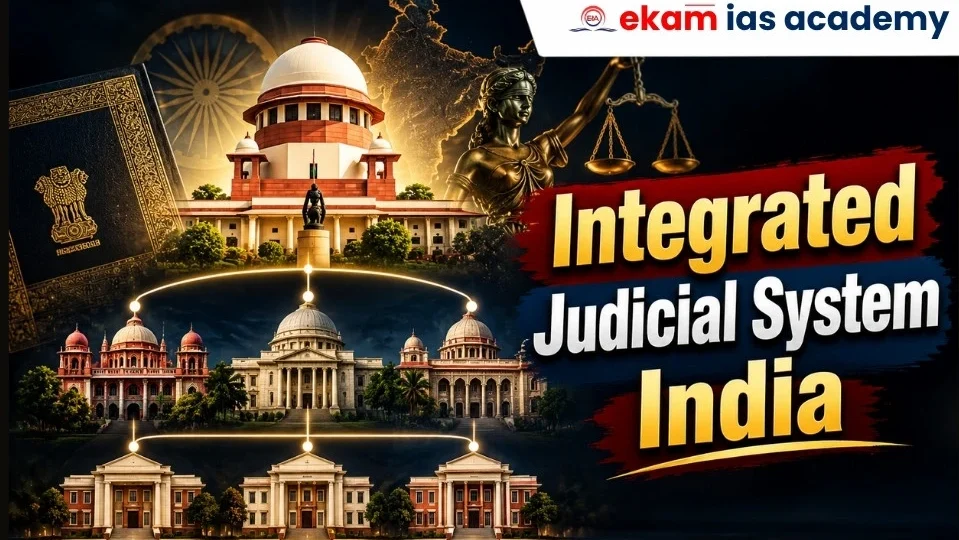
- The Unified Judicial System of India is a single unified hierarchy of courts in India which apply both Central and State laws in India.
- The Unified Judicial System of India was originally adapted from the Government of India Act, 1935. This system ensures legal consistency and upholds the concept of national integration.
- It functions under a single, non-fragmented pyramid with the Supreme Court of India UPSC at its apex.
- This framework of the Indian system of governance is of immense importance to Indian Polity and assures the rule of law and supremacy of the constitution of India.
Why Did India Adopt an Integrated Judicial System
- Avoid Diversity in Laws: Dr. B.R. Ambedkar stressed that a single Indian Integrated Judicial System prevents conflicting interpretations of federal and state laws.
- National Unity and Integrity: A single judicial structure strengthens national integration across diverse states.
- Administrative Efficiency: Eliminates jurisdictional conflicts between federal and state court systems, streamlining legal remedies.
- Historical Continuity: Retained the familiar single-tier legal framework developed under pre-independence enactments.
Constitutional Provisions Related to the Judicial System
- Part V (Articles 124–147): Governs the organization, powers, independence, and jurisdiction of the Supreme Court of India UPSC.
- Part VI (Articles 214–231 & 233–237): Establishes the High Courts in India UPSC and regulates Subordinate Courts India.
- Article 141: Declares that the law declared by the Supreme Court is binding on all courts within India, embodying an Integrated Judiciary India.
- Article 144: Mandates that all civil and judicial authorities in India act in aid of the Supreme Court.
Structure of the Indian Judicial System
- Apex Level: The Supreme Court serves as the ultimate court of appeal and guardian of the Constitution.
- State Level: High Courts in India UPSC function directly under the Supreme Court for their respective states or groups of states.
- District & Local Level: Subordinate Courts India (District Courts, Session Courts, Munsiff Courts) operate under High Court supervision.
- Pyramidal Framework: Reflects a strict hierarchical single chain of command throughout the Indian Judicial System.
Hierarchy of Courts in India
| Level | Civil Side | Criminal Side |
|---|---|---|
| District Level | District Judge | Sessions Judge |
| Intermediate Level | Civil Judge (Senior Division) | Chief Judicial Magistrate |
| Lower Level | Civil Judge (Junior Division) / Munsiff Court | Judicial Magistrate |
| Appellate Level | High Courts | High Courts |
| Apex Level | Supreme Court of India | Supreme Court of India |
- Supreme Court: Top court wielding national jurisdiction over federal, civil, constitutional, and criminal matters.
- High Courts: Regional apex courts directing the state judicial ecosystem.
- Subordinate Hierarchy: District Courts, Civil Judge Courts, and Criminal Magistrates delivering grassroots justice.
- Uniformity: Lower courts strictly adhere to the precedents set by higher Constitutional Courts in India.
Integrated Judiciary vs Dual Judiciary
| Feature | Integrated Judicial System in India | Dual Judicial System (e.g., USA) |
| Court Hierarchy | Single unified structure enforce Central and State laws | Double system: Federal Courts for Federal Laws, State Courts for State Laws |
| Law Enforcement | Same hierarchy handles all constitutional, civil, and criminal cases | Federal courts cannot enforce state-specific statutes |
| Appellate Flow | Direct appeals from District → High Court → Supreme Court | State Supreme Court decisions on state laws are usually final |
| Constitutional Nature | Unitary feature of the Constitution | Strictly federal feature |
Features of the Integrated Judicial System
- Single Chain of Appeal: Direct appellate route from local trial courts up to the Supreme Court.
- Uniformity of Law: Ensures identical application of civil and criminal statutes throughout India.
- Centralized Judicial Appointments: President appoints judges to both Supreme Court and High Courts.
- Supervisory Powers: Higher courts exercise administrative and judicial oversight over lower courts.
Integrated Judiciary and Federalism
- Unitary Tilt: Serves as a significant unitary feature within a federal constitution with a strong central bias.
- Harmonizing Dispute Resolution: Resolves federal conflicts without creating parallel state judiciary mechanisms.
- Balancing Federal Rights: Ensures uniform legal rights across states while respecting state legislative competence.
- Constitutional Harmony: Protects federal balance by acting as an impartial arbiter between Centre and States.
Supreme Court and Integration of the Judiciary
- Apex Decision Authority: Head of the Indian Judiciary Structure with binding rulings under Article 141.
- Power to Transfer Cases: Can transfer cases from one High Court to another or withdraw cases under Article 139A.
- Binding Precedents: Establishes law that brings absolute uniformity to judicial interpretation.
- Court of Record: Holds power to punish for contempt of itself and subordinate courts under Article 129.
Role of High Courts in the Integrated Judicial System
- Head of State Judiciary: Serves as the principal court of original and appellate jurisdiction in states.
- Superintendence (Article 227): Exercises administrative and judicial control over all Subordinate Courts India.
- Writ Jurisdiction (Article 226): Broader scope than the Supreme Court, enforcing Fundamental Rights and other legal rights.
- Link in Hierarchy: Connects grassroots district courts to the Supreme Court appellate chain.
Integrated Judiciary and Judicial Independence
- Security of Tenure: Judges hold office with strict removal procedures requiring Parliamentary approval.
- Financial Autonomy: Salaries and administrative expenses are charged on the Consolidated Fund.
- Insulation from Politics: Judicial conduct cannot be discussed in legislatures, keeping executive influence away.
- Contempt Powers: Keeps the Judiciary under Indian Constitution independent and authoritative.
Judicial Review in an Integrated Judicial System
- Basic Structure: Declared an unalterable feature in L. Chandra Kumar v. Union of India (1997).
- Constitutional Check: High Courts and Supreme Court review executive and legislative acts.
- Validity of Laws: Ensures state and central legislation align with constitutional provisions.
- Tribunal Oversight: Brings decision-making of specialized tribunals under High Court writ jurisdiction.
Integrated Judiciary and Fundamental Rights
- Guarantor of Liberties: Supreme Court (Article 32) and High Courts (Article 226) protect fundamental liberties.
- Writ Issuance: Enforces remedies through Habeas Corpus, Mandamus, Prohibition, Certiorari, and Quo-Warranto.
- Direct Accessibility: Citizens can directly approach Constitutional Courts in India for rights violations.
- Uniform Legal Remedies: Guarantees equal protection and rights enforcement across every state.
Integrated Judiciary and Centre-State Disputes
- Exclusive Jurisdiction (Article 131): Supreme Court adjudicates original disputes between Centre and States or inter-state disputes.
- Neutral Arbiter: Prevents state-level bias by keeping inter-governmental conflicts within the apex forum.
- Constitutional Balance: Resolves federal deadlocks to keep the Union cohesive.
- Uniform Legal Answers: Sets binding federal norms across all federating units.
Integrated Judiciary and Subordinate Courts
- Control and Oversight (Article 235): High Courts manage postings, promotions, and discipline of lower court judges.
- Uniform Procedure: Follow national procedural codes like the Code of Criminal Procedure (CrPC) and Civil Procedure Code (CPC).
- Grassroots Justice: Acts as the primary interface for citizens seeking legal remedies.
- Appellate Foundation: Forms the base tier for higher court appeals.
Advantages of an Integrated Judicial System
- Prevents Inconsistent Outcomes: Ensures that central and state statutes are interpreted consistently.
- Equality before the Law: Ensures equal treatment of all citizens of the country under the same laws.
- Preserves Constitutional Values: Supports the rule of law and values of the Constitution.
- Integrates the Nation: Creates a single legal identity for the nation.
Challenges Before the Indian Judicial System
- High Case Pendency: Backlog of millions of cases across all judicial tiers.
- Vacancies in Bench: Significant delays in filling vacancies in High Courts and Subordinate Courts.
- Expensive Appellate Process: Appealing to the Supreme Court in New Delhi is costly for rural litigants.
- Infrastructure Deficit: Inadequate digital and physical infrastructure in lower courts.
Conclusion
- The Integrated Judicial System in India ensures judicial unity, legal certainty and constitutional supremacy.
- Balancing federalism and unitary characteristics, it offers protection to the citizens of India through a system of court hierarchy.
- Efforts to remedy structural delays and address judicial vacancies would strengthen the system.
UPSC Prelims: PYQs & Practice Questions
Previous Year Questions (Prelims)
Q: Which one of the following in Indian polity is an essential feature that indicates that it is federal in character?
(a) The independence of the judiciary is safeguarded.
(b) The Union Legislature has elected representatives from constituent units.
(c) The Union Cabinet can have elected representatives from regional parties.
(d) The Fundamental Rights are enforceable by Courts of Law.
Answer: (a) The independence of the judiciary is safeguarded.
Explanation:
In a federal setup, an independent judiciary acts as an arbiter of disputes between the Centre and the States, preventing legislative and executive encroachments.
While the Integrated Judicial System in India incorporates a unitary hierarchy, judicial independence remains indispensable to upholding federalism.
Q: The power of the Supreme Court of India to decide disputes between the Centre and the States falls under its:
(a) Advisory jurisdiction
(b) Appellate jurisdiction
(c) Original jurisdiction
(d) Writ jurisdiction
Answer: (c) Original jurisdiction
Explanation:
Under Article 131, the Supreme Court has exclusive original jurisdiction over disputes between the Government of India and one or more States, or between two or more States.
This reinforces the Supreme Court's role as the apex constitutional arbiter in the Indian Integrated Judicial System.
Practice Questions
Q: With reference to the Integrated Judicial System in India, consider the following statements:
1. The High Courts enforce both Central and State laws within their respective jurisdictions.
2. The administrative expenses of the High Courts are charged to the Consolidated Fund of India.
3. The Supreme Court can transfer a case pending before one High Court to another High Court under Article 139A.
Which of the statements given above is/are correct?
(a) 1 and 2 only
(b) 1 and 3 only
(c) 3 only
(d) 1, 2, and 3
Answer: (b) 1 and 3 only
Explanation:
Statement 1 is correct: Unlike the US dual judiciary, Indian High Courts enforce both Central and State laws within their respective jurisdictions.
Statement 2 is incorrect: The administrative expenses and salaries of High Court judges/staff are charged to the Consolidated Fund of the State (though pensions are charged to the Consolidated Fund of India).
Statement 3 is correct: Article 139A empowers the Supreme Court to transfer cases between High Courts to ensure uniform legal adjudication.
Q: Which of the following constitutional provisions directly reinforce the binding nature and integration of the Indian Judiciary Structure?
1. Article 141
2. Article 144
3. Article 227
Select the correct answer using the code given below:
(a) 1 and 2 only
(b) 2 and 3 only
(c) 1 and 3 only
(d) 1, 2, and 3
Answer: (d) 1, 2, and 3
Explanation:
Article 141: Law declared by the Supreme Court is binding on all lower courts.
Article 144: Civil and judicial authorities across India must act in aid of the Supreme Court.
Article 227: Grants High Courts administrative and judicial superintendence over all subordinate courts within their territory.
UPSC Mains – Previous Year & Practice Questions
Mains Previous Year Questions
Question: How does the concept of judicial independence impact the functioning of the Integrated Judicial System in India? (UPSC CSE Mains 2021)
[15 Marks | 250 Words]
Question: Critically examine the Supreme Court's role as the ultimate interpreter of the Constitution within the unified judicial structure of India. (UPSC CSE Mains 2020)
[10 Marks | 150 Words]
Question: Discuss the significance of the High Courts in India within the integrated judicial framework, particularly regarding their supervisory and writ powers. (UPSC CSE Mains 2019)
[15 Marks | 250 Words]
Question: In what ways does the Unified Judicial System in India balance the unitary bias of the Constitution with federal autonomy? (UPSC CSE Mains 2017)
[10 Marks | 150 Words]
Question: Analyze how the collegium system for judicial appointments influences the independence and structural integrity of the Hierarchy of Courts in India. (UPSC CSE Mains 2015)
[15 Marks | 250 Words]
Mains Practice Questions
[15 Marks | 250 Words]
Question: The Indian Integrated Judicial System was designed as a single pyramidal structure to prevent legal fragmentation. Assess its structural efficacy in addressing modern pendency and access-to-justice challenges.
[10 Marks | 150 Words]
Question: Distinguish between the Integrated Judiciary India model and the US Dual Judiciary model. How does the Indian approach safeguard both fundamental rights and federal stability?
[15 Marks | 250 Words]
Question: Discuss the constitutional mechanisms under Articles 141, 144, and 227 that bind Subordinate Courts India to higher Constitutional Courts in India. How do these provisions maintain structural discipline?
Integrated Judicial System in India-FAQs
What is an Integrated Judicial System in India?
India has a single, unified judicial hierarchy headed by the Supreme Court. The same system administers both Union and State laws, unlike the dual court structure found in countries such as the USA.
What are the main constitutional provisions governing the Indian judiciary?
The Supreme Court is primarily governed by Articles 124–147, while High Courts are covered mainly under Articles 214–231. Articles 141 and 144 further strengthen judicial integration.
How does Article 141 contribute to an Integrated Judiciary?
Article 141 makes the law declared by the Supreme Court binding on all courts within India. This promotes uniformity and consistency in the interpretation and application of law.
What role do High Courts play in the Integrated Judicial System?
High Courts supervise subordinate courts under Article 227 and exercise writ jurisdiction under Article 226. They form the crucial link between district courts and the Supreme Court.
What are the major advantages of an Integrated Judicial System?
It promotes uniform interpretation of laws, equal access to justice, constitutional supremacy and national integration. It also reduces conflicts between separate Union and State judicial systems.