Table of Contents
ToggleJudicial Activism and Parliament UPSC
Mastering Judicial Activism and Parliament is vital for civil services aspirants navigating Judicial Activism UPSC, Supreme Court UPSC, and Indian Polity UPSC modules. The delicate institutional relationship between the legislature and the judiciary defines the operational framework of Indian democracy. Analyzing Judiciary and Parliament India dynamics enables candidates to evaluate how the judiciary balances fundamental rights protection against legislative supremacy within Parliament and Judiciary Relations.
What Is Judicial Activism
- Proactive Role: The proactive legal approach where courts venture beyond traditional dispute resolution to safeguard human rights.
- Rights Enforcement: Protects fundamental freedoms by stepping in when executive inaction or legislative gaps threaten constitutional guarantees.
- Dynamic Interpretation: Interprets the text of the Constitution as a living document responsive to changing societal realities.
- Administrative Accountability: Holds state executive machinery directly accountable to basic constitutional principles under Judicial Activism in India.
Judicial Activism vs Judicial Review
- Judicial Review: The formal constitutional power of courts to examine the statutory validity of legislative enactments and executive actions.
- Judicial Activism: An assertive exercise of judicial authority going beyond voiding illegal statutes to actively issuing policy directives.
- Constitutional Origin: Judicial review is explicitly rooted in the text of Article 13, Article 32, and Article 226.
- Scope Difference: Judicial review checks statutory legality; judicial activism creates affirmative remedies for governance failures.
Constitutional Basis of Judicial Review
- Article 13: Declares any legislative enactment inconsistent with fundamental rights null, void, and unenforceable.
- Article 32 & 226: Empowers the Supreme Court and High Courts to issue extraordinary constitutional writs to enforce fundamental rights.
- Article 136: Grants discretionary Special Leave Petition powers to ensure uniform judicial justice across the country.
- Article 142: Vests the Supreme Court with broad inherent jurisdiction to pass any decree necessary for doing “complete justice”.
Parliamentary Sovereignty vs Constitutional Supremacy
- British Model: Absolute Parliamentary sovereignty where legislative acts cannot be struck down by common law courts.
- Indian Model: Absolute Constitutional Supremacy India where Parliament operates strictly within constitutional boundaries.
- Judicial Oversight: Parliamentary statutes remain subject to judicial review under Parliamentary Sovereignty India.
- Harmonious Compromise: Combines legislative policy initiatives with independent judicial checks and balances.
Parliament and Judicial Review
- Law-Making Authority: Parliament possesses sovereign authority to enact laws, amend statutes, and vote on fiscal budgets.
- Constitutional Check: The judiciary reserves power to strike down parliamentary statutes violating Part III fundamental rights.
- Interactive Balance: Ensures parliamentary majorities cannot override individual fundamental freedoms guaranteed under the Constitution.
- Institutional Equilibrium: Maintains functional harmony within Judicial Review and Parliament constitutional interactions.
Evolution of Judicial Activism in India
- Locus Standi Shift: Relaxed formal procedural rules in the late 1970s to allow public-spirited citizens to petition courts.
- Post-Emergency Pivot: Expanded fundamental rights scope following lessons learned during the internal emergency period.
- Procedural Due Process: Evolved Article 21 interpretation from strict “procedure established by law” to substantive “due process of law”.
- Socio-Economic Protection: Transformed judicial procedures to protect vulnerable, unrepresented, and impoverished sections of society.
Basic Structure Doctrine and Parliament
- Kesavananda Bharati Case (1973): Established that parliamentary amending power under Article 368 cannot alter the Constitution’s basic structure.
- Judicial Review Included: Declared the power of judicial review an unamendable core feature of the Indian Constitution.
- Legislative Boundary: Restricts Parliament from passing constitutional amendments that erode judicial independence or democratic checks.
- Ultimate Constitutional Shield: Preserves structural constitutional integrity against temporary legislative majorities.
Judicial Activism and PIL
- Public Interest Litigation: Evolved as the primary procedural instrument driving Judicial Activism in India.
- Epistolary Jurisdiction: Allows informal letters and telegrams to be converted directly into formal constitutional writ petitions.
- Pro-Poor Accessibility: Democratized constitutional remedies for citizens unable to access formal higher courts due to poverty.
- Socio-Legal Commissions: Utilizes court-appointed factual commissions to investigate complex administrative and human rights abuses.
Judicial Activism and Parliament – Areas of Interaction
- Policy Vacuums: Directs administrative actions in governance areas where Parliament has failed to enact necessary legislation.
- Electoral Reforms: Mandates asset disclosure and criminal antecedent declarations for political candidates contesting elections.
- Environmental Protection: Expands Article 21 to enforce clean air, pure water, and sustainable environmental standards.
- Executive Guidelines: Issues binding interim guidelines (e.g., Vishaka guidelines) operating as temporary law until statutory enactment.
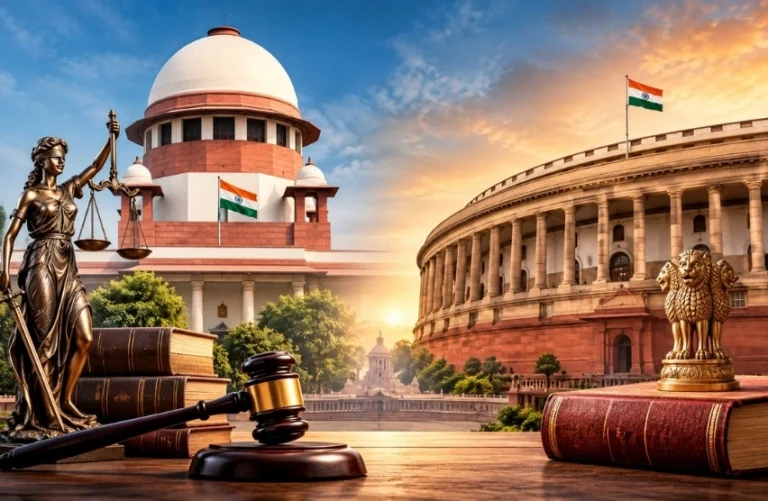
Parliament's Response to Judicial Decisions
- Statutory Nullification: Enacts retrospective validating statutes or legislative amendments to address judicial annulments.
- Constitutional Amendments: Amends specific constitutional provisions to overturn restrictive judicial precedents.
- Ninth Schedule Usage: Historically utilized Schedule IX provisions to insulate agrarian reform laws from judicial scrutiny.
- Legislative Restraint: Demonstrates legislative deference to judicial rulings protecting core fundamental human rights.
Important Examples of Judicial Activism
- Vishaka Case (1997): Formulated comprehensive binding guidelines against workplace sexual harassment pending parliamentary legislation.
- T.N. Godavarman Case (1996): Continuously monitors national forest management, conservation efforts, and environmental compliance.
- Prakash Singh Case (2006): Issued mandatory structural directions to reform state police administration and operational autonomy.
- 2G Spectrum Ruling (2012): Cancelled natural resource allocations, laying down public auction rules for national assets.
Judicial Activism and Democratic Accountability
- Legislative Accountability: Parliament remains directly answerable to the electorate every five years through general elections.
- Judicial Accountability: Judiciary exercises self-restraint; judges cannot be voted out for unpopular or flawed policy directives.
- Representation Gap: Public policy decisions require broad democratic debate, financial balancing, and legislative consensus.
- Institutional Scope: Restrains courts from becoming self-appointed primary administrators of public governance.
Constitutional Balance Between Parliament and Judiciary
- Mutual Respect: Requires legislative deference to judicial constitutional interpretation and judicial respect for legislative wisdom.
- Functional Harmony: Preserves equilibrium between parliamentary law-making powers and judicial rights-enforcement duties.
- Constitutional Balance India: Prevents both legislative authoritarianism and judicial dictatorship in national governance.
- Cooperative Constitutionalism: Combines legislative responsiveness with judicial protection of core human rights.
Judicial Activism – Way Forward
- Judicial Self-Restraint: Adhere to self-imposed boundaries, avoiding policy-making reserved for elected representatives.
- Strict PIL Filtering: Dismiss frivolous, politically motivated, or publicity-oriented public interest litigation petitions.
- Proactive Legislation: Parliament must proactively enact comprehensive legislation to address emerging socio-economic challenges.
- Institutional Coordination: Strengthen collaborative dialogue between Supreme Court and Parliament to maintain democratic governance.
Conclusion
- Constitutional Pillar: Judicial Activism and Parliament interactions maintain dynamic vitality within Indian democracy.
- Harmonious Balance: Requires protecting human rights while upholding institutional Separation of Powers India.
- UPSC Essential: Mastering Judiciary Legislature Relations India is essential for top scores in Civil Services General Studies papers.
UPSC Prelims: PYQs & Practice Questions
Previous Year Questions (Prelims)
Q: With reference to the Constitution of India, consider the following statements:
1. Judicial review refers to the power of the judiciary to pronounce upon the constitutionality of laws and executive orders.
2. The Constitution of India explicitly defines the term 'Judicial Review' under Article 13.
Which of the statements given above is/are correct?
(A) 1 only
(B) 2 only
(C) Both 1 and 2
(D) Neither 1 nor 2
Answer: (A) 1 only
Explanation:
Statement 1 is correct: Judicial review is the power of the courts to examine the constitutional validity of legislative enactments and executive orders.
Statement 2 is incorrect: Although the power of judicial review is derived from constitutional provisions like Article 13, Article 32, Article 136, Article 226, and Article 246, the specific term "Judicial Review" is nowhere explicitly defined in the text of the Constitution of India.
Q2: In India, Judicial Review implies: (UPSC CSE Prelims 2019)
(A) the power of the Judiciary to pronounce upon the constitutionality of laws and executive orders.
(B) the power of the Judiciary to question the wisdom of the laws enacted by the Legislatures.
(C) the power of the Judiciary to review all the legislative enactments before they are assented to by the President.
(D) the power of the Judiciary to review its own judgments given earlier in similar or different cases.
Answer: (A) the power of the Judiciary to pronounce upon the constitutionality of laws and executive orders.
Explanation:
Judicial review allows higher courts (Supreme Court and High Courts) to declare legislative statutes or executive orders void if they violate Part III (Fundamental Rights) or any other constitutional provision.
Courts review the legality and constitutionality of a law, not the subjective policy "wisdom" of the legislature.
Practice Questions
Q: With reference to Judicial Activism and Judicial Overreach in India, consider the following statements:
1. The doctrine of 'Basic Structure' evolved as a tool of judicial activism through the Kesavananda Bharati case (1973).
2. Judicial overreach occurs when the judiciary interferes with the policy domain reserved for the legislature or executive, violating the principle of separation of powers.
3. Article 142 of the Constitution gives the Supreme Court unrestricted power to repeal parliamentary legislation without judicial review.
Which of the statements given above are correct?
(A) 1 and 2 only
(B) 2 and 3 only
(C) 1 and 3 only
(D) 1, 2, and 3
Answer: (A) 1 and 2 only
Explanation:
Statement 1 is correct: The Basic Structure Doctrine was established by the Supreme Court in 1973 to prevent Parliament from using Article 368 to alter the fundamental features of the Constitution.
Statement 2 is correct: Judicial overreach refers to judicial intrusion into executive policy-making and legislative domains, raising concerns regarding the constitutional balance under the separation of powers.
Statement 3 is incorrect: Article 142 empowers the Supreme Court to issue decrees or orders for doing "complete justice" in matters pending before it. It does not give the Court unrestricted power to arbitrarily repeal parliamentary statutes.
Q2: Which of the following mechanisms have facilitated the growth of Judicial Activism in the Indian legal system?
1. Relaxation of the strict rule of locus standi via Public Interest Litigation (PIL)
2. Epistolary jurisdiction of the Supreme Court and High Courts
3. Expansion of the scope of Article 21 from "procedure established by law" to "due process of law"
Select the correct answer using the code given below:
(A) 1 and 2 only
(B) 2 and 3 only
(C) 1 and 3 only
(D) 1, 2, and 3
Answer: (D) 1, 2, and 3
Explanation:
Point 1 is correct: Relaxation of locus standi enabled public-spirited citizens to approach courts on behalf of disadvantaged groups through PIL.
Point 2 is correct: Epistolary jurisdiction allows courts to treat informal communications such as letters, postcards, or news reports as petitions in appropriate circumstances.
Point 3 is correct: Following the Maneka Gandhi (1978) ruling, Article 21 was interpreted to require procedures affecting life and personal liberty to be just, fair, and reasonable.
UPSC Mains – Previous Year & Practice Questions
Mains Previous Year Questions
Question: "Judicial Activism has led to a conflict between the Judiciary and the Executive/Legislature." Critically analyze this statement with suitable examples. (UPSC CSE Mains 2020, 15 Marks / 250 Words)
Question: "The Supreme Court of India keeps expanding the scope of Article 21 through judicial interpretation." In light of this statement, discuss how Judicial Activism has strengthened human rights protection in India. (UPSC CSE Mains 2019, 15 Marks / 250 Words)
Question: Examine the concept of 'Basic Structure Doctrine' as a limitation on the constituent power of the Parliament under Article 368. (UPSC CSE Mains 2018, 10 Marks / 150 Words)
Question: "Public Interest Litigation (PIL) has democratized access to justice in India, but it has also opened floodgates for frivolous litigation." Comment. (UPSC CSE Mains 2017, 12.5 Marks / 200 Words)
Question: Critically evaluate the boundary between Judicial Activism and Judicial Overreach in the context of policy-making in India. (UPSC CSE Mains 2014, 10 Marks / 150 Words)
Mains Practice Questions
[15 Marks | 250 Words]
Question: "While Judicial Activism acts as a safety valve against governance vacuums, Judicial Overreach risks disrupting the constitutional separation of powers." Discuss with recent examples of legislative-judicial friction in India.
[15 Marks | 250 Words]
Question: "Article 142 gives the Supreme Court extraordinary power to deliver 'complete justice', but its frequent exercise in executive domains has drawn criticism." Analyze the need for judicial self-restraint.
[10 Marks | 150 Words]
Question: Examine how the balance between Parliamentary Sovereignty and Constitutional Supremacy defines the relationship between the Legislature and Judiciary in India.
Judicial Activism and Parliament-FAQs
What is Judicial Activism in India?
Judicial activism refers to a proactive approach by courts to protect constitutional rights and address governance gaps. It involves dynamic interpretation of constitutional provisions and affirmative remedies.
What is the difference between Judicial Review and Judicial Activism?X
Judicial review examines the constitutional validity of laws and executive actions, while judicial activism may involve issuing affirmative directions to address governance or rights-related concerns.
How does the Basic Structure Doctrine limit Parliament?
The Kesavananda Bharati case (1973) established that Parliament’s power to amend the Constitution under Article 368 cannot destroy its basic structure. Judicial review is recognized as one of its essential features.
How does Judicial Activism affect the relationship between Parliament and the Judiciary?
Judicial activism can strengthen constitutional rights protection while also creating questions about separation of powers when courts enter areas traditionally associated with policy-making.
What are some important examples of Judicial Activism in India?
Important examples include the Vishaka case (1997), T.N. Godavarman case (1996), Prakash Singh case (2006) and the 2G Spectrum case (2012). Pasted markdown