Table of Contents
TogglePress and Education During British Period
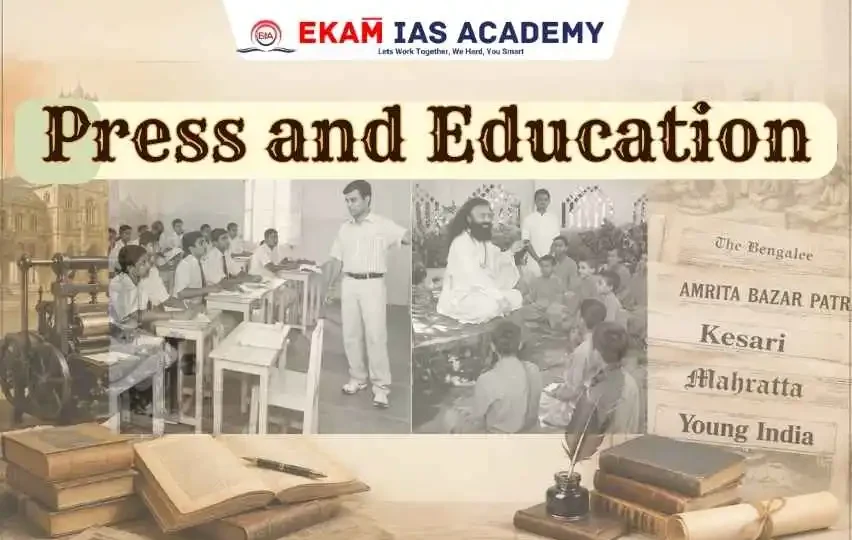
The development of Press and Education During British Period played a transformative role in shaping modern Indian society. While colonial policies intended to create an administrative workforce and maintain control, the evolution of Press and Education in India inadvertently birthed the Indian Nationalist Press.
Education During the British Period
Education During British Rule evolved through distinct phases—from initial orientalist patronization to systematic Anglicization and eventual technical expansion under the British Education Policy in India.
Important Educational Developments
- Macaulay’s Minute 1835: Advocated English-medium instruction and the “Downward Filtration Theory” to create an elite Western-educated administrative class.
- Wood’s Despatch 1854: Hailed as the Magna Carta of English Education in India, it established primary school networks, female education, and university systems in Calcutta, Bombay, and Madras.
- Hunter Commission 1882: Emphasized primary and secondary education management through local boards.
- Indian Universities Act 1904: Passed under Lord Curzon to increase official control over universities.
- Sadler Commission 1917: Recommended secondary education reform (10+2 pattern) and autonomous university administration.
- Hartog Committee 1929: Focused on primary education quality and curbing school dropouts.
- Wardha Scheme 1937: Formulated by Mahatma Gandhi emphasizing basic education through productive crafts (Nai Talim).
- Sargent Plan 1944: Proposed universal free primary education within 40 years.
Major Educational Institutions and Personalities
Raja Ram Mohan Roy (Hindu College, 1817), Ishwar Chandra Vidyasagar, and Sir Syed Ahmed Khan (Aligarh Muslim University) leveraged modern education for social reform.
Impact of British Education
Created a new intelligentsia imbued with democratic values, rationalism, and anti-colonial political thought.
Limitations of British Education Policy in India
Neglected primary education, ignored female education until late, promoted high illiteracy rates, and created a socio-cultural wedge between elites and rural masses.
Press During the British Period
The Press During British Rule emerged as an effective tool for social reform and anti-colonial mobilization, laying the foundations of the History of Education in India UPSC framework.
Important Newspapers and Journals
- Bengal Gazette (1780) by James Augustus Hickey (India’s first newspaper).
- Rast Goftar (Dadabhai Naoroji), The Bengalee (Surendranath Banerjea), Amrita Bazar Patrika (Sisir Kumar Ghosh), Kesari and Mahratta (Bal Gangadhar Tilak).
Important Personalities Associated with the Press
Nationalist icons like Raja Ram Mohan Roy (Sambad Kaumudi), Tilak, and Mahatma Gandhi (Young India, Harijan) mobilized the public via print media.
Press Laws During British Rule
Colonial authorities enacted restrictive measures to curb anti-British agitation:
- Censorship of Press Act, 1799 & Licensing Regulations, 1823.
- Vernacular Press Act 1878: Enacted by Lord Lytton to muzzle indigenous language newspapers (repealed by Lord Ripon in 1882).
- Indian Press Act 1910: Empowered local governments to demand financial security deposits from publishers.
Role of the Press in the Freedom Struggle
Newspapers During Freedom Struggle exposed economic drain, spread nationalist ideology, and mobilized regional populations.
Press and the Rise of Indian Nationalism
The Role of Press in Indian Nationalism was instrumental in uniting diverse regional struggles into a coherent anti-imperialist campaign.
Press and Education – Relationship
Modern western education nurtured literate nationalist journal writers, while print media amplified educational and social reform ideas.
Press and Education – Major Contributions
Awakened political consciousness, preserved national literature, and dismantled feudal socio-religious superstitions.
Limitations of the Press and Education
High illiteracy rates limited newspaper reach; heavy financial security requirements under colonial laws led to frequent closures of nationalist presses.
Timeline of Press and Education During British Rule
- 1780: James Augustus Hickey starts Bengal Gazette.
- 1835: Macaulay’s Minute 1835 published.
- 1854: Wood’s Despatch 1854 issued.
- 1878: Passing of the Vernacular Press Act 1878.
- 1882: Hunter Commission 1882 established.
- 1904: Indian Universities Act 1904 enacted.
- 1910: Indian Press Act 1910 passed.
- 1917: Sadler Commission 1917 formed.
- 1937: Wardha Scheme 1937 launched.
- 1944: Sargent Plan 1944 announced.
Conclusion
Mastering UPSC History Notes on print and educational history reveals how colonial administrative tools were turned into weapons of liberation. The combined influence of modern learning and the Indian Press During British Period paved the way for India’s struggle for independence.
UPSC Prelims: PYQs & Practice Questions
Previous Year Questions (Prelims)
Q: Regarding Wood’s Despatch, which of the following statements are true?
1. Grants-in-aid system was introduced.
2. Establishment of universities was recommended.
3. English as a medium of instruction at all levels of education was recommended.
Select the correct answer using the code given below:
(a) 1 and 2 only
(b) 2 and 3 only
(c) 1 and 3 only
(d) 1, 2, and 3
Answer: (a) 1 and 2 only
Explanation:
Statement 1 is correct: Wood’s Despatch (1854) introduced a
grants-in-aid system to encourage private participation in education.
Statement 2 is correct: It recommended establishing universities at Calcutta, Bombay, and Madras on the model of the University of London.
Statement 3 is incorrect: The Despatch recommended vernacular languages for primary education, while English was intended mainly for higher education, not as the medium at all levels.
Q: With reference to the Vernacular Press Act, 1878, consider the following statements:
1. It was enacted by Lord Lytton to suppress seditious nationalist literature in
Indian language newspapers.
2. It gave district magistrates the power to call upon printers and publishers to
enter into a bond without any right of appeal in a court of law.
3. Amrita Bazar Patrika turned into an English newspaper overnight
to bypass the provisions of this Act.
Which of the statements given above are correct?
(a) 1 and 2 only
(b) 2 and 3 only
(c) 1 and 3 only
(d) 1, 2, and 3
Answer: (d) 1, 2, and 3
Explanation:
All three statements are correct. Lord Lytton enacted the
Vernacular Press Act of 1878, popularly known as the
"Gagging Act", to control Indian-language newspapers.
District magistrates were given powers to demand security deposits and take action against printing presses, with limited scope for judicial appeal.
The Amrita Bazar Patrika, associated with Sisir Kumar Ghosh and Motilal Ghosh, switched to English to escape the Act's restrictions.
Practice Questions (Prelims)
Q: With reference to committee reports on British Education Policy in India, consider the following matches:
1. Sadler Commission (1917) — Recommended 12-year school course and
intermediate colleges
2. Hartog Committee (1929) — Emphasized primary education quality and
curbing school dropouts
3. Wardha Scheme (1937) — Basic education through productive crafts
(Nai Talim)
4. Sargent Plan (1944) — Universal free pre-primary education within
40 years
Which of the pairs given above are correctly matched?
(a) 1, 2, and 3 only
(b) 2 and 4 only
(c) 1 and 3 only
(d) 1, 2, 3, and 4
Answer: (d) 1, 2, 3, and 4
Explanation:
Sadler Commission (1917): Studied the problems of Calcutta University
and recommended reforms in secondary and intermediate education, including a
12-year school course.
Hartog Committee (1929): Emphasized improving the quality and consolidation of primary education rather than merely expanding enrolment, with attention to wastage and stagnation.
Wardha Scheme (1937): Based on Mahatma Gandhi's concept of Nai Talim, it promoted basic education through productive crafts and vocational activities.
Sargent Plan (1944): Proposed a comprehensive educational programme, including free and compulsory education, with a long-term target of achieving educational standards comparable to Britain within 40 years.
Q: Which of the following newspapers during the freedom struggle are correctly matched with their founders/editors?
1. Rast Goftar — Dadabhai Naoroji
2. Indian Mirror — Devendranath Tagore
3. Kesari — Bal Gangadhar Tilak
4. Voice of India — Gopal Krishna Gokhale
Select the correct answer using the code given below:
(a) 1, 2, and 3 only
(b) 1 and 3 only
(c) 2 and 4 only
(d) 1, 2, 3, and 4
Answer: (a) 1, 2, and 3 only
Explanation:
Pair 1 is correct: Rast Goftar was an Anglo-Gujarati
newspaper associated with Dadabhai Naoroji.
Pair 2 is correct: Indian Mirror was associated with Devendranath Tagore and emerged as an important English-language publication in Bengal.
Pair 3 is correct: Kesari was the Marathi newspaper founded by Bal Gangadhar Tilak in 1881 and became an important nationalist voice.
Pair 4 is incorrect: Voice of India was founded by Dadabhai Naoroji in 1883, not Gopal Krishna Gokhale.
UPSC Mains – Previous Year & Practice Questions
Mains Previous Year Questions
UPSC CSE Mains 2020 – GS Paper 1
Question: Trace the growth of the nationalist press in India during the 19th century. How did it help in creating national consciousness among the masses?
250 Words / 15 Marks
UPSC CSE Mains 2018 – GS Paper 1
Question: In what ways did the Western education system introduce new ideas of modern rationalism and political liberty in 19th-century India, despite its colonial limitations?
150 Words / 10 Marks
UPSC CSE Mains 2016 – GS Paper 1
Question: Analyze the impact of Lord Lytton's policy towards the press with special reference to the Vernacular Press Act of 1878.
150 Words / 10 Marks
UPSC CSE Mains 2007 – Modern History
Question: Examine the main provisions and significance of Wood’s Despatch of 1854 on the development of education in India.
250 Words / 15 Marks
UPSC CSE Mains 1999 – Modern History
Question: How far is it correct to say that the main purpose of British educational policy in India was to create a class of loyal clerks rather than to educate the nation?
250 Words / 15 Marks
Mains Practice Questions
[15 Marks | 250 Words]
Question: Macaulay’s Downward Filtration Theory aimed at building an administrative buffer class, yet Western education unintentionally forged the intellectual vanguard of the Indian National Movement. Elucidate.
[15 Marks | 250 Words]
Question: The colonial Indian press functioned not merely as a news delivery vehicle but as an institution of political education and opposition. Discuss with reference to prominent nationalist journalists.
[10 Marks | 150 Words]
Question: Examine how the Indian Universities Act of 1904 under Lord Curzon sought to curb nationalist activities in educational institutions, and analyze the response of the Indian intelligentsia.
Press and Education During British Period-FAQs
What was the significance of Macaulay's Minute of 1835?
Macaulay’s Minute promoted English education and Western knowledge in India. It supported educating a limited section of Indians who would, in turn, transmit Western education to wider society, reflecting the Downward Filtration Theory.
Why is Wood's Despatch of 1854 important in Indian education history?
Wood’s Despatch provided a comprehensive framework for modern education, including education departments, universities, teacher training, grants-in-aid and promotion of vernacular education. It is often regarded as the Magna Carta of English education in India.
What was the purpose of the Vernacular Press Act of 1878?
The Vernacular Press Act, 1878, introduced under Lord Lytton, aimed to control Indian-language newspapers that criticised colonial policies. It became an important symbol of colonial restrictions on the nationalist press and was repealed in 1882.
How did the press contribute to the Indian national movement?
Newspapers and journals spread nationalist ideas, exposed colonial economic exploitation, encouraged political debate and mobilised public opinion. Leaders such as Bal Gangadhar Tilak, Raja Ram Mohan Roy and Mahatma Gandhi used the press as an important instrument of political and social mobilisation.
How were British education and the Indian press connected with the growth of nationalism?
Modern education created an educated Indian intelligentsia, while newspapers provided a platform for expressing political ideas and communicating them to the public. Together, they contributed significantly to the development of political consciousness and Indian nationalism.