Table of Contents
ToggleThe Baltic Way: Gandhi’s Global Legacy
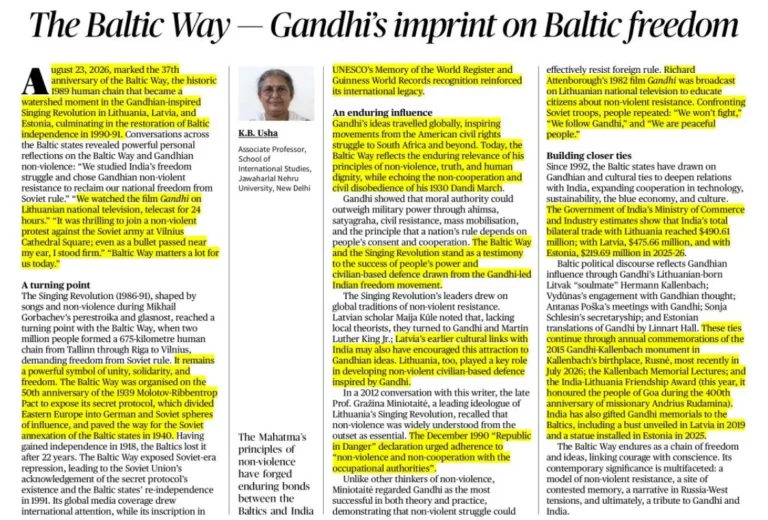
The Baltic Way was one of the most powerful examples of peaceful mass mobilisation in modern history. The historic human chain, formed across Estonia, Latvia and Lithuania in 1989, demonstrated how non-violent resistance could challenge authoritarian rule and demand national freedom.
What Was the Baltic Way?
The Baltic Way was a 675-kilometre human chain formed on August 23, 1989, across the three Baltic states. Around two million people joined hands to protest Soviet rule and demand independence.
The event became a major symbol of the Singing Revolution (1986–91), a period of largely peaceful mobilisation for political freedom in the Baltic region.
How Did Gandhi Influence the Baltic Freedom Movement?
Gandhian ideas of non-violence, Satyagraha and civil resistance influenced the Baltic freedom struggle.
The movement demonstrated Gandhi’s principle that people can challenge political authority through peaceful mobilisation, solidarity and non-cooperation rather than armed confrontation.
The Baltic Way therefore reflected the wider global relevance of Gandhian political thought.
The Role of Non-Violent Resistance
The Baltic independence movements relied heavily on mass participation, cultural mobilisation and peaceful protest.
The Singing Revolution used songs, public gatherings and collective action to build solidarity among people. This demonstrated how civilian mobilisation could become a powerful instrument of resistance against authoritarian systems.
The Baltic experience also showed that non-violence can function as a form of civilian-based defence.
Baltic Way and India’s Global Soft Power
Gandhi’s legacy continues to influence India’s cultural and diplomatic engagement with the Baltic region.
The historical connections between Gandhi’s philosophy and Baltic freedom movements provide an important example of India’s soft power, demonstrating how ideas originating in India influenced democratic and freedom struggles beyond its borders.
Significance for India–Baltic Relations
India’s relationship with the Baltic countries has expanded into areas such as technology, sustainability, economy and culture.
Cultural exchanges, Gandhi memorials and commemorations have helped preserve the historical connection between Gandhian philosophy and Baltic freedom movements.
The Baltic Way therefore represents not only a historical freedom movement but also a continuing bridge between India and the Baltic region.
Conclusion
The Baltic Way remains a powerful example of how ordinary citizens can challenge authoritarian rule through peaceful collective action. Its connection with Gandhian principles highlights the global influence of non-violence, Satyagraha and civil resistance.
For India, the Baltic Way demonstrates how Gandhi’s ideas continue to shape international perceptions of peaceful resistance and strengthen India’s cultural and diplomatic connections across the world.
Prelims MCQs
MCQ 1
The Baltic Way, associated with the struggle for independence from Soviet rule, involved which of the following countries?
A) Poland, Hungary and Romania
B) Estonia, Latvia and Lithuania
C) Finland, Sweden and Norway
D) Ukraine, Belarus and Moldova
Answer: B) Estonia, Latvia and Lithuania
MCQ 2
Consider the following statements:
- The Baltic Way was a 675-km human chain formed in 1989.
- It was associated with the Singing Revolution.
- The movement relied heavily on peaceful mass mobilisation.
Which of the statements given above is/are correct?
A) 1 only
B) 1 and 2 only
C) 2 and 3 only
D) 1, 2 and 3
Answer: D) 1, 2 and 3
MCQ 3
Which of the following Gandhian principles is most closely associated with the Baltic freedom movement?
A) Armed resistance
B) Non-violence and civil resistance
C) Economic isolation
D) Military deterrence
Answer: B) Non-violence and civil resistance
UPSC Mains Question
“The Baltic Way demonstrated the global relevance of Gandhian principles of non-violence, Satyagraha and civil resistance.” Discuss with suitable examples.
Key points to cover:
- Baltic Way — 1989, 675-km human chain
- Estonia, Latvia and Lithuania
- Singing Revolution and peaceful mass mobilisation
- Influence of Gandhian non-violence
- Civil resistance against authoritarian rule
- Role of solidarity and popular participation
- Global relevance of Gandhian philosophy
- Contemporary relevance for democratic movements
Frequently Asked Questions (FAQs)
What was the Baltic Way?
The Baltic Way was a 675-km human chain formed in 1989 across Estonia, Latvia and Lithuania to demand freedom from Soviet rule. It became a major symbol of peaceful resistance.
Which countries participated in the Baltic Way?
The Baltic Way involved Estonia, Latvia and Lithuania. Millions of people joined the human chain demanding independence and political freedom.
How did Gandhi influence the Baltic freedom movement?
Gandhian principles of non-violence, Satyagraha and civil resistance influenced the Baltic struggle. The movements relied on peaceful mass mobilisation and non-cooperation.
What was the Singing Revolution?
The Singing Revolution was a period of largely peaceful political mobilisation in the Baltic states between 1986 and 1991. Music, cultural identity and mass participation played an important role.
Why is the Baltic Way significant for India?
The Baltic Way demonstrates the global influence of Gandhian non-violence. It also contributes to cultural and diplomatic connections between India and the Baltic countries.