

...
Daily Current affairs 01 September 2026

Daily Current Affairs 01 September 2026

Share this Post

INDUS WATERS TREATY AND HAGUE ARBITRATION RULING

TOPIC: (GS2) INTERNATIONAL RELATIONS: THE HINDU

The Permanent Court of Arbitration (PCA) at The Hague ruled that the 1960 Indus Waters Treaty (IWT) between India and Pakistan remains “fully in force”, requiring India to continue fulfilling its obligations.

Indus Waters Treaty Framework

  • Signed in 1960, brokered by the World Bank.
  • Allocates six rivers of the Indus system:
    • Eastern Rivers – Ravi, Beas, Sutlej → primarily for India.
    • Western Rivers – Indus, Jhelum, Chenab → primarily for Pakistan, with India allowed limited use for domestic, irrigation, and runoftheriver hydropower projects.
  • Provides disputeresolution mechanisms: Permanent Indus Commission, Neutral Expert, and Court of Arbitration.

The Hague Court’s Ruling

  • India’s 2025 decision to place the treaty in “abeyance” after the Pahalgam terror attack was deemed invalid.
  • The Court held that the IWT cannot be unilaterally suspended or terminated; only joint modification or termination is permissible.
  • India remains bound by treaty obligations, including those related to hydroelectric projects on Western Rivers.
  • Imposed interim restrictions on the Ratle Hydroelectric Project (Chenab) — India must temporarily halt concreting above specified levels until the Neutral Expert’s decision (expected July 2027).

India’s Position

  • India did not participate in the arbitration, calling the Court’s constitution a breach of the treaty.
  • Argues that Pakistan’s move created parallel proceedings, violating the IWT’s disputeresolution framework.
  • Maintains that the Court’s pronouncements are “null and void” and that its abeyance decision remains operative.
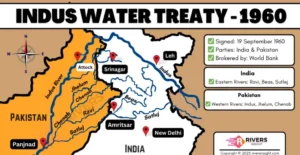
Indus Water Treaty 1960

Strategic Significance

  • Pakistan’s dependence on Indus waters makes any change in India’s approach critical for its agriculture and economy.
  • India links water cooperation to crossborder terrorism, asserting that “blood and water cannot flow together.”
  • The dispute underscores tensions between treaty law and sovereign action, raising questions about international legal jurisdiction.

Permanent Court of Arbitration (PCA)

  • Established: 1899, through the Hague Convention for the Pacific Settlement of International Disputes.
  • Headquarters: Peace Palace, The Hague, Netherlands.
  • Nature: An intergovernmental organisation that facilitates international arbitration and other forms of dispute resolution.
  • Important: Despite its name, the PCA is not a permanent court with a fixed panel of judges like the International Court of Justice (ICJ).

Purpose

    • Provides a forum for peaceful settlement of disputes through arbitration, conciliation and other dispute-resolution mechanisms.
    • Deals with disputes involving:
      • States
      • State entities
      • International organisations
      • Private parties in certain circumstances.

Arbitration

    • Parties can choose arbitrators for a particular dispute.
    • The PCA provides administrative and procedural support for the arbitration.

Jurisdiction

    • Its jurisdiction generally depends on the consent of the parties through treaties, contracts or other agreements.

Conclusion

The conflict is set to persist through India’s continued abeyance stance, Pakistan’s internationalisation efforts, and parallel Neutral Expert proceedings. The future of the IWT will hinge on whether both nations can reconcile legal obligations with evolving geopolitical realities.

INDIA’S Q1 GDP GROWTH AND EMERGING RISKS

TOPIC: (GS3) ECONOMY: THE HINDU

India’s real GDP grew 7.8% in Q1 FY202627 (April–June 2026), surpassing the RBI’s 7% estimate and marking the fastest Q1 growth in recent years.

What Is Gross Domestic Product (GDP)

  • The total monetary value of all final goods and services produced within a country’s borders during a specific period (usually a year or quarter).
  • Types:
    • Nominal GDP: Measured at current market prices (includes inflation).
    • Real GDP: Adjusted for inflation, showing true growth in output.
  • Formula: GDP=C+I+G+(X−M) ( C = consumption, I = investment, G = government spending, X = exports, M = imports) .
  • Significance: Indicator of economic health, growth trends, and policy effectiveness.

Headline Numbers

  • Real GDP growth: 7.8% (vs 6.9% in Q1 FY26; 8.6% in Q4 FY26).
  • Nominal GDP growth: 10.3%.
  • Real GVA growth: 8.2%.
  • Gross Fixed Capital Formation (GFCF): +11.9% (real), +20.4% (nominal); share of GDP rose to 34.3% from 31.4%.

Drivers of Growth

Manufacturing & Services Surge

  • Manufacturing: +9.2%, led by infrastructurebased firms.
  • Services: +10%; financial, real estate, IT & professional services grew 12.1%.
  • Construction: +7.7% (vs 5.2% last year).
  • Utilities: +8.9% (lowbase effect).
  • Agriculture: +3.6% (down from 4.4%, but resilient despite monsoon shortfall).
  • Mining: –2.4% (high base effect).

Demand Push

  • Strong GST collections, automobile sales, and core exports.
  • Rural demand supported by PMKISAN, MSP hikes, and fertiliser affordability.
  • Air passenger traffic moderated due to rising costs.

Investment Activity

  • Gross Fixed Capital Formation surge signals healthy future growth. (GFCF) Gross Fixed Capital Formation, Refers to the net increase in physical assets within an economy during a given period.
  • Investment share of GDP near 34–35% threshold, identified as critical for sustaining 7%+ growth.

Resilience Factor

  • Chief Economic Adviser V. Anantha Nageswaran highlighted “resilience” as the key message.
  • All three sectors — agriculture, manufacturing, and services — contributed positively despite West Asia tensions and monsoon concerns.

Emerging Risks

  • Crude Oil Prices: Brent may stay above $80/barrel amid USIran tensions, raising input costs and hurting exports.
  • El Niño Intensification: Threatens crop yields and winter Rabi crops.
  • Unfavourable Base Effects: Growth expected to moderate from Q2 onward.
  • Deficient Monsoon: Could weaken agriculture and rural demand.

Way Forward

  • Strengthen Supply Chains: Invest in logistics, energy, and raw material sectors to reduce bottlenecks. Revive production in crude oil, fertilisers, and electricity to stabilise supply.
  • Boost Domestic Demand: Support consumption through targeted GST reliefs, rural demand programmes, and MSME credit.
  • Accelerate Structural Reforms: Push manufacturing competitiveness via PLI schemes and digitalisation.

Conclusion

India’s GDP growth underscores strong momentum Yet, oil shocks, El Niño, and base effects pose credible risks. Sustained structural reforms, diversification, and investment in resilience will be crucial to secure growth in the coming quarters.

US–VENEZUELA OIL DEAL

TOPIC: (GS2) INTERNATIONAL RELATIONS: THE HINDU

The United States announced the world’s biggest oil deal, securing majority control over 65+ billion barrels of Venezuelan crude (around 20% of Venezuela’s proven reserves).

Key Details of the Deal

  • Operational Control: A new private company will be formed to develop 17 Venezuelan oil fields, with the US holding a 55% operational share.
  • Economic Projections: Venezuela expects around $100 billion in private investment and over $209 billion in tax revenues from this arrangement. Oil produced will be sold to US buyers at cost, ensuring cheaper supply for American refiners.
  • Legal Ambiguity: Questions remain over whether Venezuela’s interim administration has the authority to commit to such longterm agreements. Opposition leaders have raised objections, making the legal framework uncertain.

Why Does the US Want Venezuelan Oil?

  • Technical Refinery Needs:
    • US produces mainly light sweet crude (low sulphur).
    • Venezuelan oil is heavy sour crude (high sulphur), ideal for US Gulf Coast refineries built decades ago.
    • Retrofitting refineries for light crude is costly, so the US continues to import heavy crude despite being the world’s largest producer.
  • Geopolitical Calculations:
    • Strengthen energy market dominance and reserves.
    • Lower global oil prices amid Strait of Hormuz crisis.
    • Counter Iran and Russia, both heavycrude holders.
    • Limit Chinese and Russian investments in Venezuela’s oil sector.

Venezuela’s Oil Story

  • Venezuela holds about 300 billion barrels of proven oil reserves (nearly 20% of global reserves, the largest worldwide). Yet, due to systemic issues, it contributes less than 1% of global oil production.
  • Once a major crude supplier to the US, Venezuela’s fortunes changed after the 2007 nationalisation drive under Hugo Chávez, which forced companies like ExxonMobil and ConocoPhillips to exit.
  • Chronic underinvestment, corruption, and mismanagement crippled the sector. The situation worsened after US sanctions in 2019, which halted Venezuelan oil exports to America.
  • Today, Venezuela’s oil output is only onethird of early 2000s levels. With US ties severed, China emerged as its leading oil destination, while Russia invested heavily in its energy sector.

Challenges Ahead

  • Analysts estimate recovery to 1990s output only by 2040, requiring $180+ billion investment.
  • Venezuela’s dilapidated infrastructure and political resistance to foreign control complicate implementation.
  • Legal disputes over the authority of interim administration may undermine the deal’s legitimacy.

Top Countries by Proven Oil Reserves (2026)

Rank

Country

Reserves (Billion Barrels)

1. Venezuela

303.2

Largest reserves globally, mostly heavy crude; production <1% of global output due to sanctions & mismanagement.

2. Saudi Arabia

267.2

Dominant OPEC member; low-cost extraction; exports ~6.2 million barrels/day.

3. Iran

208.6

Huge reserves but limited by sanctions; exports mainly to Asia.

4. Canada

163.0

Oil sands in Alberta; high-cost extraction but stable supply.

5. Iraq

145.0

Major Middle Eastern supplier; exports ~4 million barrels/day.

Conclusion

The US–Venezuela oil deal reflects a convergence of refinery economics and geopolitical strategy. While it addresses America’s structural need for heavy sour crude and curbs rival influence in Latin America.

INDIA SEMICONDUCTOR MISSION 2.0

TOPIC: (GS3) SCIENCE AND TECHNOLOGY: THE HINDU

The Government has launched India Semiconductor Mission 2.0 (ISM 2.0) with an outlay of ₹1,27,500 crore, to cover chip design, equipment, materials, packaging, R&D, and talent development.

Semiconductor Ecosystem in India

  • Semiconductors are critical for smartphones, computers, automobiles, defence, telecom, consumer electronics, and AI infrastructure.
  • India has strong design and engineering talent, but limited domestic manufacturing capacity.
  • ISM aims to build a full-stack ecosystem to reduce dependence on imports and strengthen supply chain resilience.

ISM 2.0 – Six Pillars

  • Chip Design – Support for indigenous designs, especially strategic applications.
  • Machines & Materials – Domestic production of equipment, chemicals, and gases.
  • Fabs – Establishment of semiconductor fabrication facilities.
  • Packaging & Testing – Expansion of assembly, packaging, and testing infrastructure.
  • Research & Development – Support for advanced technologies.
  • Talent Development – Building a specialised workforce across the value chain.
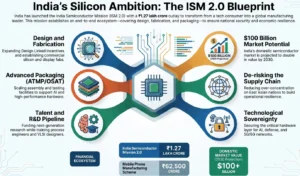
India Semiconductor Mission 2.0

Investment & Support

  • Expected to attract ₹4 lakh crore investment, generate ₹2 lakh crore production, and ₹1 lakh crore exports.
  • Create 50,000–60,000 direct jobs.
  • Capital support:
    • Up to 40% for silicon fabs.
    • Up to 35% for compound semiconductor, discrete fabs, display fabs, and packaging units.
    • Up to 30% for upstream facilities (wafers, substrates, chemicals, gases, R&D).
  • PLI incentives: 2–10% for equipment and components.
  • Chip-design start-ups: Seed funding up to ₹15 crore, co-investment, and royalty financing (5% of net revenue until 1.5x recovery).
  • R&D & Talent: Support up to 75% of project cost.

Significance

  • Builds end-to-end semiconductor ecosystem in India.
  • Strengthens supply chain resilience and reduces import dependence.
  • Supports domestic technology companies and boosts exports.
  • Generates skilled employment and enhances India’s role in global semiconductor production.
  • Aligns with India’s strategic, economic, and technological sovereignty goals.

Conclusion

ISM 2.0 is a transformative leap from project-based support to a holistic semiconductor ecosystem, ensuring India’s place in the global chip supply chain while advancing self-reliance, innovation, and strategic security.

RAMON MAGSAYSAY AWARD

TOPIC: (GS2) POLITY: THE HINDU

The 2026 Ramon Magsaysay Award has been conferred on Tommy Koh (Singaporean lawyer & diplomat), Bo Kyi (Myanmar activist), and Runa Khan (Bangladeshi social worker) for their transformative leadership and service to society.

About the Award

  • Established in 1958, named after former Philippine President Ramon Magsaysay.
  • Recognised as Asia’s highest honor, celebrating greatness of spirit and transformative leadership.
  • Presented annually on August 31st in Manila, Philippines.
  • Awardees receive a certificate and a medallion embossed with Magsaysay’s profile.

Ramon Magsaysay Award

Categories & Evolution

  • From 1958–2008, awards were given in six categories:
    • Government Service
    • Public Service
    • Community Leadership
    • Journalism, Literature & Creative Arts
    • Peace & International Understanding
    • Emergent Leadership (added in 2000, supported by Ford Foundation).
  • Since 2009, awards are no longer restricted to fixed categories, except Emergent Leadership.

Significance

  • Symbolises Asia’s Nobel Prize equivalent.
  • Recognises individuals who demonstrate courage, integrity, and service to humanity.
  • Strengthens regional solidarity by highlighting leaders of social change across diverse fields.

Conclusion

The Ramon Magsaysay Award continues to inspire Asia by honoring visionary leaders who embody service, justice, and transformative change, reinforcing the values of human dignity and solidarity.

INTEGRATED FERTILIZER MANAGEMENT SYSTEM (IFMS)

TOPIC: (GS3) ECONOMY: PIB

The Ministry of Chemicals and Fertilizers recently announced that the Integrated Fertilizer Management System (iFMS) has entered a new phase with the launch of advanced digital dashboards and analytical tools to strengthen monitoring and transparency.

About iFMS

  • A national digital platform for fertilizer management in India.
  • Developed and supported by the National Informatics Centre (NIC) for the Department of Fertilizers.
  • Connects all stages of the fertilizer ecosystem — production, imports, movement, stock availability, retail sale, and subsidy processing.
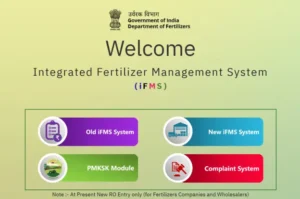
Integrated Fertilizer Management System

Key Features

  • Dealer Services: Online registration, stock tracking, dealer search.
  • Transparency Tools: Access to Management Information System (MIS) and Direct Benefit Transfer (DBT) reports.
  • Scale of Operation: Covers 14 crore Aadhaarlinked fertilizer buyers and 2.5 lakh retailers nationwide.
  • New Dashboards: Provide consolidated views of production, imports, dispatches, stocks, and retail sales.
  • Monitoring: Enables officials to track fertilizer flows at national, state, district, and retailer levels, identifying unusual trends and supply risks early.

Significance

  • Enhances efficiency and transparency in fertilizer distribution.
  • Strengthens subsidy management and prevents leakages.
  • Supports farmers’ access to timely and affordable fertilizers.
  • Aids in policy planning by providing realtime data analytics.

Conclusion

The Integrated Fertilizer Management System represents a major step in India’s push for digital governance in agriculture, ensuring efficient distribution, transparency, and farmer welfare through technologydriven monitoring.


Write a Review

Your email address will not be published. Required fields are marked *

Seraphinite AcceleratorOptimized by Seraphinite Accelerator
Turns on site high speed to be attractive for people and search engines.