

Table of Contents
ToggleONION PRICE VOLATILITY AND POLICY CHALLENGES
TOPIC: (GS2) POLITY: THE HINDU
Recently, India’s onion market witnessed sharp volatility; government export bans, duties, procurement changes exposed reactive crisis management, underscoring urgent need for longterm structural solutions.
Policy Shifts and Farmer Consequences
- Since the 1960s, India has sought to stabilise food prices while protecting farmers.
- Recent onion policy shifts included:
- Export ban (Dec 2023–May 2024).
- Minimum export price $550/tonne + 40% duty.
- Duty reduced to 20% (Sep 2024), abolished in Apr 2025.
- Farmers often face losses when government decisions change after production choices are made.
Structural Governance Challenges
- Reactive interventions: Policies often announced after price collapse, leaving many farmers and produce grades outside support coverage.
- Buffer stock strain: Central reserves risk depletion if multiple States adopt subsidies simultaneously, weakening national food security.
- Unsuitable distribution networks: Drygrain PDS systems poorly handle perishable crops like onions, leading to wastage and inefficiency.
Key Challenges
- Erratic trade policy: Frequent bans and duties create uncertainty for farmers and exporters.
- Storage limitations: Onions are highly perishable; storage losses reached 30% in 2025.
- Price shocks: Farmers sold at ₹1/kg due to poor quality and lack of storage.
- Procurement mismatch: Centre’s initial procurement price ₹12.35/kg was below cultivation cost; later raised to ₹26.45/kg, but many farmers missed the benefit.
- Climate impact: Abnormal rainfall and a 5–7% drop in Maharashtra’s kharif crop worsened supply pressures.
- State interventions: Tamil Nadu’s subsidy (₹35/kg, 1 kg per ration card) cooled retail prices but risks losses if postharvest wastage exceeds 15%.
Way Forward
- Strengthen storage infrastructure: Invest in modern coldchain and warehousing to reduce wastage.
- Stable trade policy: Avoid frequent bans/duties; adopt predictable export frameworks.
- Efficient distribution: Move stocks swiftly between surplus and deficit regions.
- Price stabilisation fund: Protect farmers against shocks through targeted procurement and insurance.
- Climate resilience: Promote adaptive cropping, water management, and resilient varieties.
GOVERNMENT SCHEMES
Price Stabilisation Fund (PSF): Provides financial support for procurement and release of pulses, onions, potatoes during price volatility.
Minimum Support Price (MSP) & PMAASHA: Ensures remunerative returns to farmers through procurement, deficiency payments, and market intervention schemes.
Unified Payments Interface (UPI): Facilitates secure, instant digital transactions, reducing cash dependency and improving market transparency.
Kisan Credit Card (KCC): Provides farmers timely, flexible credit with ATMenabled withdrawals for cultivation and allied activities.
Conclusion
India’s onion crisis underscores the limits of adhoc interventions. Sustainable solutions lie in storage, distribution, and predictable trade policies, ensuring farmers receive fair returns while consumers enjoy stable prices. A proactive, structural approach is essential to balance food security with farmer welfare.
REDUCING INDIA’S EXPOSURE TO U.S. TARIFF RISKS
TOPIC: (GS3) ECONOMY: THE HINDU
The U.S. Senate recently passed the Lindsey O. Graham Sanctioning Russia and Iran Act, 2026, authorising tariffs up to 100% on countries importing Russian crude or gas.
The Russian Oil Dilemma
- Energy diversification: India increased Russian crude imports from 2% preUkraine war to nearly 50% of total imports.
- Rising dependence: Imports doubled from 4.54 MMT (Jan 2026) to 8.96 MMT (May 2026).
- Diplomatic costs: While securing supplies, India faces U.S. pressure to reduce Russian imports.
- Tariff escalation: Section 301 imposed a 10% forcedlabour tariff; combined with sanctions, India risks 110% cumulative tariffs.
Trade Simulations and Results
Sanction Scenario
- India faces severe disruption to trade flows and growth, with welfare declining by $47 billion.
- GDP, output, and domestic demand contract sharply, while aggregate exports fall 5.1% and imports decline 5.2%, reflecting weakened competitiveness and disrupted supply chains.
Diversification Scenario
- By pursuing an IndiaEU Free Trade Agreement (FTA) as a diversification proxy, India’s welfare improves by $26.3 billion.
- GDP turns positive, sectoral output and demand recover, exports rise 3.1%, and imports increase moderately by 2.6%.
- Stronger integration with alternative markets helps offset the U.S. tariff shock, enhancing resilience and competitiveness.
Way forward
- Export diversification: Expand presence in EU, ASEAN, Africa to reduce reliance on U.S. market.
- Domestic reforms: Improve logistics, remove nontariff barriers, enhance standards, and move up the quality ladder.
- Energy security: Continue Russian imports for cost advantage but balance with renewable and alternative sources.
- Trade facilitation: Simplify procedures, strengthen supply chains, and reduce transaction costs.
INDIA–RUSSIA TRADE
Overall Trade
- Bilateral trade has grown sharply in recent years.
- Russia is now among India’s top trading partners.
- Target set: US$ 100 billion by 2030.
India’s Exports to Russia
- Mostly pharmaceuticals, machinery, chemicals, fish, tea, coffee, meat.
- Export share remains small compared to imports.
- Agriculture exports include marine products, coffee, tobacco, tea.
India’s Imports from Russia
- Dominated by crude oil, forming the bulk of imports.
- Other imports: fertilisers, vegetable oils, iron & steel, precious stones.
- Agriculture imports include vegetable oils, pulses, cereals, spices.
Conclusion
India’s dependence on Russian crude heightens U.S. tariff risks; diversification, reforms, and IndiaEU FTA are vital to safeguard resilience and competitiveness.
TOWARDS SUSTAINABLE RIVER WATER MANAGEMENT
TOPIC: (GS3) ENVIRONMENT: THE HINDU
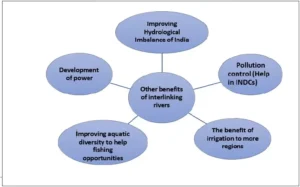
At the Southern Zonal Council meeting, Union Home Minister Amit Shah emphasised resolving southern water disputes and proposed linking major rivers from the Brahmaputra to the Cauvery to ensure water security for a century.
What is river linking
- River Linking: Connecting two or more rivers using canals, reservoirs, and storage structures.
- Purpose: Transfer water from surplus regions (floodprone basins) to deficit regions (droughtprone basins).
- Implemented under the National Perspective Plan (1980) by the National Water Development Agency (NWDA).
- Divided into three components:
- Himalayan Rivers: 14 proposed links.
- Peninsular Rivers: 16 proposed links.
- IntraState Links: 37 projects since 2005.
InterState Disputes
- Pennaiyar case: Tamil Nadu sought a tribunal against Karnataka’s alleged violation of the 1892 agreement. Despite Supreme Court directions, the tribunal is yet to be formed.
- Mekedatu issue: Tamil Nadu’s demand for a tribunal on Karnataka’s dam project remains unanswered.
- Such delays highlight the Centre’s reluctance in expeditiously resolving disputes, undermining trust in adjudication mechanisms.
Ecological and Social Concerns
- Ecological risks: Linking rivers may disturb natural flows, affecting wetlands and biodiversity.
- Kerala’s opposition: The State resists the PambaAchankovilVaippar link, fearing damage to the Vembanad wetland system.
- Social unrest: The KenBetwa project has triggered tribal protests in Chhatarpur, reflecting displacement concerns.
Way Forward
- Water conservation: Focus on judicious use rather than mega supplyside projects.
- Farmer sensitisation: Incentivise optimal irrigation practices to reduce wastage.
- Groundwater regulation: Curb indiscriminate extraction worsened by free electricity schemes.
- Sustainable irrigation: Promote microirrigation, crop diversification, and rainwater harvesting.
Conclusion
Riverlinking promises grand solutions but risks ecological damage, social unrest, and governance delays. True water security lies in conservation, efficiency, and demandside management, not in mega interlinking projects.
THE FCRA AMENDMENT BILL, 2026
TOPIC: (GS2) POLITY: THE HINDU
The FCRA Amendment Bill, 2026 raises concerns of executive overreach, asset control, and proportional safeguards in regulating foreign contributions.
Background
- FCRA framework: Since 1976, the FCRA has regulated foreign donations to safeguard national security and transparency.
- Existing powers: The state could already cancel registrations, impose penalties, and vest assets created from foreign funds.
- New provisions: The amendment expands consequences by allowing provisional vesting, possession, management, restoration, and permanent disposal of assets.
provisions of the FCRA Amendment Bill:
- Designated Authority: Government may appoint authority to manage assets after FCRA cancellation.
- Provisional Vesting: Foreign contributions and assets vest provisionally with authority for supervision.
- Management Powers: Authority can oversee organisational activities if deemed necessary for public interest.
- Restoration Mechanism: Assets restored when registration renewed, ensuring continuity of institutional independence.
- Judicial Safeguards: Bill provides revision, appeal mechanisms against executive decisions on assets.
Constitutional Concerns
- Executive control: The Designated Authority may assume possession and even manage institutional activities, raising questions of autonomy.
- Ownership vs custody: Though ownership remains, management control shifts to the state, altering institutional independence.
- Proportionality test: Supreme Court doctrine requires state measures to be proportionate. The Bill’s sweeping powers risk failing this test.
- Safeguards: While restoration and judicial appeal mechanisms exist, concerns remain about clarity, timeliness, and effectiveness.
Implications
- Civil society autonomy: Hospitals, schools, and NGOs depend on independent management, not just ownership.
- Regulatory expansion: What was earlier limited to loss of eligibility now extends to asset management and disposal.
- Precedent risk: Thousands of NGOs have lost registration in the past decade; expanded consequences could deepen mistrust.
Way Forward
- Balanced regulation: Oversight of foreign funds is legitimate, but must respect institutional autonomy.
- Clear safeguards: Legislative standards should limit executive discretion and ensure transparent procedures.
- Judicial oversight: Stronger appellate mechanisms are needed to protect rights and prevent arbitrary action.
- Demand for proportionality: Measures must balance national security with civil society’s freedom to function.
Conclusion
The FCRA Bill balances regulation and autonomy, but proportional safeguards and judicial oversight are vital to prevent executive overreach.
APPOINTMENT OF DISTINGUISHED JURISTS AS SUPREME COURT JUDGES
TOPIC: (GS2) POLITY: THE HINDU
Recently, Justice Ujjal Bhuyan highlighted Article 124(3) jurist clause, unused for 76 years, raising concerns about autonomy, diversity, and judicial overreach.
Article 124(3): Eligibility for Supreme Court Judges
- High Court Judge: Must have served as a High Court judge for minimum five years.
- Advocate: Must have practised as an advocate in a High Court for minimum ten years.
- Distinguished Jurist: In the President’s opinion, an eminent legal scholar or jurist may qualify.
- No Definition: Constitution does not define “distinguished jurist” or prescribe minimum professional experience.
Constituent Assembly Debates
- Provision added to widen choice beyond judges and advocates.
- H.V. Kamath: Advocated inclusion of eminent scholars with “outstanding juristic learning.”
- M. Ananthasayanam Ayyangar: Cited U.S. example of Felix Frankfurter, Harvard professor appointed to Supreme Court in 1939.
- Aim: Professional diversity in judiciary, similar to International Court of Justice.
High Court Context
- Initially debated for High Court appointments too.
- 42nd Amendment (1976): Allowed “distinguished jurists” as High Court judges.
- 44th Amendment (1978): Provision omitted, restricting eligibility again to judges and advocates.
Reasons for NonUse of Jurist Provision
- Collegium Reluctance: Jurist appointments require Collegium recommendation, which has rarely considered academics.
- Lack of Courtroom Experience: Legal scholars often lack procedural and advocacy exposure needed for judicial functioning.
- Bar Council Restrictions: Rule 49 prevents fulltime law teachers from practising as advocates while employed.
- Judiciary’s Practical Preference: Appointments overwhelmingly made from High Court judges; only 11 advocates elevated directly.
Significance
- Provision reflects framers’ intent to broaden intellectual diversity in judiciary.
- Could strengthen jurisprudence by including legal scholars, academics, and policy experts.
- Remains unused due to institutional inertia, procedural hurdles, and concerns over practical suitability.
Conclusion
The jurist clause in Article 124(3) embodies a vision of diversity in judicial appointments. Its nonuse highlights the dominance of conventional pathways. Reviving this provision with clear criteria, procedural reforms, and relaxation of practice restrictions could enrich the Supreme Court with broader perspectives and strengthen constitutional adjudication.
MYRISTICA SWAMPS
TOPIC: (GS3) ENVIRONMENT: THE HINDU
A recent study has warned that Myristica Swamps are on the verge of extinction, raising concerns about biodiversity loss.
About
- These are freshwater swamp forests dominated by evergreen trees of the Myristicaceae family.
- Known as living fossils, they represent primitive plant forms dating back nearly 500 million years.
- Characterised by trees with large protruding roots in waterlogged soils that remain inundated yearround.

Distribution
- Found mainly in the Western Ghats.
- Smaller patches exist in the Andaman & Nicobar Islands and Meghalaya.
- Globally, freshwater swamp forests occupy only 2.1% of Earth’s surface.
Climatic Conditions
- Occur in tropical regions with fertile alluvial plains.
- Thrive in waterlogged soils with perennial moisture.
Ecological Role
- Flood regulation: Act as natural buffers against floods.
- Groundwater recharge: Maintain perennial freshwater flow.
- Carbon sequestration: Store more carbon than nonswampy forests.
- Biodiversity hotspot: Support diverse vertebrate and invertebrate species.
Conclusion
The Myristica Swamps are rare, ancient ecosystems with immense ecological importance. Their decline threatens biodiversity, water security, and climate resilience. Urgent conservation measures are needed to preserve these living fossil habitats and their unique ecological services.
CORAL BLEACHING
TOPIC: (GS3) ENVIRONMENT: THE HINDU
The seventh Status of Coral Reefs of the World report by the Global Coral Reef Monitoring Network (GCRMN) highlighted that coral bleaching events are becoming more frequent, with recovery periods shortening dramatically.
What is Coral Bleaching?
- Occurs when corals face stress due to temperature rise, pollution, or ocean acidification.
- Under stress, zooxanthellae algae inside coral polyps produce harmful reactive oxygen species.
- Corals expel these algae, losing their colour and exposing a pale white exoskeleton.
- This ends the symbiotic relationship that sustains coral survival and growth.

Causes of Coral Bleaching
- Ocean temperature rise: Climate change is the leading driver.
- Runoff and pollution: Storms dilute seawater and bring pollutants.
- Excess sunlight: High irradiance worsens bleaching in shallow waters.
- Low tides: Air exposure during extreme tides stresses corals.
What are Corals?
- Corals are marine invertebrates forming colonies of polyps.
- They share a symbiotic relationship with zooxanthellae algae.
- Algae provide food via photosynthesis, while corals offer shelter and nutrients.
- Zooxanthellae also give corals their bright colours.
Significance
- Coral reefs support marine biodiversity, fisheries, and coastal protection.
- Bleaching threatens ecosystems, livelihoods, and global climate resilience.
Conclusion
Coral bleaching is a visible indicator of climate stress on oceans. Urgent global action on climate change, pollution control, and conservation is essential to safeguard these fragile ecosystems.