

...
Daily Current affairs 31 August 2026

Daily Current Affairs 31-August-2026

Share this Post

NEPAL’S FLOODS AND HIMALAYAN WARNING FOR INDIA

TOPIC: (GS3) DISASTER MANAGEMENT: THE HINDU

Recently, devastating floods and seismic activity in Nepal’s Himalayan region highlighted the urgent need for India to strengthen disaster preparedness.

Immediate cause of Nepal’s floods

  • The disaster began on 26 August 2026 near Langtang Lirung mountain, close to the Nepal–Tibet border.
  • A collapse of bedrock beneath a glacier sent huge masses of ice, rock, mud, and water crashing into valleys.
  • This avalanche blocked the Lhende Khola river, forming a temporary dam.
  • The dam burst, unleashing a torrent of water, mud, and debris downstream.
  • The event generated seismic energy equivalent to a magnitude 5.2 earthquake, though later analysis confirmed the quake was a result of the collapse, not the trigger.

Scale of Destruction

  • Floods and debris flows travelled nearly 100 km, destroying roads, bridges, and hydropower plants.
  • Death toll exceeded 800, with 3,000+ missing and thousands injured.
  • Economic losses estimated at ₹200 billion (USD $1.3 billion) in Nepal alone.
  • Hydropower damage: 360 MW capacity lost, nearly 8% of Nepal’s total generation.

Underlying Factors

  • Climate change accelerated glacial melting, destabilizing slopes.
  • Seismic vulnerability of the Himalayas amplified the collapse.
  • Lack of rainfall warnings meant conventional floodalert systems failed.
  • Industrial and infrastructural expansion in fragile Himalayan valleys increased exposure to risk.

Disaster Preparedness Gaps in Nepal

  • Early Warning Systems: Lack of robust glacial and seismic monitoring meant communities received no timely alerts before the avalanche and floods struck.
  • Infrastructure Vulnerability: Hydropower plants, bridges, and roads were built in fragile Himalayan valleys without adequate risk assessments, worsening destruction during the disaster.
  • Community Awareness: Local populations were not adequately trained or informed about glacial lake outburst floods (GLOFs) and evacuation protocols, leading to higher casualties.
  • Institutional Coordination: Disaster management agencies lacked integrated response mechanisms, delaying rescue and relief operations in remote, highrisk zones.

China’s Hydropower Risk

  • China’s Medog hydropower project near the Brahmaputra’s great bend lies close to the Paizhen Fault.
  • A major earthquake could unleash catastrophic floods into India’s northeast.
  • India must integrate border diplomacy with disaster risk frankness.

Way Forward for India

  • Conduct biannual disaster drills in schools, offices, and villages.Train local volunteer networks for rescue and first aid.
  • Establish safe shelters with food, water, and medical supplies in highrisk zones.Strengthen crossborder cooperation with Nepal, Bhutan, and China for early warnings.
  • Review dams, hydropower projects, and reactors in seismic zones. Promote ecosensitive construction using natural materials.
  • Establish a National Himalayan Risk Observatory integrating seismic, glacial, and climatological data. Mandate realtime public alerts via mobile networks and community radios.

THE HIMALAYAS

The Himalayas are the world’s highest mountain system, stretching across five countries India, Nepal, Bhutan, China, and Pakistan, forming a natural barrier between the Tibetan Plateau and the IndoGangetic plains.
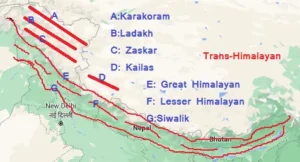
The Himalayas

Definition and Extent

  • The Himalayas are a great mountain system of Asia, formed by the collision of the Indian and Eurasian tectonic plates.
  • Stretch 2,400 km (1,500 miles) west to east, from Nanga Parbat (Pakistan) to Namcha Barwa (China).
  • Width varies between 200–400 km, covering five countries: India, Nepal, Bhutan, China, and Pakistan.

Physical Features

  • Contains the world’s highest peaks, including Mount Everest (8,849 m), K2 (8,611 m), and Kanchenjunga (8,586 m).
  • More than 110 peaks rise above 7,300 m.
  • Characterized by steep jagged peaks, glaciers, deep gorges, and landslideprone slopes.
  • Divided into four belts: Outer Himalayas (Siwaliks), Lesser Himalayas, Great Himalayas, and Tibetan Himalayas.

Conclusion

From seismic vigilance to climateinduced GLOFs and transboundary hydropower risks, India’s resilience depends on scientific transparency, infrastructural review, and communitylevel safeguarding.

INDIA AND THE CHALLENGE OF DISCRIMINATION

TOPIC: (GS2) POLITY: THE HINDU

India’s review by the U.N. Committee on the Elimination of Racial Discrimination (CERD) in 2026 expressed grave concern over violence and discrimination against minorities, Dalits, and noncitizens.

What is Discrimination?

  • Discrimination is the unfair or unequal treatment of individuals based on identity markers such as caste, race, religion, gender, or ethnicity.
  • It undermines equality, dignity, and justice, creating systemic exclusion.

Types of Discrimination

  • Castebased discrimination: Social exclusion, untouchability, and denial of opportunities to Dalits and Adivasis.
  • Religious discrimination: Targeting minorities through hate speech, violence, and citizenship deprivation.
  • Ethnic discrimination: Marginalisation of tribal and indigenous groups.
  • Gender discrimination: Unequal pay, violence, and limited representation of women.
  • Institutional discrimination: Misuse of laws (UAPA, AFSPA, FCRA) to restrict civil society and dissent.

Constitutional Provisions

  • Preamble: Promises Justice, Liberty, Equality, and Fraternity.
  • Article 14: Equality before law.
  • Article 15: Prohibits discrimination on religion, race, caste, sex, or place of birth; allows affirmative action.
  • Article 16: Equality of opportunity in public employment.
  • Article 17: Abolition of untouchability.
  • Article 19 & 21: Freedom of speech and right to life with dignity.
  • Directive Principles (Articles 38, 46): Promote social justice and protect weaker sections.

Concerns Highlighted by CERD

  • Manual sewer cleaning despite prohibition.
  • Hate speech and poor living conditions of Rohingya Muslims.
  • Citizenship deprivation via NRC and electoral roll deletions.
  • Weak NHRC independence and lack of pluralism.
  • Forest (Conservation) Amendment Act exempting national security projects from consultation.
  • Bharatiya Nyaya Sanhita not criminalising racist hate speech.

Way Forward

  • Restore NHRC’s independence and pluralism.
  • Criminalise racist hate speech explicitly.
  • Strengthen affirmative action for SCs, STs, and minorities.
  • Collect and publish disaggregated data through Census and NCRB.
  • Ensure transparent electoral roll revisions.
  • Enhance civil society participation in monitoring discrimination.

AMBEDKAR’S VISION AGAINST DISCRIMINATION

Dr. B.R. Ambedkar, the chief architect of India’s Constitution, envisioned a society free from caste, race, and faithbased discrimination. His philosophy combined legal safeguards, social reform, and political empowerment to dismantle systemic inequality.

Ambedkar’s Vision

  • Saw discrimination as a structural evil, not just individual prejudice.
  • Advocated for social justice, equality, and dignity as the foundation of democracy.
  • Believed true freedom required annihilation of caste and equal participation of marginalized groups.

Measures Proposed

Legal Safeguards

    • Drafted constitutional provisions: Article 14 (Equality before law), Article 15 (Prohibition of discrimination), Article 17 (Abolition of untouchability).
    • Ensured fundamental rights protected Dalits and minorities.

Affirmative Action

    • Advocated reservations in education, jobs, and legislatures for Scheduled Castes and Scheduled Tribes.
    • Saw political representation as essential for empowerment.

Social Reform

    • Championed education as a weapon against caste oppression.
    • Encouraged Dalits to embrace selfrespect and dignity through movements like temple entry and intercaste dining.
    • Converted to Buddhism in 1956, promoting equality and rejecting caste hierarchy.

Economic Measures

    • Advocated labour rights, minimum wages, maternity benefits, and social security.
    • Founded the Independent Labour Party (1936) to link caste emancipation with worker empowerment.

Constitutional Morality

Ambedkar stressed that constitutional morality must guide citizens and leaders alike. Laws alone cannot end discrimination; society must internalize values of fraternity, equality, and justice as enshrined in the Preamble.

Conclusion

India’s constitutional vision, rooted in the Preamble’s promise of equality and fraternity, demands proactive enforcement against discrimination. The path forward lies in strengthening institutions, empowering vulnerable communities, and upholding constitutional morality.

OBC CREAMY LAYER AND SUPREME COURT RULING

TOPIC: (GS2) POLITY: THE HINDU

On March 11, 2026, the Supreme Court ruled that salary income should not be used to exclude OBC candidates from reservation benefits when their parents work in PSUs or private employment without established equivalence of posts with government service.

What is Reservation?

  • Reservation is a system of affirmative action in India that provides preferential access to education, employment, and political representation for historically disadvantaged communities.
  • Its purpose is to ensure social justice, equality of opportunity, and upliftment of groups that have faced systemic discrimination, especially Scheduled Castes (SCs), Scheduled Tribes (STs), and Other Backward Classes (OBCs).
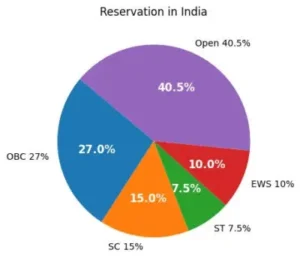
OBC Creamy Layer and Supreme Court Ruling

Constitutional Provisions

  • Preamble: Promises Justice, Equality, and Fraternity.
  • Article 15(4) & 15(5): Allows special provisions for advancement of socially and educationally backward classes.
  • Article 16(4): Permits reservation in public employment for backward classes not adequately represented.
  • Article 17: Abolishes untouchability.
  • Article 46: Directs the State to promote educational and economic interests of weaker sections.
  • Articles 330–332: Provide reservation of seats in legislatures for SCs and STs.

Supreme Court’s March 11 Ruling

  • Misapplication of Salary Income: The Court held that the Department of Personnel and Training (DoPT) wrongly counted salary income to determine creamy layer status for OBC candidates whose parents worked in PSUs or private employment.
  • Hostile Discrimination Identified: Declared this practice as “hostile discrimination”, since government employees’ salaries were excluded from the income test, creating unequal treatment between similarly placed candidates.
  • Relief for Affected Candidates: Directed the Centre to create supernumerary posts for OBC candidates excluded from Civil Services Examinations (CSE) since 2015 due to salarybased classification, ensuring fair service allocation.
  • Clarification on Income/Wealth Test: Stated that the income/wealth test must function as a residual filter, excluding only nonsalary sources like property, business, or capital gains, while consciously leaving out salaries and agricultural income.

Centre’s Concerns

  • Retrospective implementation could cause a “cascading effect” on settled services since 2012.
  • Issues of seniority, fairness, and adjustment across categories, including unreserved candidates.
  • Over 950 CSE 2025 candidates recommended under the old criteria may face uncertainty.
  • Fear of fresh claims from previously excluded candidates, leading to administrative overload.
  • Centre argues salary may sometimes be the “sole intelligible differentia” between similarly placed OBC candidates.

Future Course of Action

  • Supreme Court will set up a Bench to hear the Centre’s plea for clarification.
  • Key questions:
    • Should the ruling apply retrospectively?
    • How to balance fairness across OBC and unreserved categories?
    • Should salary income ever be considered in special cases?
  • Until clarified, the Centre seeks permission to continue allotting services under the old income test for CSE 2025.

INDRA SAWHNEY CASE (1992)

Popularly known as the Mandal Commission case, decided by a ninejudge Bench of the Supreme Court.

  • Upheld 27% reservation for OBCs in central services, but introduced the concept of the “creamy layer” to exclude the socially and economically advanced among OBCs.
  • The Court held that reservation is meant for the truly backward, and those who have gained significant social/economic advancement should not continue to benefit.
  • It clarified that reservation cannot exceed 50%, ensuring balance.
  • This judgment became the constitutional foundation for OBC reservation policy in India.

Key Points on Creamy Layer

  • 1993 DoPT Office Memorandum (OM) – Laid down exclusion criteria: children of senior officials, armed forces officers, and those exceeding income/wealth thresholds.
  • Income Limit – Initially ₹1 lakh per annum (1993), revised multiple times; currently ₹8 lakh per annum (since 2017).
  • Exclusions in Calculation – Income from salaries and agriculture was excluded, while income from business, property, and capital gains was considered.

Conclusion

The Supreme Court’s ruling strengthens equality by removing hostile discrimination, but its retrospective application poses challenges. The way forward lies in clear guidelines, transparent implementation, and safeguarding both merit and equity.

SOLAR FLARES

TOPIC: (GS1) GEOGRAPHY: THE HINDU

A new study using AdityaL1 mission data has revealed small, shortlived brightening events in the Sun’s atmosphere that occur hours before major solar flares.

Study on Solar Flare Precursors

  • Collaborative Research conducted jointly by the Manipal Centre for Natural Sciences, ISRO, and partner institutions, highlighting India’s growing role in space weather science.
  • Utilized the Solar Ultraviolet Imaging Telescope (SUIT) and Xray payloads (SoLEXS, HEL1OS) onboard the AdityaL1 mission, enabling simultaneous ultraviolet and Xray observations of the Sun.
  • Identified shortlived brightening events(PreFlare Events) in active regions of the Sun, linked to magnetic energy release. These signals appeared hours before major flares.
  • Suggested that repeated smallscale energy releases progressively destabilize magnetic fields, eventually triggering large solar flares.
  • Provides crucial insights into solar flare forecasting, enhancing preparedness against disruptions to satellites, astronauts, GPS, power grids, and communication systems.
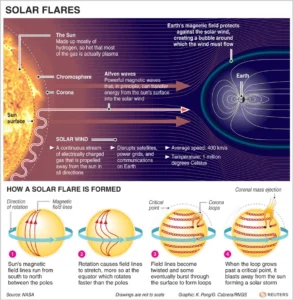
Solar Flares

What are Solar Flares?

  • Solar flares are sudden, intense bursts of radiation from the Sun’s atmosphere caused by the release of magnetic energy.
  • They emit energy across the spectrum — radio waves, visible light, UV, and Xrays.
  • Occur in active regions around sunspots where magnetic fields are strong.
  • Can disrupt satellite operations, GPS, power grids, and communication systems on Earth.

Conclusion

This study marks a step forward in predicting solar flares by identifying early warning signals. Reliable forecasting will strengthen space weather preparedness, safeguarding critical technologies and human missions in space.

INDIAN STANDARD TIME (IST)

TOPIC: (GS1) GEOGRAPHY: THE HINDU

The Union government has notified the Legal Metrology (Indian Standard Time) Rules, 2026, mandating Indian Standard Time (IST) as the single reference for all legal, administrative, commercial, and official purposes, and institutions have 180 days to align.

What is IST?

  • Indian Standard Time (IST) is the official time zone of India, set at UTC +5:30.
  • It is based on the 82.5° East longitude, passing near Mirzapur, Uttar Pradesh, chosen as the central meridian for uniformity across the country.
  • IST ensures that the entire nation follows a single time reference, despite India’s vast eastwest geographical spread.
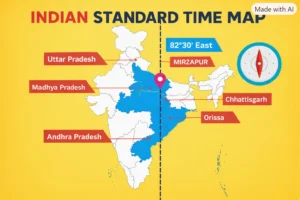
Indian Standard Time

How IST is Determined

  • Maintained by the National Physical Laboratory (NPL), New Delhi, using atomic clocks for precision.
  • Disseminated through satellite signals, internet servers, and legal metrology laboratories.
  • The new rules emphasize reducing reliance on foreign satellitebased time sources, ensuring selfreliance in timekeeping.

Significance of Uniform IST

  • Accurate timestamping of banking and digital payment transactions.
  • Synchronisation of railways, airports, and transport systems.
  • Reliable functioning of telecommunication and internet networks.
  • Precise power grid operations and emergency coordination.
  • Transparent government and legal recordkeeping.

Conclusion

By mandating IST as the common national time reference, ensures consistency across sectors, reduces dependence on foreign sources, and enhances trust in timecritical services.


PM e-BUS SEWA SCHEME

TOPIC: (GS3) ENVIRONMENT: THE HINDU

The PMeBus Sewa Scheme is gaining momentum, with over 500 electric buses operational across 23 cities and daily ridership exceeding one lakh.

About the Scheme

  • Implementing Ministry: Ministry of Housing and Urban Affairs (MoHUA).
  • Objective: Strengthen urban transport through deployment of 10,000 airconditioned electric buses across Indian cities.
  • Eligible Cities: Urban areas with populations between 3–40 lakh, and state capitals including NorthEastern and hilly regions below 3 lakh (2011 Census).
  • Duration: Support for 10 years of bus operations.

Key Features

  • Focuses on smaller cities with limited or no organized public transport.
  • Operates on a PublicPrivate Partnership (PPP) model — states manage services and payments, while the Centre provides subsidies.
  • Includes development of depots, charging infrastructure, and green mobility initiatives.
  • Integrates Intelligent Transit Management System (ITMS) and National Common Mobility Card (NCMC) for seamless ticketing and lastmile connectivity.

Significance

  • Promotes clean, efficient, and inclusive urban transport.
  • Reduces carbon emissions and dependence on fossil fuels.
  • Enhances urban accessibility, especially in TierII and TierIII cities.
  • Aligns with India’s NetZero and Smart Cities goals.

Conclusion

The PMeBus Sewa Scheme is a transformative initiative driving India toward ecofriendly, digitally integrated, and equitable urban mobility, ensuring that sustainable transport reaches every corner of the country.

Write a Review

Your email address will not be published. Required fields are marked *

Seraphinite AcceleratorOptimized by Seraphinite Accelerator
Turns on site high speed to be attractive for people and search engines.