
Table of Contents
ToggleTackling Food Loss and Waste: India’s Opportunity for Food Security and Sustainability
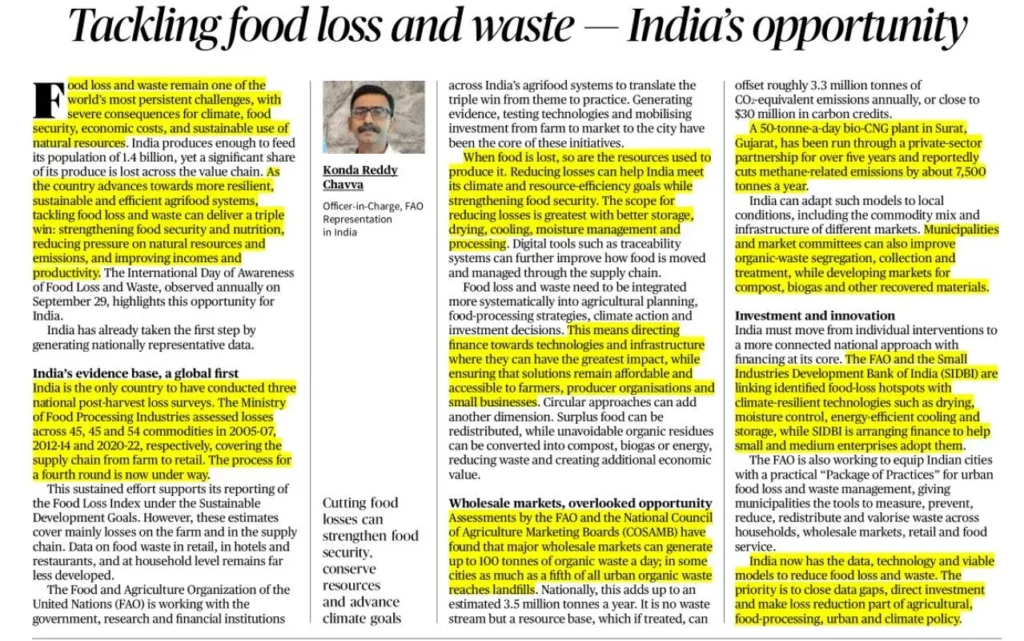
Food loss and food waste are major challenges affecting food security, natural resources, climate action and economic efficiency. For India, reducing losses across the agricultural and food supply chain can create multiple benefits, including better food availability, higher farmer incomes, efficient resource use and lower environmental pressure.
The article highlights India’s growing evidence base, technological opportunities and the need for coordinated action across agriculture, food processing, wholesale markets and urban waste management.
India’s Evidence Base on Food Loss
India has undertaken national post-harvest loss surveys covering different commodities and stages of the supply chain. The Ministry of Food Processing Industries conducted assessments covering 45, 46 and 54 commodities during different periods, including 2005–07, 2012–14 and 2020–22.
These studies provide an important evidence base for identifying where losses occur and where interventions can have the greatest impact.
However, the article notes that data on food waste at retail outlets, hotels, restaurants and households remains comparatively less developed.
Reducing Food Loss Through Technology
Food loss can occur because of inadequate storage, transportation, processing and handling. Important intervention areas include:
- Better storage facilities
- Drying technologies
- Cooling and cold-chain infrastructure
- Moisture management
- Food processing
- Digital traceability systems
Targeted investment in these areas can help reduce losses while improving resource efficiency.
Wholesale Markets: An Untapped Opportunity
Wholesale agricultural markets can generate substantial quantities of organic waste. According to the article, assessments by the FAO and National Council of Agricultural Marketing Boards indicate that some major wholesale markets can generate up to 100 tonnes of organic waste per day.
Organic waste can become a resource through:
- Composting
- Biogas production
- Bio-CNG
- Energy recovery
The article cites a 50-tonne-a-day bio-CNG plant in Surat, Gujarat, developed through a private-sector partnership, as an example of converting organic waste into useful energy.
Food Loss, Climate and Circular Economy
Reducing food loss also reduces the resources used to produce food, including water, energy, land and agricultural inputs. It can therefore contribute to India’s climate and resource-efficiency goals.
Circular-economy approaches can further enhance value by redistributing surplus food and converting organic residues into compost, biogas or energy.
Policy and Investment Priorities
The article calls for a coordinated national approach involving government agencies, financial institutions, municipalities, markets and businesses.
The FAO and Small Industries Development Bank of India (SIDBI) are highlighted for linking identified food-loss hotspots with climate-resilient technologies such as drying, moisture control and energy-efficient cooling and storage.
Conclusion
India has an opportunity to make food loss reduction an integral part of agricultural, food-processing, urban and climate policy. Better data, targeted technology, improved infrastructure and circular-economy solutions can help transform food loss and waste from an environmental challenge into an opportunity for food security, resource conservation and economic value creation.
Vocabulary
1. Food Loss – Food lost before reaching consumers.
2. Circular Economy – Reusing resources and minimising waste.
3. Traceability – Tracking food across the supply chain.
Prelims MCQs
MCQ 1
With reference to food loss and waste in India, consider the following statements:
- Food loss can occur during storage, transportation, processing and handling.
- Better cooling, drying and moisture-management technologies can help reduce food losses.
- Converting organic food waste into biogas and compost is an example of a circular-economy approach.
Which of the statements given above is/are correct?
A. 1 and 2 only
B. 2 and 3 only
C. 1 and 3 only
D. 1, 2 and 3
Answer: D. 1, 2 and 3
Explanation: The article identifies storage, drying, cooling, moisture management and processing as important areas for reducing food losses. It also highlights converting organic residues into compost, biogas or energy as a circular-economy solution.
MCQ 2
Consider the following statements regarding food waste management:
- Wholesale agricultural markets can generate substantial quantities of organic waste.
- Organic waste from markets can potentially be converted into bio-CNG.
- Reducing food loss contributes only to food security and has no relevance to climate objectives.
Which of the statements given above is/are correct?
A. 1 and 2 only
B. 2 and 3 only
C. 1 and 3 only
D. 1, 2 and 3
Answer: A. 1 and 2 only
Explanation: The article highlights wholesale markets as an important source of organic waste and cites a 50-tonne-a-day bio-CNG plant in Surat, Gujarat as an example. Reducing food loss also conserves resources and can support climate and resource-efficiency goals, making Statement 3 incorrect.
UPSC Mains Question
“Reducing food loss and waste can simultaneously strengthen food security, resource efficiency and climate action.” Discuss. (10 Marks)
Key points to cover:
- Food loss threatens food security, natural resources and climate goals.
- Better storage, drying, cooling, processing and traceability can reduce post-harvest losses.
- Organic waste can be converted into compost, biogas and energy, supporting a circular economy.
- India needs better data, investment and coordinated policies to build a resource-efficient food system.
Frequently Asked Questions (FAQs)
What is food loss and waste?
Food loss refers to reductions in food quantity or quality across the supply chain, while food waste generally involves food discarded at later stages such as retail, food service and households.
Why is reducing food loss important for India?
It can strengthen food security, conserve natural resources, reduce emissions and improve economic returns across the food supply chain.
How can technology reduce food loss?
Improved storage, drying, cooling, moisture management, processing and digital traceability can help reduce post-harvest losses.
How can organic food waste be converted into resources?
Organic waste can be processed into compost, biogas, bio-CNG or energy, supporting circular-economy practices.
What role can wholesale markets play?
Wholesale markets can improve segregation and treatment of organic waste while creating opportunities for composting, biogas and other resource-recovery activities.
Source From : The Hindu
In US-China AI Race, India’s Place Depends on Capabilities Built at Home
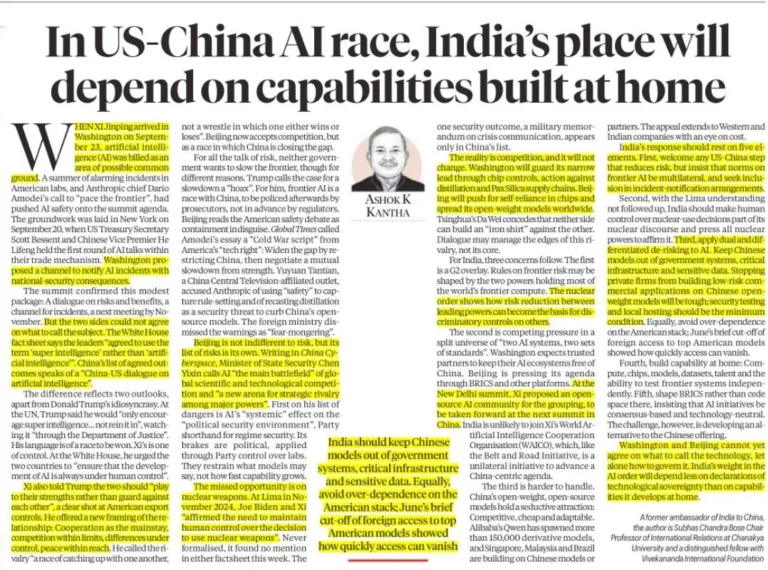
The intensifying US-China artificial intelligence (AI) competition is creating a new strategic environment in which advanced AI is increasingly linked to economic competitiveness, national security and technological sovereignty. Recent US-China discussions have included AI risks, incident notification and human control, even as differences remain over approaches to AI development and governance.
US-China AI Rivalry
The United States and China are competing across frontier AI models, computing infrastructure, semiconductors, data and AI governance. The rivalry could contribute to a fragmented global AI ecosystem, with different technological standards and access regimes emerging around the two major powers. CSIS
The article highlights an important concern for India: dependence on external AI systems could create vulnerabilities if access to advanced models, chips or computing infrastructure becomes restricted. At the same time, Chinese open-weight AI models are becoming increasingly attractive because of their accessibility and adaptability.
What Does It Mean for India?
India’s challenge is not simply choosing between the US and China. It is to develop domestic technological capabilities while maintaining international partnerships.
Key priorities include:
- Building domestic AI computing infrastructure
- Developing indigenous AI models
- Strengthening semiconductor and critical technology capabilities
- Protecting sensitive data and digital infrastructure
- Expanding AI research and skilled human resources
- Developing robust AI safety and governance mechanisms
IndiaAI Mission is already focused on areas including AI compute infrastructure, datasets, indigenous models, skilling and startup support.
The article also highlights the importance of avoiding excessive dependence on any single foreign technology ecosystem. India’s technology policy therefore involves a balance between strategic autonomy, global cooperation and technological openness.
India and Global AI Governance
India can also contribute to shaping international AI norms through platforms such as the G20, BRICS and other multilateral forums. The country has articulated a governance approach emphasising safe, trusted and inclusive AI innovation.
The broader lesson is that India’s influence in the emerging AI order will depend not only on diplomatic positioning but also on the capabilities it develops domestically.
Vocabulary
1. De-risking – Reducing strategic dependence without complete separation.
2. Compute – Computing capacity required to develop AI systems.
3. echnological Sovereignty – Ability to control critical technological capabilities.
Prelims MCQs
MCQ 1
Consider the following statements regarding the emerging US–China AI competition:
- The US–China AI rivalry extends beyond AI models to computing infrastructure, critical technologies and data.
- India’s strategic challenge includes avoiding excessive dependence on a single foreign technology ecosystem.
- Technological sovereignty requires complete technological isolation from foreign countries.
Which of the statements given above is/are correct?
A) 1 and 2 only
B) 2 and 3 only
C) 1 and 3 only
D) 1, 2 and 3
Answer: A) 1 and 2 only
Explanation: The article highlights competition over AI models, computing infrastructure and sensitive technologies, and stresses the importance of reducing over-dependence. Technological sovereignty does not mean complete isolation; it involves developing critical domestic capabilities while maintaining international cooperation.
MCQ 2
With reference to India’s approach to the emerging global AI order, consider the following statements:
- India needs to strengthen domestic AI capabilities, including computing infrastructure and indigenous AI models.
- India’s approach involves balancing technological openness with strategic autonomy.
- India must align exclusively with either the US or China to protect its technological interests.
Which of the statements given above is/are correct?
A) 1 only
B) 1 and 2 only
C) 2 and 3 only
D) 1, 2 and 3
Answer: B) 1 and 2 only
Explanation: The article emphasises building capabilities at home while engaging with multiple technology ecosystems and international platforms. It does not suggest exclusive alignment with either the US or China.
UPSC Mains Question
“India’s position in the global AI order will depend on capabilities built at home.” Discuss. (10 Marks)
Key points to cover:
- AI has emerged as a strategic arena in US-China technological competition.
- Competition extends to chips, AI models, standards, data and critical infrastructure.
- India needs differentiated de-risking—protect sensitive sectors while avoiding excessive dependence on either power.
- India’s global influence in AI will ultimately depend on domestic compute, chips, models, datasets and talent.
Frequently Asked Questions (FAQs)
Why is the US-China AI race important for India?
It could influence global AI standards, technology access, supply chains and national security.
What should India focus on amid the AI rivalry?
India needs stronger domestic capabilities in AI models, compute, semiconductors, talent and data infrastructure.
What is technological sovereignty?
It refers to a country’s ability to maintain critical technological capabilities and reduce excessive dependence on external systems.
What is the IndiaAI Mission?
It is a national initiative supporting AI compute infrastructure, datasets, indigenous AI models, skilling and innovation.
How can India contribute to global AI governance?
India can promote multilateral cooperation, responsible AI development, safety standards and inclusive access through international platforms.