

...
Daily Current affairs 30 September 2026

Daily Current Affairs 30 September 2026

Share this Post

SUPREME COURT AND ESSENTIAL MEDICINES AND DRUG PRICING

TOPIC: (GS2) POLITY: THE HINDU

The Supreme Court has questioned very high mark-ups between the Price to Retailer (PTR) and the price ultimately paid by patients, particularly for essential and cancer medicines. It asked the Centre to examine whether the 16% retailer margin used under DPCO, 2013 should have wider application to prevent excessive pricing.

What is the issue?

  • Large gaps can exist between the price at which medicines reach retailers/hospitals and their Maximum Retail Price (MRP).
  • The Court cited an instance of a cancer medicine supplied at about ₹3,000 but sold for nearly ₹27,000, raising questions about where the additional margin goes.
  • Hospitals requiring patients to purchase medicines only from in-house pharmacies can further limit consumer choice and price competition.

Drug Price Regulation in India

  • The Drugs (Prices Control) Order (DPCO), 2013 is the principal framework for regulating medicine prices.
  • The National Pharmaceutical Pricing Authority (NPPA) fixes ceiling prices of scheduled formulations and monitors prices of non-scheduled medicines.
  • For calculating ceiling/retail prices of scheduled formulations and new drugs, DPCO provides a 16% margin on Price to Retailer.
  • Non-scheduled medicines are generally outside direct ceiling-price control, although NPPA monitors their prices and can intervene in public interest.

Why Affordable Medicines Matter

  • Public health: High medicine prices can delay or interrupt treatment, especially for cancer and chronic diseases.
  • Household finances: Expensive treatment increases out-of-pocket expenditure and risks distress borrowing.
  • Public expenditure: Inflated medicine costs can indirectly increase the financial burden on publicly funded healthcare programmes.
  • Market ethics: Large trade margins raise concerns about information asymmetry because patients usually have limited bargaining power or ability to substitute prescribed medicines.

Government Measures and Examples

  • In 2019, NPPA capped trade margins on 42 selected non-scheduled anti-cancer medicines. The government subsequently reported price reductions across hundreds of brands and estimated annual patient savings of about ₹984 crore.
  • Affordable access is also promoted through PMBJP (Jan Aushadhi), AMRIT pharmacies and Ayushman Bharat-PMJAY.

Way Forward

  • Expand transparent disclosure of PTR, trade margins and MRP across the supply chain.
  • Strengthen NPPA monitoring and enforcement against overcharging.
  • Review trade-margin rationalisation for high-cost essential medicines.
  • Allow patients greater freedom to purchase medicines outside hospital pharmacies.
  • Balance affordability, availability, pharmaceutical innovation and viable distribution margins.

Conclusion:

Affordable essential medicines are central to the constitutional goal of equitable healthcare; transparent pricing and proportionate trade margins can protect both patients and public finances.

JAMMU & KASHMIR STATEHOOD AND THE ROAD AHEAD

TOPIC: (GS2) POLITY: THE HINDU

The Jammu and Kashmir Legislative Assembly passed a resolution on September 28, 2026, seeking early restoration of full Statehood to the Union Territory. The development has renewed debate on federalism, democratic representation and Centre–UT relations.

Background

  • The Jammu and Kashmir Reorganisation Act, 2019 reorganised the former State into two Union Territories — J&K with a legislature and Ladakh without one — from October 31, 2019.
  • This followed constitutional changes concerning Article 370, which had provided special arrangements for J&K.
  • In its 2023 Article 370 judgment, the Supreme Court recorded the Union government’s assurance that J&K’s Statehood would be restored and directed that restoration should take place “at the earliest and as soon as possible”.

Why is Statehood Significant?

  • Stronger representative government: A State government has greater control over administration than a UT with a legislature.
  • Federalism: Restoration would strengthen the role of elected institutions within India’s federal structure.
  • Democratic accountability: Greater powers with elected representatives can improve responsiveness to local needs.
  • Political confidence: It could deepen public participation in constitutional and democratic processes.

Evidence of Democratic Participation

  • The 2024 J&K Assembly election recorded 63.88% turnout, according to the Election Commission of India.
  • The 2024 Lok Sabha election also saw J&K record 58.65% turnout, compared with 44.37% in 2019.
  • Such participation indicates the importance of strengthening elected institutions while continuing security efforts.

Key Challenges

  • Security: Cross-border terrorism and militancy remain important considerations in governance.
  • Centre–State coordination: Security priorities need to coexist with democratic decentralisation.
  • Institutional transition: Restoration would require clarity regarding powers, administrative structures and Centre-State responsibilities.
  • Regional aspirations: Governance must address the diverse concerns of Jammu, Kashmir and different social communities.

FORMATION OF NEW STATES

  • Article 2: Parliament can admit or establish new States in the Union of India.
  • Article 3: Parliament can create new States, merge or separate territories, and alter the area, boundaries or names of existing States.
  • Procedure: The Bill can be introduced in Parliament only with the President’s recommendation; the President refers it to the affected State Legislature for its views, but Parliament is not bound by those views.
  • Article 4: Such a Bill requires only a simple majority in Parliament and is not considered a constitutional amendment under Article 368.

Conclusion:

A durable peace in Jammu and Kashmir requires security and development to advance alongside democratic representation, constitutionalism and cooperative federalism.

SURVEILLANCE AND INDIA’S EMERGING PRIVACY CHALLENGE

TOPIC: (GS2) GOVERNANCE: THE HINDU

Recent debates over facial-recognition surveillance, doxxing/deepfakes and verification of electoral rolls have brought informational privacy back into focus.

Privacy as a Constitutional Right

  • In K.S. Puttaswamy v. Union of India (2017), the Supreme Court recognised privacy as a fundamental right under Article 21, connected with dignity, liberty and autonomy.
  • State interference with privacy must satisfy legality, legitimate State purpose and proportionality.
  • Thus, privacy is not absolute, but restrictions require constitutional justification.

Privacy Challenges in the Digital Age

  • Facial Recognition: AI-based cameras can identify individuals in crowds, raising concerns about mass surveillance, profiling and possible chilling effects on peaceful assembly.
  • Doxxing and Deepfakes: Publishing addresses, photographs or other personal details can expose individuals to harassment and threats. AI-generated content makes impersonation and misinformation easier.
  • Public-private data chain: Police or government bodies may use technology supplied or managed by private companies. This raises questions over data storage, sharing, retention and accountability.
  • Electoral databases: Electoral-roll verification serves the legitimate purpose of maintaining accurate rolls, but procedures must also prevent wrongful exclusion of eligible citizens.
Surveillance and indias emerging privacy challenge

Electoral Roll Dimension

  • Under Article 326, adult citizens meeting legal requirements are entitled to electoral registration.
  • The Election Commission states that intensive revision seeks both to include eligible citizens and remove ineligible, deceased or shifted persons.
  • Hence, electoral integrity must be balanced with due process, accessibility and protection against exclusion.

Existing Safeguards

  • Constitution: Articles 14, 19 and 21 provide safeguards relating to equality, freedoms, liberty and privacy.
  • Digital Personal Data Protection Act, 2023: establishes obligations regarding processing of digital personal data, while also providing specified exemptions.
  • Information Technology framework: addresses certain cyber offences and unlawful disclosure of information.
  • Courts can review surveillance or data-processing measures that violate constitutional rights.

Challenges

  • Algorithmic errors: Facial recognition can produce false matches, making human oversight essential.
  • Fragmented accountability: Responsibility becomes unclear when government bodies, vendors and online platforms handle the same data.
  • Democratic freedoms: Unchecked identification can discourage legitimate protest, association and expression.
  • Cybersecurity: Larger biometric and identity databases create attractive targets for data breaches.

Way Forward

  • Enact clear rules governing facial recognition and biometric surveillance, including necessity and proportionality tests.
  • Introduce independent oversight and regular audits of surveillance technologies.
  • Adopt purpose limitation, data minimisation and fixed retention periods.
  • Provide citizens accessible mechanisms for notice, correction, grievance redressal and compensation.
  • Develop safeguards against deepfakes and doxxing without undermining legitimate free speech.

Conclusion:

In a data-driven democracy, privacy protection must follow personal information across its entire life cycle—not merely regulate who first collects it.


RISING SULPHUR PRICES AND INDIA’S FERTILISER SECURITY

TOPIC: (GS3) ECONOMY: THE HINDU

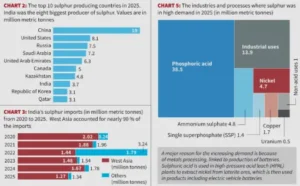
International sulphur prices have risen sharply amid Russia-related supply restrictions, West Asian tensions and growing industrial demand, increasing costs for import-dependent India.
The issue matters because sulphur is a crucial input for phosphatic fertilisers, chemicals and critical-mineral processing, linking geopolitics directly with agriculture and the clean-energy transition.

Sulphur: Why is it Important?

  • Sulphur is a non-metallic element mainly recovered as a by-product of petroleum refining and natural-gas processing.
  • It is converted largely into sulphuric acid, an important industrial chemical.
  • Major uses include fertilisers, petroleum refining, chemicals, pharmaceuticals and metal processing.
  • Sulphuric acid is particularly important for producing phosphatic fertilisers such as DAP and for processing minerals such as nickel.

Why are Global Prices Rising?

  • Russia-Ukraine conflict: Disruptions to Russian oil and gas-processing facilities and export restrictions have reduced supplies.
  • West Asian instability: The region is a major centre of hydrocarbon production and seaborne sulphur trade; conflict therefore creates supply and shipping risks.
  • Structural constraint: Unlike commodities whose production can quickly increase with higher prices, most sulphur is obtained as a by-product of oil and gas processing.
  • Energy transition: Rising nickel processing, including Indonesia’s expanding industry, has increased sulphuric-acid demand. Nickel is used in several lithium-ion battery chemistries.

Why is India Vulnerable?

  • India produces sulphur domestically, including through petroleum refineries, but domestic availability does not fully meet demand.
  • Dependence on imports exposes India to geopolitical disruptions, freight costs and international price volatility.
  • The Commerce Ministry’s TradeStat system tracks sulphur imports by commodity and source country, highlighting its significance in India’s import basket.
  • Government data also show that international sulphur prices had already risen sharply: the Department of Fertilizers reported an approximately 182% year-on-year increase in June 2025.

Multi-dimensional Impact on India

  • Agriculture: Costlier sulphur can raise production costs of phosphatic fertilisers.
  • Fiscal: Higher input costs can increase pressure on the government’s fertiliser subsidy framework.
  • Inflation: Higher fertiliser costs can indirectly affect farm economics and food prices.
  • External sector: Expensive imports add to India’s import bill and foreign-exchange requirements.
  • Energy transition paradox: Expansion of EV batteries and critical-mineral processing can increase demand for a commodity linked largely to the fossil-fuel industry.

Way Forward

  • Diversify sulphur imports beyond highly concentrated supply regions.
  • Increase recovery of sulphur from domestic refineries and gas-processing facilities.
  • Strengthen domestic fertiliser raw-material security; for example, government-owned FACT has arranged sulphur supplies from BPCL and MRPL, reducing its import dependence.
  • Integrate fertiliser, mineral, energy and trade policies to anticipate commodity shocks.

Conclusion:

India’s sulphur challenge shows that strategic resilience requires not merely securing energy supplies, but also safeguarding the critical by-products on which agriculture and emerging industries depend.

AFSPA AND THE DEBATE OVER CIVIL LIBERTIES

TOPIC: (GS2) POLITY: THE HINDU

The Union Home Ministry has extended the Armed Forces (Special Powers) Act (AFSPA), 1958 in specified areas of Manipur, Nagaland and Arunachal Pradesh for another six months from October 1, 2026, following a review of the security situation.

What is AFSPA?

  • Enacted in 1958, AFSPA provides special operational powers to the armed forces in areas facing serious insurgency or internal-security challenges.
  • Its constitutional context is linked to the Union’s responsibility under Article 355 to protect States against external aggression and internal disturbance.
  • Jammu and Kashmir is governed by a separate AFSPA law of 1990.

What is a ‘Disturbed Area’?

  • Under Section 3, the Governor of a State, Administrator of a Union Territory or Central Government may declare an area “disturbed” when armed forces are considered necessary to aid civil power.
  • Such notification activates the special powers provided by the Act.

Major Powers under AFSPA

  • Use of force: Authorised personnel may, after due warning and subject to statutory conditions, use force even to the extent of causing death against specified violations involving prohibited assemblies or weapons.
  • Arrest: A person suspected of committing certain cognisable offences may be arrested without a warrant.
  • Search: Premises may be entered and searched without a warrant for specified purposes.
  • Destruction: Certain arms dumps, fortified positions or shelters used by armed groups may be destroyed.
  • Legal protection: Under Section 6, prosecution or other legal proceedings for acts done or purportedly done under AFSPA require previous sanction of the Central Government.

Why is AFSPA Considered Necessary?

  • Provides security forces operational flexibility in areas affected by insurgency and armed violence.
  • Supports civil administration where ordinary policing capacity may be inadequate.
  • Helps secure strategically sensitive and border regions.
  • The government links the shrinking geographical application of AFSPA to improvements in security. In June 2026, it stated that roughly 80% of the Northeast was outside AFSPA coverage.

Key Concerns

  • Fundamental rights: Wide powers of arrest, search and use of force create concerns regarding Articles 14 and 21.
  • Accountability: Prior sanction for prosecution has generated debate over effective remedies for alleged excesses.
  • Federalism: Both Union and State authorities can declare disturbed areas, making Centre-State coordination important.
  • Public trust: Long-term application may create alienation if extraordinary security arrangements become normalised.
  • Duration: Continued application should reflect periodic, evidence-based assessment of local security conditions.

Way Forward

  • Review disturbed-area notifications regularly using objective security indicators.
  • Ensure strict adherence to proportionality, operational safeguards and judicial directions.
  • Strengthen local police, intelligence and civilian administration so extraordinary measures become less necessary.
  • Ensure credible investigation of alleged human-rights violations.
  • Complement security operations with peace agreements, development, employment and political dialogue. Government data point to peace accords and declining insurgency alongside the reduction of AFSPA areas in the Northeast.

Conclusion:

AFSPA should remain an exceptional security instrument, with its use continuously tested against necessity, accountability, constitutional rights and the goal of restoring normal civilian governance.

EDIBLE OIL IMPORT DUTY CUT AND BALANCING CONSUMER PRICES

TOPIC: (GS3) ECONOMY: THE HINDU

The Union government has reduced the Basic Customs Duty (BCD) on major imported edible oils from September 24, 2026 to soften domestic prices ahead of the festive season.

What has the Government Changed?

  • BCD on crude palm oil and crude soybean oil has been reduced from 10% to 5%, while crude sunflower oil has been reduced from 10% to nil.
  • Duties on refined edible oils have also been lowered.
  • However, the government retained a 19.25 percentage-point duty gap between crude and refined oils, encouraging import of crude oil for refining within India.

Why was the Duty Reduced?

  • Control food inflation: Import duty forms part of the landed cost. Lower taxation can reduce wholesale and retail prices if benefits are passed to consumers.
  • Global price pressure: Rising international vegetable-oil prices had increased India’s import costs.
  • Festival demand: Consumption by households, sweet manufacturers, restaurants and food-processing businesses generally increases during the festive period.
  • Supply security: Lower duties can encourage imports and prevent domestic shortages or sudden price spikes.
  • Thus, customs duty acts as a counter-cyclical policy tool — reduced when consumer prices rise and increased when cheap imports threaten farmers.

Why is India Vulnerable?

  • India meets only around 44% of its edible-oil requirement domestically, with imports accounting for about 56% of consumption in 2023-24.
  • Domestic oilseed farming is vulnerable because about 76% of the cultivated area is rain-fed, resulting in unstable yields.
  • Palm, soybean and sunflower oil imports therefore expose India to global prices, exchange-rate movements, geopolitical disruptions and exporting-country policies.

Why are Farmers Concerned?

  • Cheaper imported oils can depress domestic oilseed prices, particularly affecting soybean, sunflower, mustard and groundnut growers.
  • Lower farm-gate prices may discourage farmers from shifting land towards oilseeds.
  • This creates tension with India’s objective of Atmanirbharta in edible oils.
  • Import tariffs are themselves used by the government to protect farmers from global price fluctuations; hence frequent duty changes require careful calibration.

Government’s Long-term Strategy

  • NMEO–Oilseeds, approved with an outlay of ₹10,103 crore, seeks to raise primary oilseed production from 39 MT in 2022-23 to 69.7 MT by 2030-31.
  • NMEO–Oil Palm promotes domestic palm-oil cultivation through planting support, irrigation, processing infrastructure and price assurance.
  • MSP and PM-AASHA procurement provide additional support to domestic oilseed farmers.

Way Forward

  • Make import-duty changes predictable and calibrated to avoid sudden shocks to farmers.
  • Expand irrigation, high-yielding seeds, oil extraction efficiency and processing infrastructure.
  • Strengthen MSP procurement when international prices fall sharply.
  • Diversify import sources while promoting oils from mustard, groundnut, rice bran and other domestic sources.
  • Ensure that duty reductions are actually transmitted to consumers through market monitoring.

Conclusion:

India needs a calibrated edible-oil policy that protects consumers from inflation today without weakening farmers, domestic production and food security tomorrow.

Write a Review

Your email address will not be published. Required fields are marked *

Seraphinite AcceleratorOptimized by Seraphinite Accelerator
Turns on site high speed to be attractive for people and search engines.