
Table of Contents
ToggleWhat is Preventive Detention? Constitutional Safeguards in India
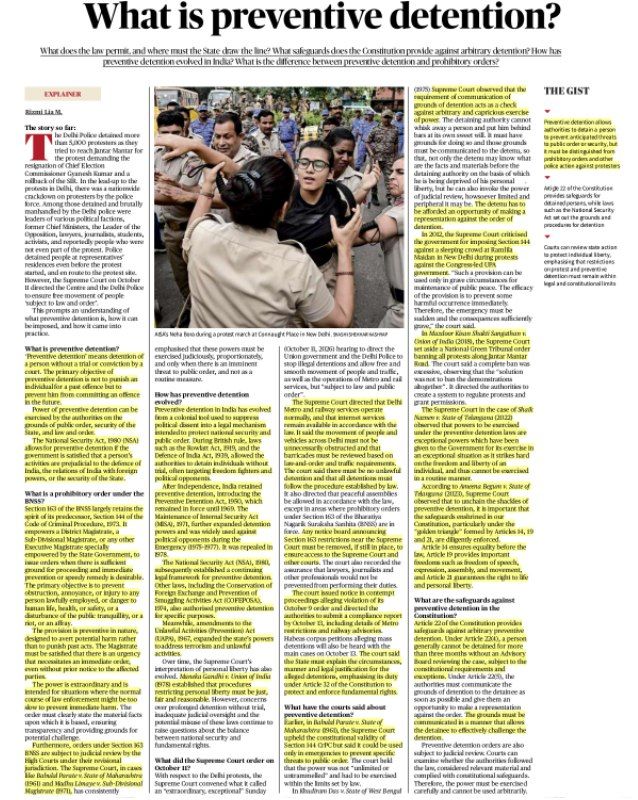
Preventive detention is a mechanism under which a person may be detained without a criminal trial or conviction, with the objective of preventing them from committing certain acts considered harmful to public order, national security or other specified interests. Unlike punitive detention, which follows an offence and judicial process, preventive detention is based on the anticipated conduct of a person.
The Constitution of India recognises preventive detention but also provides safeguards to prevent its arbitrary use.
What is Preventive Detention?
Preventive detention is intended to prevent a person from carrying out a potentially harmful act, rather than punish them for an offence already committed.
The concept evolved significantly during colonial rule and continued after Independence through laws such as the Preventive Detention Act, 1950. The article highlights the subsequent use of laws such as the Maintenance of Internal Security Act (MISA), 1971, and the National Security Act (NSA), 1980.
Constitutional Framework Under Article 22
Article 22 provides important safeguards concerning arrest and detention.
However, certain safeguards available to ordinary arrested persons do not apply in the same manner to preventive detention. Article 22 specifically provides a separate constitutional framework for preventive detention.
Key safeguards include:
- A person detained under a preventive detention law must generally be informed of the grounds of detention.
- The detained person must be given an opportunity to make a representation against the detention.
- Article 22 provides for the role of an Advisory Board in cases involving prolonged preventive detention.
- The constitutional framework places limits on how long a person can be detained without the required procedural safeguards.
Judicial Safeguards
The Supreme Court has repeatedly emphasised that preventive detention laws must be applied strictly and according to constitutional and statutory procedures.
Courts can examine whether detention authorities have complied with mandatory safeguards, properly considered relevant material and provided the detainee an effective opportunity to challenge the detention.
This judicial scrutiny is important because preventive detention involves a serious restriction on personal liberty.
Preventive Detention vs Punitive Detention
The fundamental distinction is simple:
- Preventive detention: seeks to prevent a future harmful act.
- Punitive detention: follows an alleged offence and aims to punish the person through the criminal justice process.
Thus, preventive detention is an exceptional power that must be balanced against the constitutional protection of individual liberty.
Conclusion
Preventive detention represents a difficult constitutional balance between national security and public order on one side and individual liberty on the other. While the Constitution permits preventive detention in specified circumstances, it also establishes safeguards against arbitrary deprivation of liberty. Effective judicial review, communication of grounds and meaningful opportunities for representation are therefore essential to ensure that preventive detention does not become a substitute for ordinary criminal procedure.
Vocabulary
1. Preventive Detention – Detention to prevent anticipated harmful acts.
2. Prohibitory Order – Restriction imposed to maintain public order.
3. Judicial Review – Court examination of legality.
Prelims MCQs
MCQ 1
Consider the following statements:
1. Preventive detention does not require a prior criminal conviction.
2. Article 22 provides safeguards against preventive detention.
3. Preventive detention orders are completely beyond judicial review.
Which are correct?
A) 1 and 2 only
B) 2 and 3 only
C) 1 and 3 only
D) 1, 2 and 3
Answer: A
UPSC Mains Question
“Preventive detention poses a challenge to the balance between national security and personal liberty.” Examine with reference to constitutional safeguards. (10 Marks)
Frequently Asked Questions (FAQs)
What is preventive detention?
Preventive detention is the detention of a person to prevent them from committing a potentially harmful act, rather than to punish them for an offence already committed.
Which Article of the Constitution deals with preventive detention?
Article 22 of the Constitution provides the principal constitutional framework and safeguards relating to preventive detention.
What is the difference between preventive and punitive detention?
Preventive detention aims to prevent future harmful conduct, whereas punitive detention follows an offence and forms part of the process of punishment.
What safeguards are available to a person under preventive detention?
The constitutional framework includes safeguards such as communication of grounds, an opportunity to make a representation and Advisory Board review in cases of prolonged detention.
Which major law currently provides for preventive detention?
The National Security Act, 1980 (NSA) is one of India’s major laws providing for preventive detention.
Source From : The Hindu
The Other G2: Three Lessons for India from US-Russia Ties
The evolving relationship between the United States, Russia and China has important implications for India’s strategic autonomy and foreign policy. The article highlights how changing U.S.-Russia relations, the growing Russia-China partnership and Washington’s approach towards Moscow are reshaping the global strategic environment. For India, the challenge is to protect its interests while maintaining relationships with all major powers.
Why US-Russia Relations Matter for India
U.S.-Russia relations have remained complicated because of the Ukraine conflict, sanctions and disagreements over Russia’s engagement with the West. However, the possibility of improved relations between Washington and Moscow could significantly affect India.
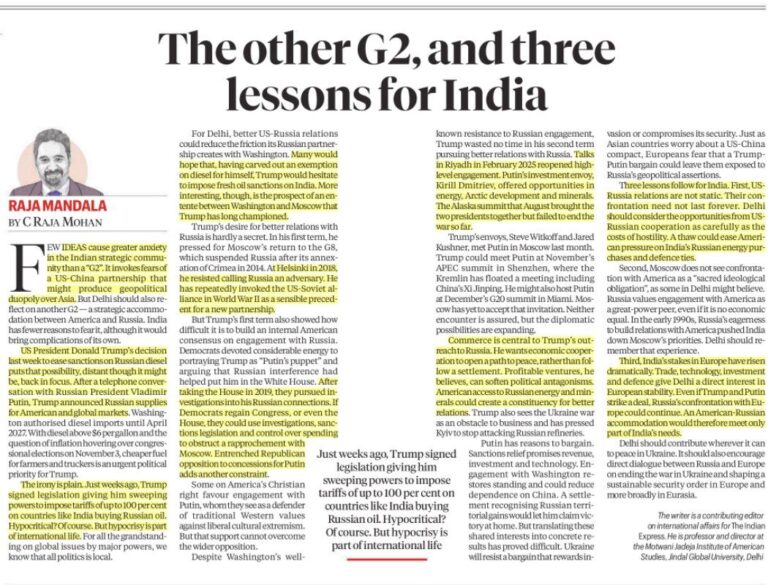
Better U.S.-Russia relations could reduce friction between India and Washington over India’s defence and energy ties with Russia. India could potentially benefit from greater strategic flexibility and reduced pressure concerning its Russian oil and defence purchases.
At the same time, India cannot assume that U.S.-Russia relations will permanently improve. The article stresses that Russia’s relations with the United States are not static and that India must carefully assess every strategic opportunity.
Three Lessons for India
1. Russia-U.S. Relations Are Not Static
India should recognise that relations between major powers can change rapidly. Russia may cooperate with Washington in some areas while continuing strategic engagement with China.
Therefore, India must assess Russian cooperation based on its own national interests rather than assuming permanent alignment between Moscow and any particular power.
2. Moscow Does Not See Washington as a Permanent Adversary
The article points out that Russia does not necessarily view confrontation with the United States as an ideological obligation. This creates opportunities for India.
India should use diplomatic engagement with both Moscow and Washington to safeguard its interests while avoiding excessive dependence on either side.
3. Europe Remains Strategically Important
The third lesson concerns Europe. India’s economic, technological, investment and defence relationships with European countries have expanded considerably.
Even if U.S.-Russia relations improve, India should continue strengthening its engagement with Europe, particularly on issues related to Ukraine, European security and the broader Eurasian order.
Conclusion
India’s foreign policy must remain flexible in an increasingly multipolar world. The emerging strategic competition among the United States, Russia and China demonstrates that partnerships can shift according to changing interests. India should therefore focus on strategic autonomy, diversified partnerships and national interest, while deepening ties with the U.S., Russia, Europe and other major powers.
Vocabulary
1. Rapprochement – Improvement in strained diplomatic relations.
2. Strategic Autonomy – Independent foreign policy decision-making.
3. Geopolitical Bargaining – Negotiations driven by strategic interests.
Prelims MCQs
MCQ 1
Consider the following statements:
1. Russia is a permanent member of the UN Security Council.
2. India follows a policy of strategic autonomy.
3. The G7 is a formal military alliance.
Which are correct?
A) 1 and 2 only
B) 2 and 3 only
C) 1 and 3 only
D) 1, 2 and 3
Answer: A
UPSC Mains Question
“Renewed US-Russia engagement presents both opportunities and challenges for India’s strategic autonomy.” Discuss. (10 Marks)
Frequently Asked Questions (FAQs)
Why are US-Russia relations important for India?
Changes in U.S.-Russia relations can influence India’s defence cooperation, energy security and strategic autonomy.
What is the first lesson for India?
India should recognise that Russia-U.S. relations are not static and should assess opportunities based on its own interests.
Does Russia consider the U.S. a permanent adversary?
The article argues that Russia does not necessarily see confrontation with the U.S. as a permanent ideological obligation.
Why is Europe important for India?
India has growing economic, technological, investment and defence relationships with European countries, making Europe strategically significant.
What should India focus on amid great-power competition?
India should pursue strategic autonomy, diversified partnerships and an interest-based foreign policy.