Table of Contents
ToggleIndia’s China+1 Lessons Lie Within Its Own States
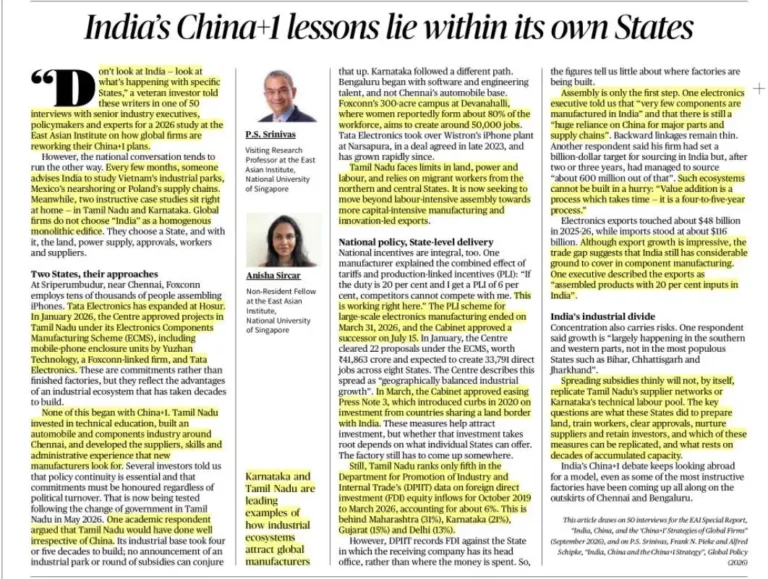
The global China+1 strategy is encouraging multinational companies to diversify manufacturing beyond China. India has emerged as an important destination, but the experience of different Indian States shows that attracting global manufacturers requires more than subsidies and policy announcements. Land, power, skilled labour, infrastructure, approvals and reliable supply chains play a decisive role.
The experience of Tamil Nadu and Karnataka offers valuable lessons for India’s manufacturing ambitions.
What is the China+1 Strategy?
China+1 refers to the strategy of companies reducing excessive dependence on China by establishing manufacturing or supply-chain operations in additional countries.
India is well positioned to benefit from this trend because of its large domestic market, growing manufacturing capabilities and government incentives. However, global companies increasingly compare specific industrial ecosystems rather than simply choosing India as a whole.
Tamil Nadu and Karnataka: Two Different Approaches
Tamil Nadu has developed a strong manufacturing ecosystem around Chennai and Sriperumbudur. Companies such as Foxconn and Tata Electronics have expanded their presence in the State.
The State’s advantages include technical education, an established automobile and components industry, skilled workers and an extensive supplier network. These factors create the industrial ecosystem that large manufacturers require.
Karnataka, meanwhile, has followed a somewhat different path. Foxconn’s planned campus at Devanahalli near Bengaluru is expected to create substantial employment, while Tata Electronics’ plant at Narsapura demonstrates the State’s growing electronics manufacturing potential.
Why State-Level Ecosystems Matter
The article highlights an important distinction between national policy and State-level implementation. Central schemes such as the Production Linked Incentive (PLI) scheme can provide incentives, but actual investment decisions depend heavily on what individual States can offer.
Manufacturers require:
- Reliable electricity and infrastructure
- Adequate industrial land
- Skilled and trainable workers
- Efficient approvals
- Strong supplier networks
- Logistics and connectivity
- Stable and predictable policies
Therefore, subsidies alone cannot create a globally competitive manufacturing ecosystem.
The Electronics Manufacturing Challenge
India’s electronics exports have grown, but the article points out that a significant share of components and inputs are still sourced from outside India. Moving from assembly to deeper manufacturing requires time and the development of domestic supplier ecosystems.
The article notes that building such ecosystems can take several years because suppliers need confidence in long-term demand before making large investments.
Conclusion
India’s China+1 opportunity will ultimately depend on what happens within its States. Tamil Nadu and Karnataka demonstrate how industrial ecosystems, skilled labour, infrastructure and supplier networks can attract global manufacturers.
For India to convert China+1 into sustained manufacturing growth, the focus must move beyond attracting individual factories towards building complete, competitive and geographically distributed industrial ecosystems.
Vocabulary
1. China+1 Strategy – Diversifying manufacturing beyond China.
2. Value Addition – Increase in product value through production.
3. Industrial Ecosystem – Network of suppliers, workers and infrastructure.
Prelims MCQs
MCQ 1
Consider the following statements:
1. PLI incentivises domestic manufacturing.
2. ECMS promotes electronics component production.
3. China+1 requires complete withdrawal from China.
Which are correct?
A) 1 and 2 only
B) 2 and 3 only
C) 1 and 3 only
D) 1, 2 and 3
Answer: A
UPSC Mains Question
“India’s success under the China+1 strategy depends on State-level industrial ecosystems rather than incentives alone.” Discuss. (10 Marks)
Frequently Asked Questions (FAQs)
What is the China+1 strategy?
China+1 is a business strategy in which companies diversify manufacturing and supply chains beyond China to reduce excessive dependence on a single country.
Why are Tamil Nadu and Karnataka important for China+1?
Both States have developed industrial ecosystems involving skilled labour, infrastructure, suppliers and manufacturing capabilities, helping attract global companies.
What is the role of the PLI scheme?
The Production Linked Incentive (PLI) scheme provides incentives linked to production and can support large-scale manufacturing investments.
Why are supplier networks important for manufacturing?
Strong supplier networks help manufacturers obtain components, materials and services efficiently, reducing costs and improving production reliability.
What is India's major challenge in electronics manufacturing?
India needs to move beyond assembly and develop deeper domestic component manufacturing and supplier ecosystems.