Table of Contents
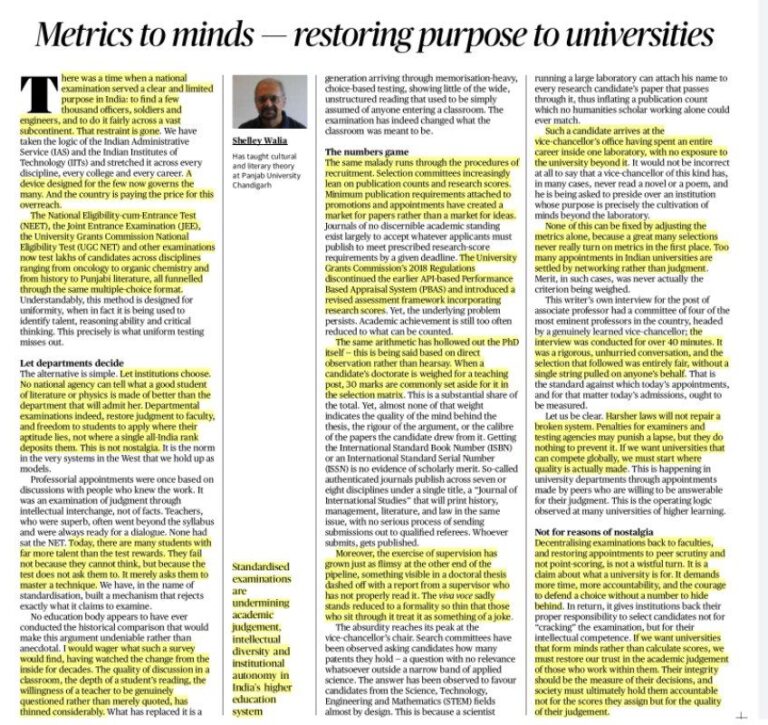
ToggleMetrics to Minds: Restoring Purpose to Universities
India’s higher education system is increasingly shaped by standardised examinations, rankings, publications and measurable performance indicators. While these metrics can improve transparency and accountability, excessive dependence on them can weaken academic judgment, intellectual diversity and the autonomy of universities. The central challenge is to ensure that universities cultivate knowledge, curiosity, research and independent thinking, rather than simply rewarding what can be easily counted.
The Rise of Standardised Examinations
National examinations such as the JEE, NEET and UGC NET have expanded access to higher education and created common benchmarks for evaluating candidates. However, the article questions whether standardised testing can adequately identify qualities such as intellectual curiosity, creativity, reasoning ability and a genuine interest in learning.
A system dominated by examination scores can encourage students to optimise for tests rather than develop deeper academic abilities.
Universities Need Academic Judgment
The article argues for greater responsibility to be given to departments and academic institutions in selecting students and faculty. Academic appointments should consider the quality of scholarship, teaching ability and intellectual contribution rather than relying excessively on standardised metrics.
Professional appointments historically depended more on discussions among people familiar with the candidate’s work. This allowed academic judgment to play a greater role in evaluating potential.
The Problem with Counting Publications
Research assessment has increasingly become associated with measurable indicators such as publications, citations and journal credentials. The article refers to changes in assessment frameworks and argues that academic achievement is too often reduced to what can be counted.
Publication numbers alone cannot necessarily reveal the originality, importance or intellectual depth of research. Similarly, bibliometric indicators may encourage academics to focus on producing measurable outputs rather than pursuing meaningful questions.
Rethinking Faculty Appointments
The article advocates a system in which universities carefully evaluate teaching, research quality, intellectual contribution and academic judgment.
A candidate’s ability to conduct meaningful research should matter more than simply accumulating publications. Universities must also avoid creating incentives where candidates optimise their profiles merely to satisfy predetermined selection criteria.
Conclusion
India’s universities need a better balance between accountability and academic autonomy. Metrics can provide useful information, but they should support—not replace—academic judgment. Universities ultimately exist to develop knowledge, independent thought and intellectual capability. Restoring that purpose requires stronger faculty autonomy, better evaluation of scholarship and selection systems that recognise qualities that cannot always be reduced to numbers.
Vocabulary
1. Standardisation – Applying uniform assessment criteria.
2. Peer Review – Evaluation by experts in the same field.
3. Academic Autonomy – Freedom of institutions in academic decisions.
Prelims MCQs
MCQ 1
Which of the following can improve higher education quality?
1. Institutional autonomy
2. Peer-based academic evaluation 3. Exclusive reliance on publication counts
Which are correct?
A) 1 and 2 only
B) 2 and 3 only
C) 1 and 3 only
D) 1, 2 and 3
Answer: A
UPSC Mains Question
“Excessive standardisation and metric-based evaluation undermine academic excellence in Indian universities.” Discuss.
(10 Marks)
Frequently Asked Questions (FAQs)
Why are standardised examinations important in higher education?
They provide common benchmarks and can improve transparency and comparability in student selection.
What is the major criticism of excessive reliance on metrics?
Metrics may encourage students and academics to focus on measurable outputs rather than genuine learning, research and intellectual development.
Why is departmental autonomy important?
Departments are often better positioned to assess a candidate’s subject knowledge, research potential, teaching ability and intellectual contribution.
Can publication numbers alone measure research quality?
No. Publication counts do not necessarily capture the originality, significance or intellectual depth of research.
What should universities prioritise?
Universities should prioritise academic judgment, intellectual diversity, quality research, teaching and independent thinking, alongside appropriate accountability.
Source From : The Hindu
NRI as the Non-Returning Indian: What Gets Lost in the US Visa Debate
The debate over US visas for Indian professionals, particularly H-1B visas, is often viewed through the lens of immigration, employment and skilled-worker mobility. However, there is a larger issue at stake: India’s loss of human capital. When highly skilled Indians settle abroad permanently, India may gain through remittances and global networks, but it can also lose talent, expertise and entrepreneurial potential.
India’s Long History of Labour Export
India has historically supplied workers to different parts of the world. The article highlights that labour migration has evolved from colonial-era systems of indentured labour to today’s movement of highly skilled professionals.
The contemporary Indian migrant is often a highly educated professional working in sectors such as technology, research, healthcare and business.
The United States has benefited significantly from Indian talent, while Indian professionals have gained access to better employment opportunities and living standards.
The H-1B Visa Debate
Recent comments by U.S. Vice-President JD Vance and Commerce Secretary Piyush Goyal have brought the contribution of Indian H-1B visa holders into focus.
The article points out that Indian professionals have contributed to the U.S. economy and that American companies benefit from access to skilled Indian workers. At the same time, concerns over immigration and the treatment of foreign workers can influence future migration patterns.
The broader question is not simply whether Indians should migrate, but what India loses when skilled citizens do not return.
Human Capital: Necessity or Loss?
India benefits from overseas migration through remittances, knowledge networks and international connections. The article argues that the export of human capital should not automatically be viewed as a loss.
However, when highly skilled professionals settle permanently abroad, India may lose potential researchers, entrepreneurs, academics and professionals who could contribute to domestic development.
This becomes particularly important as India faces the challenge of creating opportunities for its growing educated population.

The Need to Attract Talent Back
The article argues that India must create an environment where returning professionals see meaningful opportunities. This requires improvements in:
- Research and innovation ecosystems
- Employment opportunities
- Universities and educational institutions
- Entrepreneurship
- Professional autonomy
- Government and institutional support
India’s challenge is therefore not merely to prevent migration but to make returning to India an attractive choice.
Conclusion
The migration of skilled Indians is both an opportunity and a challenge. Overseas Indians contribute through remittances, expertise and global networks, but permanent migration can also result in the loss of valuable human capital. India needs policies that transform its global talent network into a domestic advantage by creating an environment where skilled professionals can return, innovate and contribute to India’s development.
Vocabulary
1. Brain Drain – Emigration of skilled professionals.
2. H-1B Visa – US visa for specialty occupations.
3. Mode 4 – Temporary movement of service providers under the WTO framework.
Prelims MCQs
MCQ 1
Consider the following statements:
1. WTO Mode 4 concerns the temporary movement of natural persons supplying services.
2. Remittances can strengthen a country’s foreign exchange inflows.
3. H-1B visas automatically grant permanent US residency.
Which are correct?
A) 1 and 2 only
B) 2 and 3 only
C) 1 and 3 only
D) 1, 2 and 3
Answer: A
UPSC Mains Question
“India must shift from exporting skilled talent to creating opportunities that attract and retain human capital.” Discuss.
(10 Marks)
Frequently Asked Questions (FAQs)
What is the main issue in the US visa debate for India?
Beyond immigration policy, the issue concerns India’s human-capital loss when skilled professionals permanently settle abroad.
Why are H-1B visas important for Indians?
H-1B visas provide opportunities for skilled Indian professionals to work in the United States, particularly in specialised sectors.
How does India benefit from overseas Indians?
India benefits through remittances, knowledge networks, international connections and overseas professional expertise.
What is brain drain?
Brain drain refers to the migration of highly skilled and educated people from their home country to other countries, potentially reducing domestic human capital.
How can India attract its global talent back?
India can improve research opportunities, employment, entrepreneurship, universities and professional ecosystems to make returning more attractive.