
Daily Current affairs 19 October 2026

Daily Current Affairs 19 October 2026

Share this Post

INDIA'S CARBON MARKET AND THE OPEN COALITION ON COMPLIANCE CARBON MARKETS (OCCCM)

TOPIC: (GS3) ENVIRONMENT: THE HINDU

India’s Carbon Credit Trading Scheme (CCTS) has entered its compliance phase, with industrial companies submitting mandatory emissions reports.

What is OCCCM?

  • Formation: Launched in May 2026 in Florence by the European Union, China and Brazil.
  • Objective: Promote cooperation among countries operating mandatory carbon pricing systems.
  • Focus areas: Carbon accounting, monitoring, reporting and verification (MRV), and credible carbon offsets.
  • Membership: Includes countries such as Germany, New Zealand, Canada and Singapore.
  • Nature: A voluntary cooperation platform, not a body imposing emission reduction targets.

India’s Carbon Credit Trading Scheme (CCTS)

  • Legal basis: Established under the Energy Conservation Act, 2001, amended in 2022.
  • Launch: Notified in 2023 to develop an Indian carbon market.
  • Compliance mechanism: Covered industries receive greenhouse gas emission-intensity targets.
  • Carbon credits: Better-performing entities may earn certificates, while non-compliant entities must purchase credits or face applicable penalties.
  • Institutions: Bureau of Energy Efficiency (BEE) administers the scheme; the Central Electricity Regulatory Commission (CERC) regulates trading.
  • Climate goals: Supports India’s updated Nationally Determined Contributions (NDCs) and net-zero target for 2070.

Why Should India Consider Joining OCCCM?

  • Global influence: Participate in shaping international carbon market standards.
  • Economic opportunities: Future market linkages could attract climate finance and reward cleaner production.
  • Export competitiveness: Better carbon accounting can help Indian exporters respond to foreign environmental requirements.
  • Technology transfer: Encourage cooperation in low-carbon technologies and industrial innovation.
  • Developing-country interests: Work with countries such as Brazil to promote fair and affordable climate transitions.

Link with the EU’s Carbon Border Adjustment Mechanism (CBAM)

  • CBAM: Applies carbon-related charges to specified carbon-intensive imports entering the European Union.
  • Affected sectors: Includes iron and steel, aluminium, cement, fertilisers, electricity and hydrogen.
  • India’s concern: Higher compliance costs may affect exporters, particularly smaller businesses.
  • OCCCM’s relevance: Common MRV practices could improve preparedness, although OCCCM does not itself determine CBAM rules.

Conclusion

India should explore OCCCM membership to shape fair global carbon rules while protecting its development priorities, export competitiveness and climate commitments.

UNSAFE RIVER TRANSPORT IN INDIA AND PUBLIC SAFETY

TOPIC: (GS3) ENVIRONMENT: THE HINDU

On October 13, at least 13 children drowned after an overcrowded country-made boat capsized in Raghopur, Vaishali district, Bihar.

Background of the Issue

  • Geographical challenges: Riverine regions of Bihar and Uttar Pradesh depend heavily on boats for daily transport.
  • Poor connectivity: Floods, changing river channels and inadequate all-weather roads isolate villages.
  • Raghopur example: Despite progress on the Kachchi Dargah–Bidupur bridge, flooded approach roads continued to disrupt access.

Major Causes of Boat Accidents

  • Unsafe vessels: Poor maintenance, leakage and absence of safety equipment.
  • Overloading: Boats frequently carry passengers beyond permitted capacity.
  • Untrained operators: Inadequate licensing and training increase accident risks.
  • Weak enforcement: Night-time restrictions, inspections and registration requirements are often ignored.
  • Limited alternatives: Residents must use risky transport to access schools, healthcare and employment.

Legal and Institutional Framework

  • Inland Vessels Act, 2021: Provides for vessel registration, safety standards, surveys and regulation of inland navigation.
  • Bengal Ferries Act, 1885: Governs ferry operations in applicable jurisdictions.
  • Model Rules, 2011: Provide a framework for safer ferry operations.
  • Article 21: Protects the right to life and personal safety.
  • Article 21A: Guarantees free and compulsory education for children aged 6–14 years.

Social and Governance Implications

  • Children’s vulnerability: Unsafe journeys restrict access to education and ordinary social activities.
  • Rural inequality: Poor communities face greater transport risks.
  • Administrative failure: Reactive enforcement reflects weak preventive governance.
  • Disaster vulnerability: Monsoon flooding further reduces accessibility.

Way Forward

  • Strict regulation: Mandatory registration, inspections and trained boat operators.
  • Safety measures: Life jackets, passenger limits and emergency rescue arrangements.
  • Better infrastructure: All-weather roads, bridges and reliable public ferries.
  • Child protection: Safe school transport and accessible local services.
  • Community participation: Local safety monitoring and awareness programmes.

Conclusion

Safe and affordable transport must be treated as an essential public service to protect lives, reduce rural inequality and ensure inclusive development.

FEMALE LABOUR FORCE PARTICIPATION IN INDIA AND GENDER INEQUALITY

TOPIC: (GS2) POLITY: THE HINDU

The Periodic Labour Force Survey (PLFS) 2025 highlights rising Female Labour Force Participation Rates (FLFPR), particularly in rural India.

What is Female Labour Force Participation Rate?

  • FLFPR: Percentage of women in the relevant population who are employed or actively seeking or available for work.
  • PLFS: Conducted by the National Statistics Office (NSO) under the Ministry of Statistics and Programme Implementation (MoSPI).
  • Importance: Measures women’s economic participation and helps assess gender equality and inclusive development.

Major Findings of PLFS 2025

  • Rural India: FLFPR increased from 33% in 2019–20 to 45.9% in 2025.
  • Urban India: Increased from 23.3% to 27.7% during the same period.
  • Average Annual Percentage Point (AAPP) change: Measures the average yearly increase or decrease in participation.
  • National AAPP: Rural areas recorded 2.58 percentage points annually, compared with 0.88 in urban areas.
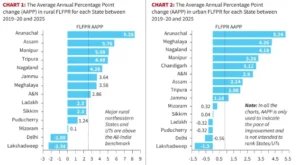
Female Labour Force Participation in India and Gender Inequality

Performance of Northeastern States and UTs

  • Arunachal Pradesh: Recorded the highest improvement, with rural AAPP of 8.28 and urban AAPP of 5.24.
  • Other northeastern States: Meghalaya, Nagaland, Manipur, Assam and Tripura showed notable improvements.
  • Union Territories: Chandigarh and Andaman & Nicobar Islands improved, while Delhi and Lakshadweep recorded declines.
  • Regional variation: National averages conceal major differences in employment opportunities across States.

Why is Female Participation Increasing?

  • Rural livelihoods: Agriculture, self-employment and family enterprises provide work opportunities.
  • Government initiatives: DAY-NRLM promotes women’s self-help groups and livelihood activities.
  • Education and skills: Improved access to training can expand employment opportunities.
  • Economic necessity: Household financial pressures may encourage more women to seek work.

Challenges

  • Unpaid work: Many women remain engaged in unpaid family labour.
  • Employment quality: Rising participation does not necessarily indicate secure or well-paid jobs.
  • Care responsibilities: Domestic duties restrict access to formal employment.
  • Urban barriers: Safety concerns, transport limitations and inadequate childcare reduce participation.
  • Data interpretation: Higher growth from a low starting point does not automatically indicate better overall performance.

Way Forward

  • Quality employment: Expand formal jobs, social security and equal pay.
  • Care infrastructure: Strengthen affordable childcare and workplace facilities.
  • Regional policies: Design employment programmes according to local economic conditions.
  • Skill development: Promote digital literacy, entrepreneurship and market access.
  • Better measurement: Track wages, working hours and employment quality alongside FLFPR.

Conclusion

India must convert rising female labour participation into secure, productive and fairly paid employment to achieve genuine women-led development.


SEPARATION OF POWERS AND JUDICIAL PROPRIETY

TOPIC: (GS2) POLITY: THE HINDU

According to the reported October 2026 developments, CJI Surya Kant declined a meeting with Opposition leaders Rahul Gandhi and Mallikarjun Kharge over allegations concerning the Chief Election Commissioner (CEC).

Background of the Controversy

  • Opposition’s concerns: Alleged irregularities in the Election Commission’s Special Intensive Revision (SIR) of electoral rolls.
  • Public protests: Leaders also questioned reported arrests, transport restrictions and police action in Delhi.
  • Constitutional issue: Whether political leaders can directly approach the CJI outside formal judicial proceedings.

Demands Raised Before the CJI

  • Transparency: Complete disclosure of records relating to the SIR exercise.
  • Independent review: A committee headed by a retired Supreme Court judge to examine voter deletions.
  • Interim relief: Suspension of the SIR process pending scrutiny.
  • Judicial intervention: Consideration of the representation as a public-interest petition.

Why Did the CJI Refuse?

  • Pending litigation: Related issues were reportedly already before the Supreme Court.
  • Judicial neutrality: Private discussions with political representatives could create perceptions of bias.
  • Procedural fairness: All affected parties must receive equal opportunities to present arguments.
  • Proper remedy: Leaders were advised to approach the Court through formal petitions.

Constitutional and Legal Framework

  • Separation of powers: Legislature, executive and judiciary perform distinct constitutional functions.
  • Article 32: Enables citizens to approach the Supreme Court for enforcement of fundamental rights.
  • Article 324: Entrusts election supervision to the Election Commission.
  • Basic structure doctrine: Kesavananda Bharati (1973) protects essential constitutional principles.
  • Judicial review: Minerva Mills (1980) reinforces constitutional limits and institutional balance.

Judicial Propriety and the Bangalore Principles

  • Judicial propriety: Judges must act impartially and avoid situations creating reasonable doubts about their independence.
  • Bangalore Principles, 2002: Identify six values — independence, impartiality, integrity, propriety, equality, and competence and diligence.
  • Sub judice principle: Matters pending before courts should be decided through judicial proceedings, not private representations.
  • Natural justice: Both sides must receive a fair hearing under the principle audi alteram partem.

Way Forward

  • Political influence: Informal interactions between judges and political leaders may weaken public confidence.
  • Institutional accountability: Election Commission decisions remain subject to lawful judicial scrutiny.
  • Transparency: Sensitive constitutional disputes should be heard openly through established procedures.
  • Judicial independence: Clear ethical standards and reasoned judgments help maintain public trust.

Conclusion

Constitutional democracy requires an independent judiciary that protects fundamental rights through impartial adjudication while respecting institutional boundaries.

ETHANOL BLENDING IN INDIA AND FOOD SECURITY

TOPIC: (GS3) ECONOMY: THE HINDU

Oil Marketing Companies (OMCs) have excluded ethanol produced from sugarcane juice, sugar syrup and B-heavy molasses from their 2026–27 procurement tender. The decision aims to protect domestic sugar supplies amid production concerns while maintaining India’s 20% ethanol-blending programme.

Background of the Decision

  • Ethanol Blended Petrol (EBP): Ethanol, a biofuel produced from agricultural materials, is mixed with petrol to reduce fossil fuel consumption.
  • E20 target: India aims to maintain petrol containing 20% ethanol.
  • Procurement: OMCs have sought approximately 11 billion litres of ethanol for 2026–27.
  • Reason: Poor rainfall in Maharashtra and Karnataka has raised concerns about sugar production and prices.

Changes in Ethanol Procurement

  • Excluded sources: Sugarcane juice, sugar syrup and B-heavy molasses.
  • Permitted sources: Maize, broken rice, surplus Food Corporation of India (FCI) rice and C-heavy molasses.
  • Price revision: Maize-based ethanol procurement price reduced from ₹71.86 to ₹68.86 per litre.
  • Key distinction: B-heavy molasses retains more fermentable sugar than C-heavy molasses, making its diversion more significant for sugar availability.

Importance of Ethanol Blending

  • Energy security: Reduces dependence on imported crude oil.
  • Environment: Can lower certain vehicle emissions and fossil fuel use.
  • Rural economy: Creates demand for agricultural produce and supports distilleries.
  • Economic benefits: Encourages domestic biofuel production and related investment.

Challenges

  • Food versus fuel: Diverting edible crops towards ethanol may affect food availability.
  • Water stress: Sugarcane cultivation requires substantial irrigation.
  • Farmer concerns: Changing feedstock policies may affect incomes and investment decisions.
  • Supply constraints: Grain availability and distillery capacity may limit ethanol production.

Government Initiatives

  • National Policy on Biofuels, 2018: Promotes ethanol blending and diversified feedstocks.
  • Pradhan Mantri JI-VAN Yojana: Supports advanced biofuels using agricultural residues.
  • Diversification: Encourage second-generation ethanol from crop waste instead of relying mainly on food crops.
  • Balanced policy: Adjust feedstock allocation according to harvests, food stocks and fuel demand.
  • Sustainability: Promote water-efficient farming and stable procurement policies.

Conclusion

India’s ethanol strategy must strengthen energy independence without compromising food security, farmers’ livelihoods or environmental sustainability.

IMPACT OF INTERNET USE ON CHILDREN AND MENTAL WELL-BEING

TOPIC: (GS2) GOVERNANCE: THE HINDU

An ICSSR-supported study has highlighted the psychological, behavioural and online safety risks associated with excessive Internet use among schoolchildren.

Key Findings of the Study

  • Survey coverage: Over 2,000 children aged 9–14 and approximately 500 parents in Delhi.
  • Internet access: 97.6% of surveyed children accessed the Internet from home, mainly through smartphones.
  • Screen time: Average daily Internet use was approximately 4.5 hours.
  • Online risks: Nearly 47% reported interacting with strangers online.
  • Gender gap: Boys generally enjoyed greater digital access, while girls faced more restrictions.

Benefits of Digital Technology

  • Education: Access to learning materials and digital classrooms.
  • Skill development: Opportunities for creativity, communication and technological learning.
  • Social inclusion: Online communities encourage collaboration and information sharing.

Challenges

  • Mental health: Anxiety, loneliness, mood changes and sleep disturbances.
  • Digital dependence: Difficulty controlling screen time and emotional reactions.
  • Cyber threats: Cyberbullying, impersonation and exposure to inappropriate content.
  • Digital literacy gap: Technical skills often exceed awareness of online manipulation and privacy risks.

Government Initiatives

  • Digital Personal Data Protection Act, 2023: Provides safeguards for children’s personal data.
  • POCSO Act, 2012: Protects children against sexual offences, including relevant online abuse.
  • Cyber Crime Portal: Enables reporting of online offences.
  • NEP 2020: Supports digital education and responsible technology integration.

Way Forward

  • Schools: Introduce age-appropriate digital safety education.
  • Parents: Encourage open communication and balanced screen habits.
  • Platforms: Strengthen child-friendly privacy and safety features.
  • Government: Expand counselling, cyber awareness and digital inclusion programmes.

Conclusion

India must build a child-friendly digital ecosystem that promotes learning while protecting mental health, privacy and online safety.

Write a Review

Your email address will not be published. Required fields are marked *