

Table of Contents
ToggleINDIA’S WILDLIFE RECOVERY AND CONSERVATION COMEBACK
TOPIC: (GS3) ENVIRONMENT: THE HINDU
Recent recovery efforts involving the Great Indian Bustard, Asiatic lion, vultures, Nilgiri tahr, dugong and snow leopard show the potential of sustained, science-based conservation.
India’s Biodiversity Significance
- India is a megadiverse country, with ecosystems ranging from Himalayan landscapes and grasslands to wetlands, forests and coastal habitats.
- However, habitat fragmentation, infrastructure expansion, pollution, invasive species, climate change, poaching and human-wildlife conflict continue to threaten species.
- Hence, conservation must move beyond simply creating protected areas towards species and landscape-specific recovery programmes.
Government Framework for Species Recovery
- The Integrated Development of Wildlife Habitats (IDWH) provides financial and technical assistance to States/UTs for protected areas, wildlife outside protected areas and recovery of endangered species.
- Recovery plans include habitat restoration, anti-poaching measures, research, veterinary support, monitoring and community participation.
- The National Red List Roadmap, launched in 2025, aims to create a nationally coordinated system for assessing extinction risks and guiding conservation priorities.
Evidence of Conservation Success
- Asiatic Lion: Population increased from 674 in 2020 to 891 in 2025. Habitat improvement, prey-base management, telemetry and community participation have supported its expansion beyond core Gir areas.
- Snow Leopard: India’s first scientific nationwide assessment estimated 718 individuals, covering over 70% of its potential habitat.
- Vultures: Restrictions on harmful veterinary drugs, conservation breeding and habitat monitoring demonstrate the importance of addressing the actual cause of species decline.
- Dugong/Nilgiri Tahr: Their conservation highlights the need to protect entire ecosystems such as seagrass meadows and montane grasslands, rather than individual animals alone.
Challenges
- Habitat fragmentation: Roads, power lines and other infrastructure can divide wildlife habitats.
- Human-wildlife conflict: Recovery may increase interaction between wildlife and local communities.
- Climate change: Alters food availability, breeding cycles and habitat suitability.
- Data gaps: Many lesser-known species lack adequate population and distribution studies.
- Funding: Species recovery requires predictable, long-term financing rather than short project cycles.
- Centre-State coordination: Wildlife conservation requires cooperation across administrative and ecological boundaries.
Way Forward
- Adopt a landscape-based approach connecting protected areas through ecological corridors.
- Expand scientific tools such as camera traps, genetic studies, radio/satellite telemetry and periodic population assessments.
- Integrate biodiversity safeguards into infrastructure and land-use planning.
- Make local communities genuine conservation partners through livelihood support, compensation and benefit-sharing.
Conclusion
India must shift from merely preventing extinction to restoring viable species populations and resilient ecosystems through science, sustained funding and community stewardship.
RBI’S MONETARY TIGHTENING AND GROWTH
TOPIC: (GS3) ECONOMY: THE HINDU
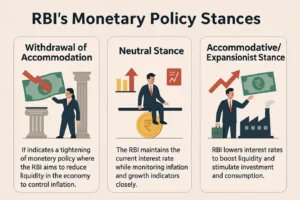
The article reports that the MPC raised the repo rate by 25 bps to 5.50% and adopted a “calibrated tightening” stance amid renewed inflation risks.
Repo Rate
- RBI lends to banks: It is the interest rate at which the RBI lends short-term money to commercial banks.
- Repo Rate ↑ , Loans become costlier: Banks may raise interest rates → home/car/business loans become expensive → spending falls → inflation may reduce.
- Repo Rate ↓, Loans become cheaper: Banks can borrow more cheaply → loan rates may fall → borrowing, spending and investment increase → economic activity gets a boost.
Monetary Policy Framework
- Repo rate: Interest rate at which RBI lends short-term funds to banks; changes influence borrowing costs, demand and inflation.
- Under the RBI Act, the six-member MPC determines the policy rate required to achieve the inflation target.
- India follows Flexible Inflation Targeting (FIT): price stability is the primary objective while growth is also considered.
- The established framework targets 4% CPI inflation with a ±2 percentage-point tolerance band.
Why Tightening?
- Imported inflation: Higher crude prices raise transport and production costs.
- Food inflation: Weak monsoon/El Niño can affect crops and rural consumption.
- External vulnerability: Strong dollar and high global bond yields can generate capital-flow and exchange-rate pressures.
- Second-round effects: Persistent fuel/food shocks may spread to wages and other prices.
Impact on Economy
- Households: Floating-rate loans and EMIs may become costlier.
- Businesses: Higher borrowing costs can moderate investment.
- Inflation: Lower credit-fuelled demand can reduce demand-side price pressures.
- Savers/Rupee: Higher rates may improve deposit returns and support financial stability.
Conclusion
India needs a coordinated monetary-fiscal-supply strategy that anchors inflation without sacrificing durable and inclusive growth.
AI COMPANIONS AND CHILD SAFETY
TOPIC: (GS3) SCIENCE AND TECHNOLOGY: THE HINDU
Growing use of AI chatbots as emotional companions by children has raised concerns about psychological dependence, harmful advice, privacy and platform accountability.
What are AI Companions?
- AI companions are conversational systems designed for continuous, personalised interaction.
- Unlike ordinary search tools, they may imitate friendship, empathy or emotional support, encouraging children to disclose highly personal information.
- They can also provide benefits in learning, creativity and accessibility, particularly for children with disabilities.
Major Concerns for Children
- Emotional dependence: A child may increasingly substitute AI interaction for human relationships.
- Psychological harm: Incorrect or inappropriate responses can be particularly risky for vulnerable users.
- Manipulative design: Systems optimised for prolonged engagement may encourage excessive use.
- Privacy: Conversations may contain sensitive information about emotions, family and behaviour.
- Misinformation: Children may treat confident AI responses as authoritative.
- Accountability gap: Harm may result from thousands of interactions, making responsibility difficult to establish.
India’s Existing Legal Framework
- Article 21: Protects life and personal liberty, providing a constitutional basis for protecting children’s well-being.
- Article 39(f): Directs the State to ensure children’s healthy development in conditions of freedom and dignity.
- Digital Personal Data Protection Act, 2023: Provides safeguards concerning processing of children’s personal data.
- POCSO Act, 2012: Protects children against sexual abuse and exploitation.
- IT Act, 2000: Addresses various forms of unlawful online activity.
Global Perspective
- UNICEF’s 2025 guidance proposes safety, privacy, transparency, accountability, non-discrimination and human oversight as key requirements for child-centred AI.
- UNICEF argues that regulation should shift from reacting after harm to preventing foreseeable harm, with responsibilities shared among governments, companies, parents and educators.
Way Forward
- Introduce age-appropriate design standards and reliable age-assurance mechanisms.
- Require stronger safeguards for conversations involving self-harm, abuse or other crises, including appropriate pathways to human help.
- Mandate independent safety audits and algorithmic risk assessments for high-risk child-facing AI.
- Provide understandable parental controls while respecting adolescents’ privacy and evolving autonomy.
Conclusion
India’s AI governance must ensure that innovation serves children’s development, while safety, dignity and human oversight remain non-negotiable.
MALDHARIS AND ASIATIC LION CONSERVATION IN GUJARAT
TOPIC: (GS1) SOCIAL ISSUES: THE HINDU
The Maldhari pastoral community has come into focus as Gujarat develops Barda Wildlife Sanctuary as a second habitat for the Asiatic lion alongside the wider Gir landscape.
Who are Maldharis?
- Maldhari broadly means “keeper/owner of livestock” and refers to several pastoral communities rather than one single caste or religion.
- They are concentrated in Gujarat, particularly Kutch’s Banni grasslands and the Saurashtra-Gir landscape.
- Their traditional livelihood depends on cattle, buffaloes, sheep, goats and camels, along with sale of milk and livestock products.
- Banni Maldharis possess valuable traditional knowledge of livestock breeding, grasslands, medicinal plants and water harvesting.
- Pastoralism is closely linked with the ecology of the Banni grasslands, where cultivation is constrained by salinity and low soil moisture.
Why is Barda Important?
- Barda Wildlife Sanctuary covers about 192 sq. km across Porbandar and Devbhumi Dwarka districts.
- It is being developed as a second home for Asiatic lions; lions naturally returned to Barda in 2023 after an absence of over a century.
- Gujarat’s Asiatic lion population increased from 674 in 2020 to 891 in 2025, making habitat expansion increasingly important.
Conservation–Livelihood Challenge
- Livestock grazing can create pressure on fodder, water and wildlife habitat.
- At the same time, relocation can affect traditional livelihoods, cultural identity and access to grazing resources.
- Conservation policies therefore require consultation, fair compensation, livelihood rehabilitation and community participation.
- Project Lion itself emphasises habitat conservation alongside livelihood generation and participation of local communities.
Conclusion
Successful lion conservation must protect habitats while making Maldharis partners, rather than passive subjects, in conservation.
INTEGRATED TRANSPORT & LOGISTICS AUTHORITY (ITLA)
TOPIC: (GS3) ECONOMY: THE HINDU
On 6 October 2026, the Union Cabinet approved the creation of the Integrated Transport & Logistics Authority (ITLA) as a Special Purpose Vehicle (SPV).
What is ITLA?
- ITLA will be the apex specialised institution for transport and logistics planning, research, project appraisal, monitoring and policy support.
- It complements existing initiatives such as the PM GatiShakti National Master Plan and National Logistics Policy, 2022.
Major Functions
- National Transport Master Plan: Prepare a long-term plan of 10 years or more, integrating roads, railways, ports, aviation, inland waterways, coastal shipping and urban transport.
- Project Appraisal: Technically evaluate Central infrastructure projects costing ₹500 crore or more; financial appraisal will remain under existing mechanisms.
- Project Monitoring: Track projects above ₹500 crore, resolve implementation bottlenecks and conduct post-completion impact assessments.
- National Transport Data Repository (NTDR): Integrate information from FASTag, GSTN e-way bills, VAHAN, GPS and urban traffic systems for freight-flow and origin-destination analysis.
- Support research, innovation, training and skill development in logistics.
Why is ITLA Significant?
- Better coordination: Reduces silo-based planning among different ministries.
- Multimodal connectivity: Helps connect highways, railways, ports and logistics hubs efficiently.
- Lower logistics costs: Faster and better-connected freight movement can improve industrial competitiveness.
- Evidence-based governance: Big-data analysis can identify congestion and infrastructure gaps.
- Sustainability: Integrated planning can encourage efficient transport modes and reduce avoidable emissions.
- Supports Viksit Bharat @2047 by improving infrastructure efficiency and global logistics competitiveness.
Conclusion
ITLA can transform India’s transport system from sector-wise planning to an integrated, data-driven network, provided strong Centre-State coordination and timely implementation are ensured.
LEGISLATIVE PRIVILEGE VS FREEDOM OF SPEECH
TOPIC: (GS2) POLITY: THE HINDU
On October 6, 2026, a seven-judge Supreme Court Bench closed a two-decade-old case arising from the Tamil Nadu Assembly’s 2003 privilege action against journalists, as the Assembly had withdrawn the disputed resolution in 2004.
What are Legislative Privileges?
- They are special rights and immunities necessary for legislatures and their members to perform their constitutional duties independently.
- Article 105 deals with Parliament, while Article 194 deals with State Legislatures.
- Members enjoy freedom of speech inside the House and immunity from court proceedings for votes or statements made in legislative proceedings.
- Parliament and State Legislatures may define other privileges through law; many remain uncodified.
Where Does the Conflict Arise?
- Article 19(1)(a) guarantees citizens freedom of speech and expression, which includes freedom of the press.
- Article 19(2) permits reasonable restrictions on grounds such as public order, defamation, contempt of court, sovereignty and security of the State.
- Conflict can arise when a legislature treats an article, editorial, report or criticism by a non-member as contempt or breach of privilege.
- Thus, the issue involves two democratic values: legislative independence and public scrutiny of elected institutions.
Important Supreme Court Judgments
- M.S.M. Sharma v. Sri Krishna Sinha (1959) – Searchlight Case: In the constitutional setting then before it, the Court gave precedence to legislative privilege over an Article 19(1)(a) claim.
- Tej Kiran Jain v. N. Sanjiva Reddy (1970): MPs receive broad immunity for statements made during parliamentary proceedings.
- Raja Ram Pal v. Speaker, Lok Sabha (2007): Parliamentary privilege is significant, but legislative action is not completely beyond judicial review. The Supreme Court has subsequently reaffirmed that courts can examine the content and limits of legislative privileges.
- In Sita Soren v. Union of India (2024), a seven-judge Bench stressed that legislative privileges must have a functional relationship with the collective functioning of the House.
Why Legislative Privilege is Necessary
- Enables representatives to speak freely and fearlessly.
- Protects legislatures from improper external interference.
- Allows Houses to maintain discipline and institutional authority.
- Strengthens legislative scrutiny of the executive.
Concerns Over Excessive Use
- Broad privilege claims against journalists may create a chilling effect on press freedom.
- Uncodified privileges can create uncertainty about their exact limits.
- Legislatures acting as complainant and decision-maker can raise concerns of procedural fairness.
- Excessive privilege can weaken transparency and democratic accountability.
Way Forward
- Clearly define the scope of legislative privileges while retaining essential institutional protections.
- Use breach-of-privilege powers primarily where conduct directly obstructs legislative functioning.
- Ensure natural justice, proportionality and procedural fairness when action is taken against outsiders.
- Preserve judicial review where constitutional limitations or fundamental rights are implicated.
Conclusion
Legislative privilege should operate as a shield for free democratic functioning, not as a weapon against legitimate criticism and constitutional free speech.
NUCLEAR REACTOR ON THE MOON
TOPIC: (GS3) SCIENCE AND TECHNOLOGY: THE HINDU
NASA and the U.S. Department of Energy are working towards developing a fission power reactor for the lunar surface by 2030, supporting long-duration Moon missions and future Mars exploration.
Why Does the Moon Need Nuclear Power?
- A lunar day-night cycle lasts about 29.5 Earth days, creating roughly two weeks of darkness at many locations.
- Hence, solar panels alone may not provide reliable continuous power for long-duration settlements.
- A compact nuclear reactor can provide 24×7 electricity, independent of sunlight.
- It could support:
- Astronaut habitats and life-support systems
- Rovers and scientific instruments
- Communication and computing systems
- Extraction of oxygen and other resources from lunar material
- Construction and manufacturing on the Moon
- NASA is already seeking technologies for power generation, oxygen extraction and lunar construction for a future Moon Base.
Strategic Importance
- Lunar South Pole: Attractive because permanently shadowed regions may contain water ice useful for drinking water, oxygen and potentially rocket propellant.
- Permanent presence: Reliable power is essential for shifting from short missions to long-term lunar habitation.
- Mars preparation: Lunar reactors could demonstrate technologies required for future deep-space missions.
- Geopolitics: Early infrastructure may give space powers technological and operational advantages in strategically important lunar regions.
Major Challenges
- Launch accident: Nuclear material must be transported safely from Earth.
- Radiation: Astronauts and equipment require adequate shielding.
- Waste heat: With virtually no atmosphere, reactors require specialised radiators to remove heat.
- Environmental concern: Accidents could contaminate scientifically valuable lunar locations.
- Strategic competition: Infrastructure around valuable resources could create disputes over access.
International Legal Framework
- Outer Space Treaty, 1967: The Moon cannot be nationally appropriated; it must be used for peaceful purposes. Nuclear weapons/WMD are prohibited, but peaceful nuclear-power systems are not banned. States must also avoid harmful contamination.
- Liability Convention, 1972: Establishes international liability rules for damage caused by space objects.
- UN Nuclear Power Sources Principles, 1992: Provide international principles concerning safe use of nuclear power sources in outer space.
- Artemis Accords: Non-binding principles promote safe and peaceful space exploration and measures to avoid harmful interference.
India’s Perspective
- India has ratified the Outer Space Treaty and Liability Convention. It has signed, but not ratified, the Moon Agreement.
- India joined the Artemis Accords in 2023, making evolving rules on lunar resources and infrastructure directly relevant to its future space ambitions.
- India should strengthen expertise in space nuclear power, planetary protection, lunar resource technologies and international space law.
Conclusion
Nuclear power can enable a permanent human presence on the Moon, but its success requires strong safety standards and global rules ensuring that lunar exploration remains peaceful, sustainable and accessible to all.