Table of Contents
ToggleMunicipal Councils in India
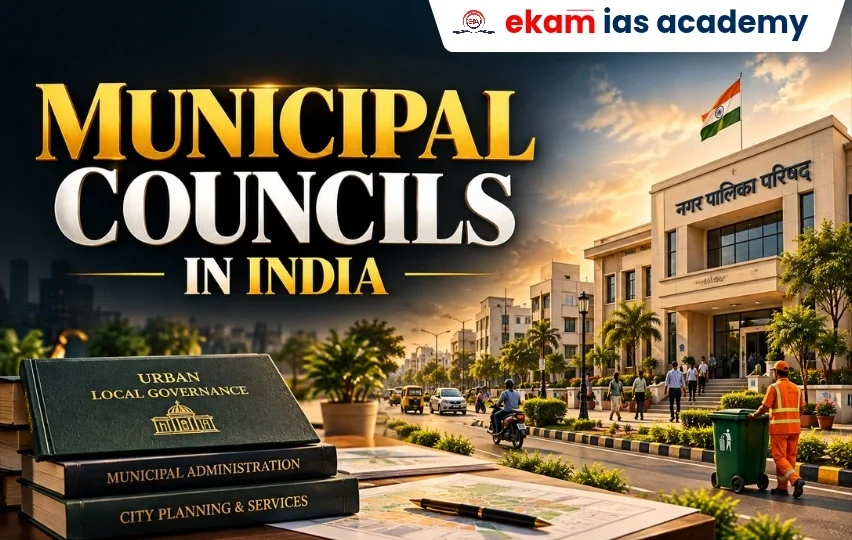
- Municipal Councils in India (Nagar Palikas) represent the middle tier of Urban Local Bodies in India, established for the administration of smaller urban areas.
- Mastering the Municipal Council UPSC module is vital for civil services aspirants covering Urban Local Government UPSC, Urban Administration in India, and Indian Polity UPSC topics.
- Designed to promote Decentralisation of Power in India, these bodies bridge the administrative gap between rural Panchayats and major metropolitan corporations.
- Studying the framework of a Nagar Palika in India provides essential insights into grassroots democracy and civic infrastructure management under Municipal Governance in India.
Constitutional Background
- 74th Constitutional Amendment Act: Enacted in 1992 (effective June 1, 1993) to accord constitutional status and protection to urban municipal bodies.
- Part IXA Insertion: Introduced Articles 243P to 243ZG into the Constitution of India to standardize urban municipal structures.
- Article 243Q Mandate: Categorizes urban local bodies into Nagar Panchayats, Municipal Councils (for smaller urban areas), and Municipal Corporations (for larger urban areas).
- Twelfth Schedule Integration: Enlisted 18 functional responsibilities to be devolved to local municipal bodies by State Legislatures.
Municipal Council: Meaning and Composition
- Definition: A urban local governing body constituted for a smaller urban area based on demographic size, density, non-agricultural employment, and local revenue.
- Elected Representatives: Composed of Ward Councillors directly elected by voters residing within designated territorial ward constituencies.
- Nominated Members: Includes individuals with special knowledge or experience in municipal administration, appointed as per state laws (without voting rights in council elections).
- Ex-Officio Representation: Grants representation to Members of Parliament (MPs) and Members of Legislative Assemblies (MLAs) representing the municipal constituency.
Important Constitutional Provisions
- Article 243R (Composition): Governs the composition of municipalities and the manner of electing representatives and office-bearers.
- Article 243S (Wards Committees): Mandates the constitution of Wards Committees in municipal areas having a population of three lakh or more.
- Article 243T (Reservations): Reserves seats for Scheduled Castes, Scheduled Tribes, and at least one-third of total seats for women.
- Article 243ZD (District Planning): Provides for the creation of District Planning Committees (DPCs) to consolidate rural and urban development plans.
Functions and Responsibilities of Municipal Councils
- Civic Infrastructure Maintenance: Constructing and maintaining town roads, street lighting, public parks, and civic amenities.
- Public Health and Sanitation: Overseeing urban solid waste management, drainage, public toilets, and epidemic prevention measures.
- Urban Planning and Land Regulation: Regulating urban land use, approving building construction plans, and managing town growth.
- Social and Economic Development: Implementing urban poverty alleviation schemes, managing public markets, and maintaining birth/death registries.
Tenure, Elections and Disqualification
- Fixed Tenure: Fixed 5-year tenure from the date of its first meeting under Article 243U; mandatory elections must be held before expiration.
- Dissolution Norms: If dissolved prematurely, Municipal Council Elections India must be conducted within 6 months to serve the remaining term.
- Independent Election Oversight: Conducted under the superintendence, direction, and control of the State Election Commission (Article 243ZA).
- Disqualification Rules (Article 243V): Minimum contesting age is 21 years; disqualifications follow state legislative election criteria.
Financial Powers and Sources of Revenue
- Tax Revenue (Internal): Levies property taxes, professional taxes, entertainment taxes, and vehicle/advertisement taxes.
- Non-Tax Revenue: Collects user charges for water supply, sewerage, parking fees, and building plan approval fees.
- Assigned Revenues & Grants: Receives state tax shares and grants-in-aid recommended by the State Finance Commission (Article 243Y).
- Central & State Welfare Grants: Receives tied and untied grants for urban infrastructure development under central and state sector schemes.
Municipal Council vs Municipal Corporation
← Swipe left or right to view the full table →
| Metric / Feature | Municipal Council | Municipal Corporation |
|---|---|---|
| Urban Settlement Type | Smaller urban areas. | Larger urban areas, including many metropolitan cities. |
| Population Threshold | Generally serves smaller urban populations. Criteria vary by state. | Generally serves larger urban populations. There is no uniform nationwide population threshold; criteria vary by state. |
| Political Head | President / Chairperson, depending on state law. | Mayor. Powers and responsibilities vary by state law. |
| Administrative Head | Chief Municipal Officer (CMO) / Executive Officer, depending on state law. | Municipal Commissioner . Often an IAS officer; appointment rules vary by state. |
Municipal Council vs Gram Panchayat
← Swipe left or right to view the full table →
| Metric / Feature | Municipal Council | Gram Panchayat |
|---|---|---|
| Governance Scope | Urban Local Body (Part IXA, Indian Constitution). | Rural Local Body (Part IX, Indian Constitution). |
| Constitutional Schedule | Twelfth Schedule (18 Functional Subjects). | Eleventh Schedule (29 Functional Subjects). |
| Foundational Assembly | Ward Committees / Ward Sabhas. | Gram Sabha (All registered village voters). |
| Primary Economic Base | Non-agricultural trade, industries, and services. | Agriculture and allied rural activities. |
Governance and Administrative Structure
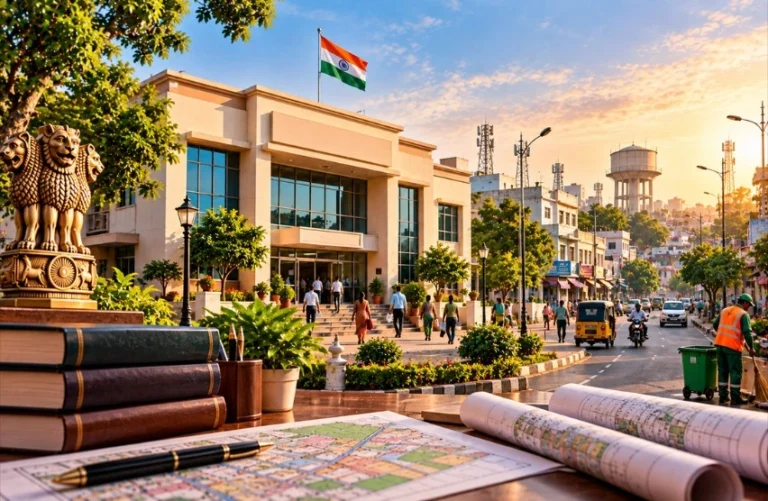
- Political Wing: Headed by the Council President/Chairperson, who presides over council debates and administrative meetings.
- Executive Wing: Led by the Chief Municipal Officer (CMO) or Executive Officer (EO), appointed by the State Government to execute decisions.
- Standing Committees: Special functional committees formed to oversee specific domains like public works, health, and municipal finance.
- Administrative Bureaucracy: Comprises municipal engineers, health inspectors, accountants, and revenue officers executing daily civic duties.
Role of Municipal Councils in Urban Development
- Local Infrastructure Creation: Enhances internal connectivity, street illumination, and municipal water supply networks.
- Planned Urban Growth: Prevents unorganized urban sprawl through zoned land-use policies and building regulations.
- Slum Upgradation: Drives urban renewal by providing basic housing, sanitation, and drinking water facilities to low-income clusters.
- Environmental Sustainability: Promotes green urban spaces, sewage treatment, and eco-friendly solid waste disposal systems.
Challenges Faced by Municipal Councils
- Financial Dependency: Inadequate local tax collection mechanisms leading to over-reliance on state discretionary grants-in-aid.
- Administrative Interference: Excessive state government control and delays by bureaucracy in devolving operational powers.
- Staffing Shortages: Shortage of qualified technical staff, urban planners, and municipal engineers to manage urban growth.
- Friction in Leadership: Conflict between elected ward members and state-appointed Chief Municipal Officers regarding administrative authority.
Conclusion
- Municipal Councils in India remain vital democratic institutions for transforming smaller towns into sustainable urban centers.
- Realizing effective Municipal Council Powers and Responsibilities requires strengthening financial devolution and administrative capability.
- Thorough clarity on Structure of Municipal Councils enables civil services candidates to write high-scoring answers for Indian Polity UPSC examinations.
UPSC Prelims: PYQs & Practice Questions
Previous Year Questions (Prelims)
Q: Local self-government can be best explained as an exercise in:
(a) Federalism
(b) Democratic decentralization
(c) Administrative delegation
(d) Direct democracy
Answer: (b) Democratic decentralization
Explanation:
The core constitutional objective behind establishing Urban Local Bodies such as Municipal Councils and Municipal Corporations under the 74th Constitutional Amendment Act and Rural Local Bodies such as Panchayats under the 73rd Amendment is democratic decentralization.
It empowers grassroots communities by transferring political decision-making power, financial resources, and functional accountability directly to local elected representatives.
Q: With reference to the 74th Constitutional Amendment Act, consider the following statements:
1. It added Part IXA to the Constitution of India titled "The Municipalities".
2. It mandates the constitution of Nagar Panchayats for smaller urban areas and Municipal Councils for transitional areas.
Which of the statements given above is/are correct?
(a) 1 only
(b) 2 only
(c) Both 1 and 2
(d) Neither 1 nor 2
Answer: (a) 1 only
Explanation:
Statement 1 is correct: The 74th Constitutional Amendment Act, 1992 added Part IXA (Articles 243P to 243ZG) titled "The Municipalities".
Statement 2 is incorrect: Under Article 243Q, a Nagar Panchayat is constituted for a transitional area (rural to urban), whereas a Municipal Council is constituted for a smaller urban area, and a Municipal Corporation is for a larger urban area.
Practice Questions
Q: With reference to Municipal Councils in India (Nagar Palikas), consider the following statements:
1. A Municipal Council is constituted for a smaller urban area based on factors such as population, density, and percentage of non-agricultural employment.
2. The administrative head of a Municipal Council is typically an officer designated as the Chief Municipal Officer (CMO), appointed by the State Government.
3. The 74th Amendment Act mandates that members nominated to a Municipal Council for their special knowledge in municipal administration have the right to vote in Council meetings.
Which of the statements given above are correct?
(a) 1 and 2 only
(b) 2 and 3 only
(c) 1 and 3 only
(d) 1, 2, and 3
Answer: (a) 1 and 2 only
Explanation:
Statement 1 is correct: Article 243Q(2) states that a Governor specifies a smaller urban area for constituting a Municipal Council by considering factors such as population, density, non-agricultural employment, revenue, and economic importance.
Statement 2 is correct: Unlike a Municipal Corporation, the executive wing of a Municipal Council is generally headed by a Chief Municipal Officer (CMO) or Executive Officer appointed by the State Government.
Statement 3 is incorrect: Under Article 243R(2)(a), persons having special knowledge or experience in municipal administration who are nominated to the Municipality do not have the right to vote in meetings of the Municipality.
Q: Consider the following statements regarding the constitution and tenure of Municipal Councils under Part IXA of the Indian Constitution:
1. Every Municipal Council is granted a fixed 5-year tenure from the date appointed for its first meeting.
2. In case of premature dissolution of a Municipal Council, elections must be completed within 6 months of dissolution.
3. If the remainder of the period for which a dissolved Municipal Council would have continued is less than six months, no election is necessary to be held.
Which of the statements given above are correct?
(a) 1 and 2 only
(b) 2 and 3 only
(c) 1 and 3 only
(d) 1, 2, and 3
Answer: (d) 1, 2, and 3
Explanation:
Statement 1 is correct: Under Article 243U(1), every Municipality continues for five years from the date appointed for its first meeting unless dissolved earlier.
Statement 2 is correct: Article 243U(3) requires elections to reconstitute a Municipality to be completed before the expiration of six months from the date of its dissolution.
Statement 3 is correct: The proviso to Article 243U(3) states that where the remainder of the period for which the dissolved Municipality would have continued is less than six months, it is not necessary to hold an election for constituting the Municipality for such period.
UPSC Mains – Previous Year & Practice Questions
Mains Previous Year Questions
Question: The 74th Constitutional Amendment Act intended to decentralize municipal governance, but Municipal Bodies in smaller towns continue to suffer from financial dependency and functional paralysis. Discuss. (Mains 2020)
Question: Assess the importance of the State Finance Commission in strengthening the financial health of Urban Local Bodies like Municipal Councils and Municipalities in India. (Mains 2018)
Question: In the absence of a well-articulated revenue generation mechanism, local self-governments remain mere implementing agencies for central and state schemes. Comment in the context of Municipal Councils. (Mains 2015)
Question: Discuss the role of District Planning Committees (DPCs) constituted under Article 243ZD in integrating the planning processes of rural Panchayats and urban Municipal Councils. (Mains 2013)
Question: Compare the structural hierarchy, political leadership, and executive authority between a Municipal Corporation and a Municipal Council in India. (Mains 2009 – GS Paper II / Public Administration)
Mains Practice Questions
[15 Marks | 250 Words]
Question: Municipal Councils (Nagar Palikas) represent the vital middle tier of urban governance in India. Analyze the key structural impediments preventing them from effectively managing rapid urbanization in Tier-2 and Tier-3 towns.
[15 Marks | 250 Words]
Question: The dual friction between the political executive (Council Chairperson) and the state-appointed administrative executive (Chief Municipal Officer) often paralyzes decision-making in Municipal Councils. Suggest administrative reforms to resolve this executive impasse.
[10 Marks | 150 Words]
Question: Evaluate how the non-devolution of functional items listed under the Twelfth Schedule has weakened the operational autonomy of Municipal Councils.


Municipal Councils in India-FAQs
What is a Municipal Council in India?
A Municipal Council is an urban local government body constituted for a smaller urban area under Article 243Q of the Constitution. Its composition and functioning are governed by Part IXA of the Constitution and relevant state laws.
Which Constitutional Amendment gave constitutional status to Municipal Councils?
The 74th Constitutional Amendment Act, 1992 gave constitutional recognition to urban local bodies and inserted Part IXA (Articles 243P–243ZG) relating to Municipalities.
What are the main functions of a Municipal Council?
Municipal Councils may undertake functions such as urban planning, regulation of land use, roads, water supply, sanitation, solid waste management, slum improvement, urban poverty alleviation, parks and street lighting, as provided through the Twelfth Schedule and state legislation.
What is the difference between a Municipal Council and a Municipal Corporation?
Under Article 243Q, a Municipal Council is constituted for a smaller urban area, whereas a Municipal Corporation is constituted for a larger urban area. The precise criteria for determining these areas are specified by the Governor through public notification, considering factors such as population, density, revenue and non-agricultural employment.
Who is responsible for urban local government and development in India?
Urban development is primarily a State subject, while the Ministry of Housing and Urban Affairs (MoHUA) plays a coordinating, policy and programme-support role at the Union level. The 74th Amendment provides the constitutional framework for Urban Local Bodies.