Table of Contents
ToggleCan India and China Coexist Peacefully? Challenges and the Way Forward
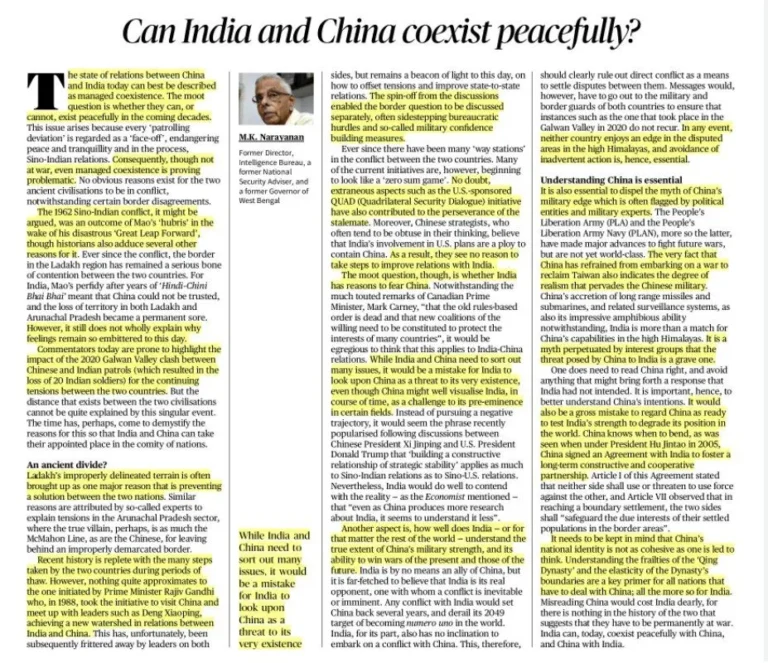
India–China relations remain one of Asia’s most complex strategic relationships. The relationship can be described as managed coexistence, marked by economic engagement alongside persistent border tensions. Despite repeated efforts to improve relations, unresolved territorial disputes, military deployments and strategic competition continue to create challenges between the two countries.
Historical Roots of the Dispute
The 1962 India–China conflict remains a major turning point in bilateral relations. The article highlights how unresolved territorial disagreements, particularly in Ladakh and Arunachal Pradesh, continue to influence mutual perceptions.
Several attempts have been made to improve relations. The Rajiv Gandhi–Deng Xiaoping engagement in 1988 initiated a new phase of diplomatic interaction, followed by subsequent agreements aimed at maintaining peace and tranquillity along the border.
However, periodic border confrontations have continued to test these arrangements.
Why Peaceful Coexistence Is Difficult
The article identifies several factors that complicate India–China relations:
- Unresolved boundary dispute: Differing perceptions of the Line of Actual Control remain a major source of tension.
- Military competition: Infrastructure development, military deployments and strategic capabilities contribute to mutual suspicion.
- Strategic competition: Both countries seek greater influence in Asia and beyond.
- External partnerships: India’s engagement with groupings such as the Quad is viewed cautiously by China.
- Historical mistrust: Past conflicts and competing narratives continue to influence contemporary relations.
At the same time, the article argues that India should avoid viewing China only through the lens of confrontation. Understanding China’s military strength, strategic ambitions, economic capabilities and political system is essential for developing an effective long-term policy.
The Way Forward
India should pursue a balanced strategy combining border security with diplomatic engagement. Peaceful resolution of disputes requires sustained dialogue, confidence-building measures and mechanisms to prevent local tensions from escalating into wider conflict.
India must also strengthen its economic, technological and military capabilities while maintaining strategic autonomy.
Conclusion
India and China may have deep differences, but permanent confrontation is neither desirable nor inevitable. Managed competition, sustained dialogue and mutual respect for territorial interests can provide the foundation for peaceful coexistence. India’s long-term objective should be to protect its national interests while keeping diplomatic channels open and preventing border disputes from turning into broader strategic conflict.
Vocabulary
1. Managed Coexistence – Managing differences without armed conflict.
2. Strategic Stability – Preventing conflict through restraint and dialogue.
3. Confidence-Building Measures (CBMs) – Steps to reduce military mistrust and tensions.
Prelims MCQs
MCQ 1
Consider the following statements:
1. The McMahon Line is associated with the eastern sector of the India–China boundary.
2. The 1993 India–China agreement aimed to maintain peace and tranquillity along the LAC.
3. The Line of Actual Control is a mutually agreed and fully demarcated international boundary.
Which are correct?
A) 1 and 2 only
B) 2 and 3 only
C) 1 and 3 only
D) 1, 2 and 3
Answer: A
UPSC Mains Question
“Peaceful coexistence between India and China requires strategic restraint and mutual trust.” Examine.
(10 Marks)
Frequently Asked Questions (FAQs)
What is the major issue in India–China relations?
The unresolved boundary dispute and differing perceptions of the Line of Actual Control remain major sources of tension.
Why is the 1962 war important in India–China relations?
The 1962 conflict deeply affected mutual trust and continues to influence perceptions of the bilateral relationship.
What was the significance of the Rajiv Gandhi–Deng Xiaoping meeting?
The 1988 engagement helped initiate a new phase of diplomatic interaction between India and China.
Why is China strategically important for India?
China’s military, economic and technological capabilities make it a major factor in India’s regional and global strategic calculations.
How can India and China maintain peaceful coexistence?
Sustained diplomatic dialogue, confidence-building measures, effective border management and strategic preparedness can help prevent escalation.