

Table of Contents
ToggleINDIA'S DECLINING FERTILITY RATE AND TWO-CHILD NORM
TOPIC: (GS2) POLITY: THE HINDU
The Supreme Court observed that laws disqualifying people for having more than two children have become outdated due to India’s declining fertility rate. It called for reconsideration of the Javed v. State of Haryana (2003) judgment, highlighting reproductive freedom and democratic participation.
What is the Two-Child Norm?
- It is a population-control measure restricting certain benefits or eligibility for individuals having more than two children.
- Some States introduced such provisions for contesting Panchayati Raj elections.
- Objective: Control population growth and encourage smaller families.
- Concern: Such restrictions may disproportionately affect women and disadvantaged communities.
Key Observations of the Supreme Court
- Changing demographics: India’s Total Fertility Rate (TFR) has declined from approximately 3.02 to 1.9, according to the judgment.
- Replacement level: A TFR of approximately 2.1 is needed for long-term population replacement under standard demographic assumptions.
- Outdated justification: Population-control restrictions require reconsideration when fertility falls below replacement level.
- Reproductive autonomy: Citizens should not face unfair restrictions on political participation because of their reproductive choices.
- Judicial review: The Court suggested reconsidering its earlier ruling through a larger Bench.
Important Constitutional Dimensions
- Article 21: Protects personal liberty, dignity, privacy and reproductive autonomy.
- Article 14: Guarantees equality before law and protection against arbitrary discrimination.
- Article 15: Prohibits discrimination on specified grounds, including sex.
- Article 243F: Provides the constitutional framework for disqualification from Panchayat membership.
- 73rd Constitutional Amendment: Strengthens grassroots democracy and political participation.
India’s Changing Demographic Profile
- Population ageing: The share of people aged 60 and above increased from 8.3% in 2014 to 9.7% in 2024, according to the article.
- Future projection: Older persons could constitute nearly 15% of the population by 2036.
- Demographic dividend: A shrinking proportion of young workers may eventually reduce economic advantages.
- Regional differences: Fertility levels vary significantly across States, requiring locally appropriate policies.
- Population momentum: India’s population can continue increasing despite below-replacement fertility.
Challenges of Declining Fertility
- Labour shortages: A smaller future workforce may affect productivity and economic growth.
- Higher dependency: More elderly people may require pensions, healthcare and long-term care.
- Fiscal pressure: Public spending on social security could increase.
- Gender inequality: Unpaid care responsibilities may disproportionately burden women.
- Uneven transition: Some States may age faster than others, creating regional economic differences.
Government Initiatives
- National Population Policy, 2000: Supports population stabilisation through voluntary and informed choices.
- Mission Parivar Vikas: Improves access to family-planning services in identified high-fertility areas.
- Reform outdated laws: Review population-linked electoral disqualifications.
- Support families: Expand childcare, maternity benefits and affordable housing.
- Healthy ageing: Strengthen geriatric healthcare, pensions and elderly care.
- Women’s empowerment: Improve education, employment and reproductive healthcare without coercion.
Conclusion
India must shift from coercive population-control measures towards a rights-based demographic policy that protects reproductive freedom, strengthens democracy and prepares society for population ageing.
INDIA'S ANAEMIA CHALLENGE AND IRON FORTIFICATION
TOPIC: (GS2) POLITY: THE HINDU
India’s high anaemia burden has renewed debate over the effectiveness and safety of Double-Fortified Salt (DFS) containing iodine and iron.
What is Anaemia
- Anaemia: A condition in which haemoglobin levels are insufficient to meet the body’s oxygen requirements.
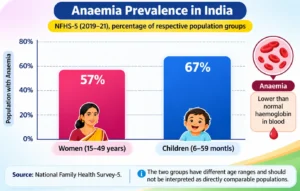
- NFHS-5 (2019–21): Around 57% of women aged 15–49 and 67.1% of children aged 6–59 months were anaemic.
- Major effects: Fatigue, reduced productivity, poor learning outcomes and increased maternal health risks.
- Iron deficiency: An important cause, but not responsible for every case.
What Is Double-Fortified Salt?
- DFS contains two micronutrients: iodine and iron.
- It aims to improve micronutrient intake through a commonly consumed household product.
- Advantage: Potentially reaches vulnerable populations through existing food distribution systems.
- Limitation: Iron intake depends on salt consumption, which varies across individuals.
Why Iron Alone Is Insufficient
- Multiple deficiencies: Vitamin B12, folate, vitamin A and protein deficiencies can contribute to anaemia.
- Infections: Malaria, hookworm and chronic inflammation affect haemoglobin levels.
- Genetic disorders: Thalassaemia and sickle cell disease require specialised management.
- Poor absorption: Phytates in cereals and pulses can reduce non-haem iron absorption.
- Health risks: Excess iron may harm susceptible individuals, particularly those with iron-overload disorders.
Public Health Concerns
- Salt reduction: WHO recommends consuming less than 5 grams of salt daily to reduce hypertension risks.
- Unequal exposure: Children and women may consume less fortified salt than adult men.
- Programme overlap: Fortified rice, DFS and iron-folic acid tablets may create overlapping iron exposure.
- Monitoring gaps: Haemoglobin testing alone cannot identify the underlying cause.
Government Initiatives
- Anaemia Mukt Bharat: Uses a 6×6×6 strategy involving beneficiaries, interventions and institutional mechanisms.
- Iron-Folic Acid supplementation: Targets vulnerable age groups.
- National Deworming Day: Reduces worm-related health problems.
- POSHAN Abhiyaan: Promotes improved maternal and child nutrition.
- Eat Right India: Encourages safe, healthy and balanced diets.
Way Forward
- Targeted intervention: Identify iron deficiency before prescribing additional iron where feasible.
- Better diagnostics: Expand access to ferritin, vitamin B12 and inflammation testing.
- Dietary diversity: Improve affordability of eggs, pulses, green vegetables and fortified foods.
- Disease prevention: Strengthen malaria control, sanitation and deworming.
- Evidence-based fortification: Conduct monitored district-level DFS pilots before nationwide expansion.
- Outcome monitoring: Measure reductions in anaemia rather than merely counting distributed tablets.
Conclusion
India can reduce anaemia sustainably only by combining targeted nutrition, accurate diagnosis, infection control and affordable healthy diets instead of relying on iron fortification as a universal solution.
CYCLONE DISASTER MANAGEMENT IN INDIA AND COOPERATIVE FEDERALISM
TOPIC: (GS3) DISASTER MANAGEMENT: THE HINDU
Back-to-back cyclones Arnab and Murasu caused extensive agricultural and infrastructure damage in Andhra Pradesh and Odisha.
Impact of Recent Cyclones
- Cyclone Arnab: Made landfall on October 28, causing estimated losses of ₹4,526 crore in Andhra Pradesh.
- Cyclone Murasu: Crossed the coast on November 3, affecting approximately 52,500 hectares of standing crops.
- Odisha: Nearly 90,000 hectares of crops were reportedly damaged by Arnab.
- Human impact: Andhra Pradesh reported seven deaths across both cyclones.
- Comparison: Cyclone Hudhud (2014) caused 63 deaths and approximately ₹22,000 crore in damage.
Factors Behind Improved Disaster Response
- Early warnings: IMD forecasts support timely evacuation and preparedness.
- Technology: Andhra Pradesh’s Real Time Governance Society (RTGS) enables monitoring and coordination.
- Inter-State assistance: Karnataka, Telangana and Tamil Nadu supported rescue operations.
- Community preparedness: Awareness and evacuation planning help reduce casualties.
Major Challenges
- Agricultural losses: Crop damage threatens farmers’ incomes and food security.
- Infrastructure damage: Roads, electricity networks and public facilities require costly repairs.
- Insurance gaps: Limited enrolment and claim-related difficulties weaken financial protection.
- Fiscal constraints: States may lack sufficient resources for permanent reconstruction.
- Climate vulnerability: Coastal settlements face repeated cyclone, flooding and storm-surge risks.
Institutional and Financial Framework
- Disaster Management Act, 2005: Establishes India’s disaster management framework.
- NDMA: Provides national disaster management guidelines.
- SDRF and NDRF: Support eligible disaster-related expenditure under prescribed norms.
- 15th Finance Commission: Recommended dedicated funding arrangements for disaster mitigation, response and recovery.
- PM Fasal Bima Yojana: Provides insurance against notified crop losses, subject to scheme conditions.
Way Forward
- Expand affordable crop insurance and ensure timely claim settlement.
- Invest in cyclone-resistant housing, roads and electricity infrastructure.
- Strengthen coastal shelters, mangroves and nature-based protection.
- Use satellite data and universities for damage assessment and risk forecasting.
- Provide additional central assistance for major reconstruction projects.
- Promote cooperative federalism through coordinated financing, rescue and rehabilitation.
Conclusion
India must move beyond immediate cyclone relief towards resilient reconstruction, reliable farmer protection and stronger Centre–State cooperation to reduce future disaster losses.
BRICS CARBON MARKETS PARTNERSHIP AND CLIMATE COOPERATION
TOPIC: (GS3) ENVIRONMENT: THE HINDU
The 18th BRICS Summit in New Delhi (2026) reiterated support for implementing the BRICS Carbon Markets Partnership.
What Is a Carbon Market?
- A carbon market allows trading of credits or allowances linked to greenhouse gas emissions.
- One carbon credit generally represents one tonne of carbon dioxide equivalent (CO₂e) reduced or removed.
- Compliance markets: Industries meet legally prescribed emission obligations.
- Voluntary markets: Organisations purchase credits voluntarily to support climate commitments.
BRICS Carbon Market Partnership
- Background: The partnership memorandum was acknowledged at the 2025 Rio Summit.
- Objective: Promote cooperation, technical knowledge and capacity-building among member countries.
- Current limitation: No common trading platform, binding targets or implementation timeline.
- Potential: Brazil, China, India and Indonesia host a significant share of registered carbon-credit projects globally.
Existing Carbon Market Systems
- China: Operates an Emissions Trading System covering major industrial sectors.
- India: Implements the Carbon Credit Trading Scheme (CCTS), 2023, with emission-intensity targets and offset mechanisms.
- Brazil: Its 2024 legislation provides for a national cap-and-trade system.
- Key difference: Countries use different emission limits, credit eligibility rules and regulatory frameworks.
Why Common Standards Are Necessary
- Measurement, Reporting and Verification (MRV): Ensures reliable and comparable emission data.
- Common accounting: Prevents inconsistent calculation of carbon reductions.
- Mutual recognition: Allows acceptance of accredited verification agencies.
- Digital registries: Track credit ownership, transfers and cancellation.
- Transparency: Reduces double counting, fraud and greenwashing.
International and Economic Significance
- EU’s CBAM: Its definitive phase began in January 2026, imposing carbon-related obligations on covered imports.
- UK CBAM: Scheduled to begin in January 2027.
- Export competitiveness: Verified emission data can help Indian steel, aluminium and cement exporters.
- Climate justice: Common standards may strengthen developing countries’ position in international negotiations.
Challenges
- Differences between absolute emission caps and intensity-based targets.
- Unequal market sizes and concerns about China’s pricing influence.
- Conflicting national regulations and restrictions on international payments.
- Risk of counting the same emission reduction in multiple countries.
- Limited technical capacity in some member countries.
Way Forward
- Establish common MRV standards using internationally recognised methods.
- Launch small pilot projects between willing BRICS members.
- Apply Article 6.2 of the Paris Agreement for authorised international carbon transfers.
- Use corresponding adjustments to prevent double counting.
- Involve the New Development Bank in registry infrastructure and climate finance.
- Direct part of trading benefits towards adaptation in vulnerable countries.
Conclusion
A transparent and interoperable carbon market framework can transform BRICS climate cooperation into a practical instrument for emission reduction, fair trade and sustainable development.
UN REPORT ON GAZA CONFLICT AND INDIA'S DIPLOMATIC POSITION
TOPIC: (GS2) INTERNATIONAL RELATIONS: THE HINDU
A UN Commission of Inquiry chaired by former Indian judge Justice S. Muralidhar has reportedly accused Israeli forces of serious international crimes against Palestinians.
Key Findings of the UN Commission
- Alleged violations: The Commission reported evidence of war crimes, crimes against humanity and genocide.
- Civilian casualties: It cited more than 75,000 Palestinian deaths since October 2023, including thousands of women and children.
- Evidence examined: Medical records, satellite images, forensic material, witness statements and military videos.
- AI in warfare: Raised concerns about automated targeting systems and civilian casualties.
- Accountability: Called for investigations, prosecutions and stronger international action.
International Legal Framework
- Geneva Conventions, 1949: Protect civilians, prisoners and wounded persons during armed conflicts.
- Genocide Convention, 1948: Requires States to prevent and punish genocide.
- Rome Statute, 1998: Establishes the International Criminal Court (ICC).
- International humanitarian law: Requires distinction between civilians and combatants, proportionality and precautions during attacks.
- ICJ: Decides disputes between States; the ICC investigates individual criminal responsibility.
Challenges to International Action
- UN Security Council: Political divisions and veto powers can obstruct binding measures.
- UN General Assembly: Can recommend collective action but generally cannot enforce resolutions.
- State sovereignty: Limits international intervention and cooperation.
- Selective enforcement: Different responses to conflicts raise concerns about consistency.
- Technology gaps: Existing laws face challenges from AI-assisted military decisions.
India’s Position and Interests
- Palestinian statehood: India supports a negotiated two-state solution.
- Israel relations: Defence, agriculture, technology and strategic cooperation remain important.
- Humanitarian concerns: India has supported assistance to Palestinian civilians.
- Diplomatic balance: India must reconcile strategic interests with international law and civilian protection.
Way Forward
- Ensure independent investigations and accountability for proven violations.
- Strengthen humanitarian access and civilian protection.
- Develop international standards for responsible military AI.
- Encourage ceasefire implementation and diplomatic negotiations.
- Support UN reforms and peaceful conflict resolution.
Conclusion
Lasting peace in West Asia requires civilian protection, credible accountability and consistent application of international law, alongside a negotiated political settlement.
AGNIPATH SCHEME AND NEW PATHWAY TO REGULAR MILITARY SERVICE
TOPIC: (GS2) POLITY: THE HINDU
The Union Cabinet has reportedly approved an additional two-year service period for Agniveers under the Agnipath scheme.
About the Agnipath Scheme
- Launched: June 2022 by the Ministry of Defence.
- Objective: Recruit young personnel into the Army, Navy and Air Force.
- Original tenure: Four years, including training.
- Age eligibility: Generally 17.5–21 years at recruitment, subject to notified conditions.
- Original retention: Up to 25% of each batch could enter regular service.
Key Features of the Reported Revision
- Extended tenure: The remaining 75% may serve two additional years.
- Regular recruitment: After six years, eligible and willing Agniveers may be considered for permanent enrolment.
- Financial benefits: Higher remuneration and an enhanced Seva Nidhi package.
- Seniority: Additional service-related benefits are proposed.
- Selection: Regular appointment remains subject to prescribed criteria, not automatic absorption.
Significance
- Operational readiness: Longer service helps retain trained personnel.
- Defence modernisation: Supports a younger, technologically capable military.
- Employment security: Provides additional opportunities for military careers.
- Skill development: Improves experience in technical and operational roles.
Challenges
- Managing additional salary and long-term personnel costs.
- Ensuring transparent and merit-based selection.
- Maintaining unit cohesion and career progression.
- Providing civilian employment support to personnel who eventually leave.
Way Forward
- Publish clear eligibility and retention rules.
- Assess operational performance and financial sustainability.
- Strengthen reskilling and rehabilitation programmes.
- Ensure coordination among all three armed services.
Conclusion
A carefully implemented Agnipath reform can improve military preparedness while offering greater career stability and fair opportunities to young soldiers.
INDIA'S CHALLENGE OF ACHIEVING INCLUSIVE PROSPERITY
TOPIC: (GS2) POLITY: THE HINDU
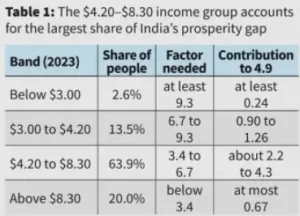
The World Bank’s recent Poverty and Equity Brief highlights India’s sharp decline in extreme poverty but reveals a substantial prosperity gap of 4.9.
India’s Progress in Poverty Reduction
- Extreme poverty: Declined to 2.6% in 2023, using the World Bank’s $3-a-day poverty line.
- Lower-middle-income poverty: Fell from 57.7% in 2011 to 16.1% in 2023, using the $4.20 threshold.
- Multidimensional poverty: Declined from 53.8% in 2005–06 to 16.4% in 2019–21, according to OPHI estimates.
- Remaining challenge: Nearly 80% of Indians fall below the $8.30-a-day upper-middle-income poverty benchmark.
Understanding the Prosperity Gap
- Meaning: A World Bank indicator measuring how far people remain from a prosperous living standard.
- Benchmark: $28 per person daily, measured using 2021 Purchasing Power Parity (PPP).
- India’s score: 4.9, indicating a substantial shortfall from the prosperity benchmark.
- Significance: Poverty reduction does not automatically ensure financial security, quality employment or social mobility.
Structural Barriers to Prosperity
- Informal employment: Nearly 90% of workers were informally employed, according to the ILO’s India Employment Report 2024.
- Low-quality jobs: Self-employment and unpaid family work often provide unstable incomes.
- Stagnant wages: Limited growth in inflation-adjusted earnings restricts purchasing power.
- Youth unemployment: Educated young people face difficulties finding suitable jobs.
- Skill mismatch: Educational qualifications frequently fail to match industry requirements.
Human Development Challenges
- Education: Unequal learning outcomes weaken employability.
- Healthcare: High household spending reduces savings and financial security.
- Gender inequality: Unpaid care responsibilities restrict women’s economic participation.
- Regional disparities: Employment opportunities differ across States and rural-urban areas.
- Social exclusion: Caste, gender and location can influence access to opportunities.
Government Initiatives
- MGNREGA: Provides rural employment-based income support.
- DAY-NRLM: Promotes women’s self-help groups and rural livelihoods.
- PMKVY: Supports skill development and employability.
- PM-JAY: Provides eligible households financial protection against hospitalisation costs.
- PM Jan Dhan Yojana: Expands access to formal banking services.
Way Forward
- Promote labour-intensive manufacturing and productive MSMEs.
- Expand formal jobs with social security and fair wages.
- Improve public education, healthcare and vocational training.
- Support women’s employment through childcare and safe transport.
- Encourage regional industrial growth and rural non-farm enterprises.
- Track income mobility, job quality and inequality alongside poverty reduction.
Conclusion
India’s development success must be measured not merely by how many people escape poverty, but by how many gain secure livelihoods, quality services and genuine opportunities for prosperity.

Scoreboard: Promoting Innovation Through State-Level Benchmarking
TOPIC: (GS2) India Science and Technology: THE HINDU
NITI Aayog recently launched the India Science and Technology (S&T) Scoreboard to assess research and innovation performance across States and Union Territories.
About the S&T Scoreboard
- Developed by: Science and Technology Division, NITI Aayog.
- Nature: Interactive digital platform providing information on India’s research and innovation ecosystem.
- Coverage: All States and Union Territories.
- Objective: Enable policymakers to compare scientific capabilities, identify weaknesses and adopt successful practices.
Major Features
- State benchmarking: Compares research performance between two States or UTs.
- Research indicators: Covers scientific publications, patents, institutions and research funding.
- Innovation ecosystem: Includes start-ups, deep-tech enterprises and Atal Tinkering Labs.
- Policy database: Documents State-level science, technology and start-up policies.
- Patent analysis: Examines applications, technological strengths and interstate collaboration.
Priority Research Areas
- Covers 11 nationally important research sectors.
- Major examples include artificial intelligence, semiconductors, clean energy, critical minerals and agriculture.
- Helps identify regional specialisation and emerging technological strengths.
Significance for India
- Cooperative federalism: Encourages States to share successful innovation practices.
- Competitive federalism: Promotes performance-based improvement.
- Atmanirbhar Bharat: Supports domestic technological capabilities.
- Economic development: Encourages research commercialisation, investment and skilled employment.
- Regional balance: Highlights underserved areas requiring additional research infrastructure.
Conclusion
The India S&T Scoreboard can transform India’s innovation ecosystem by turning reliable research data into stronger State policies, balanced technological growth and national competitiveness.