Table of Contents
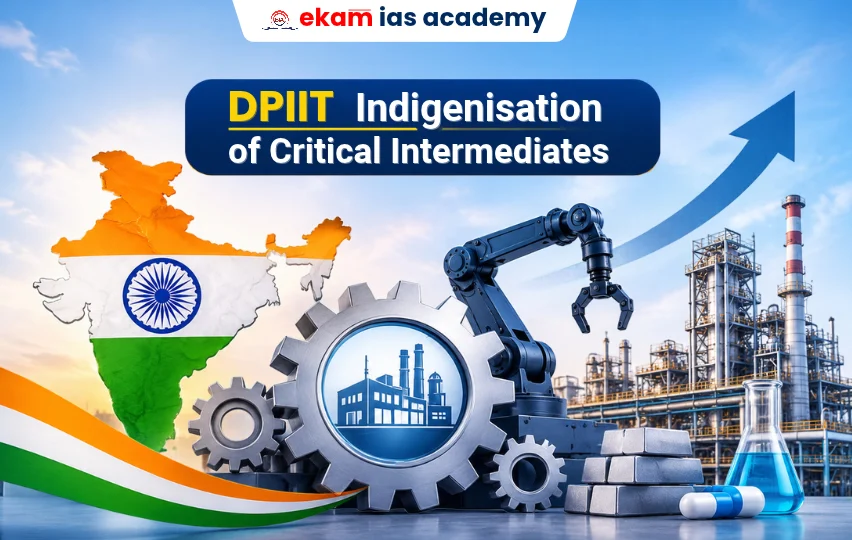
ToggleThe DPIIT Indigenisation of Critical Intermediates initiative, led by the Department for Promotion of Industry and Internal Trade (DPIIT), aims to promote domestic manufacturing of 100 critical intermediates and capital goods. The move seeks to reduce import dependence, strengthen industrial resilience and build greater technological self-reliance.
The initiative assumes greater significance amid China’s proposed export licensing restrictions on specialised machinery and manufacturing technologies.
Summary
The initiative aims to reduce dependence on Chinese imports, deepen India’s capital-goods ecosystem and improve supply-chain security. However, technological gaps, high capital costs, dependence on critical minerals and long project gestation periods remain major challenges.
What is Driving DPIIT's Indigenisation Push?
India’s dependence on imported machinery and industrial inputs creates vulnerabilities during geopolitical or trade disruptions. China’s export restrictions on critical minerals in recent years have demonstrated how concentrated supply chains can become strategic pressure points.
The initiative also seeks to address India’s large trade imbalance with China and move manufacturing beyond an assembly-led model towards deeper domestic value addition and technology development.
The success of sectors such as mobile-phone manufacturing demonstrates that targeted industrial policies can build scale. The next challenge is to replicate this progress in upstream industrial components and sophisticated capital goods.
Which are the Key Sectors Targeted in the DPIIT 100-Item List?
Six sector-specific working groups cover pharmaceuticals and medical devices; chemicals and textiles; capital goods and automobiles; energy; construction and infrastructure equipment; and defence, aerospace and electronics.
Solar manufacturing is an important focus. While India has substantial module-assembly capacity, domestic cell, ingot and wafer manufacturing remains comparatively limited.
The initiative also targets tunnel boring machines, essential for metro, hydropower and infrastructure projects, along with petrochemicals and basic chemicals such as PVC, polyethylene, polypropylene and polystyrene.
What are the Challenges Associated with Indigenisation Drive?
Developing alternatives to Chinese machinery can significantly increase capital costs. India also faces gaps in specialised engineering knowledge, process technology and high-efficiency manufacturing.
There are concerns that excessive protection could raise input costs for MSMEs. Moreover, deep-tech capital goods projects often require three to five years before reaching commercial scale.
What Measures Can India Adopt to Promote Indigenisation of Capital Goods?
India can establish a dedicated National Capital Goods Mission, strengthen overseas access to critical minerals through KABIL and international partnerships, and develop competitive manufacturing clusters.
Other priorities include rationalising inverted customs duties, promoting circular-economy practices, providing patient capital for long-gestation projects and strengthening industry-academia R&D through institutions such as ANRF.
Conclusion
India’s manufacturing ambitions require a transition from importing and assembling components to developing indigenous technologies and competitive supply chains. Indigenising critical capital goods can strengthen Atmanirbhar Bharat, reduce strategic vulnerabilities and support India’s emergence as a globally competitive manufacturing hub.


FAQs on DPIIT Indigenisation of Critical Intermediates
What is DPIIT's Indigenisation of Critical Intermediates Initiative?
The Department for Promotion of Industry and Internal Trade (DPIIT) is promoting domestic manufacturing of 100 critical intermediates and capital goods to reduce import dependence, strengthen supply chains and improve India’s technological self-reliance.
Why is India focusing on the indigenisation of critical intermediates?
India depends heavily on imported machinery, specialised industrial components and manufacturing technologies, particularly from China. Indigenisation aims to reduce strategic vulnerabilities, strengthen domestic value addition and support Atmanirbhar Bharat.
Which sectors are covered under DPIIT's 100-item indigenisation initiative?
The initiative covers six broad sectors, including pharmaceuticals and medical devices, chemicals and textiles, capital goods and automobiles, energy, construction and infrastructure equipment, and defence, aerospace and electronics.
What are the major challenges in indigenising critical capital goods in India?
Key challenges include high capital investment, technological gaps, dependence on imported critical minerals, limited domestic R&D capabilities and long gestation periods. Higher production costs may also affect the competitiveness of MSMEs.
How can DPIIT's indigenisation initiative strengthen India's manufacturing sector?
The initiative can promote domestic value addition, reduce import dependence, encourage technological innovation and improve supply-chain resilience. Measures such as a National Capital Goods Mission, industry-academia R&D, competitive manufacturing clusters and access to patient capital can strengthen its long-term effectiveness.