Table of Contents
ToggleTo Strengthen the Supreme Court, Divide It
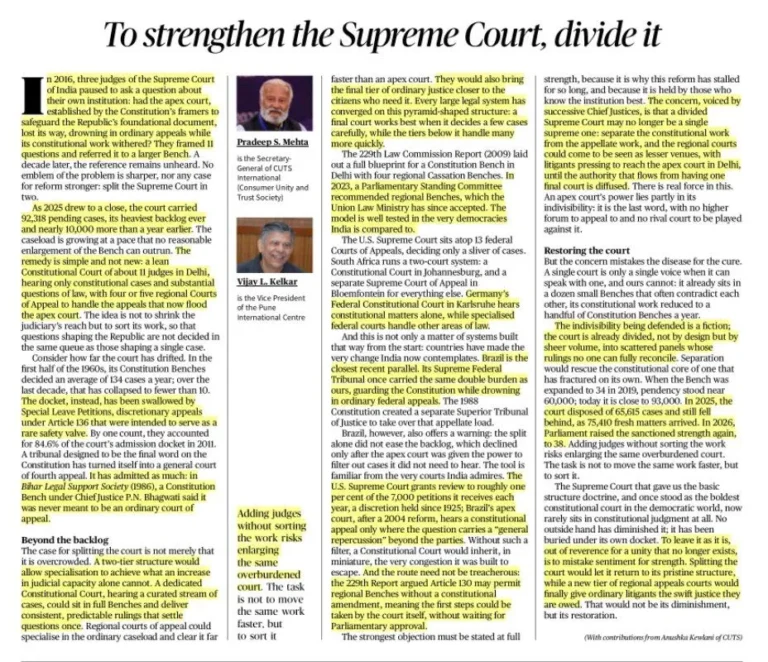
The Supreme Court of India is facing a growing pendency crisis, raising concerns about its ability to function efficiently as the nation’s constitutional court and final court of appeal. The editorial argues that a two-tier structure, with a dedicated Constitutional Court and regional appellate courts, could strengthen judicial capacity and reduce the Supreme Court’s workload.
The Problem of Pendency
The Supreme Court was reported to have around 92,318 pending cases, with nearly 10,000 more cases than a year earlier.
A major concern is the growing burden of Special Leave Petitions (SLPs) under Article 136, which were originally envisaged as an exceptional safety valve but have increasingly contributed to the Court’s ordinary caseload.
This creates several problems:
- Delayed justice and prolonged litigation.
- Constitutional questions competing with routine appeals.
- Overburdening of the apex court.
- Reduced opportunity for the Court to focus on significant constitutional issues.
The Proposed Two-Tier Structure
The editorial supports creating a Constitutional Court of about 11 judges in Delhi, supported by several regional appellate courts.
Under such a model:
- The Constitutional Court would focus primarily on substantial constitutional questions.
- Regional courts could handle ordinary appeals.
- Regional appellate courts could specialise in different areas of law.
- The Supreme Court could become a more focused constitutional institution.
The 22nd Law Commission Report (2009) had proposed a similar framework through regional Constitution Benches. A Parliamentary Standing Committee in 2023 also recommended regional benches.
International Experience
The editorial points to judicial models in countries such as:
- United States – federal appellate courts with the Supreme Court at the apex.
- South Africa – separate constitutional and appellate structures.
- Germany – specialised federal courts.
- Brazil – separate institutions dealing with constitutional and ordinary legal matters.
These examples demonstrate that separation of constitutional and ordinary appellate functions can coexist with a strong apex court.
Concerns
Opponents may argue that dividing the Court could weaken its institutional unity and authority. However, the editorial counters that the existing structure already contains multiple benches and that excessive workload itself risks weakening the Court.
Adding judges without restructuring the workload may simply enlarge the same overburdened system.
Conclusion
The objective should not be to weaken the Supreme Court but to restore its original constitutional purpose. Separating constitutional adjudication from routine appellate work could improve efficiency, reduce pendency and allow the apex court to concentrate on questions of national and constitutional importance.
Vocabulary
1. Constitution Bench – Bench of at least five judges deciding substantial constitutional questions.
2. Special Leave Petition (SLP) – Discretionary appeal under Article 136.
3. Judicial Decentralisation – Distribution of judicial functions across regions.
Prelims MCQs
MCQ 1
Consider the following statements:
1. PM2.5 particles can penetrate deep into the lungs.
2. Air pollution is influenced by both local emissions and regional atmospheric transport.
3. GRAP provides a permanent substitute for structural emission-reduction policies.
Which are correct?
A) 1 and 2 only
B) 2 and 3 only
C) 1 and 3 only
D) 1, 2 and 3
Answer: A
UPSC Mains Question
“Separating constitutional adjudication from appellate functions can strengthen the Supreme Court.” Critically examine. (10 Marks)
Frequently Asked Questions (FAQs)
What is the main proposal of the editorial?
To create a two-tier judicial structure with a Constitutional Court and regional appellate courts.
What is Article 136?
It empowers the Supreme Court to grant Special Leave to Appeal against judgments or orders of courts and tribunals in India.
Why is regionalisation being proposed?
To reduce the Supreme Court’s workload and improve access to appellate justice.
What did the 22nd Law Commission Report propose?
It recommended a framework involving regional Constitution Benches.
What is the key UPSC relevance?
The issue connects with judicial reforms, separation of powers, access to justice, pendency, Article 136 and constitutional adjudication.
Source From : The Hindu
Our Magical Thinking on Pollution: Annual Rituals, Hope and Accountability
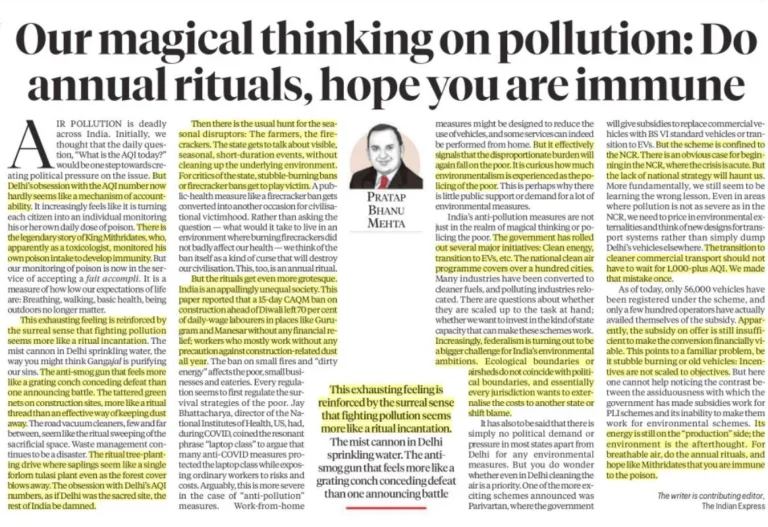
Air pollution remains a persistent public-health and environmental challenge in India. The editorial argues that India’s response often becomes an annual ritual of temporary restrictions, rather than a sustained strategy addressing the structural sources of pollution.
The Problem with the Current Approach
Air pollution is increasingly treated through measures such as:
- Monitoring daily Air Quality Index (AQI).
- Seasonal restrictions on construction and industrial activity.
- Bans on firecrackers and stubble burning.
- Work-from-home advisories.
- Restrictions on vehicles during severe pollution episodes.
However, these interventions often focus on managing the symptoms rather than the underlying causes.
The editorial particularly questions the tendency to treat pollution as a seasonal problem, even though sources such as transport, industry, construction and waste management operate throughout the year.
Pollution and Inequality
Pollution-control policies can disproportionately affect vulnerable sections of society.
A temporary ban on construction or restrictions on small businesses may affect daily-wage workers more severely because they often lack income security and social protection.
Similarly, measures such as work-from-home may be easier for formal-sector employees but difficult for workers dependent on physical workplaces.
Therefore, environmental policy must integrate social justice and livelihood concerns.
Beyond Annual Rituals
The editorial points towards the need for structural and long-term interventions.
Important measures include:
- Strengthening the National Clean Air Programme (NCAP).
- Expanding cleaner public transport and electric mobility.
- Shifting industries towards cleaner fuels.
- Improving waste-management systems.
- Designing region-specific pollution-control strategies.
- Establishing clear targets, timelines and accountability mechanisms.
The editorial also highlights the need for greater Centre-State coordination, particularly because air pollution crosses administrative boundaries.
Governance Challenge
Pollution control requires more than announcing schemes or subsidies. Weak implementation, fragmented institutional responsibility and inadequate monitoring can dilute policy outcomes.
The transition to cleaner commercial transport, for instance, requires financially viable incentives, adequate infrastructure and realistic timelines rather than temporary announcements.
Conclusion
India needs to move from an “AQI-centric” and episodic approach to a source-based, year-round pollution-control strategy. Environmental governance must combine scientific evidence, institutional coordination, social protection and measurable accountability. Clean air should be treated not as a seasonal emergency but as a continuous public-health and governance priority.
Vocabulary
1. AQI – Index measuring ambient air pollution levels.
2. Airshed Management – Coordinated pollution control across a shared air region.
3. Environmental Externality – Environmental cost imposed on others without compensation.
Prelims MCQs
MCQ 1
Consider the following statements:
1. PM2.5 particles can penetrate deep into the lungs.
2. Air pollution is influenced by both local emissions and regional atmospheric transport.
3. GRAP provides a permanent substitute for structural emission-reduction policies.
Which are correct?
A) 1 and 2 only
B) 2 and 3 only
C) 1 and 3 only
D) 1, 2 and 3
Answer: A
UPSC Mains Question
“India’s air pollution crisis reflects a failure of structural governance rather than merely seasonal emissions.” Critically examine. (10 Marks)
Frequently Asked Questions (FAQs)
Why is India’s approach to air pollution criticised as an annual ritual?
Because many interventions intensify during severe pollution seasons instead of addressing pollution sources throughout the year.
How does air pollution become an issue of social justice?
Pollution-control measures can disproportionately affect daily-wage workers and vulnerable communities whose livelihoods depend on physical workplaces.
What is the National Clean Air Programme?
NCAP is a national framework aimed at improving air quality through coordinated pollution-control measures across cities.
Why is Centre-State coordination important?
Air pollution crosses administrative boundaries, making isolated action by individual jurisdictions insufficient.
What should be the long-term approach?
India needs source-based interventions, cleaner transport, better waste management, cleaner fuels, measurable targets and institutional accountability.