
Prime Minister Narendra Modi is visiting Manila on 16–17 November 2026 to attend the 23rd ASEAN–India Summit and 21st East Asia Summit.
Background and Key Facts
- ASEAN: Association of Southeast Asian Nations; 11 members, including Timor-Leste, which joined in 2025.
- Partnership: India became a sectoral dialogue partner in 1992, a summit-level partner in 2002, and a Comprehensive Strategic Partner in 2022.
- Act East Policy: Introduced in 2014, upgrading the earlier Look East approach into economic, cultural and security cooperation.
- Milestones: 2027 marks 35 years of dialogue relations and five years of the Comprehensive Strategic Partnership.
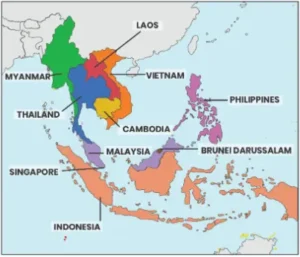
Significance of the Manila Summits
- Diplomacy: The summits provide opportunities to strengthen regional cooperation amid growing geopolitical tensions.
- ASEAN centrality: India supports ASEAN-led institutions where regional countries shape decisions without domination by major powers.
- East Asia Summit: A leaders-led forum involving 19 countries, discussing regional political, security and economic challenges.
- Strategic balance: India promotes inclusive dialogue amid South China Sea disputes and Taiwan Strait tensions.
- Strategic autonomy: India balances partnerships through the Quad and ASEAN-led institutions.
Maritime and Security Cooperation
- 2026 theme: Designated the ASEAN–India Year of Maritime Cooperation.
- Joint exercise: The second ASEAN–India Maritime Exercise involved INS Sahyadri and INS Kulish in the Philippines.
- Shared priorities: Maritime surveillance, search and rescue, submarine-cable security, information sharing and disaster relief.
- Indian contribution: The Information Fusion Centre–Indian Ocean Region helps strengthen maritime awareness and trust.
- Regional vision: Cooperation complements India’s MAHASAGAR approach and respect for international maritime law.
Trade and Connectivity
- Trade: Bilateral merchandise trade reached approximately $128 billion in 2025–26, showing ASEAN’s economic importance.
- Pending issue: Review of the ASEAN–India Trade in Goods Agreement (AITIGA) remains unfinished.
- Obstacles: Unequal market access, complex rules of origin and non-tariff barriers affect Indian exporters.
- Transport: Better ports, shipping links and India–Myanmar–Thailand highway connectivity can improve supply chains.
Digital and People-to-People Partnerships
- Digital economy: India can share UPI experience, digital public infrastructure and fintech expertise.
- Project Nexus: Seeks to link domestic instant-payment systems, making cross-border transfers faster and cheaper.
- Innovation: Start-up collaboration, data connectivity and submarine cables can support regional technology businesses.
- Education: Nalanda University, tourism, university exchanges and skills partnerships deepen cultural connections.
- Development: Renewable energy and healthcare cooperation extend benefits beyond major cities.
Challenges and Way Forward
- Geopolitics: US–China rivalry and competing partnerships complicate regional consensus.
- Practical barriers: Trade imbalances, infrastructure delays and regulatory differences reduce cooperation.
- Action: Complete the AITIGA review, build digital links and sustain maritime exercises.
- Roadmap: Implement the ASEAN–India Plan of Action 2026–2030 through measurable, people-centred projects.
Conclusion
A stronger India–ASEAN partnership will transform the Act East Policy into a foundation for regional prosperity, strategic stability and an inclusive Indo-Pacific.
Nvidia, a leading American AI chip company, faces uncertainty following the resignation of its co-founder and CEO, Jensen Huang, in November 2026.
What Is Nvidia?
- Company: American semiconductor designer founded in 1993, best known for graphics processing units (GPUs).
- GPU: Performs parallel calculations essential for training and running artificial intelligence models.
- Business model: Designs chips while specialist foundries manufacture them.
- CUDA: Software ecosystem encourages developers to continue using Nvidia hardware.
Reasons for Rapid Growth
- AI demand: Chatbots, scientific research and automation require advanced computing power.
- Data centres: Large technology companies purchase powerful servers for AI workloads.
- Revenue: Nvidia earned $96.2 billion in the quarter ending July 2026, including $89 billion from data centres.
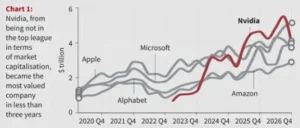
- Growth: The supplied chart shows revenue rising more than 12-fold since 2023.
- Valuation: It crossed $4 trillion in market capitalisation.
- Market concentration: Nvidia represented 7.6% of the S&P 500 index in March 2026.
Leadership Crisis
- Resignation: Co-founder Jensen Huang stepped down on 12 November 2026 amid personal-conduct allegations.
- Interim CEO: Chief Financial Officer Colette Kress assumed temporary leadership.
- Corporate governance: The episode raises questions about board supervision, succession planning and institutional credibility.
- Investor confidence: Sudden leadership changes may increase share-price volatility.
Threats to Nvidia’s Dominance
- Competitors: AMD offers rival processors, while Google’s Tensor Processing Units (TPUs) provide specialised alternatives.
- Market share: The newspaper chart estimates Nvidia retained roughly 60% of AI computing in 2026.
- China: Huawei and other firms are developing alternatives amid American export controls.
- Technology: More efficient AI models may reduce reliance on costly chips.
- Financial exposure: Nvidia invests in AI businesses that may subsequently purchase its products.
- Circular investments: The chart estimates nearly $99 billion in AI-related stakes and commitments by July 2026.
Wider Economic and Environmental Issues
- Market risk: Heavy dependence on a few technology firms may destabilise stock indices.
- Competition: Concentrated chip supply can raise prices and limit buyer choice.
- Strategic dependence: Semiconductor manufacturing relies on complex international supply chains.
- Energy consumption: AI data centres require substantial electricity and cooling water.
- IEA estimate: Global data-centre electricity demand could reach 945 TWh by 2030.
Implications for India
- IndiaAI Mission: ₹10,372 crore supports affordable computing, datasets and domestic innovation.
- Semicon India: The ₹76,000-crore programme encourages chip design, fabrication and packaging.
- Opportunities: AI infrastructure creates demand for skilled engineers, research and digital services.
- Way forward: Diversify suppliers, strengthen indigenous technologies, improve cybersecurity and promote energy-efficient data centres.
Conclusion
Nvidia’s experience shows that technological leadership must be supported by innovation, competition, responsible corporate governance and resilient supply chains.
India remains the world’s largest rice exporter, but groundwater depletion and greenhouse gas emissions threaten the sustainability of its rice economy.
India’s Rice Economy
- Production: Estimated 154.02 million tonnes of rice in 2025–26.
- Global position: The world’s largest rice exporter since 2012, supplying roughly 30–35% of global exports.
- Major producers: Uttar Pradesh, Telangana, West Bengal, Punjab, Chhattisgarh, Odisha, Andhra Pradesh and Tamil Nadu.
- Export growth: Shipments increased from 17.73 million tonnes (2020–21) to 21.57 million tonnes (2025–26); earnings rose from $8.82 billion to $11.54 billion.
Basmati Versus Non-Basmati Exports
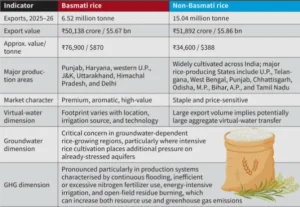
- Basmati: 6.52 million tonnes, earning ₹50,138 crore ($5.67 billion) in 2025–26.
- Non-Basmati: 15.04 million tonnes, earning ₹51,892 crore ($5.86 billion).
- Value gap: Non-Basmati exports exceeded twice Basmati’s volume but earned only slightly more.
- Policy lesson: Premium quality, geographical indication (GI), branding and processing can raise returns without proportionately increasing production.
Water and Groundwater Concerns
- Virtual water: Water used to produce exported goods, indirectly traded with them.
- Green water: Rainwater stored in soil; creates less pressure on freshwater withdrawals.
- Blue water: Irrigation drawn from groundwater, rivers or reservoirs, potentially depleting scarce supplies.
- Regional stress: Punjab, Haryana and western Uttar Pradesh face serious pressure from groundwater-intensive paddy.
- Policy distortion: Assured procurement, minimum support prices and subsidised electricity may favour rice cultivation in unsuitable regions.
Climate and Environmental Costs
- Methane: Waterlogged paddy fields generate methane, a powerful greenhouse gas.
- Nitrous oxide: Excess nitrogen fertilisers and changing soil conditions can increase emissions.
- Energy footprint: Pumping groundwater consumes electricity or diesel, increasing environmental costs.
- Climate vulnerability: Droughts, heatwaves and erratic monsoons threaten yields and farmer incomes.
Sustainable Cultivation Practices
- Alternate Wetting and Drying (AWD): Irrigate periodically instead of continuously flooding fields.
- Direct-Seeded Rice (DSR): Sow seeds directly, reducing transplantation labour and potentially saving water.
- System of Rice Intensification (SRI): Improve spacing, plant management and irrigation efficiency.
- Balanced fertilisation: Soil testing and integrated nutrient management reduce waste and pollution.
- Caution: Results vary by soil, rainfall and weed pressure; local trials remain essential.
Government Measures and Way Forward
- PMKSY: Promote efficient irrigation through Per Drop More Crop.
- Atal Bhujal Yojana: Strengthen community-led groundwater management in participating areas.
- Crop diversification: Encourage millets, pulses and oilseeds in water-stressed regions.
- Export strategy: Improve traceability, GI branding, milling quality and access to premium markets.
- New indicators: Measure export value per cubic metre of blue water, emissions per kilogram, farmer income and aquifer trends.
- Food security: Protect domestic availability and farmer livelihoods.
Conclusion
India’s rice-export success must be measured not merely in tonnes shipped, but in farmer income generated, groundwater conserved and carbon emissions reduced.
The 30-year India–Bangladesh Ganga Water Treaty is scheduled to expire on 12 December 2026, creating uncertainty over future water sharing.
What Is the Ganga Water Treaty?
- Signed on 12 December 1996 by Prime Ministers H.D. Deve Gowda and Sheikh Hasina.
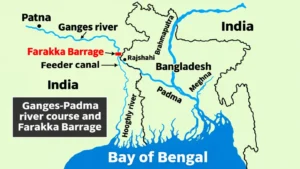
- The 30-year treaty governs sharing of Ganga water at Farakka Barrage, West Bengal, expiring 12 December 2026.
- Water is divided in 10-day periods, January 1–May 31, according to available river flow.
Water-Sharing Formula
- Up to 70,000 cusecs: India and Bangladesh receive 50% each.
- 70,000–75,000 cusecs: Bangladesh receives 35,000 cusecs; India gets the remainder.
- 75,000 cusecs or more: India receives 40,000 cusecs; Bangladesh gets the remainder.
- Special guarantee: Each country gets 35,000 cusecs during three alternating 10-day periods between March 11 and May 10.
- Below 50,000 cusecs: Both governments must consult immediately over emergency adjustments.
Monitoring and Legal Provisions
- A Joint Committee monitors flows at Farakka and Hardinge Bridge, Bangladesh.
- Unresolved differences move to the Joint Rivers Commission (JRC), then both governments.
- The agreement provides five-year reviews and renewal through mutual consent.
- Pending agreement after a review, India must release at least 90% of Bangladesh’s calculated share.
Significance and Challenges
- Bangladesh: Predictable dry-season water supports irrigation, fisheries, river navigation and ecosystem health.
- India: Sharing must account for water needs in West Bengal and upstream States.
- Climate risks: Altered rainfall, droughts and sedimentation complicate fixed water-sharing formulas.
- Diplomacy: Failure to renew could damage confidence in bilateral cooperation.
Way Forward
- Immediate option: Consider a three-to-five-year extension, as suggested, without assuming renewal is agreed.
- Long-term reforms: Update flow data, ensure transparent monitoring, consult Indian States and protect environmental flows.
- Regional cooperation: Address the separate Teesta dispute through dialogue and basin-wide planning.
Conclusion
A fair, climate-resilient Ganga Water Treaty is essential for protecting water security, ecological sustainability and long-term India–Bangladesh relations.