

Table of Contents
ToggleVB-G RAM G AND THE FISCAL BURDEN ON STATES
TOPIC: (GS2) POLITY: THE HINDU
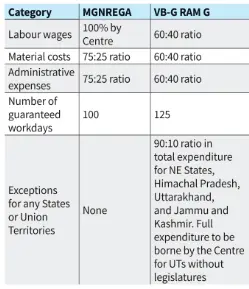
The Viksit Bharat Guarantee for Rozgar and Ajeevika Mission (Gramin) – VB-G RAM G, which replaced MGNREGA from July 1, 2026, has raised concerns as States’ expenditure is projected to rise nearly six-fold compared to 2024–25.
Changes in the Scheme
- Shift in Funding Pattern: Earlier Centre–State ratio was ~90:10; now revised to 60:40, increasing States’ share substantially.
- Normative Allocation: Union government will decide annual allocations for each State based on “objective parameters.”
- State Responsibility: States must bear costs beyond allocation, including unemployment allowance and compensation for delayed payments.
- Demand-Driven to Controlled Model: MGNREGA was demand-driven; VB-G RAM G centralises budget control with the Union.
Expenditure Projections
- Overall Increase: States’ spending could rise from ₹7,700 crore (2024–25) to ₹51,000 crore (2026–27) — nearly 600% increase.
- State-Level Impact: Uttar Pradesh, Tamil Nadu, and Bihar may see 600–800% rise in expenditure.
- Pending Dues: Centre had ₹20,422 crore dues to States in 2025–26, adding to fiscal stress.
- Interim Allocation: Centre announced ₹95,692 crore for 2026–27, but clarity on States’ share and settlement of past dues is missing.
Implications of VB-G RAM G
- Fiscal Stress: States’ expenditure projected to rise from ₹7,700 crore (2024–25) to ₹51,000 crore (2026–27), reflecting a nearly 600% increase in wage, material, and administrative costs.
- Employment Guarantee: While the scheme promises 125 days of work per household, past records show difficulty in ensuring even 100 days under MGNREGA, raising concerns about implementation capacity.
- Equity Concerns: Poorer States with higher rural demand (e.g., Bihar, UP) will face disproportionate fiscal burden, widening regional inequalities in employment support.
- Policy Shift: Transition from a demand-driven model (MGNREGA) to centralised control reduces States’ flexibility to respond to local shocks, undermining the principle of decentralised rural employment planning.
Way Forward
- Transparent Allocation Formula: States’ expenditure projected to rise from ₹7,700 crore (2024–25) to ₹51,000 crore (2026–27); a clear formula is needed to prevent arbitrary burdens.
- Centre–State Fiscal Coordination: Earlier 90:10 sharing ratio now shifted to 60:40, requiring stronger cooperative federalism to balance fiscal responsibilities.
- Timely Release of Funds: Pending dues of ₹20,422 crore (2025–26) highlight the need for prompt disbursement and settlement to ensure uninterrupted wage payments.
- Innovative Financing Models: Options like social impact bonds, NABARD-backed funds, and CSR partnerships can reduce reliance on borrowings and stabilize State budgets.
- Demand-Driven Flexibility: MGNREGA guaranteed 100 days, VB-G RAM G promises 125 days; retaining demand-driven design ensures protection of rural livelihoods during shocks.
Conclusion
VB-G RAM G risks overburdening States unless fiscal sharing is rebalanced; safeguarding rural employment requires cooperative federalism and transparent funding mechanisms.
BUILDING INDIA’S COAL CHEMISTRY CAPABILITY
TOPIC: (GS2) POLITY: THE HINDU
In 2026, India faced an energy crisis when the Strait of Hormuz was disrupted. This showed how risky it is to depend too much on imported fuel.
Refinery Flexibility
- Indigenous Technology Strength: India must build its own technological capability to withstand global energy shocks.
- Coal-to-DME Solution: Dimethyl Ether (DME), made from coal, is a clean gas similar to LPG and can be blended up to 20% with LPG using the same cylinders and pipelines.
- Import Reduction Potential: A 20% DME blend could replace 6.3 million tonnes of LPG imports annually, saving nearly ₹34,000 crore in foreign exchange.
- Energy Self-Reliance: Leveraging India’s vast coal reserves for DME production reduces dependence on Gulf countries and strengthens energy security.
- Diversified Crude Supply: India tripled its crude suppliers in two decades, enabling refineries to adapt to varied crude types.
- Crisis Response Capacity: During the 2026 Strait of Hormuz crisis, non-Hormuz crude intake rose from 55% to 70% within weeks, showing adaptability.
- LPG Production Flexibility: Domestic LPG output increased from 35 TMT/day to 54 TMT/day in just five days by adjusting refinery operations.
- Lesson in Resilience: Indigenous R&D, metallurgy, and process engineering built the technical discipline that allowed India’s refineries to absorb shocks and maintain supply.
Coal Chemistry Opportunity
- DME as Substitute: DME, produced via coal gasification, can be blended up to 20% with LPG (approved by BIS).
- Import Reduction: A 20% blend could displace 6.3 million tonnes of LPG imports annually, saving ₹34,000 crore in forex.
- Abundant Coal Reserves: India holds one of the world’s largest coal reserves, offering raw material security.
Policy & Institutional Push
- CSIR Innovation: National Chemical Laboratory developed indigenous methanoltoDME technology.
- Government Action: Union Cabinet approved a ₹37,500 crore scheme for coal/lignite gasification, targeting 100 MT annually by 2030.
- Incentives: 20% plant & machinery cost support, extended coal linkage tenure to 30 years.
Challenges Ahead
- High Ash Content: Indian coal has higher ash compared to Chinese coal, making gasification more complex and less efficient.
- Capacity Gap: Current gasification infrastructure is far below the required levels, limiting large-scale adoption of coal-to-DME technology.
- Industrial Discipline: Success requires long-term investment in metallurgy, catalysis, and process engineering, similar to the two-decade evolution of India’s refinery sector.
Strategic Significance
- Import Reduction: Coal-to-DME can cut LPG imports by 6.3 million tonnes annually, saving nearly ₹34,000 crore in foreign exchange.
- Innovation Ecosystem: Builds strong domestic linkages between research labs, industry, and government institutions, fostering indigenous capability.
- National Goals: Aligns with Aatmanirbhar Bharat and India’s long-term energy transition targets, ensuring resilience and sustainability.
Conclusion
India’s coal chemistry capability, especially coaltoDME, can transform energy security by turning abundant domestic coal into a strategic substitute for LPG, ensuring resilience against future global shocks.
A UNIFIED POLICY ARCHITECTURE FOR INDIA’S ENERGY FUTURE
TOPIC: (GS3) ECONOMY: THE HINDU
The Indian National Science Academy (INSA) released a policy brief (May 2026) proposing a unified national energy framework to align India’s diverse energy resources and institutions with longterm goals of energy selfreliance (2047) and netzero emissions (2070).
India’s Energy Landscape
- Achievements: Nearuniversal electrification (Saubhagya), clean cooking fuel access (Ujjwala), and renewable capacity growth from 40 GW (2015) to 260 GW (2025).
- Challenges:
- Dependence on imported oil and gas.
- Rising demand from industrialisation and urbanisation.
- Need to balance energy security, affordability, and sustainability.
Framework Pillars Proposed by INSA
- Adequacy: Reliable, diversified supply through conventional + emerging sources, modern grids, storage, and digital technologies.
- Access: Equitable services, stronger lastmile delivery, decentralised solutions for rural areas.
- Affordability: Innovative financing, efficient markets, and consumer safeguards to keep transition inclusive.
- Appropriate Sustainability: Contextspecific solutions aligned with India’s socioeconomic priorities, workforce development, and regional pathways.
CrossCutting Enablers
- Circular Economy: Recycling, reuse, and resource efficiency.
- Carbon Capture & Storage (CCUS): Reduce emissions from hardtoabate industrial sectors.
- Green Hydrogen: Emerging technology for clean industrial fuel.
Phased Approach
- NearTerm Priorities: Strengthen infrastructure, accelerate renewables, expand storage, and institutional coordination.
- MediumTerm: Integrate lowcarbon technologies, bioresources, and regional transition pathways.
- LongTerm: Build a resilient, interconnected energy ecosystem with diversified sources (coal, renewables, biomass, natural gas, wastetoenergy).
Strategic Significance of Coal-to-DME
- Energy Security: Strengthens India’s resilience by reducing dependence on LPG imports, saving nearly ₹34,000 crore annually in foreign exchange.
- Inclusive Growth: Ensures affordable energy access for households and rural communities, supporting equitable development.
- Climate Commitments: Aligns with India’s Paris Agreement goals and the net-zero pledge for 2070, by promoting cleaner fuels like DME.
- Innovation Ecosystem: Encourages collaboration between research labs, industry, and government, building a robust domestic innovation framework for energy transition.
Conclusion
India’s energy future requires a unified, integrated policy architecture that balances adequacy, access, affordability, and sustainability ensuring resilience, equity, and longterm growth.
STATE GOVERNMENT FINANCES
TOPIC: (GS3) ECONOMY: THE HINDU
Kerala and Tamil Nadu recently released white papers on State finances, warning of alarming debt levels. This has revived debate on whether State debt reflects fiscal mismanagement or structural imbalance in Indian federalism.
The Core Fiscal Dilemma
- Structural Imbalance: Union controls most taxation powers, while States bear the bulk of social and economic spending.
- Deficit Build-up: Debt accumulates as States spend more on welfare and development than their receipts allow.
- Social Sector Focus: Health, education, agriculture, and irrigation dominate State budgets, directly impacting citizens.
Kerala’s Case Study
- High Social Spending: Since the 1960s, Kerala invested heavily in health and education, achieving strong social outcomes.
- Revenue vs Transfers: Kerala raises 1.5 times the national percapita average in own-tax revenue, yet its Union tax devolution share is only 1.92%, below its population share of 2.6%.
- Budget Composition:
- ~20% on salaries (teachers, nurses, police).
- 15.3% on pensions.
- 16.5% on interest payments.
- Only 10% for capital expenditure, limiting future growth capacity.
The Investment Trap
- Cutting revenue expenditure risks weakening social gains.
- Yet, lack of capital investment hampers infrastructure, higher education, and public transport.
- Educated youth migrate due to limited opportunities, widening inequality between visible private affluence and weak public finances.
Comparative Perspective
- Decentralised Investment: Provinces borrow heavily against domestic savings, coordinated by central planning.
- Borrowing Costs:
- Chinese local governments borrow at ~2%.
- Indian States borrow via State Development Loans (SDLs) at 6.5–7.5%, higher than Union borrowing costs.
- Result: Indian States face both borrowing limits and higher debt costs, tightening fiscal stress.
Rethinking State Debt
- Government bonds are funded by citizens’ savings via banks and insurance companies.
- Borrowing for welfare and development is more productive than underspending.
- India needs mechanisms to let States access domestic savings at lower cost, enabling wellplanned investments.
Conclusion
India’s fiscal federalism must evolve to give States greater financial flexibility and cheaper borrowing options, ensuring they can sustain welfare gains while investing in future growth.
STEEP FREIGHT COSTS AND MSME EXPORTERS
TOPIC: (GS3) ECONOMY: THE HINDU
The ongoing West Asia conflict has sharply increased freight costs and container shortages, severely impacting India’s MSME exporters, especially those dealing in perishables and engineering goods.
Current Situation
- Freight Cost Surge:
- Thoothukudi/Kochi to Colombo: $400 → $600 per 20 TEU.
- South India to Jebel Ali: $300–400 → $5,700 per 20 TEU; $900–1,050 → $7,500 per 40 TEU.
- Transit delays: Shipments now take two weeks longer.
- Container Shortages: Containers stuck at West Asian ports, reducing availability and pushing costs higher.
- Commodity Price Rise: Steel up 30%, copper and brass prices doubled, packaging costs surged.
Sectoral Impact
- Engineering MSMEs: Rising input costs + freight hikes erode margins.
- Garment Exporters: Freight to U.S./EU rose 200%, now easing slightly; West Asia costs remain extreme ($4,500 for 20 TEU, $5,900 for 40 TEU).
- Perishable Goods: Exporters face losses due to delays in container availability.
Buyer Response & Global Context
- Cost Sharing: Few buyers willing to share freight hikes; most refuse due to inflation in their own countries.
- Global Comparison: Situation mirrors the COVID19 pandemic, when freight costs spiked uncontrollably.
- EEPC India View: Chairman Pankaj Chadha calls the rise “dramatic,” stressing exporters have no option but to absorb costs.
Policy Concerns
- Exporters raised the issue with the Union government, but no relief measures announced yet.
- Freight costs are market-driven and not easily regulated, leaving MSMEs vulnerable.
- Pending dues and lack of subsidies further strain MSME liquidity.
Broader Implications
- MSME Competitiveness: Rising costs reduce India’s price advantage in global markets.
- Employment Impact: MSMEs employ millions; losses could affect rural and semiurban livelihoods.
- Trade Balance: Higher logistics costs weaken export competitiveness, impacting overall trade balance.
Conclusion
India’s MSME exporters face a logistics and cost crisis, and without targeted government support, rising freight costs could erode their global competitiveness and threaten rural employment security.
RBI’S FINANCIAL STABILITY REPORT (FSR) 2026
TOPIC: (GS3) ECONOMY: THE HINDU
The Reserve Bank of India (RBI) released its Financial Stability Report (FSR) 2026, highlighting geopolitical fragmentation and AI-driven disruption as key global risks, while reaffirming the resilience of India’s banking and financial system.
About the FSR
- Publication: Biannual report since 2010, prepared with inputs from the Financial Stability and Development Council (FSDC) subcommittee.
- Purpose: Acts as an early-warning system to identify systemic risks, evaluates health of banks, NBFCs, and insurance, and builds public confidence in financial stability.
Global Risks Identified
- Geopolitical Fragmentation: Conflicts disrupt trade, investment flows, and supply chains.
- AI Disruption: Advances in AI promise productivity gains but raise concerns over jobs, regulation, and market volatility.
- Financial Vulnerabilities:
- High public debt in major economies.
- Fragile bond markets and elevated asset valuations.
- Rising role of leveraged non-bank financial intermediaries (NBFIs).
- Hawkish monetary policies in advanced economies tightening global liquidity.
India’s Macro-Financial Resilience
- Strong Growth: Economy resilient despite external shocks.
- Moderating Inflation: Price stability aided by policy measures.
- Healthy Balance Sheets: Firms and banks maintain adequate capital and liquidity buffers.
- Institutional Safeguards: RBI committed to strengthening systemic resilience.
Banking Sector Health
- Asset Quality: GNPA ratio declined to 1.8% (March 2026), lowest in decades.
- Stress Tests:
- Baseline: GNPA may rise slightly to 1.9% by 2028.
- Adverse scenarios: GNPA could reach 3.8–4.1%, still manageable.
- Sectoral Trends:
- Agriculture remains weakest: GNPA 5.1%, accounting for 37.2% of total NPAs.
- Large borrowers’ GNPA fell from 2.4% (2024) to 1.2% (2026), showing improved credit discipline.
- Slippage Ratio: Declined to 1.2% in FY 2025–26, reflecting reduced fresh defaults.
Growth Outlook & Vision
- Financial markets remain orderly despite global volatility.
- System supports credit expansion, investment, and growth.
- AI-driven productivity expected to aid resilience globally.
- RBI stresses that stability requires not just regulation but also:
- Fair business conduct.
- Improved customer experience.
- Financial inclusion.
- Efficient services for households and businesses.
Conclusion
India’s financial system is fundamentally strong and resilient, but sustained vigilance against global shocks and inclusive reforms will be critical to safeguard long-term stability.
PROJECT BRAHMANK
TOPIC: (GS3) ECONOMY: THE HINDU
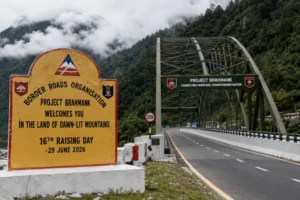
The Border Roads Organisation (BRO) recently celebrated the 16th Raising Day of Project BRAHMANK at Ranaghat, Arunachal Pradesh, highlighting its role in strengthening connectivity in sensitive border districts.
About Project BRAHMANK
- Establishment: Raised on 29 June 2011 at Ranaghat, East Siang district; became fully functional on 3 December 2011.
- Area of Responsibility: Covers Siang, East Siang, West Siang, Upper Siang, Shi-Yomi (Arunachal Pradesh) and parts of Dhemaji (Assam).
- Role: Develops and maintains strategic road infrastructure for the Armed Forces and connects remote villages to the national mainstream.
Importance of Project BRAHMANK
- Strategic Connectivity: Provides operational mobility to defence forces in sensitive border zones.
- Socio-Economic Impact: Enhances access to markets, healthcare, and education for remote tribal communities.
- Integration: Helps integrate border villages into national development frameworks, reducing isolation.
Border Roads Organisation
- Formation: Established on 7 May 1960 to secure borders and develop infrastructure in remote regions.
- Administrative Control: Brought fully under the Ministry of Defence in 2015.
- Scope: Builds and maintains roads, bridges, tunnels, airfields, and marine works in India’s border areas and friendly neighbouring countries.
- Motto: Shramena Sarvam Sadhyam — “Everything is achievable through hard work.”
Broader Significance
- Strengthens India’s border security architecture.
- Supports Act East Policy by improving connectivity in the North-East.
- Demonstrates how infrastructure projects can serve both strategic defence needs and civilian development goals.
Conclusion
Project BRAHMANK exemplifies how border infrastructure strengthens national security while empowering remote communities, making it a vital pillar of India’s frontier development strategy.
MOUNT EREBUS
TOPIC: (GS1) GEOGRAPHY: THE HINDU
Mount Erebus, the southernmost active volcano in the world, is unique for having a permanent lava lake and for releasing tiny crystals of pure gold into the atmosphere.
Location & Geographical Features
- Stratovolcano: Situated on Ross Island in the Ross Sea, Antarctica.
- Height: Stands at 3,794 m (12,448 ft), second tallest volcano in Antarctica after Mount Sidley.
- Volcanic Group: Part of the McMurdo Volcanic Group within the West Antarctic Rift System (Terror Rift).
- Ring of Fire: Belongs to the Pacific “Ring of Fire.”

Activity & Unique Traits
- Active Lava Lake: Continuous lava lake in the summit crater since 1972.
- Eruption Style: Mostly Strombolian eruptions, ejecting volcanic bombs onto the crater rim.
- Gold Crystals: Only known volcano to emit microscopic pure gold crystals into the atmosphere.
- Other Active Volcano: Alongside Deception Island, one of only two active volcanoes in Antarctica.
Significance of Mount Erebus
- Insights into Volcanism: Offers valuable knowledge about intraplate volcanic activity and the broader geology of Antarctica.
- Natural Laboratory: Serves as a rare global site to study active lava lakes, which are extremely uncommon worldwide.
- Resource Potential: Demonstrates the possibility of extracting resources from volcanic emissions, such as microscopic gold crystals, though practical extraction remains unfeasible.
- Fire and Ice Interaction: Symbolizes the dramatic coexistence of volcanic fire and polar ice, showcasing Earth’s extreme natural contrasts.
Conclusion
Mount Erebus stands as a rare geological marvel — a volcano of fire and gold in the frozen heart of Antarctica, embodying the dynamic forces shaping Earth’s most remote landscapes.