
India released two captive-bred male Great Indian Bustards (GIBs) into the wild at Desert National Park, Jaisalmer, marking a major rewilding milestone.
About the Great Indian Bustard
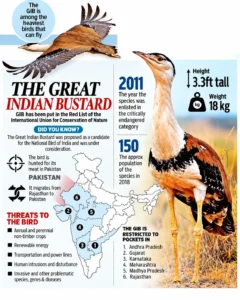
- Great Indian Bustard (Ardeotis nigriceps) is a large ground-dwelling bird associated with India’s arid and semi-arid grasslands.
- Locally called Godawan in Rajasthan, it is strongly connected with the Thar landscape.
- Its decline reflects the historical neglect of grasslands, which were often treated as wastelands.
- GIBs are particularly vulnerable to power-line collisions because of poor frontal vision and limited manoeuvrability.
India’s GIB Recovery Programme
- The programme involves MoEFCC, Rajasthan Forest Department and Wildlife Institute of India, with National CAMPA support.
- Conservation centres at Sam and Ramdevra currently hold 97 birds, including 57 captive-bred individuals.
- Captive breeding produced 24 chicks in 2025 and 29 in 2026.
- Rajasthan has established around 200 sq. km of fenced grassland enclosures inside Desert National Park.
- Conservation now combines breeding, habitat restoration, threat reduction, research and community participation.
Major Threats to GIB
- Grassland conversion: Irrigation, farming and infrastructure have fragmented natural habitats.
- Power transmission lines: Collisions remain a serious mortality risk for these heavy birds.
- Low reproductive rate: Slow breeding makes population recovery naturally difficult.
- Habitat fragmentation: Roads and development reduce continuous breeding and feeding landscapes.
- Renewable-energy expansion: Solar and transmission infrastructure can overlap with important GIB habitats.
Conservation versus Development Challenge
- In 2021, the Supreme Court directed undergrounding of specified power lines in priority GIB habitats.
- In 2024, it reconsidered a broad undergrounding requirement and constituted an Expert Committee to balance GIB protection with renewable-energy development.
- This demonstrates the broader principle of sustainable development—climate action and biodiversity protection must progress together.
Why Landscape-Based Conservation is Necessary
- Species survive through connected grasslands, wetlands, forests and ecological corridors, not isolated enclosures.
- Protected-area-only approaches can increase human-wildlife conflict when recovering animals move beyond boundaries.
- Conserving landscapes simultaneously protects multiple species, ecosystem services and local livelihoods.
- Examples such as elephant corridors and tiger landscapes show the importance of ecological connectivity.
Way Forward
- Protect and restore native grassland ecosystems instead of classifying them as wastelands.
- Secure GIB breeding habitats and movement corridors through scientific land-use planning.
- Use underground cables, bird diverters and route modification where technically appropriate.
- Integrate biodiversity safeguards into renewable-energy and infrastructure planning from project inception.
- Expand community-led conservation by involving pastoralists and grassland-dependent local communities.
Conclusion
India’s conservation success will depend not merely on saving individual species, but on protecting the connected landscapes that sustain wildlife and people.
Coal inventories at several thermal power plants have fallen sharply amid rapidly rising electricity demand and weaker hydropower availability.
Present Situation
- According to the article, 84 of 191 thermal plants had critically low coal stocks by September-end 2026.
- The Central Electricity Authority (CEA) continuously monitors coal receipts, consumption and stocks at thermal power stations.
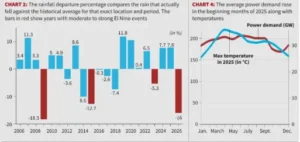
- India’s electricity system is experiencing exceptionally high demand; CEA reported peak demand met of 270.2 GW in July 2026.
Why is Power Demand Rising?
- Extreme temperatures: Hotter conditions increase electricity consumption for fans, coolers and air-conditioners.
- Economic growth: Industrialisation, urbanisation and expanding commercial activity increase electricity requirements.
- Cooling demand: Rising household incomes are increasing ownership and use of cooling appliances.
- Electrification: Electric mobility, appliances and expanding electricity access add new sources of demand.
- Hydropower variability: Weak rainfall can reduce hydroelectric generation, increasing pressure on thermal plants.
Role of El Niño
- El Niño refers to abnormal warming of the central and eastern equatorial Pacific Ocean.
- It can influence atmospheric circulation and is often associated with weaker Indian monsoon conditions, though impacts vary between events.
- Reduced rainfall can lower reservoir levels and hydropower generation, increasing dependence on coal-fired electricity.
- High temperatures simultaneously increase cooling requirements, creating a double pressure on electricity supply.
Why Coal Remains Important
- Coal plants provide dispatchable electricity, supporting the grid when renewable generation fluctuates.
- India still possesses a substantial coal-based power fleet; as of February 2026, coal and lignite capacity was about 227.8 GW.
- MoSPI’s Energy Statistics also demonstrates the continuing structural importance of coal in India’s energy system.
Challenges
- Energy security: Low inventories increase vulnerability during unexpected demand surges.
- Supply-chain constraints: Railway availability and mine-to-plant logistics can affect timely coal delivery.
- Climate challenge: Greater coal generation can increase greenhouse-gas and local air-pollutant emissions.
- Renewable intermittency: Solar and wind require storage and flexible generation for round-the-clock reliability.
- Climate-power feedback: Rising temperatures increase cooling demand, placing additional stress on electricity infrastructure.

Way Forward
- Maintain adequate strategic coal stocks before high-demand summer and monsoon periods.
- Improve railway logistics and mine-to-plant coordination for uninterrupted coal transportation.
- Accelerate solar, wind, hydro and nuclear capacity to diversify electricity generation.
- Expand battery and pumped-storage systems for balancing variable renewable electricity.
- Promote energy-efficient air-conditioners, buildings and cooling technologies to moderate peak demand.
Conclusion
India’s energy security requires reliable short-term coal management alongside faster clean-energy, storage and efficiency transitions for long-term resilience.
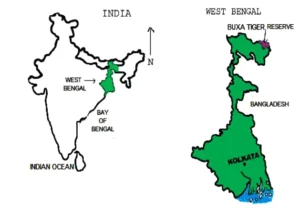
A three-year-old tigress from Valmiki Tiger Reserve, Bihar, has been released into Buxa Tiger Reserve, West Bengal, under a phased tiger reintroduction programme.
About Buxa Tiger Reserve
- Located in Alipurduar district, West Bengal, Buxa became a Tiger Reserve in 1983.
- Spread over about 761 sq. km, it forms an important part of the eastern Himalayan foothill ecosystem.
- It has transboundary connectivity with Bhutan forests and ecological linkages towards Jaldapara and Assam’s forest landscapes.
- Such connectivity allows wildlife movement, genetic exchange and long-term population survival.
Why Did Tigers Decline in Buxa?
- Habitat degradation and fragmentation reduced suitable areas for breeding and movement.
- Declining natural prey populations weakened the reserve’s capacity to sustain tigers.
- Human settlements and tea estates increased pressure around the forest landscape.
- Railways, roads and commercial traffic fragmented habitats and increased wildlife risks.
- Changing land use further affected the ecological quality of tiger habitats.
Why Was Valmiki Selected?
- Valmiki Tiger Reserve (VTR) lies in Bihar within the Terai Arc Landscape.
- Its terrain and ecological conditions are considered relatively similar to those of Buxa.
- Tigers from the Sundarbans were considered less suitable because they are adapted to a distinctive mangrove and tidal ecosystem.
- Source-population suitability is crucial for improving adaptation and reintroduction success.
How Will Reintroduction Work?
- The tigress will initially undergo soft release, remaining temporarily within an acclimatisation enclosure.
- Authorities will assess her health, behaviour, movement and adjustment before wider release.
- Radio telemetry, camera traps and field monitoring will track post-release survival and movement.
- Additional tigers may subsequently be introduced to establish a genetically viable breeding population.
India’s Experience with Tiger Reintroduction
- Sariska Tiger Reserve, Rajasthan received reintroduced tigers beginning in 2008 after local extinction.
- Panna Tiger Reserve, Madhya Pradesh subsequently demonstrated significant population recovery through reintroduction.
- However, Satkosia Tiger Reserve, Odisha faced adaptation problems, human-tiger conflict and local resistance.
- These experiences show that translocation succeeds only when habitat, prey and community conditions are favourable.
Challenges
- Improving prey density and habitat quality before expanding the tiger population.
- Managing human-tiger conflict around villages, livestock areas and tea estates.
- Reducing wildlife risks from railways, roads and heavy commercial traffic.
- Ensuring relocation, where necessary, follows voluntary, fair and livelihood-sensitive rehabilitation.
- Maintaining ecological corridors for safe movement and genetic connectivity.
Way Forward
- Adopt landscape-level conservation rather than focusing only on reserve boundaries.
- Restore prey populations, grasslands and forest habitats through scientific management.
- Develop wildlife crossings and regulate high-risk linear infrastructure in critical corridors.
- Strengthen community participation, compensation and livelihood programmes around Buxa.
- Continue long-term scientific monitoring and adaptive management under NTCA-WII protocols.
Conclusion
Buxa’s tiger recovery will succeed only when reintroduction is supported by healthy habitats, abundant prey, connected corridors and local community participation.