

Table of Contents
ToggleEnglish in India: From Colonial Language to a Symbol of Identity and Opportunity
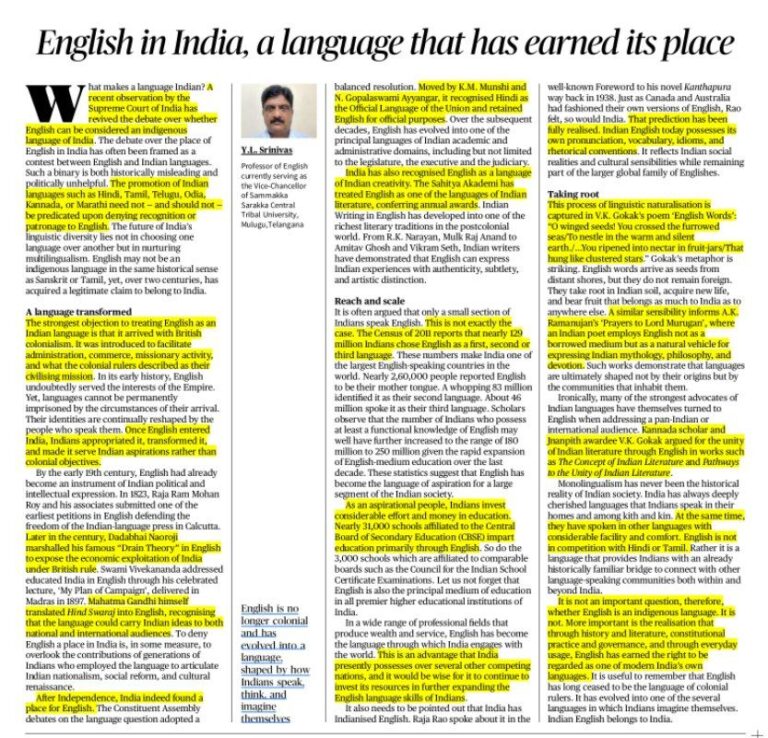
The status of English language in India has evolved significantly from being a colonial instrument to becoming a medium of education, communication, and global engagement. The debate over whether English is an indigenous language reflects India’s complex linguistic history and its ability to transform external influences into part of its own identity.
English today represents not only colonial history but also India’s aspirations, knowledge economy, and multicultural character.
Historical Evolution of English in India
From Colonial Tool to Indian Language
English arrived in India during British rule and was initially promoted to serve colonial administrative and economic interests. It became a language of governance, education, and elite communication.
However, over time, Indians reshaped English according to their own social and cultural realities. Indian writers, thinkers, and professionals adopted English to express Indian experiences and perspectives.
The language gradually moved beyond its colonial association and became a tool for intellectual and social expression.
Role of English in Modern India
Language of Education and Global Opportunity
English plays an important role in:
- Higher education and research
- Science and technology
- International communication
- Professional opportunities
With the expansion of education and globalisation, English has become a bridge connecting India with the wider world.
It has also enabled Indian authors and professionals to contribute globally while reflecting Indian culture and experiences.
English and Indian Identity
A Language Adapted by Indians
The debate on English being an Indian language highlights how languages evolve through usage and cultural adaptation.
Indian English has developed its own:
- Vocabulary
- Expressions
- Literary traditions
- Regional influences
Writers and speakers have created a distinct Indian form of English that reflects local realities and identities.
Balancing Indian Languages and English
Need for Linguistic Diversity
While English provides economic and global advantages, India’s indigenous languages remain central to cultural heritage and social identity.
A balanced approach requires:
- Promoting Indian languages
- Ensuring access to quality English education
- Encouraging multilingualism
English should complement Indian languages rather than replace them.
Conclusion
English in India has travelled a remarkable journey—from a colonial language to a medium of empowerment, creativity, and global participation. Its Indianisation demonstrates how societies can adapt external influences while preserving their cultural identity.
The future of India’s linguistic landscape lies in embracing multilingualism, where English and Indian languages coexist as sources of knowledge, opportunity, and cultural expression.
Vocabulary
1. Linguistic Pluralism – Coexistence of many languages
2. Indigenisation – Adapting something to local culture
3. Multilingualism – Use of multiple languages
4. Cultural Assimilation – Integration into a local cultural setting
5. Linguistic Identity – Identity shaped by language
Frequently Asked Questions (FAQs)
How did English transform from a colonial language into an Indian language of opportunity?
English was introduced during British rule but was later adapted by Indians for education, literature, governance, and global communication. It has evolved into a tool reflecting Indian experiences and aspirations.
Why is English important in contemporary India?
English provides access to higher education, technology, research, international communication, and employment opportunities. It acts as a bridge between India and the global knowledge economy.
Does the growth of English threaten Indian languages?
English need not replace Indian languages. A balanced multilingual approach can preserve cultural identity while providing access to global opportunities.
What is Indian English?
Indian English is a distinct form of English shaped by Indian society, culture, and regional influences. It includes unique expressions, vocabulary, and literary traditions.
How should India approach language policy in the future?
India should promote multilingualism by strengthening Indian languages while ensuring quality English education. Both can coexist to support cultural preservation and development.
Source From : The Hindu
MSME Clusters in India: Unlocking Growth Through Collaboration and Innovation
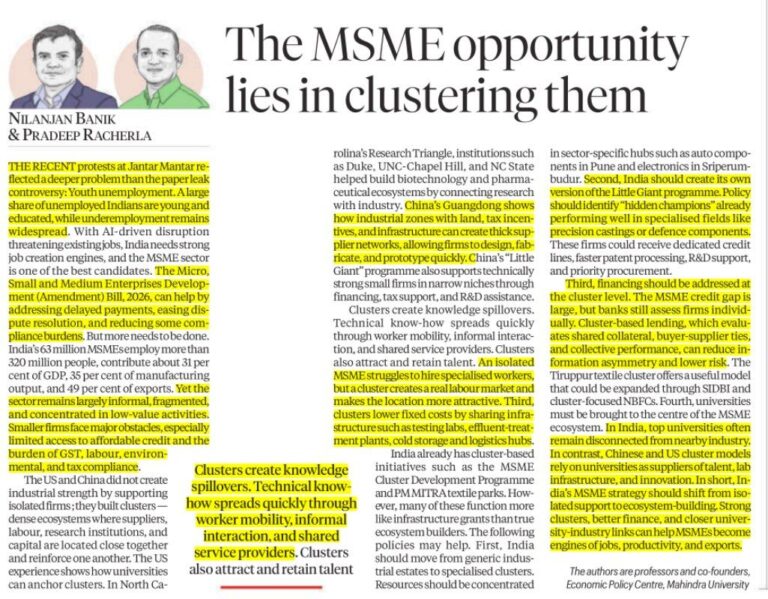
The Micro, Small and Medium Enterprises (MSME) sector is one of India’s most important engines of employment, manufacturing, and exports. However, despite its significant contribution to the economy, many MSMEs continue to face challenges such as limited access to finance, technology gaps, fragmented markets, and compliance burdens.
A cluster-based approach can help transform MSMEs by creating connected ecosystems where businesses, research institutions, suppliers, and service providers work together.
Importance of MSMEs in India’s Economy
Backbone of Employment and Manufacturing
India’s MSME sector plays a crucial role in:
- Generating large-scale employment
- Supporting manufacturing growth
- Promoting entrepreneurship
- Contributing to exports
However, many MSMEs operate individually with limited resources, reducing their ability to compete globally.
Why MSME Clusters Matter
Creating an Ecosystem for Growth
MSME clusters bring together businesses operating in similar sectors and locations. These clusters enable:
- Shared infrastructure
- Better access to technology
- Skilled workforce development
- Knowledge sharing
- Stronger market linkages
Clusters create knowledge spillovers, where technical skills and innovations spread through worker mobility, informal interactions, and shared service providers.
Lessons from Global Models
Learning from China and the United States
Successful industrial ecosystems in countries like China and the US show that clustering can accelerate economic growth.
China’s industrial zones combine:
- Land availability
- Infrastructure support
- Tax incentives
- Supplier networks
- Research linkages
Similarly, research-driven clusters in the US connect universities, industries, and innovation centres.
These models demonstrate the importance of collaboration between industry, government, and academic institutions.
Challenges Faced by Indian MSMEs
Need for Stronger Support Systems
Indian MSMEs face challenges including:
- Difficulty accessing affordable credit
- Limited technological adoption
- Lack of specialised infrastructure
- Weak industry-university connections
- Fragmented production systems
Individual firms often struggle to overcome these barriers alone.
Way Forward: Building Competitive MSME Clusters
India needs to shift from isolated support schemes towards ecosystem-based development.
Key measures include:
- Developing sector-specific clusters
- Providing cluster-level financing
- Strengthening MSME infrastructure
- Linking universities with industries
- Supporting specialised manufacturing hubs
Cluster-based financing can reduce risks by evaluating collective performance rather than only individual firms.
Conclusion
The future of India’s MSME sector depends on creating strong, innovation-driven clusters. By combining finance, technology, infrastructure, and knowledge networks, MSME clusters can become powerful engines of employment, productivity, and global competitiveness.
A shift from supporting individual enterprises to building connected ecosystems will help India achieve sustainable industrial growth.
Vocabulary
1. MSME Cluster – Geographic concentration of related firms
2. Knowledge Spillover – Informal spread of expertise
3. Cluster Financing – Lending based on cluster strength
4. Supply Network – Linked producers and suppliers
5. Industrial Ecosystem – Firms, workers and institutions working together
Frequently Asked Questions (FAQs)
Why are MSME clusters important for India’s economic growth?
MSME clusters help small businesses overcome challenges by providing shared infrastructure, technology access, skilled labour, and market linkages. They improve productivity and make Indian enterprises more competitive globally.
How do MSME clusters benefit small businesses?
Clusters enable knowledge sharing, reduce production costs, improve access to finance, and encourage innovation through cooperation among industries, suppliers, and research institutions.
What challenges do Indian MSMEs currently face?
Indian MSMEs face issues such as limited credit availability, technology gaps, fragmented markets, compliance burdens, and weak industry–academic connections.
What can India learn from global MSME cluster models?
Countries like China and the US have developed successful industrial ecosystems by connecting businesses with infrastructure, research institutions, and financial support systems.
How can MSME clusters support employment generation?
By improving productivity, expanding manufacturing capacity, and creating specialised industrial ecosystems, MSME clusters can generate large-scale employment opportunities and promote entrepreneurship.